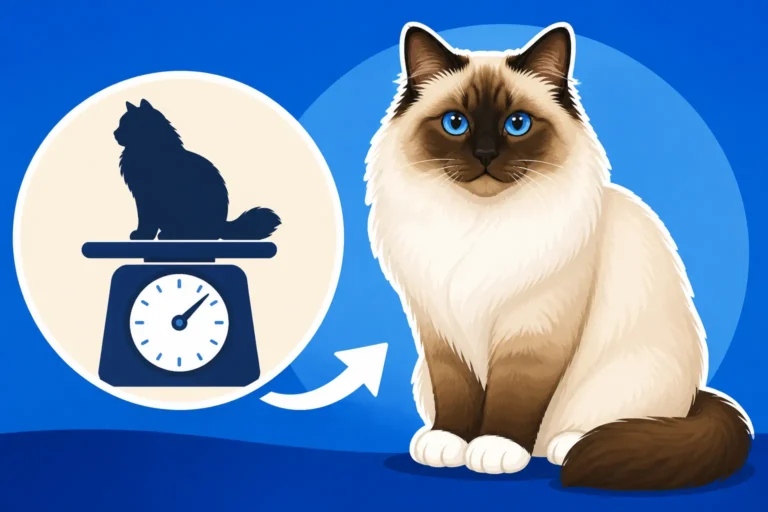
How a Birman’s Ears Should Be Set
A Birman’s ears can look too wide apart, too large, or oddly placed in a photograph when the real issue is the angle of the head or the camera. This guide explains the Birman ear set, how it relates to the breed’s rounded head, what to look for when comparing cats, and how to tell ordinary variation from an ear problem that needs veterinary attention.
What a Birman’s ear set means
Ear set is about position, not just size
When someone talks about a Birman’s ear set, they mean where the ears sit on the head and the direction they point—not simply how big or small they are. A cat can have ears that are a reasonable size but appear poorly placed if they sit too high, too close together, or at an angle that disrupts the overall shape of the head.
In the Birman, the ears are generally described as medium in size, set well apart, and slightly tilted forward, with rounded tips. These qualities should look balanced with the head rather than drawing attention to the ears alone. The breed’s head is broad and rounded, so ear placement is judged as part of the complete outline.
This is why a close-up photo can be misleading. A camera held above a cat may make the ears look farther apart; a low angle can make them look larger. A Birman looking sharply to the side may also seem to have uneven ears, even when they sit evenly when the cat faces forward.
How the ears fit the Birman’s head
A Birman’s ears should complement the shape of its head without making it look sharply angular or overly narrow. The space between the ears matters, but so does the transition from the cheeks and forehead to the ears. The overall impression is soft and balanced, not pointed or extreme.
The other facial features help create that impression. Birman judges consider the head as a whole, including the rounded contours, blue eyes, and distinctive nose profile. For a closer look at how these features work together, see What a Birman's Roman Nose Should Look Like and Which Eye Shape a Birman Should Have. Neither feature should be evaluated in isolation from the ears and head.
The Birman’s profile also differs from that of some other longhaired cats. A flatter face or a more sharply pointed muzzle can change how the ears appear to sit, even when their actual position is similar. The nose and chin contribute to the balance of the face too; Why a Birman's Chin Is Judged explains another part of the breed’s overall expression.
Breed standards and individual variation
Breed standards describe an ideal, but individual cats are not stamped from one template. Ear shape, head width, age, posture, and expression all affect what you see. Even within a litter, siblings can have slightly different-looking ears while sharing the same general breed type.
Standards may also differ in wording between registries and countries. One standard might emphasize that the ears are moderately sized and well spaced, while another may describe their forward tilt or rounded tips in more detail. If you are assessing a show prospect, check the standard used by the registry or show organization involved rather than relying on a single photo or an informal description.
For a broad sense of which features receive attention in the show ring, read What the CFA Birman Standard Weights Most. That wider context helps prevent a common mistake: treating one detail, such as ear size, as if it determines the quality or identity of the whole cat.
How to assess a Birman’s ears fairly
Look at the cat from the front and in profile
Start with the cat relaxed and facing you at eye level. From the front, notice whether the ears seem balanced on either side of the head and whether there is a natural-looking space between them. Then look from the side to see whether they angle slightly forward and blend into the head’s outline.
Do not make a judgment from a single snapshot. A cat turning its head, listening for a sound, or flattening its ears in uncertainty can look very different from the same cat at rest. If you are comparing photographs, try to use images taken from similar angles and with the cat’s head in a similar position.
| What to observe | What a balanced look suggests | Why one view may mislead |
|---|---|---|
| Front view | Ears appear evenly placed and well spaced | A tilted head can make one ear seem higher |
| Side view | Ears sit naturally and angle slightly forward | A low camera angle can exaggerate ear size |
| Ear tips | Tips appear rounded rather than sharply pointed | Fur and image resolution can blur the outline |
| Overall head | Ears suit the width and rounded shape of the head | A close crop hides the cheeks, nose, and profile |
Consider age and growth
A kitten’s proportions change as it grows. The head may broaden, the coat may develop, and the relationship between ears and face can look different over time. An ear that seems prominent on a small kitten may look more balanced once the head and body mature.
This is one reason not to make confident predictions about a kitten’s future show appearance from a very early photograph. If you are choosing a kitten, ask the breeder how the head and ears are developing, and look at clear pictures or, where possible, the kitten in person. A responsible assessment considers health, temperament, structure, and the kitten’s stage of growth—not a single feature in isolation.
A cat’s expression matters as well. Alertness can lift the ears and make them appear taller; relaxation can soften their angle. If you are trying to understand a cat’s general head shape, compare the ears with the face as a whole rather than measuring their placement against a cropped image.
Separate ear set from other facial features
The ears are one piece of a larger visual picture. The cheeks, forehead, eyes, nose, and chin all affect how the head reads. A broad face may make the same ears appear more widely spaced, while a narrower face can make them seem closer together.
The Birman’s coat adds another visual factor. Fur around the cheeks and neck can soften the outline, especially in a full-coated adult. Coat texture and length are separate from ear placement, but they can change how clearly you see the ear bases. What a Birman's Coat Texture Should Be offers useful context for the coat itself.
When comparing breeds, avoid assuming that any longhaired cat with blue eyes and pointed coloring has a Birman’s head or ear set. The Birman has its own combination of features, including its white gloves. For another identifying detail, How to Tell a Birman From a Ragdoll by Its Feet explains why the paws can be helpful when distinguishing the breeds.
Ear set, ear position, and health are different questions
A temporary ear posture is not a structural trait
A cat’s ears move constantly. They swivel toward a noise, turn sideways when the cat is uncertain, and may flatten when the animal feels threatened or uncomfortable. Those temporary movements do not tell you where the ears are structurally set on the head.
If your cat’s ears look uneven in one moment, watch again when it is calm and facing forward. A sudden change in the way one ear is carried, especially if it persists, is different from a long-standing difference in appearance. The first may deserve attention; the second may simply be part of the cat’s natural variation.
Do not force a cat’s head into position to inspect the ears. A relaxed observation is more useful and kinder. If handling is needed, keep it brief and gentle, and stop if the cat becomes distressed.
Signs that call for a veterinary check
Ear shape alone does not diagnose a health problem. However, redness, swelling, a strong odor, unusual discharge, repeated head shaking, persistent scratching, or apparent pain are reasons to contact a veterinarian. A cat that suddenly holds one ear differently may also need an examination, particularly if the change comes with other signs of discomfort.
Avoid putting cotton swabs deep into the ear canal or using household remedies. The delicate structures inside the ear can be injured, and the wrong product may make irritation worse. A veterinarian can advise whether cleaning is needed and which method is appropriate for that cat.
If a veterinarian recommends a particular ear-care product, follow their instructions rather than selecting one based only on a product description or online reviews. Some owners purchase supplies through their clinic, while others use retailers such as Chewy; the important part is confirming that the product is suitable for your cat and using it as directed. Chewy listings can help you locate a recommended item, but they are not a substitute for an examination when symptoms are present.
Cleaning only when it is appropriate
Healthy ears do not necessarily need routine cleaning. Over-cleaning can irritate the skin, and a clean-looking ear does not need extra treatment just because a cat has long fur. Ask your veterinarian whether your Birman needs cleaning and how often, especially if there is a history of recurring wax or inflammation.
If cleaning has been recommended, use the product and technique your veterinarian specifies. Keep the process calm: choose a quiet moment, have the supplies ready, and reward the cat afterward. For an owner who needs to restock a vet-approved cleanser or cotton pads, Chewy may be one place to check alongside a veterinary clinic or local pet supplier. Do not substitute a different formula simply because it is easier to find.
If your cat resists, do not turn a short care task into a struggle. Ask the clinic to demonstrate the technique or discuss another approach. Chewy may offer a convenient way to reorder supplies once you know exactly what your veterinarian has recommended, but product choice and treatment decisions should remain guided by professional advice.
Choosing or describing a Birman’s ear set
Questions to ask a breeder or judge
If you are evaluating a kitten or young adult, ask specific questions rather than relying on a vague label such as “perfect ears.” You might ask whether the ears are well balanced with the head, how the breeder thinks the kitten is developing, and whether the assessment is based on the relevant breed standard.
A breeder’s answer should make room for development and variation. No one can guarantee every kitten will mature into a show-winning adult, and ear placement is only one aspect of type. If the cat is being considered for showing, ask which registry standard is being used and whether an experienced judge or mentor has assessed the cat.
For a pet home, ear set usually matters much less than sound health, comfortable handling, a suitable temperament, and a good match with your household. A slightly different ear shape does not make a cat less loving or less deserving of a home.
What photographs can and cannot show
Photos are useful for observing general balance, but they are not a reliable substitute for seeing a cat in person. Lens distortion, lighting, cropping, head angle, and the cat’s expression can all change the apparent distance between the ears. A photograph that makes the ears look tall or close together may simply have been taken from an unhelpful angle.
When viewing breeder photos, look for several images rather than one posed close-up. A front-facing image can show spacing; a side view can show the profile; a relaxed, natural photo may reveal how the ears sit when the cat is not being posed. If you are comparing cats, use images with similar angles and ask for clarification when something is unclear.
The same caution applies to online discussions. A cropped image can prompt strong opinions about a cat’s ears while concealing the broader head shape. If you need a meaningful structural assessment, seek someone familiar with the breed and the relevant standard.
A practical way to remember the ideal
Think of the Birman’s ears as part of a balanced, rounded head: moderately sized, separated rather than crowded, gently forward in their orientation, and softly rounded at the tips. The goal is harmony with the face, not maximum size, extreme spacing, or a rigid pose.
That description can help you understand what breeders and judges mean, but it should not turn ordinary pet ownership into a constant inspection. A Birman’s ears do not need to look identical from every angle, and temporary movement is normal. Focus on the whole cat—and contact your veterinarian if the ears show signs of discomfort or a sudden change.
Disclaimer
This article is for general informational purposes only and does not constitute professional advice. Laws, prices and regulations vary by location and change over time. Consult a qualified professional for guidance on your specific situation.