Why a Snowshoe’s White Markings Are Not Birman Gloves
A Snowshoe’s white feet can look remarkably like a Birman’s at first glance, especially in a kitten photo. The difference is in the pattern: Birman gloves are a specific, carefully defined feature of the breed, while Snowshoe white markings follow a different pattern and may vary from cat to cat. This guide explains what to look for—and what markings alone cannot prove.
What Birman gloves actually look like
The white is limited to the paws
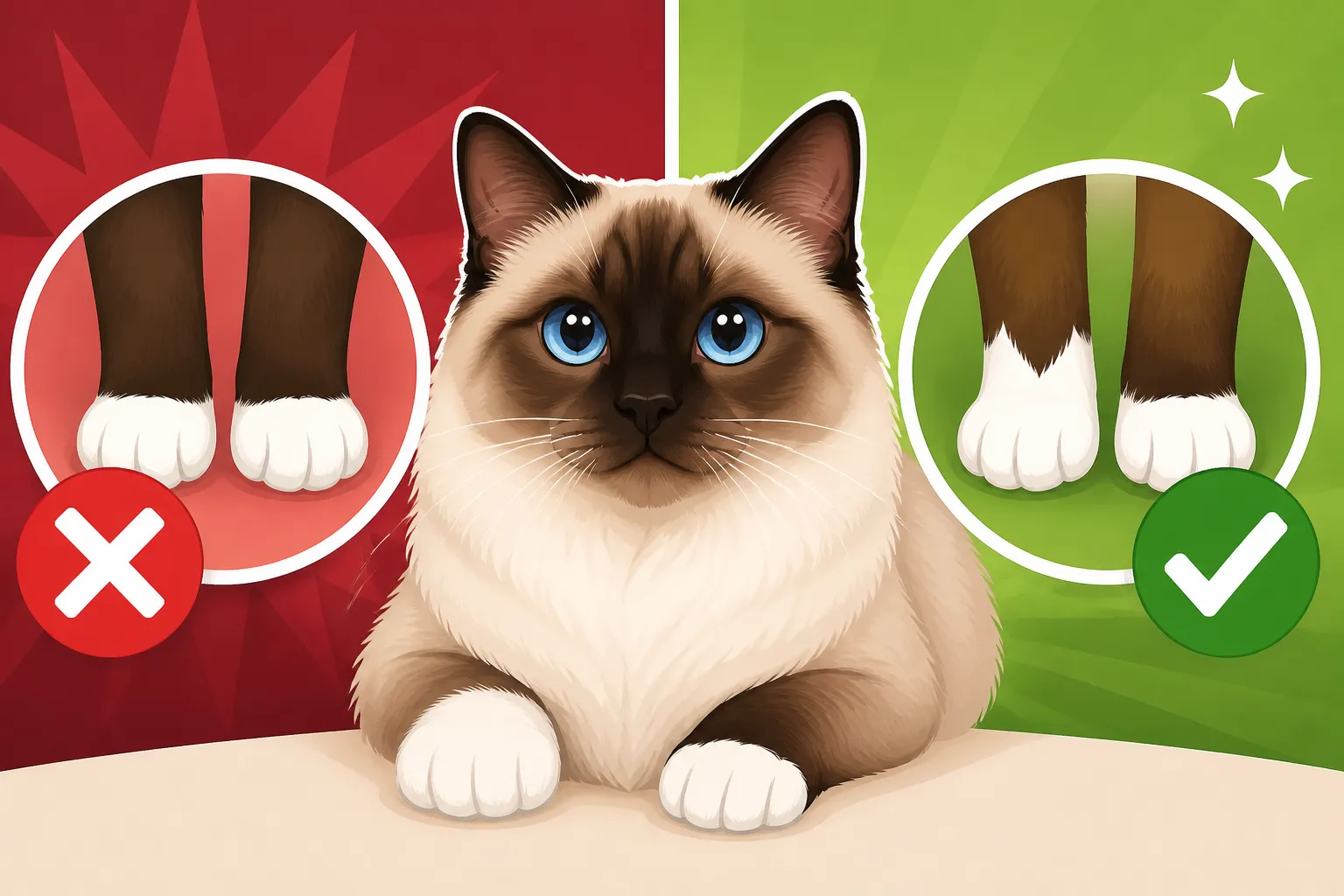
A Birman is a colorpoint cat: its face, ears, legs and tail are darker than its pale body. The breed’s signature white marking is on the feet, where it is described as a glove. Ideally, the white covers the toes and paw without climbing unevenly up the leg.
On the front paws, the gloves are expected to end at a similar height. On the hind paws, the white can extend farther up the back of the foot in a feature called a lace or gauntlet. These details matter in breed standards, but a pet Birman does not need show-perfect markings to be a beloved, healthy companion.
The shape and placement are more telling than the simple presence of white fur. A photograph of a cat with white socks may suggest a Birman at a glance, but it does not show whether the markings fit the breed’s characteristic glove-and-lace pattern. The way the pattern is judged is explained in How a Birman's Gloves Are Scored.
The four paws are considered together
Birman markings are not usually assessed by looking at one paw in isolation. A breeder or judge looks at all four: how high the front gloves reach, whether they are reasonably even, and how the white on the hind paws forms its laces. Exact standards can vary somewhat between registries, but the overall pattern is a coordinated feature, not simply four white feet.
This is why a clear side view and photos of the underside of the paws can help when someone is trying to understand a cat’s markings. Even then, lighting, fur length and the cat’s position can make details hard to see. A fluffy paw tucked under a body may hide where the white actually ends.
For show cats, the details are especially important. The front gloves should end evenly, while the hind laces have their own expected shape and position. You can read more about one part of that assessment in Why a Birman's Front Gloves Must End Evenly and How High a Birman's Lace Should Run.
Gloves are part of a larger breed picture
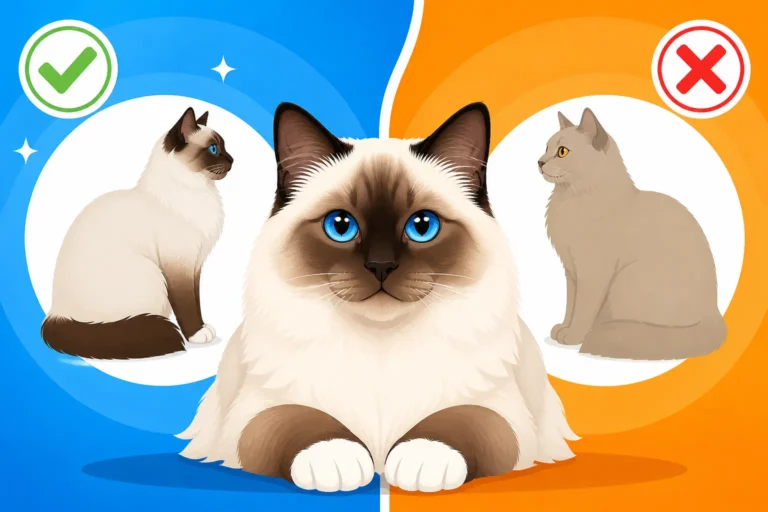
White paws alone do not make a cat a Birman. The overall appearance also includes a colorpoint coat, blue eyes and a medium-to-longhaired body, alongside the breed’s characteristic head and build. A cat that has white feet but lacks other Birman traits may be a mixed-breed cat or another breed with white markings.
Even a cat that looks very much like a Birman cannot be identified with certainty from appearance alone. If breed identity matters—for example, when adopting a cat advertised as pedigreed—ask for the pedigree and registration paperwork, and check that the documents match the cat. Photos can support an impression; they cannot replace reliable records.
The Birman’s point pattern is another useful part of the comparison. Its body is pale and its extremities are darker, rather than having the more extensive white patterning associated with many Snowshoes. Why a Birman Is Always Pointed and Never Solid explains that basic colorpoint appearance.
How Snowshoe white markings differ
Snowshoe markings can cover more than the paws
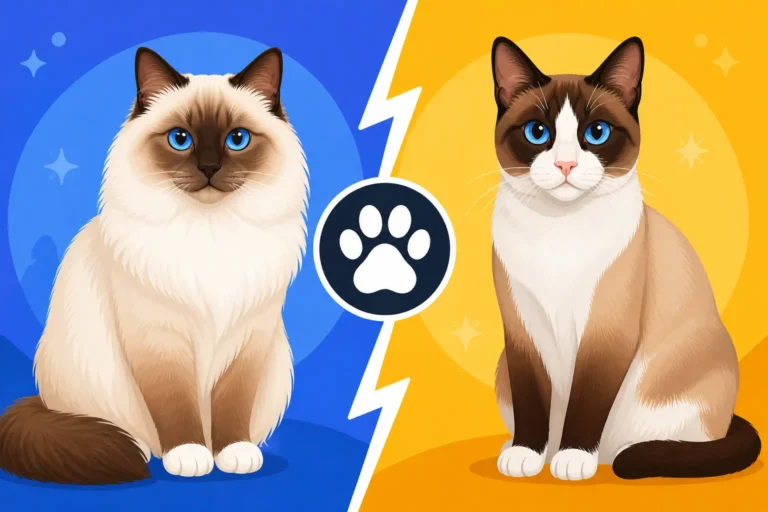
Snowshoes are also colorpoint cats, and white feet are a familiar feature of the breed. But their white markings are not the same as Birman gloves. Snowshoes may have white mittens on the feet and white areas elsewhere, including a distinctive facial marking that is often described as an inverted V. The amount and placement of white can differ between individual cats.
That broader, more variable arrangement is the practical clue. A Snowshoe’s white may extend beyond the feet or form a face pattern, while Birman gloves are the specific white markings on the paws. Not every Snowshoe has an equally neat or symmetrical pattern, and a cat’s markings may not match an idealized breed illustration.
This does not mean that every Snowshoe will have an obvious white facial V, or that a cat with a white V must be a Snowshoe. Breed standards and individual appearance are not identical, and mixed ancestry can produce a wide range of looks. The markings are useful clues, not a stand-alone identification test.
Similar colors can create a misleading first impression
Both breeds can have dark points against a lighter body, blue eyes and white on the feet. Put a young cat in a bright photograph, and those similarities can make the two look more alike than they do in person. Long fur can blur the edge of a glove, while a sitting pose can hide a facial or leg marking.
| Feature | Birman | Snowshoe |
|---|---|---|
| White feet | Characteristic gloves, with particular attention to placement and shape | White mittens are common, but the pattern can vary |
| White on the face | Not the defining Birman glove feature | May include a characteristic inverted-V facial marking |
| Pointed coat | A defining part of the Birman’s appearance | Also common in Snowshoes |
| Pattern emphasis | Coordinated white markings on all four paws | White markings may appear on paws and other parts of the body |
| What appearance can establish | A visual resemblance, not pedigree by itself | A visual resemblance, not pedigree by itself |
A useful comparison should include the cat’s whole body and face, not just a close-up of its paws. Look at the point pattern, where the white appears, and whether the cat’s markings seem to follow the Birman glove-and-lace arrangement. Then treat the result as a visual assessment rather than proof of breed.
For a more focused breed comparison, see How a Birman Differs From a Snowshoe. It helps to consider the whole set of traits rather than letting the white feet decide the answer.
Markings can be imperfect without changing a cat’s identity
A Birman can have uneven gloves or laces that do not match the show ideal. That may affect how the cat is judged in a show setting, but it does not automatically mean the cat is not a Birman. Likewise, Snowshoe markings can be less symmetrical or less clearly defined than a person expects from a breed description.
The genes behind coat patterns do not arrange themselves like paint applied to a template. In Birmans, the gloving trait is associated with a specific inherited pattern, but the visible white can still vary. What the KIT Gloving Variant Does discusses the genetic feature, while Why Birman Gloves Vary Despite the Fixed Gene explains why a shared breed trait does not make every cat’s paws look identical.
So if you are comparing two cats, avoid setting an arbitrary rule such as “all four paws must be exactly the same.” The important question is whether the overall pattern looks consistent with the breed, not whether each marking is a perfect mirror image.
How to tell the difference without guessing
Check the markings in a useful order
If you are trying to distinguish a Snowshoe from a Birman, it helps to slow down and inspect the cat as a whole. A quick glance at white toes is the least reliable approach, because that feature is shared by many cats.
Use this checklist:
- Look at the face. Is there a noticeable white marking, such as an inverted V, in addition to the darker colorpoint mask? That can fit a Snowshoe pattern, though it is not conclusive.
- Look at the body. Both cats may be pointed, so note how much white appears beyond the paws and how the darker points are distributed.
- Inspect all four feet. For a Birman, check whether the white is limited to the paws and whether the front gloves and hind laces form the characteristic arrangement.
- Consider coat and build. A Birman is longhaired, with a silky coat and a fuller ruff; coat length and texture can help distinguish the overall look, but they are not proof on their own.
- Ask about documentation. If the cat is represented as a pedigreed Birman or Snowshoe, request the relevant registration and pedigree information.
If you are choosing a pet, these observations can help you understand what the cat resembles. They should not replace practical adoption questions about temperament, health history, care needs and the living situation that will suit that particular animal.
Use photos as clues, not as a verdict
Ask for several views if you are evaluating a cat remotely: a full-body photo, a clear face view, and images of all four paws. Natural, even lighting is more useful than a heavily filtered picture. A close-up with the legs partly hidden may make white markings look higher or lower than they are.
If you already have supplies at home, a clean, light-colored surface can make the boundaries of the coat easier to see in a photo. For routine paw care, use only products intended for cats; if you shop through Chewy, check the label and directions rather than assuming a general household wipe is suitable. Avoid scrubbing simply to make the white look brighter.
A cat’s fur can also look different when it is damp, dirty or photographed under warm indoor lighting. If a white patch appears yellowed or stained, that alone says nothing about whether the cat is a Birman or Snowshoe. Gentle grooming and an appropriate litter setup may help keep paws cleaner; Chewy is one place owners may browse for cat-safe grooming supplies or litter options, but the product should suit the individual cat.
Ask the right questions when breed matters
If a breeder describes a kitten as a Birman, ask what registry it is registered with and request paperwork that identifies the kitten and its parents. A responsible conversation should include more than a confident claim about white paws. You can also ask to see the parents, discuss health screening, and clarify whether the kitten is being sold as a pet or with breeding or show rights.
If you are adopting from a shelter or rescue, exact breed identification may not be available. That is common, and it does not make the cat any less worth adopting. Describe what you can see—such as a pointed coat, white paws or a facial marking—without treating an uncertain breed label as a guarantee.
Be cautious of anyone who insists that a single marking proves pedigree or uses a photo alone to promise a show-quality result. Even among pedigreed Birmans, glove quality can vary, and the visible pattern is only one part of the cat. For a broader explanation of variation in the breed, see Which Modifier Genes Affect a Birman's Gloves.
Caring for white paws and choosing a cat
Keep care gentle and practical
White fur can show litter dust or dirt more visibly than darker fur, but it does not require harsh whitening products. Check the paws when you groom your cat, especially between the toes, and remove ordinary debris gently. If the skin looks irritated, the cat is licking its feet persistently, or the fur is discolored in a way that does not wash away, ask a veterinarian rather than experimenting with cleaners.
For routine grooming, a soft cloth or cat-safe wipe may be useful when a paw is a little dusty. Read the packaging carefully, especially if a product is scented or intended for another species. Chewy may offer a range of cat grooming supplies, but choosing a product by its label and your cat’s needs matters more than choosing a particular retailer.
Litter is another small but practical factor. Dusty litter can cling to paws and long fur, while a cat may track litter around the house regardless of breed. Try a suitable litter in a clean box and observe how your cat responds. Switching suddenly can upset some cats, so make changes gradually when possible.
Choose by the individual cat, not by the socks
The distinction between Snowshoe markings and Birman gloves is interesting, especially for breed enthusiasts, but it should not overshadow the everyday match. A cat’s personality, comfort with household activity, grooming needs and health history matter far more than whether its white feet meet a breed standard.
A Birman’s longer coat generally needs regular combing, while the grooming routine for an individual Snowshoe depends on its coat length and condition. Some cats enjoy being brushed; others need short, calm sessions and time to get used to handling. If you have questions about the breed’s characteristic paws, How a Birman's Gloves Are Scored offers a useful look at why those markings receive such careful attention.
At home, the simplest conclusion is often the most honest: the cat has white paws and may resemble one breed more than another. If there is no pedigree, call it a colorpoint cat with white markings rather than presenting a guess as a fact. Whether the white forms tidy Birman gloves or a Snowshoe’s more varied pattern, it is one part of a whole cat—not a measure of its worth or the quality of the bond you will build.
Disclaimer
This article is for general informational purposes only and does not constitute professional advice. Laws, prices and regulations vary by location and change over time. Consult a qualified professional for guidance on your specific situation.