Why a Birman Is Confused With a Ragamuffin
A Birman and a Ragamuffin can look surprisingly alike in a quick photo: both may have semi-long coats, blue eyes, and a gentle expression. The confusion is understandable, especially when a Ragamuffin has color-point markings or white feet. This guide explains the features that overlap, the details that distinguish the breeds, and how to make a more reliable identification.
Why Birmans and Ragamuffins Look Alike
Their coats and expressions can create the same first impression
Both breeds have soft, semi-long coats and are often described as affectionate, calm companions. In a photograph, a fluffy cat with a broad face and relaxed expression can look “Birman-like” even if it is a Ragamuffin. Coat length alone is not a dependable way to tell them apart.
The resemblance becomes stronger when a Ragamuffin has a pointed pattern: a lighter body with darker color on the face, ears, legs, and tail. That pattern is familiar in Birmans, so people may assume the cat is one. But a similar pattern does not make a cat a Birman. Ragamuffins come in a wider range of colors and patterns, and their markings are not required to follow the Birman breed standard.
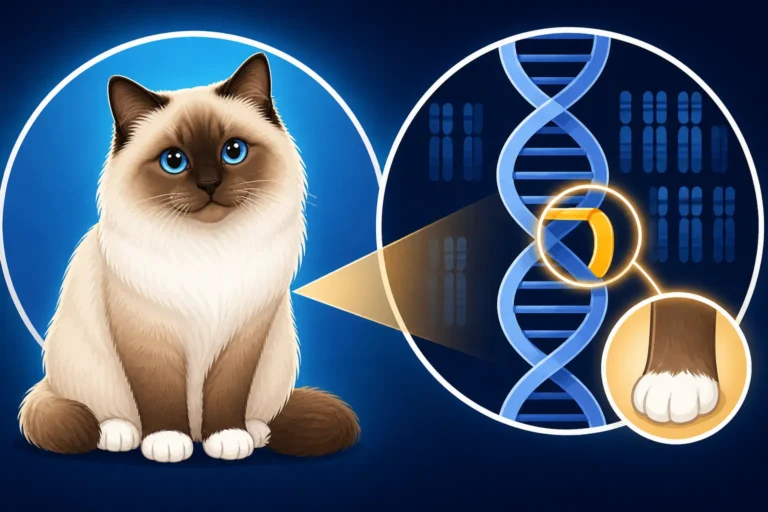
White paws can add another layer of confusion. Birmans are known for their characteristic white gloves, but a Ragamuffin may also have white on its paws. The distinction is not simply “white feet versus colored feet.” It is the shape, placement, and consistency of the markings, considered alongside the cat’s other traits. For more on the breed’s defining markings, see What Judges Look For on a Birman's Paws First.
Similar personalities do not settle the question
People often try to identify a breed by temperament. That can be a useful clue in some situations, but it is a weak test here. Birmans and Ragamuffins are both commonly described as sociable, people-oriented cats. Either may follow a family member from room to room, settle nearby, or enjoy gentle handling.
Individual cats vary, too. A Birman may be reserved with visitors, while a Ragamuffin may greet them confidently; another cat of either breed may behave the opposite way. Age, early socialization, health, household routine, and personality all influence how a cat acts. A calm disposition is not proof of either breed.
This matters when a cat is being identified from a short video or a shelter listing. A caption such as “sweet and cuddly” tells you about the cat’s observed behavior, not its pedigree. It is more useful to look at the coat pattern, paws, head shape, and documentation together.
The Features That Help Distinguish the Breeds
Start with the color pattern and the paws
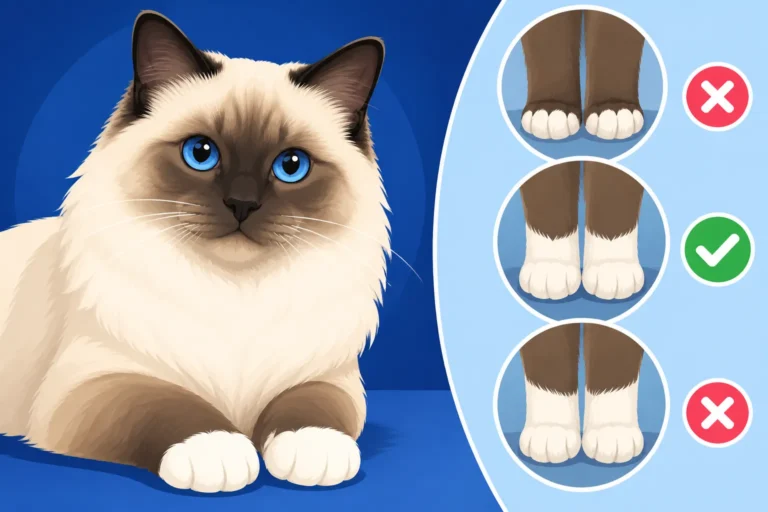
A Birman is a pointed cat: its body is lighter than its face, ears, legs, and tail. Its blue eyes are a defining feature, and the breed is also known for white gloves on the front paws and white laces on the hind paws. The markings are intended to be distinct and balanced, though real cats may have small imperfections. The accepted colors and patterns are described in Which Point Colors the Birman Standard Allows.
A Ragamuffin can also be pointed, but it is not limited to the Birman’s classic pattern. Ragamuffins may appear in many colors and patterns, with or without white. Some can have colored points and white paws that make a casual observer think of a Birman. However, their white markings are not necessarily the carefully defined gloves and laces associated with the Birman standard.
When looking at paws, check all four rather than relying on one close-up. On a Birman, the front gloves should look like neat white mittens, while the hind markings extend farther up the back of the feet. A single white toe or uneven patch is not enough to establish breed identity. The way the markings fit the rest of the cat’s appearance matters, too.
| Feature | Birman | Ragamuffin |
|---|---|---|
| Coat pattern | Always pointed | Many patterns, including pointed |
| Eye color | Blue is a defining breed trait | Can vary with coat pattern and registry standard |
| White paws | Recognizable gloves and hind laces are characteristic | White markings may occur but are not the defining Birman pattern |
| Coat colors | Point colors recognized by the breed standard | Broad range of colors and patterns |
| Best evidence of breed | Pedigree plus breed traits | Pedigree plus breed traits |
Photos can be misleading because lighting alters coat color, and a cat’s pose may hide part of a glove or lace. If the question matters for adoption, registration, or breeding, ask for pedigree documentation rather than trying to make a final call from a picture.
Compare the head, body, and overall impression
Birmans have a medium-to-large, sturdy body, but they are not simply oversized fluffy cats. Their profile includes a distinctive Roman nose, and the head is generally rounded without the extremely flat face associated with some other longhaired breeds. You can learn more about this profile in What a Birman's Roman Nose Should Look Like.
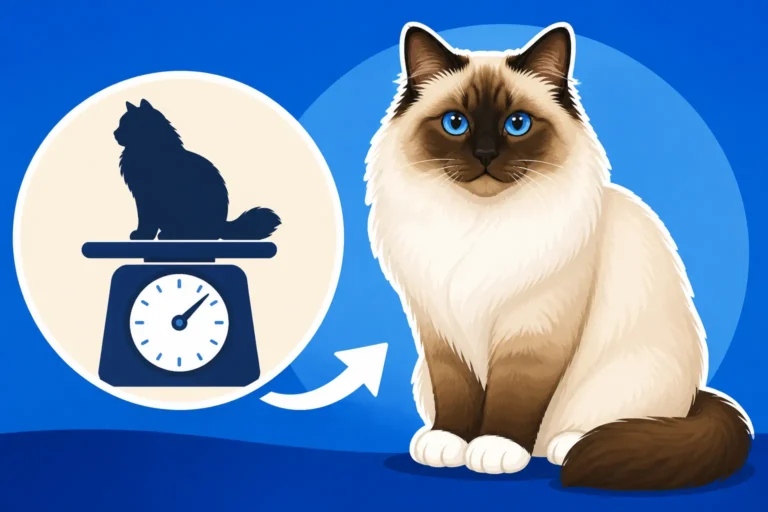
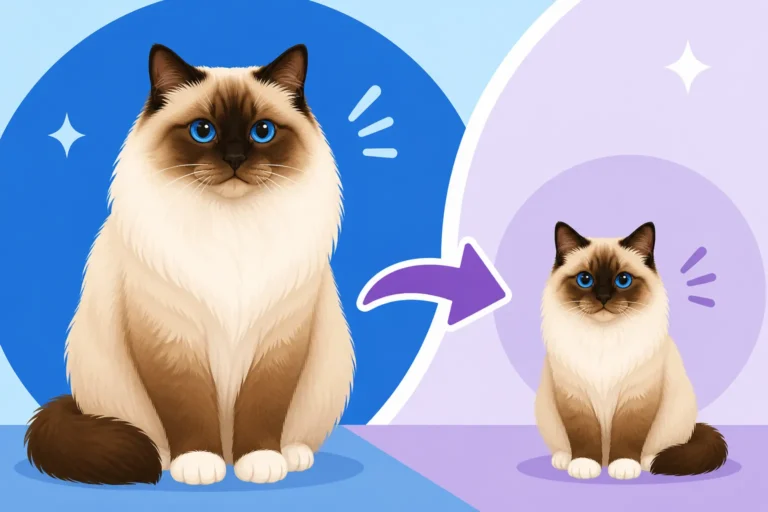
Ragamuffins are also substantial cats, with a broad, rounded appearance and a plush coat that can make their frame seem even bigger. Their head and body shape may feel softer or more full in outline. Still, size and proportions are not foolproof clues: cats vary within a breed, and coats can exaggerate the silhouette.
A useful way to compare the two is to step back from isolated features. Ask whether the cat’s whole appearance fits the breed: Does the pattern, eye color, paw marking, and profile form a consistent Birman picture? Or does the cat have a broader range of markings and a plush, rounded look more typical of a Ragamuffin? One trait can mislead; several traits considered together are more informative.
For a Birman-specific look at eye color, see Which Eye Color a Birman Must Have. For a coat comparison, What a Birman's Coat Texture Should Be explains the texture expected in the breed.
Why Photos and Online Listings Can Be Misleading
A single image hides important details
A front-facing photo may show a pointed face and blue eyes but crop out the paws. A side view may reveal body shape but conceal the eye color or the back-leg markings. Fluffy fur can also hide the exact edges of white markings, while warm indoor lighting can make pale fur look cream or darker points look nearly black.
Image editing and camera settings introduce further uncertainty. Brightness, white balance, shadows, and filters can change how a cat’s coat appears. Even unedited photos may not show the true color accurately if the cat is sitting near a window or under a yellow lamp.
If you are trying to distinguish a Birman from a Ragamuffin online, look for several clear views: face, side profile, all four paws, and the cat standing naturally. Treat those pictures as clues, not proof. A breeder’s paperwork or a reliable pedigree record is much stronger evidence than a breed label on a marketplace listing.
Breed labels are sometimes used loosely
Some listings use a breed name to describe appearance rather than documented ancestry. A fluffy, blue-eyed, pointed cat might be called a “Birman” even if its background is unknown. The reverse can happen as well: a purebred cat may be listed under a broad label such as “longhair” because the person posting the listing is unsure of its breed.
That does not mean every uncertain listing is misleading. A shelter may reasonably describe a cat by its visible traits when no pedigree is available. In that situation, “Birman-like” or “Ragamuffin-type” is a description, not a verified breed identity. If breed certainty is important to you, ask what documentation exists and whether the cat’s parentage is recorded.
The distinction is especially important when comparing cats for a particular household. A family choosing a companion animal may care more about temperament, health history, grooming needs, and how the cat responds to children or other pets than about the exact breed label. A cat’s actual behavior and care requirements are more useful than assumptions based on a name.
How to Identify a Cat More Reliably
Use a checklist instead of one striking feature
A practical identification starts with a group of observations. Note whether the cat is pointed, whether its eyes are blue, how the white markings sit on the front and back paws, and what its head profile looks like. Then compare those details with the breed standard rather than deciding based on coat length or a friendly personality.
A quick checklist can help:
- Look at the whole coat pattern. A Birman should be pointed; a Ragamuffin may have a much wider range of patterns.
- Check the eyes. Blue eyes are expected in a Birman, while Ragamuffins can have different eye colors depending on their coat and accepted standard.
- Inspect all four paws. Look for the characteristic Birman gloves and hind laces, not just any white fur.
- View the cat from the side. The profile and overall proportions may provide helpful context.
- Ask for records. A pedigree is the clearest way to confirm a registered purebred cat.
This process will not always let you identify a cat with certainty from appearance alone. Cats can have mixed ancestry, and individual features can vary. If the cat has no pedigree, the most honest description may be “a longhaired cat with Birman-like markings” rather than a definite breed claim.
Give pedigree and personal fit more weight than resemblance
For a registered cat, ask to see its pedigree and confirm that the documents identify the breed. A responsible breeder should be able to explain the cat’s lineage and answer reasonable questions about its parents and care. A striking photo or an online listing title is not a substitute for that information.
If you are adopting, there may be no way to establish breed with certainty, and that is perfectly fine. Focus on the cat in front of you: its health, energy level, comfort with handling, and response to the people or animals in your home. Birmans and Ragamuffins can share a gentle, companionable nature, but neither breed label guarantees a particular temperament.
For comparison with another commonly confused longhaired breed, How to Tell a Birman From a Ragdoll by Its Feet covers the Birman’s paws in a different comparison. And if you are deciding between the two breeds rather than identifying a cat you already know, How a Birman Differs From a Ragdoll offers additional context about how appearance and breed traits are assessed.
In the end, Birmans are confused with Ragamuffins because the breeds can share long, soft coats, a relaxed expression, and even pointed coloring or white paws. The most useful visual clues are the Birman’s blue eyes, pointed pattern, characteristic gloves and laces, and overall breed profile. For certainty, though, documentation matters more than resemblance.
Disclaimer
This article is for general informational purposes only and does not constitute professional advice. Laws, prices and regulations vary by location and change over time. Consult a qualified professional for guidance on your specific situation.