Why a Pale Eyed Birman Is Penalized
A Birman’s eyes can look beautifully blue at home and still seem pale under show lighting, which can leave owners wondering whether a judge has spotted a health problem or simply a difference from the breed ideal. This guide explains why eye color matters in the ring, what “pale” means, and how to separate a show assessment from a veterinary concern.
Why eye color matters in the Birman standard
The ideal is a vivid, deep blue
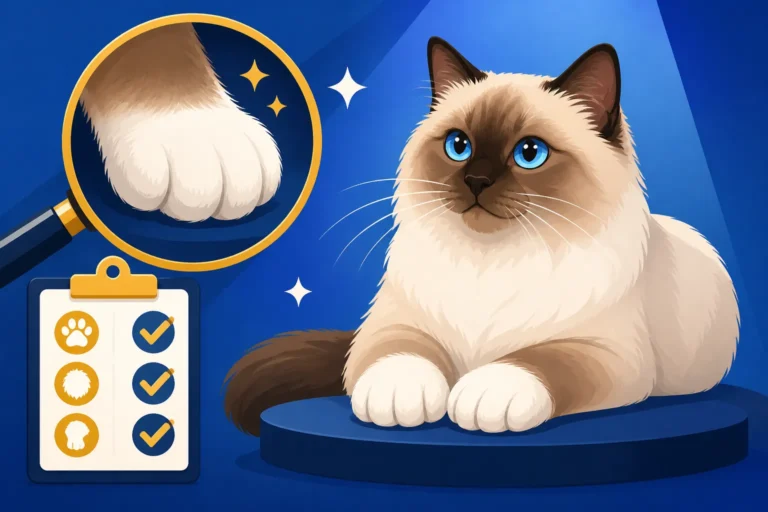
The Birman is a pointed cat, and blue eyes are part of its characteristic appearance. Breed standards generally favor eyes with a rich, vivid blue color rather than a washed-out or pale shade. Judges assess how closely a cat matches the standard, so eye color can affect its overall evaluation alongside features such as coat, body type, head shape, and white markings.
The preference is about the shade and intensity of the blue, not whether the cat can see. A judge may describe a Birman’s eyes as too pale when they appear lighter or less saturated than the preferred color. That is a show-quality assessment; it does not, by itself, mean the cat has a medical problem.
The wording and scoring can differ between registries, so the precise standard for a particular show should be checked with the relevant organization. For a broader explanation of the expected color, see Which Eye Color a Birman Must Have and How Deep a Birman's Blue Eyes Should Be.
A penalty is not the same as a disqualification
When a judge finds a feature less than ideal, it may count against the cat’s overall assessment. A pale eye color is generally a departure from the preferred shade, not an automatic reason a Birman cannot enter a show. The effect depends on the applicable standard, the judge’s evaluation, and how the cat compares with other entries.
That distinction can be frustrating if you have heard “penalized” and interpreted it as “the cat is unsuitable” or “something is wrong.” In the show ring, a penalty is about conformation to a written breed ideal. It does not erase a Birman’s pedigree, affectionate temperament, or value as a companion.
A cat with lighter eyes can still be a perfectly healthy, much-loved Birman. If you are choosing a pet rather than a show prospect, eye shade should not be treated as a measure of how well the cat will fit into your home.
Why a Birman’s eyes may look pale
Lighting and surroundings change what you see
Eye color can appear different from one room to another. Cool daylight, warm indoor bulbs, shadows, and the color of nearby walls can all affect how blue an iris looks to the human eye. A cat photographed beside a bright window may appear to have deeper blue eyes than the same cat photographed in a dim room.
Cameras add another layer of variation. Automatic exposure, white balance, phone screens, and photo editing can shift the apparent color. A breeder’s picture taken in bright, even light is not always directly comparable with a quick indoor photo taken on a cloudy afternoon.
If you want to judge the color fairly, look at the cat in neutral, even light and from more than one angle. Avoid relying on a single photograph or comparing a picture on one screen with another picture on a different screen. How a Birman's Blue Eyes Look Paler in Dim Light explores why everyday lighting can make the shade seem less intense.
Age and individual differences matter
Kittens’ features change as they grow, and their eye color may not look like an adult’s fully developed color straight away. A young kitten’s eyes should not be assessed as though they were already a finished show cat. If a kitten is being considered for competition, a breeder or experienced exhibitor can help explain how its color is developing and what the relevant standard expects.
Even among adult Birmans, the exact appearance of blue can vary. Some eyes may look deeper and more saturated, while others appear lighter. The standard describes an ideal; it does not mean every individual will have an identical shade.
It is also worth separating visible eye color from eye shape. Judges may assess these as distinct features, and a blue eye does not automatically meet every part of the standard. For details on the expected shape, see Which Eye Shape a Birman Should Have.
| What you notice | What it may mean in a show context | What to do |
|---|---|---|
| Eyes look lighter in a dim room | Lighting may be reducing the apparent depth of blue | Recheck in neutral, even light |
| Eyes look different in photos and in person | Camera settings or screens may alter color | Assess the cat in person when possible |
| A judge describes the color as pale | The shade may be less intense than the standard prefers | Ask which standard or feature informed the assessment |
| One eye suddenly looks cloudy or different | This is not simply a breed-standard issue | Contact a veterinarian promptly |
| A kitten’s eye color is still developing | The appearance may change with maturity | Ask the breeder or veterinarian about the kitten’s development |
Show assessment versus eye health
Pale blue is not automatically a health warning
A pale shade of blue, on its own, is not the same thing as a cloudy, irritated, or painful eye. The show standard is concerned with the appearance of the color in relation to the breed ideal. A veterinary examination considers the health and function of the eye, including changes in the cornea, pupil, and surrounding tissues.
That difference matters because owners can become understandably anxious after hearing that a cat’s eyes are “too pale.” If the eyes have looked that way consistently and the cat is behaving normally, the comment may be about show presentation rather than an illness. Still, routine veterinary checks are sensible for every cat, including Birmans. For that distinction, read Why a Birman's Blue Eyes Are Not a Health Risk.
Watch for a change from your cat’s usual appearance. Cloudiness, redness, discharge, frequent blinking, squinting, pawing at the face, or a sudden difference between the eyes deserves veterinary attention. A show judge cannot diagnose an eye condition, and a breed-standard comment should never replace an examination if something seems wrong.
What to ask if you are concerned
If a judge comments on eye color, ask whether the observation concerns the shade of blue, the eye’s clarity, or another feature. A clear explanation can help you understand whether the feedback is about the standard or whether the judge noticed something that should be checked. If the comment sounds medical, follow up with your veterinarian rather than trying to interpret it from the ring-side remark alone.
At a routine appointment, mention any change you have noticed and describe when it began. If possible, bring a clear photo taken in ordinary light, especially if the appearance varies or the change is intermittent. Your veterinarian can assess whether the eyes look healthy and advise whether any further examination is appropriate.
Regular checks are useful even when a Birman seems calm and comfortable. Cats may not make obvious complaints when something is bothering them, so noticing changes early is helpful. See Why a Birman's Eyes Should Be Checked at Every Visit for more on what ongoing eye checks can contribute to routine care.
What to do if your Birman has pale eyes
If your cat is a pet
For a companion Birman, prioritize comfort and health over a show-ring preference. You do not need to alter the lighting, use products, or try to make the eyes look darker. Eye drops, supplements, or cosmetic treatments should not be used to change the appearance unless a veterinarian has recommended a treatment for a specific medical reason.
Instead, note what is normal for your cat. Look at the eyes occasionally in consistent, natural light so you can recognize a genuine change. Keep routine veterinary appointments, and seek advice if you notice discomfort, cloudiness, discharge, or a sudden shift in appearance.
A pale-eyed Birman can still be a wonderful example of the breed in everyday life. Breed standards exist to guide judging; they are not a checklist that determines whether a cat is healthy, cherished, or a good fit for its family.
If you are preparing for a show
Start with the current standard used by the registry and show you plan to enter. Ask the breeder or an experienced Birman exhibitor how judges in that setting describe eye color, and request an honest assessment of your cat under ordinary, even lighting. That conversation can clarify whether the issue is genuinely the shade or simply how a photograph made it look.
Keep show preparation focused on normal care and presentation. A clean, comfortable cat and accurate expectations are more useful than trying to manipulate eye color. If you are buying a kitten specifically for showing, discuss eye color, maturity, and other standard features with the breeder, while remembering that young cats continue to develop.
Finally, treat judge feedback as information about the show standard—not as a verdict on your cat. A lighter blue may cost points in a competition, but it does not define the Birman’s health or personality. For the wider context of how breed characteristics are evaluated, see How a Birman's Gloves Are Scored.
Disclaimer
This article is for general informational purposes only and does not constitute professional advice. Laws, prices and regulations vary by location and change over time. Consult a qualified professional for guidance on your specific situation.