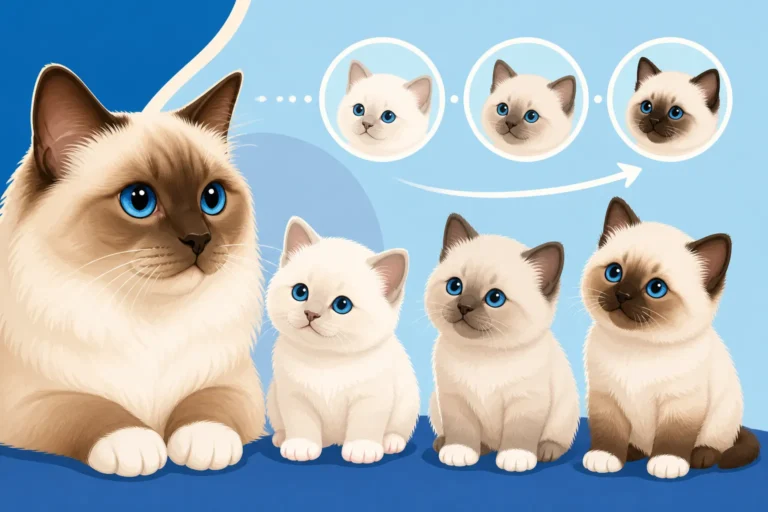
What Judges Look For on a Birman’s Paws First
When you first glimpse a Birman cat, it's often their striking blue eyes, luxurious coat, and those captivating white paws that immediately grab your attention. But for anyone involved in the world of Birman breeding or showing, those pristine white "gloves" and "laces" aren't just charming aesthetic details; they are the very hallmark of the breed, the first thing a judge's eye sweeps to. This guide will delve deep into exactly what the breed standards demand for those sacred paws and why perfecting them is a breeder's ultimate goal.
The Sacred Secret of Birman Paws: Gloves and Laces
The Birman cat is steeped in mystique and ancient lore, often referred to as the "Sacred Cat of Burma." This rich history is inextricably linked to the very feature we're discussing: their distinctive white paws. It’s a captivating blend of myth and genetic science that makes these markings so special.
The Legend and the Reality of White Feet
The foundational legend of the Birman cat tells a beautiful tale of a goddess, a golden-eyed blue cat named Sinh, and the sacred Temple of Lao-Tsun. It recounts how Sinh's paws remained pure white, symbolizing purity, even as his body transformed to golden, and his eyes to sapphire blue, mirroring his beloved priest, Mun-Ha. This story explains the white gloves, emphasizing their sacred origin and significance. The Birman Is the Sacred Cat of Burma, and the Story Is a Legend For enthusiasts and breeders, this legend isn't just a charming anecdote; it underpins the breed's unique identity. The white paws are not merely a fancy marking; they are a direct link to the Birman's mystical past, a physical manifestation of its sacred status.
Beyond the myth, the reality of these white feet lies in genetics. Every Birman cat carries two copies of a specific gene variant that gives them their unique white markings. The Gloving Gene Every Birman Carries Two Copies Of This isn't just random white spotting; it's a very particular pattern of white restricted to the paws, creating the "gloved" effect. Understanding this genetic basis helps appreciate the dedication involved in breeding Birmans to the standard. Breeders are constantly working to hone this genetic trait to produce the most perfectly marked kittens, recognizing that these feet are the very essence of what makes a Birman, well, a Birman. Without these characteristic markings, a cat, no matter how beautiful, simply wouldn't meet the breed's defining physical attribute.
What Exactly are "Gloves" and "Laces"?
When we talk about Birman paws, we're not just saying "white feet." The terminology is specific: "gloves" for the front paws and "laces" or "gauntlets" for the back. Each has its own precise requirements within the breed standard.
The "gloves" refer to the white markings on the front paws. Imagine a cat wearing tiny, perfectly fitted white mittens. These white areas should be of an even length across the paw, covering the toes and extending slightly up the foot, but never going past the 'wrist' joint. The key here is uniformity and a crisp, clean line where the white meets the colored point of the leg. It's about a clear, elegant demarcation that highlights the individual toes and the graceful arch of the paw. An ideal front glove looks as though it was meticulously painted on, with no smudges or uneven edges.
The "laces," also known as "gauntlets," are the white markings on the hind legs. These are even more intricate and specific than the front gloves. On the back of the hind paws, the white extends further up the hock, forming an inverted 'V' shape. This "V" should be symmetrical on both back legs and ideally reach about one-half to two-thirds of the way up the hock, but again, never extending beyond the hock joint itself. The white should stop abruptly, presenting a clear contrast with the darker point color of the leg. This delicate balance between the white glove on the front and the distinctive lace on the back is what truly defines the Birman's paw elegance and sets it apart from other pointed breeds. It's often the part of the marking that is most difficult to achieve perfectly and thus highly prized by judges.
The Front Paws: Precision and Symmetry of the Gloves
The front paws of a Birman cat are where a judge's keen eye often begins its assessment. The "gloves" must not only be white but must conform to very strict criteria of height, evenness, and definition. These seemingly small details contribute massively to a Birman's overall conformation score.
The Ideal Line and Evenness of the Front Gloves
When a judge looks at a Birman's front paws, they are looking for absolute precision. The white 'glove' should ideally cover the toes and extend up the paw to form a perfect, straight, and even line all the way around the paw, finishing just before the wrist joint. This line should be uniform in height on both sides of the paw and between both front paws. Think of it as a painter's clean stroke, perfectly straight and consistent. Any deviation from this, such as one side of the glove running higher than the other, or one glove being significantly taller or shorter than its counterpart, is considered a fault.
Symmetry is paramount here. The left front glove should be a mirror image of the right front glove in terms of height, shape, and crispness of the edge. It's a testament to the breeder's skill and selective breeding programs when this level of symmetry is achieved. Imagine a pair of delicate porcelain gloves; they should look identical. If a glove extends too high up the leg, almost like a white "sleeve," it begins to detract from the distinct "glove" appearance. Similarly, if the white is patchy or doesn't extend far enough, leaving colored toes, it also fails to meet the standard. These subtle differences, often imperceptible to the casual observer, are critical for a judge.
The Importance of a Clear Break
Beyond the height and evenness, the quality of the "break" is crucial. The break refers to the line where the pristine white of the glove meets the darker, pointed color of the cat's leg. This line needs to be sharp, clean, and well-defined, without any blurring, smudging, or feathering. It should look like a distinct boundary, not a gradual fade.
A clear break is vital because it emphasizes the unique "gloved" appearance that is so characteristic of the Birman. If the white feathers into the color, or if there are flecks of color within the white, it loses that crisp, elegant look. This can often happen with "smudged" gloves, where the white and color seem to bleed into each other, rather than presenting a distinct line. Breeders work tirelessly to achieve this clean demarcation, as it speaks volumes about the genetic quality and adherence to the breed standard. This clarity of the line enhances the striking contrast between the deep point color and the purity of the white, making the paws a focal point of beauty rather than an area of distraction. It's an intricate detail that sets a truly show-quality Birman apart.
The Back Paws: The Intricacy of Laces (Gauntlets)
If the front paws are about elegant gloves, the back paws introduce an even more specialized and intricate set of markings known as "laces" or "gauntlets." These are arguably the most challenging markings to achieve perfectly and are a key differentiator for the Birman.
The Perfect Inverted 'V' of the Laces
The distinct feature on the hind legs is the white "lace" or "gauntlet" that extends up the back of the hock. This white marking should form an inverted 'V' shape, rising gracefully from the foot. The 'V' should be clearly defined and symmetrical on both hind legs, with the two arms of the 'V' tapering to a point as they ascend the hock. It's not just a streak of white; it's a specific, elegant pattern that frames the back of the leg.
The length and placement of these laces are paramount. They should extend approximately one-half to two-thirds of the way up the hock, but crucially, they must not go beyond the hock joint. If they run too high, they are considered "gauntlets" (which is a fault if excessive), blurring the line between a distinct lace and an overly white leg. The white should ideally stop sharply and evenly on both hind legs, creating a balanced appearance. A judge will meticulously check for the symmetry of the 'V' shape and its consistent length on both back paws. This intricate detail truly showcases the unique genetic artistry of the Birman breed.
Consistency and Balance with the Gloves
While the laces on the back paws have a distinct shape and length requirement, they must also exist in harmony and balance with the front gloves. It's an overall package that judges are looking for – a cohesive presentation of white markings across all four paws.
The white on the back paws, while forming a 'V' and extending higher, should not overwhelm the appearance of the front gloves. There needs to be a sense of proportion. For instance, if the front gloves are relatively short and neat, but the back laces are exceptionally long, it creates an imbalance. The ideal Birman presents a graceful flow of white markings that complement each other. Judges assess how all four white markings contribute to the entire picture of the cat. Disproportionate laces, whether too short, too long, or too wide compared to the front gloves, can be considered a fault. The goal is a uniform impression of elegant white purity on all extremities. This consistency is part of what makes a Birman truly stand out in the show ring, demonstrating that careful breeding has resulted in a cat that embodies the standard from nose to tail, and especially, from paw to paw (see How to Tell a Birman From a Ragdoll by Its Feet).
Common Faults and "Mismarks" in Birman Paws
Even with careful breeding, achieving perfection in Birman paw markings is incredibly challenging. The genetics, while fixed for the gloving gene, are influenced by various modifier genes that can lead to a wide array of "mismarks" or faults. Understanding these common deviations is key to appreciating the rarity of a perfectly marked Birman. Why Glove Genetics Are Unpredictable in a Birman
Unevenness and Asymmetry
One of the most frequent faults seen in Birman paw markings is unevenness and asymmetry. As discussed, the ideal is perfectly symmetrical front gloves and hind laces, matching in height, shape, and crispness. However, cats are not machines, and slight variations are common.
Unevenness can manifest in several ways:
- Different heights on front paws: One front glove might extend higher up the leg than the other, creating a visually unbalanced appearance.
- Laces of unequal length or shape: The inverted 'V' on one hind leg might be longer, wider, or shaped differently than on the other.
- Inconsistent line breaks: One paw might have a beautifully crisp line where the white meets the color, while another might be smudged or feathered.
These asymmetries, even if minor, significantly impact a Birman's show potential. Judges are looking for an almost artistic perfection in the symmetry of these markings. A cat with noticeably uneven gloves or laces will struggle to place highly in competition, as these are fundamental deviations from the breed standard. For breeders, these "mismarked" kittens, while still beautiful and healthy, are typically sold as pet-quality cats, often under a neuter contract to prevent these traits from being propagated in the breeding pool. Why a Mismarked Birman Is a Pet Price Cat
Gauntlets and "Runner" Marks
Two specific types of marking faults that judges scrutinize very carefully are excessive "gauntlets" and "runner" marks. While the term "gauntlet" is used to describe the lace marking itself, when it's excessive, it becomes a fault.
- Excessive Gauntlets: A true faulting "gauntlet" occurs when the white on the hind legs extends too far up the leg, past the hock joint, sometimes reaching almost to the flank. This blurs the distinction between a delicate "lace" and a largely white leg, moving away from the defined point pattern of the Birman. While a certain length of lace is desired, an overabundance of white in this area is a significant fault. It indicates that the modifier genes for gloving have allowed the white to spread beyond the acceptable boundaries.
- Runner Marks or "Boot Laces": These refer to streaks or splashes of white that run up any of the legs, often along the back of the front legs or the sides of the hind legs, outside of the standard glove and lace areas. Instead of a clean, horizontal cut-off for the front gloves or a neat inverted 'V' for the laces, a runner mark is like an erratic streak of white. These "boot laces" are highly undesirable because they interrupt the clean lines and distinct point coloration that defines the Birman's appearance. Both excessive gauntlets and runner marks suggest a deviation from the ideal expression of the gloving gene and are considered serious faults in the show ring.
Gloveless or Excessively White Paws
While rare, it is possible for a Birman to be born with either too little or too much white on its paws, both of which are considered severe faults.
- Gloveless Paws: A Birman born without any white on its paws, or with only tiny, indistinct flecks, is considered "gloveless." This is a significant deviation from the breed standard, as the white gloves are the defining characteristic of the Birman. Such a cat cannot be registered as a Birman, regardless of its pedigree, because it lacks the fundamental visual trait. Why a Gloveless Birman Kitten Cannot Be Registered It's a clear indication that the gloving gene, though carried, has not expressed itself in the characteristic manner, likely due to other genetic influences.
- Excessively White Paws/Legs: On the opposite end of the spectrum, a Birman might have too much white, where the paws and even parts of the lower legs are entirely white, resembling more of a generalized white spotting rather than the specific glove and lace pattern. This also goes against the breed standard, which calls for distinct, contained white markings, not large areas of white that would classify the cat as bi-color or van. This overabundance of white disrupts the delicate balance and precise demarcation expected, making the cat unsuitable for showing as a Birman. These extreme deviations highlight the fine line breeders walk in consistently producing kittens that embody the nuanced beauty of the Birman's unique markings.
Why Paw Markings Matter So Much in Judging
You might wonder why such seemingly small details about paw color carry so much weight in the judging ring. The answer lies deep within the breed's history, its genetic uniqueness, and the incredible challenge and dedication required to maintain its distinctive appearance.
The Historical Significance and Breed Identity
The white gloves and laces of the Birman cat are not just decorative; they are the bedrock of its identity. As the legend of the Temple of Lao-Tsun illustrates, these markings are intrinsic to the very origin story of the breed, a divine blessing that sets the Birman apart. This historical narrative, whether entirely factual or embellished over time, has deeply ingrained the significance of the paws into the breed's standard and perception.
Among all pointed breeds, the Birman stands almost alone with its consistently inherited white gloves and laces. While other breeds might have white spotting, the specific pattern and genetic fixity of the Birman's markings are unique. This makes the paws a defining characteristic, a "signature" trait. To deviate from this is to lose a piece of what fundamentally makes a Birman a Birman. Maintaining these distinct features is therefore not just about winning ribbons; it's about preserving the breed's heritage and ensuring that future generations of Birmans continue to carry the hallmarks of their sacred ancestors. It's a commitment to a standard that has been carefully cultivated over decades, a living link to their storied past.
The Challenge of Breeding for Perfect Markings
Achieving perfect gloves and laces in a Birman kitten is an art form and a scientific endeavor. While we know that every Birman carries the gene for gloving Whether Every Birman Carries Two Copies of the Gloving Gene, the expression of that gene in a perfectly symmetrical and clearly delineated manner is incredibly complex. It's not a simple dominant/recessive trait, but rather influenced by a host of modifier genes that can lead to endless variations.
Breeders dedicate years, even decades, to understanding their lines and carefully selecting breeding pairs to optimize the consistency and quality of these markings. They scrutinize every kitten from birth, watching how the white develops, as the final markings aren't clear until several weeks old. How a Breeder Judges a Birman Kitten's Gloves Why a Birman Kitten's Gloves Are Clearest at Eight Weeks It requires immense knowledge of genetics, careful observation, and often, a touch of luck. The unpredictability means that even a litter from two impeccably marked parents can produce kittens with minor faults, highlighting the difficulty. This challenge makes the achievement of a perfectly marked Birman all the more valuable and respected in the cat fancy world. It's a testament to the breeder's skill, patience, and unwavering commitment to the breed standard.
Impact on Show Career and Breeding Programs
The quality of a Birman's paw markings directly translates into its potential for a successful show career and its value within a breeding program. Even a small fault, such as an uneven glove or a slightly high lace, can be the difference between a Grand Champion and a cat that never earns a single point.
In the highly competitive world of cat shows, judges are looking for the closest embodiment of the breed standard. Since the white paws are such a distinctive and difficult-to-perfect trait, a Birman with impeccable gloves and laces will naturally stand out. Such a cat is not only prized for its show ring success but also becomes incredibly valuable in a breeding program. These individuals are seen as having the best genetic expression of the gloving trait, and breeding them helps to solidify and improve the markings in future generations. Breeders will invest significantly in acquiring such cats to enhance their own cattery lines. Conversely, a Birman with significant marking faults, while still a wonderful pet, would not be used in a breeding program aiming for show quality, and would typically be placed in a pet home with a neuter contract. This emphasis underscores how critical these markings are, not just for aesthetics, but for the very future and genetic health of the Birman breed.
Beyond the Paws: Other Key Birman Traits Judges Observe
While the paws are undeniably a critical starting point, judging a Birman is a holistic process. A judge assesses the entire cat, looking for a harmonious blend of physical attributes and temperament that together define the breed.
Head Type and Eye Color
The head of a Birman is a cornerstone of its appearance, contributing to its sweet and gentle expression. Judges look for a specific shape and structure that sets it apart. The head should be broad and rounded, neither flat nor pointed, with a strong, firm chin. There should be a distinct, medium-length "Roman" nose, which means it has a gentle curve rather than being straight or having a stop (indentation). This Roman profile gives the Birman its distinctive regal look. What a Birman's Roman Nose Should Look Like The ears should be medium-sized, set well apart, and tilted slightly forward, blending smoothly into the rounded contours of the head.
Equally important are the eyes. A Birman's eyes must be deep, vivid sapphire blue – the more intense, the better. The shape should be almost round, set well apart, contributing to the breed's characteristic gentle and serene expression. Any deviation from this deep blue, such as pale or watery blue eyes, is considered a fault. The overall impression of the head, with its balanced features and striking eye color, is crucial for conveying the Birman's gentle yet majestic presence. It's about more than just individual parts; it's about how they come together to create that unforgettable Birman gaze.
Body Type and Coat Quality
The Birman's body is often described as semi-cobby or substantial, meaning it has a medium-to-large build that is neither overly slender nor excessively heavy. The body should be long and rectangular, with a good, solid musculature. It should feel firm and substantial when handled, indicating good bone structure. The legs should be medium length, in proportion to the body, with large, rounded paws. The tail is also a key feature; it should be medium length, in balance with the body, and carried proudly with a full, flowing plume.
The coat is another defining characteristic. Birmans have a semi-longhaired coat that is remarkably silky to the touch, often described as flowing. Crucially, they lack a dense undercoat, which is a major reason why their coat mats far less than other longhaired breeds like Persians. No Undercoat Is What Makes a Birman Easy to Groom This single coat means less shedding and easier grooming. The coat should be longest around the ruff, forming a luxurious mane, and on the tail. Judges assess the texture, length, and overall condition of the coat, looking for that distinctive silky feel and healthy sheen. A dull, woolly, or excessively matted coat would be considered a fault, detracting from the Birman's elegant presentation.
Temperament as a Defining Trait
While not a physical marking, temperament is an incredibly important aspect of the Birman standard, and judges often assess it implicitly, especially in the handling process. The Birman is renowned for its placid, gentle, and affectionate nature. They are known for being quiet, devoted companions who thrive on human interaction without being overly demanding. Why Every Standard Calls the Birman a Gentle Breed
A show-quality Birman should demonstrate this serene temperament during judging. They should be calm and cooperative when handled, allowing the judge to examine their features without fear, aggression, or excessive skittishness. A cat that hisses, struggles, or tries to escape will lose points, regardless of how perfect its physical attributes are. This calm demeanor reflects the breed's historical role as temple cats and their long-standing reputation as ideal companions. A Birman's easy-going nature makes them a pleasure to live with and to show. While it's not a visible marking, the underlying confidence and gentleness of a Birman is an essential part of its overall allure and is certainly something judges take into account when evaluating the whole cat.
| Paw Marking Feature | Ideal Standard | Common Faults | Impact on Judging |
|---|---|---|---|
| Front Gloves | Even, clean white on paws, symmetrical, crisp line | Uneven height, smudged line, colored flecks, too high | Minor faults deduct points; major faults disqualify |
| Hind Laces | Inverted 'V' shape, symmetrical, 1/2 to 2/3 up hock, crisp line | Uneven 'V', extends too high (gauntlet), too low, smudged | Minor faults deduct points; major faults disqualify |
| Overall Balance | All four paws harmonious in white distribution | Disproportionate white between front and back paws | Affects overall symmetry score |
| Excess White | Contained to gloves/laces | "Runner" marks, splashes, completely white legs | Severe fault, can lead to disqualification |
| Lack of White | Distinct, clearly visible white markings | Gloveless paws, indistinct flecks | Disqualification (cannot be registered) |
When caring for your Birman, even if they aren't show cats, remember the importance of those beautiful white paws. Regular gentle grooming, perhaps using a specialized comb from places like Chewy, can help keep their silky coat and pristine gloves in top condition. Keeping a clean litter box, potentially with a low-dust litter, is also key to preventing staining on those white feet. Even without a judge's critical eye, appreciating the unique beauty of your Birman's paws connects you to their rich history and distinctive charm.
Disclaimer
This article is for general informational purposes only and does not constitute professional advice. Laws, prices and regulations vary by location and change over time. Consult a qualified professional for guidance on your specific situation.