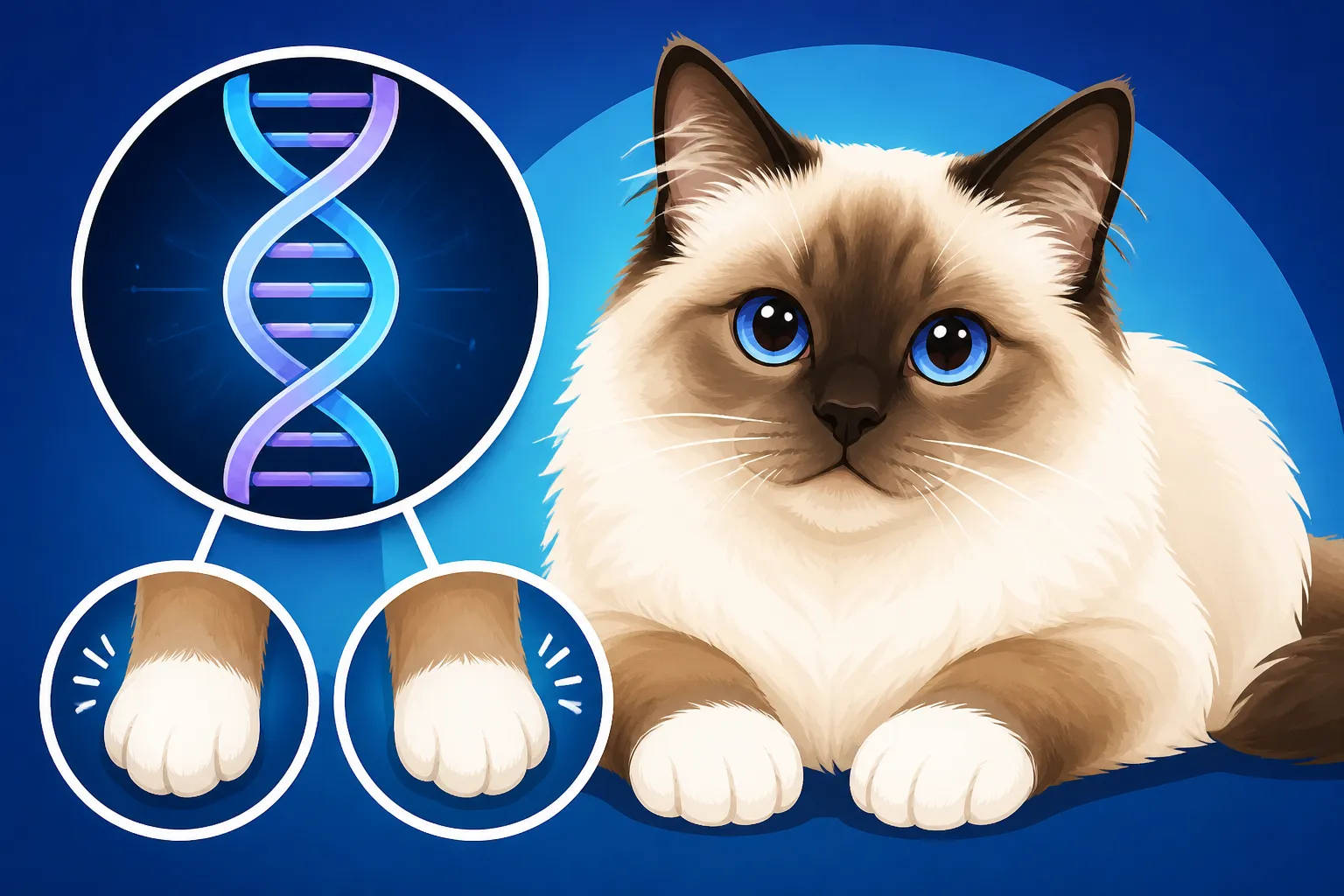
The Gloving Gene Every Birman Carries Two Copies Of
One of the most captivating features of the Birman cat is undoubtedly their distinctive white paws, often referred to as "gloves" and "laces." Many new Birman owners, and even those who've loved the breed for years, often wonder how these pristine white markings come to be, especially when the rest of their coat adheres to the colorpoint pattern. This guide will delve deep into the fascinating genetics behind the Birman's signature white paws, exploring the specific gene responsible and why it's such a unique and defining characteristic of this beloved breed.
The Birman's Signature: Those Iconic White Gloves
The Birman cat stands out in a crowd of colorpoint breeds largely because of its beautiful white "gloves" on all four paws, often complemented by white "laces" running up the back of the hind legs. This isn't just a charming aesthetic; it's a hallmark of the breed, a defining characteristic that sets them apart from similar-looking cats like the Ragdoll or Himalayan. When you first encounter a Birman, your eyes are immediately drawn to those perfectly snow-white feet, contrasting elegantly with their darker points. It’s a vision of pure grace and often sparks curiosity about how such precise markings are inherited.
Imagine a stunning seal point Birman, with its deep brown points on the face, ears, legs, and tail, draped in a luxurious, silky cream body coat. Now picture those four feet, dipped in what appears to be pure white paint, perfectly symmetrical and stopping abruptly at the ankle or "knuckle." This striking contrast is what breeders strive for and what cat fanciers adore. The "gloves" are ideally pure white, matching the immaculate white on the chest and belly, and free from any flecks of colored hair. It's truly an artistry of nature, guided by specific genetic instructions that have been meticulously refined over generations of breeding.
For any Birman enthusiast, understanding these gloves goes beyond mere aesthetics. It speaks to the history of the breed, its unique genetic blueprint, and the dedication of breeders who have worked to preserve this trait. These aren't just random white spots; they are a direct expression of a powerful gene, carefully managed to maintain the breed's integrity and unique visual appeal. It’s a feature that demands attention and, once understood, only deepens the appreciation for this magnificent feline.
What Exactly Are Birman Gloves and Laces?
When we talk about "Birman gloves," we're referring to the immaculate white markings on the cat's front paws, ideally symmetrical and extending up to the "knuckle" or just above. Think of them as if the cat dipped its front paws into a pot of pristine white paint. These gloves should be pure white, with no color seeping through, creating a clean, crisp line against the darker points of the leg. This precise boundary is what judges look for in the show ring, and what owners admire in their pets. The consistency and clarity of these front gloves are key indicators of good breeding and adherence to the breed standard.
Then there are the "laces," which are the white markings extending further up the back of the hind legs. These laces usually start from the sole of the paw, covering the entire foot, and then extend upwards in a tapering point, ideally symmetrical and ending just below the hock joint. The perfect lace forms an inverted 'V' shape, adding another layer of elegance to the Birman's appearance. While the gloves are about a clean, horizontal line, the laces are about an upward sweep of white, framing the darker hock. What a Birman's Back Lace Should End At is a crucial detail for breeders aiming for show-quality markings.
The combination of the precise front gloves and the flowing back laces creates the Birman's iconic look. These markings are not simply random white patches; they are distinct, genetically defined patterns. When these markings are perfectly balanced, clean, and well-defined, they elevate the Birman's aesthetic from beautiful to truly breathtaking. Any deviation, such as unevenness or colored spots within the white, is considered a "mismark" and impacts the cat's show potential, though it certainly doesn't diminish their charm as a beloved pet.
Why the White Paws Are So Unique to the Birman
You might see other pointed breeds with white on their paws, but the Birman's gloves and laces are distinct. Many other breeds with white markings have them due to different genetic factors, often related to generalized white spotting genes that can produce anything from a white locket to extensive white patches. These white spotting patterns are usually less precise and can appear anywhere on the body, lacking the specific placement and symmetry that defines the Birman. For instance, a bicolor cat might have white feet, but it won't have the clean, 'gloved' appearance unique to the Birman.
What truly makes the Birman's white paws unique is that they are always present and always confined to the paws, with the distinct glove and lace pattern. This isn't a random occurrence; it's a fixed genetic trait. Every Birman, by definition of the breed, must have these white markings. This contrasts sharply with breeds where white spotting is an optional trait, or where the white patterns are highly variable. The consistency of the Birman's white paws, despite variations in their exact length or symmetry, points to a very specific and deeply embedded genetic mechanism. Whether a Birman Without Gloves Exists is a question that highlights this uniqueness; genetically, a true Birman cannot exist without the gloving gene expression.
This fixed nature of the gloving gene means that breeders aren't trying to introduce white onto the paws; they're working with a gene that ensures white paws, and their focus is on refining the quality and symmetry of those white markings. It's a subtle but profound difference in breeding approach compared to managing white spotting genes in other breeds. The Birman's gloving is a testament to selective breeding that has isolated and stabilized this specific, charming genetic expression, making it an unmistakable signature of the breed.
Unpacking the Genetics: What is the Gloving Gene?
Understanding the Birman's gloves means diving into the fascinating world of feline genetics, specifically focusing on the gene responsible for this unique trait. Unlike many white markings in cats, the Birman's gloves aren't caused by the common white spotting gene (often designated 'S'). Instead, they are the result of a very specific genetic mutation that, through careful breeding, has become fixed within the Birman population. This gene orchestrates the precise deposition of pigment, or rather, the lack thereof, on the extremities of the paws. It's a gene that essentially tells certain cells on the lower limbs, "Don't produce pigment here, no matter what the base coat color is."
The scientific community has identified the gene responsible for the Birman gloving as residing on the KIT locus. This particular mutation is what gives the Birman its distinctive pattern, and it behaves in a way that is unique to the breed. It’s not about diluting color or preventing color entirely; it’s about creating those specific white "socks" and "laces" in a cat that is otherwise a full-fledged colorpoint. This specificity is why you won't see this exact type of gloving in other breeds that simply have general white spotting. It’s a beautifully precise genetic instruction that ensures the Birman's aesthetic remains consistent across generations.
The intricacies of this gene mean that even though all Birmans carry it, the expression of the gloves can still vary. This is where the art and science of breeding truly come into play. While the gene dictates that white paws will be present, other modifier genes and environmental factors can subtly influence the exact length, symmetry, and clarity of the gloves and laces. It's a delicate balance, and breeders spend years studying lines and pedigrees to understand how to consistently produce kittens with the most desirable glove markings.
The Role of Pigment Migration in Glove Formation
To understand how the Birman's white gloves form, it helps to think about how pigmentation develops in a kitten. All Birman kittens are born pure white or nearly white. Their points (ears, face, paws, tail) gradually darken as they mature, a characteristic of all colorpoint cats. This color development is due to a temperature-sensitive enzyme that only allows pigment to be expressed in cooler areas of the body. The paws, being extremities, are naturally cooler, and therefore should develop pigment according to the colorpoint gene.
However, the gloving gene specifically interferes with this process on the paws. Instead of allowing melanocytes (the pigment-producing cells) to migrate and function normally in those specific areas of the paws, the gloving gene either prevents their migration or their ability to produce pigment. It’s like a genetic block that says, "Stop here! No pigment allowed past this point on the paws." This mechanism is localized and precise, allowing the rest of the cat's points to develop their color, while the paws remain pristine white. The effect is particularly striking because it's such a precise interruption of an otherwise uniform colorpoint pattern.
This selective interference means the white gloves are not merely unpigmented areas; they are areas where pigment has been actively prevented from forming or migrating, despite the genetic predisposition for colorpoint markings. It’s a fascinating example of how a single gene can exert such precise control over a complex biological process, resulting in such a visually striking and consistent breed characteristic. Understanding this process helps to appreciate the subtle genetic dance that gives the Birman its unique appeal.
Identifying the KIT Gloving Variant
The specific genetic variant responsible for the Birman's gloving has been identified within the KIT gene. The KIT gene is known to play a crucial role in various biological processes, including the development and migration of melanocytes. Mutations in the KIT gene are often associated with white spotting patterns in many animal species, including cats. However, the Birman's specific mutation is distinct in how it expresses itself, giving rise to the characteristic gloves and laces rather than generalized white spotting. What the KIT Gloving Variant Does is a deep dive into the molecular mechanics, but suffice it to say, this particular variant has a very targeted effect.
Researchers have found that the Birman gloving is caused by a specific deletion in the KIT gene. This deletion is inherited in an autosomal recessive manner, but paradoxically, all Birmans carry two copies of this variant, meaning they are homozygous for it. This homozygosity is what makes the trait fixed within the breed; every Birman cat you encounter, from a champion show cat to a beloved pet, carries this precise genetic instruction for white paws. The presence of two copies of this specific KIT variant is the genetic fingerprint of the Birman's gloves and laces.
Knowing about this specific variant allows for genetic testing, although it's rarely necessary for Birmans themselves since the trait is fixed. However, it's invaluable for scientific research into feline coat color genetics and for understanding how unique mutations can shape entire breeds. The identification of this KIT gloving variant solidified the scientific basis for the Birman's distinctive appearance, moving it beyond anecdotal observation into verifiable genetic fact.
Why Every Birman Carries Two Copies
One of the most defining aspects of the Birman's genetics, particularly concerning its iconic white gloves, is that every single Birman carries two copies of the specific gene variant responsible for these markings. This isn't just a common occurrence; it's an absolute rule within the breed. This genetic situation, where an individual has two identical copies of a particular gene variant, is known as homozygosity. For the gloving gene, it means that Birmans are homozygous for the gloving allele. This might sound a bit technical, but it’s the cornerstone of why their paws are always white, making them instantly recognizable.
Imagine a puzzle where every piece fits together in a very specific way to form the picture of a Birman with white gloves. If a cat only had one piece of this puzzle, or a different piece altogether, the picture wouldn't be complete. For Birmans, having two identical copies of the gloving gene ensures that the "white gloves" picture is always fully formed. It's a unique evolutionary path for a breed, where a specific trait became so essential to its identity that it was intentionally fixed in the gene pool through selective breeding over many generations.
This universal homozygosity means that when two Birmans are bred together, they will always pass on a copy of the gloving gene to each of their offspring. Consequently, every kitten born from two Birman parents will inherit two copies of the gloving gene and will, therefore, always express the characteristic white gloves and laces. This predictability is a huge advantage for breeders, as they don't have to worry about whether a kitten will have the fundamental white paw markings – they just have to worry about the quality of those markings. Why Every Birman Has Two Copies of the Gloving Gene provides even more detail on this fascinating aspect.
The Consequences of a Fixed Gene
The fact that the gloving gene is fixed, meaning all Birmans are homozygous for it, has several profound implications for the breed. Firstly, it guarantees the Birman's signature appearance. You will never encounter a purebred Birman that lacks white gloves and laces. If a cat presented as a Birman does not have these markings, it is either not a true Birman or has been misidentified. This genetic stability provides a consistent visual identifier for the breed, making it easy for enthusiasts and judges to distinguish them. It’s part of the magic that makes a Birman a Birman.
Secondly, this fixed gene simplifies breeding decisions regarding the gloves themselves. Breeders don't need to perform genetic tests to confirm the presence of the gloving gene, nor do they need to track carriers of an "ungloved" allele. The gene is simply there, in every single Birman. Their focus can then shift entirely to other aspects of the gloves, such as symmetry, length, and the crispness of the white. This means breeders can concentrate on refining the quality of the expression rather than ensuring the presence of the trait. They are aiming for perfection within a guaranteed framework.
Finally, the fixed nature of this gene illustrates a successful instance of selective breeding shaping a breed's genetic makeup. It’s a testament to the dedication of early Birman breeders who identified this desirable trait and worked tirelessly to ensure its consistent inheritance. This process, while fixing a beloved characteristic, also highlights the careful balance breeders must maintain to ensure overall genetic diversity and health within the breed, preventing potential bottlenecks that could lead to other issues.
Why Two Birmans Can't Produce an Ungloved Kitten
Given the understanding of the Birman's gloving gene and its fixed nature, the answer to whether two Birmans can produce an ungloved kitten is a resounding no. Since every Birman carries two copies of the gloving gene (is homozygous for it), each parent will invariably pass on one copy of this gene to every single kitten they produce. Therefore, every kitten in a purebred Birman litter will inherit one gloving gene from the mother and one gloving gene from the father, resulting in two copies and, consequently, the expression of white gloves and laces.
This is a fundamental principle of Mendelian genetics applied to a fixed trait. If an ungloved kitten were to appear in a litter supposedly from two purebred Birmans, it would immediately raise questions about the lineage of one or both parents. It would suggest that at least one parent was not a purebred Birman and introduced an allele that either lacked the gloving gene or possessed a different form of white spotting that could produce variable results. This is why reliable breeders always provide pedigrees and often DNA test results. Whether Two Birmans Can Produce an Ungloved Kitten is a common query, and understanding this genetic reality is key.
In essence, the gloving gene is so deeply embedded and uniformly present in the Birman gene pool that the production of an ungloved kitten from two purebred Birmans is genetically impossible. This provides immense consistency for the breed's appearance and is one of the charming certainties that Birman enthusiasts cherish about their cats. It also underlines the rigorous standards breeders adhere to to maintain the purity and distinct characteristics of the Sacred Cat of Burma.
The Unpredictable Art of Breeding for Perfect Gloves
While we know that every Birman will inherently have white gloves and laces thanks to their fixed gloving gene, achieving perfection in these markings is an entirely different story. Breeders often describe it as an art form, a delicate dance between genetics, chance, and meticulous selective breeding. It's one of the biggest challenges in Birman breeding, leading to a wide range of pricing and show potential within a single litter. Even with two parents that have excellent glove markings, there's no guarantee that every single kitten will inherit that same level of perfection. This unpredictability can be a source of both excitement and frustration for breeders, but it's also what makes each Birman kitten truly unique.
The ideal glove is symmetrical, a pure, unblemished white, and extends to just the right height on the front paws (the "knuckle"), with the back laces forming a perfect inverted V and tapering elegantly up the hock. Deviation from this ideal—whether it's uneven glove lengths, "runners" of white extending too far up the leg, patches of color within the white, or laces that are too short or too long—are all considered faults. These faults don't make the cat any less of a Birman, or any less lovable, but they do impact its eligibility and success in the show ring. Why Perfect Birman Gloves Are Almost Impossible to Breed highlights the inherent difficulty.
This striving for perfection drives much of the Birman breeding world. Breeders dedicate years to studying lines, analyzing pedigrees, and carefully selecting breeding pairs, all with the hope of consistently producing kittens that come as close to the breed standard's ideal gloves as possible. It's a continuous learning process, where experience and a keen eye for subtle genetic indicators become invaluable tools in this charmingly unpredictable art.
What Breeders Look for in Glove Markings
When a Birman breeder evaluates a kitten's gloves, they're looking for a very specific set of criteria that align with the breed standard. The front gloves, first and foremost, must be pure white and ideally symmetrical. Imagine a line drawn horizontally across the front paws; the white should meet this line evenly on both feet. Any unevenness, where one glove extends higher or lower than the other, is considered a fault. The white should also be pristine, free from any colored spots or "smudges" that would disrupt its purity. How a Breeder Judges a Birman Kitten's Gloves goes into further detail.
For the back paws, the focus shifts to the "laces." The white here should cover the entire paw, extending up the back of the leg in a tapering point, forming an inverted V shape. The ideal length of these laces is crucial; they shouldn't extend too high up the leg, but also shouldn't be too short, creating an abrupt halt of white. Symmetry is again paramount, with the laces on both hind legs ideally matching in length and shape. The overall impression should be one of elegance and balance, with the white seamlessly framing the darker points.
Beyond the length and symmetry, breeders also assess the texture and quality of the white fur itself. It should be as silky and luxurious as the rest of the Birman's coat. Any signs of thinness or coarse hair within the glove area can also be a minor fault. Breeders often handle kittens from a very young age, meticulously observing how the gloves develop as the kitten grows, knowing that the final appearance of the gloves will determine its future, whether as a beloved pet, a show contender, or a future breeding cat.
Common Glove Faults and Mismarks
Despite the fixed gloving gene, various deviations from the ideal glove standard are quite common in Birman litters. These are known as "faults" or "mismarks" and while they make a cat unsuitable for showing, they typically don't affect its health or wonderful temperament. One of the most frequent faults is unevenness in the front gloves, where one paw might have a shorter or longer white marking than the other. This asymmetry, though minor, is a significant deviation from the desired balance. Another common issue is "runners" or "gauntlets," where the white extends too far up the leg, often past the hock on the hind legs or high up the forearm on the front. What a Birman With Gauntlets Cannot Be Shown is a good example of how specific these faults can be for show purposes.
Sometimes, a Birman might have a colored spot or "bar" within the white glove area, which is also considered a fault. This can be a small patch of point color intruding into the pristine white. Conversely, a lace might be too short, not extending high enough up the hock, or it might be completely absent on one or both hind legs, leaving just the white paw without the characteristic upward sweep. These variations are often genetically influenced by modifier genes that interact with the main gloving gene, subtly altering its expression.
It's important to remember that these faults are purely cosmetic according to breed standards. A Birman with mismarked gloves is just as healthy, affectionate, and beautiful as one with perfect markings. In fact, many people prefer a pet Birman with a unique set of gloves, appreciating their individuality. Breeders usually sell mismarked kittens at a "pet price" with a neuter contract, ensuring they go to loving homes where their cosmetic imperfections don't matter, allowing families to enjoy the unique charm of the Birman without the premium associated with show-quality markings.
Beyond Genetics: Other Factors Influencing Glove Expression
While the gloving gene is a non-negotiable component of a Birman's appearance, and every Birman indeed carries two copies, the quality and precision of those white gloves aren't solely determined by this single gene. It's a much more complex interplay of genetics, where other "modifier genes" act like subtle adjusters, fine-tuning how the main gloving gene is expressed. Think of the main gloving gene as the blueprint that dictates "white paws," while modifier genes are the architects adding the precise details of symmetry, height, and crispness. This intricate genetic dance is what makes breeding for perfect gloves so challenging yet rewarding.
These modifier genes can influence everything from the exact height of the white "socks" on the front paws to the length and shape of the "laces" on the hind legs. They might dictate how sharply the white contrasts with the colored points or how pristine and free of colored flecks the white remains. Understanding these modifier genes is still an area of ongoing research, but breeders have long observed their effects through generations of selective breeding. They know from experience that certain pairings tend to produce better glove quality, even if the exact genetic mechanisms aren't fully mapped out yet. Why Birman Gloves Vary Despite the Fixed Gene is a clear indicator that there's more at play than just one gene.
Furthermore, it's not just genetics. Environmental factors, though typically less impactful than genes, can also have a subtle role, particularly during the critical developmental stages of a kitten. While they won't create gloves (as the main gene does that), extreme conditions or nutritional deficiencies could theoretically impact overall coat development, including the purity or texture of the white areas. However, for most well-cared-for Birman kittens, it's the complex genetic tapestry woven by modifier genes that largely determines the final masterpiece of their white paws.
Modifier Genes and Their Subtle Effects
Modifier genes are like the silent partners in the genetic expression of the Birman's gloves. They don't determine if the gloves appear, but rather how well they appear. These genes can influence the distribution of white cells, the sharpness of the border between white and color, and even the purity of the white itself. For instance, some modifier genes might promote a more even migration of pigment-inhibiting cells, leading to perfectly symmetrical front gloves. Others might ensure that the white on the laces tapers gradually, creating that elegant inverted V shape, rather than stopping abruptly or becoming too narrow. Which Modifier Genes Affect a Birman's Gloves delves deeper into these specific genetic influences.
The challenge for breeders lies in the fact that these modifier genes are often polygenic, meaning multiple genes work together to create the desired effect, and their inheritance patterns can be complex. It’s not usually a simple dominant/recessive relationship. This makes predicting the exact quality of gloves in a litter much harder than predicting a basic coat color. Breeders rely heavily on observing the glove quality in parent cats, grandparents, and previous litters to make informed decisions about breeding pairs. They look for consistent patterns of excellent glove markings across generations, hoping to concentrate those positive modifier genes in their breeding lines.
This is why experienced Birman breeders are so invaluable. They possess an intuitive understanding, honed over years, of which cats tend to produce offspring with superior gloves, even without fully knowing the intricate genetic code. They learn to recognize the subtle cues in a cat's lineage and appearance that suggest a strong complement of desirable modifier genes. It’s this blend of genetic science and observational experience that elevates Birman breeding to an art form.
Environmental Influence on Glove Development
While genetics are undeniably the primary driver behind the Birman's distinctive gloves, it's natural to wonder if external factors play any role, however minor. Generally, the genetic programming for the white gloves is robust, meaning environmental conditions won't fundamentally change whether a Birman has gloves or not. The fixed gene ensures their presence. However, certain environmental factors could subtly influence the quality or maintenance of the white areas, though these effects are usually secondary to genetics.
For example, the overall health and nutritional status of a pregnant queen and her developing kittens can impact coat quality in general. A severely undernourished queen might produce kittens with a less robust coat, which could theoretically manifest as slightly less pristine or less dense white fur on the gloves. Similarly, during early kittenhood, severe illness or stress might in rare cases have a very slight, temporary impact on coat development, but this is an extreme scenario and unlikely to alter the fundamental gloving pattern. Healthy kittens from well-cared-for mothers are almost always what breeders strive for to ensure optimal development across all traits.
More practically, environmental factors primarily affect the cleanliness and appearance of the white gloves rather than their genetic formation. A Birman whose litter box isn't kept meticulously clean, or who plays in muddy areas, will naturally have discolored or dirty white paws. This isn't a genetic fault but a care issue. This is why Keeping a Birman's White Gloves White is a consistent concern for owners, often leading to choices like dust-free litter. So, while a clean environment won't make perfect gloves, it certainly helps them look their best.
The Impact of Gloving on Breed Standards and Showing
For anyone involved in the world of Birman cats, from dedicated breeders to aspiring show exhibitors, the white gloves are not just a charming feature; they are the cornerstone of the breed standard. In cat shows, the gloves and laces are among the most heavily weighted criteria, often accounting for a significant portion of a Birman's total score. This intense focus means that even a cat with an otherwise perfect head, body, and coat can be penalized, or even lose, due to imperfect glove markings. It creates a very high bar for any Birman aspiring to championship titles.
The detailed descriptions of ideal gloves in breed standards across various cat registries are incredibly precise, outlining everything from the desired height on the front paws to the shape and symmetry of the back laces. Judges spend considerable time meticulously examining each paw, looking for even the slightest deviation from the ideal. This scrutiny validates the immense effort breeders put into their programs, aiming to produce kittens that conform as closely as possible to these exacting standards. It's a constant pursuit of genetic excellence and aesthetic perfection, all centered around those distinctive white paws.
This emphasis on gloving also means that the price of a Birman kitten is heavily influenced by the quality of its paw markings. A kitten with "show quality" gloves will command a significantly higher price than one with "pet quality" gloves, even if both are otherwise healthy and beautiful. It's a direct reflection of the breeding difficulty and the inherent value placed on this unique trait within the Birman fancy. Understanding this context helps to explain why breeders are so passionate and particular about the specific appearance of their cats' gloves.
How Judges Evaluate a Birman's Gloves
When a Birman enters the show ring, the judge's assessment of its gloves is a highly detailed process. They don't just glance at the paws; they meticulously examine them, often lifting each paw to get a clear view. The front gloves are scrutinized for their purity (no colored spots or smudges), their height (ideally ending at the "knuckle" or "break" of the paw), and, most importantly, their symmetry. Both front gloves should match perfectly in extension. Any unevenness, even a slight difference, can result in points deducted. What Judges Look For on a Birman's Paws First are often those critical front gloves.
The hind legs come next, with judges looking at the "laces." Here, the white should cover the entire paw and extend up the back of the leg in a clear, tapering point, forming an inverted 'V'. The preferred length of these laces is typically to the hock, or slightly below. Again, symmetry between the two back laces is crucial, as is the purity of the white. Any "runners" (white extending too far up the leg), "gauntlets" (white covering the entire leg above the hock), or a lack of definitive "laces" (just white paws without the upward V) are considered faults that will lead to a lower score. How a Birman's Gloves Are Scored depends on these specific criteria.
Ultimately, a Birman with perfectly symmetrical, pure white gloves and well-defined laces is a rare and highly prized specimen. It represents the pinnacle of successful breeding, where both the fundamental gloving gene and the subtle influence of modifier genes have aligned to produce an ideal expression of this signature trait. This rigorous judging process ensures that only the best examples of the breed, particularly regarding their iconic paws, achieve championship status.
| Glove/Lace Feature | Ideal Standard | Common Faults | Impact on Show Score |
|---|---|---|---|
| Front Gloves | Pure white, symmetrical, ending evenly at the "knuckle" | Uneven length, colored spots/smudges, "runners" extending too high | Moderate to High Penalty |
| Back Laces | Pure white, V-shaped, symmetrical, extending to hock | Too short/absent, uneven length, "gauntlets" (too high), colored spots | Moderate to High Penalty |
| Purity of White | Pristine, unblemished white | Any colored hairs or flecks within the white areas | Minor to Moderate Penalty |
| Definition | Clear, sharp line between white and color | Blurred or indistinct edges between white and color | Minor Penalty |
Why Good Gloving Correlates with Higher Kitten Prices
It's no secret that the price tag on a Birman kitten can vary significantly, even within the same litter, and the quality of its gloves is often the primary driver of this difference. A Birman kitten with show-quality gloves and laces, meaning they conform very closely to the breed standard's ideal, will inevitably command a higher price. This is because such a kitten represents years of dedicated breeding, careful genetic selection, and the successful navigation of the inherent unpredictability in glove expression. Breeders invest considerable time, effort, and resources into producing kittens that have the potential to excel in the show ring, and this investment is reflected in the price.
Conversely, a Birman kitten with "pet quality" gloves—those with minor faults like unevenness, short laces, or small colored spots—will typically be sold at a lower price. These kittens are often placed in loving pet homes with a strict neuter contract, ensuring they are not used for breeding. This pricing structure doesn't diminish their value as companions; they are just as loving, playful, and healthy as their show-quality siblings. The difference is purely aesthetic, based on the stringent requirements of the show standard. Why a Mismarked Birman Is a Pet Price Cat explains this rationale clearly.
For a prospective Birman owner, understanding this pricing dynamic is crucial. It means you can often find a beautiful, healthy Birman kitten at a more accessible price if you're not concerned with show ring perfection. It's about prioritizing your needs: do you want a potential champion, or a wonderful family member whose unique quirks, including their slightly imperfect gloves, you'll adore? Either way, the Birman's gloving gene ensures you'll get those iconic white paws, no matter the price point.
Caring for Those Pristine White Paws
Owning a Birman cat means taking pride in their unique appearance, and those beautiful white gloves are often the first thing people notice. Keeping them pristine, however, requires a little conscious effort. Unlike darker paws that can camouflage a bit of dirt or litter dust, the Birman's snow-white feet show everything! This isn't just about aesthetics; maintaining clean paws can also contribute to your Birman's overall hygiene and comfort. After all, nobody wants dirty paws tracking through the house or ending up on their favorite blanket.
The key to pristine paws often comes down to prevention and prompt cleaning. It starts with the right kind of litter, extends to regular inspections, and occasionally requires a gentle spot clean. Your Birman, with its calm and cooperative temperament, will usually be quite amenable to having its paws handled, especially if you start the routine when they are a kitten. This makes the task much easier for you and a stress-free experience for them. It’s a small price to pay for those stunning, immaculate white feet that truly define the breed.
Remember, a Birman's white gloves are not just a genetic marvel; they are a part of their charm that owners cherish. While minor discoloration from everyday life is inevitable, a proactive approach to paw care ensures they remain as close to their genetically determined perfection as possible. It's a commitment to maintaining the elegance that the gloving gene so beautifully provides.
Choosing the Right Litter to Prevent Staining
One of the biggest culprits for dingy white Birman paws is the litter box. Many traditional clay litters, especially those with fine dust, can easily adhere to a Birman's silky fur and, over time, cause a yellowish or grayish discoloration on their beautiful white gloves. Imagine your Birman stepping out of a dusty litter box; those fine particles cling to their paws and, when licked, can even contribute to ingestion of dust. This is why selecting the right litter is paramount for maintaining those pristine white markings.
When choosing litter for a Birman, prioritize low-dust or dust-free options. Silica gel litter, made from tiny crystals, is an excellent choice as it's typically very low in dust and less likely to stick to fur. Similarly, some paper-based litters or natural wood pellet litters can also be good options, provided they are made of materials that won't easily stain. Avoid litters with strong dyes or perfumes, as these can sometimes transfer to the fur or cause irritation. Many owners find brands like Chewy's in-house litter options or others specifically marketed as low-dust to be very effective. Why Litter Discolors a Birman's White Feet is a common frustration for owners.
Beyond the type of litter, the frequency of scooping and full litter changes is also critical. A clean litter box means less opportunity for fecal matter or urine to come into contact with the white paws. Aim to scoop at least once, preferably twice, daily, and perform a full litter change and box cleaning weekly. A clean environment contributes significantly to keeping those gloves looking their best.
Routine Cleaning and Maintenance
Even with the best litter, daily life means those white gloves might need a little extra attention now and then. Incorporating a quick paw check into your routine is a great habit. After your Birman uses the litter box, or after a particularly active play session, take a moment to gently wipe their paws. Keep some pet-safe, unscented wipes near the litter box or in a convenient location. A quick wipe can remove any lingering dust, tiny debris, or stray litter particles before they have a chance to stain the fur.
For more stubborn marks, a gentle spot clean might be necessary. You can use a damp cloth with a tiny bit of cat-safe shampoo (specifically formulated for white coats if you want an extra brightening boost). Apply a small amount, gently lather, and then rinse thoroughly with a clean, damp cloth. Always ensure the paws are completely dry afterwards to prevent skin irritation or fungal issues. For those really tough stains, some Birman owners swear by a small amount of cornstarch or baking soda, gently rubbed into the fur and then brushed out, to absorb oils and lift discoloration, though this should be used sparingly and carefully.
Don't forget the areas between their paw pads! These hidden spots can accumulate dirt and debris, potentially leading to matting or irritation. A soft toothbrush can be a useful tool for gently cleaning these areas. Regular nail trims are also part of overall paw health and can prevent nails from becoming stained or harboring dirt. With a little consistent care, your Birman's genetically perfect white gloves will remain a dazzling highlight of their already stunning appearance.
Disclaimer
This article is for general informational purposes only and does not constitute professional advice. Laws, prices and regulations vary by location and change over time. Consult a qualified professional for guidance on your specific situation.