Why Perfect Birman Gloves Are Almost Impossible to Breed
It's a dream for many Birman enthusiasts: a kitten with those utterly perfect white "gloves" on all four paws, crisp and symmetrical, ending just right. But if you've ever spoken to a Birman breeder, you'll know that achieving this level of perfection, consistently across a litter, is one of the most maddeningly elusive goals in the breed. It's not just about luck; it's a deep dive into complex genetics, careful selective breeding, and a whole lot of patience. This guide will explore why those exquisite Birman gloves are so difficult to perfect, delving into the genetic nuances and the painstaking efforts breeders undertake.
The Birman Standard: Defining the Elusive Perfection
Before we can even talk about why perfect Birman gloves are almost impossible to breed, we need to understand what "perfect" actually means in the world of Birman cats. The breed standard, set by various cat registries around the globe, lays out very specific criteria for the ideal gloving. It’s a detailed blueprint that breeders strive for, often for generations, and it’s far more intricate than just "white feet."
Defining the Ideal Front Gloves
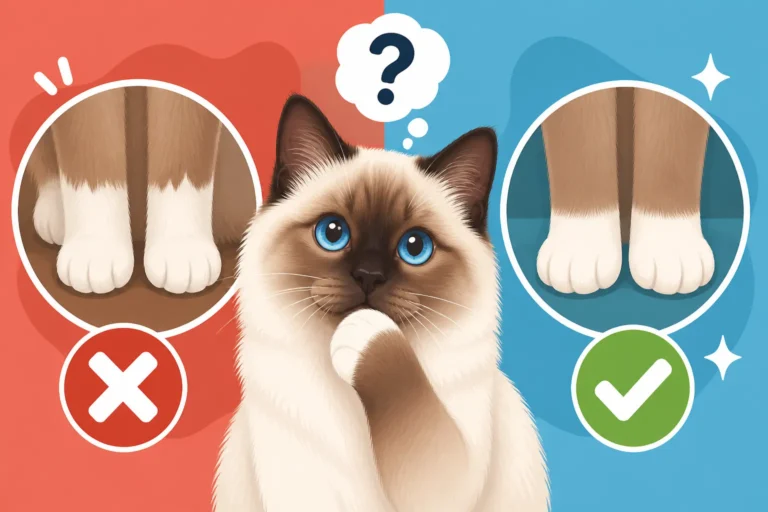
For the front paws, the standard is usually quite clear: the white gloves should be confined to the paws themselves, forming a symmetrical "glove" that ends in an even line across the paw, just at or above the joint where the toes meet the leg. Imagine dipping your cat's paws into a pot of white paint, and that's the ideal. There should be no white extending up the front of the leg (often called "runners") or uneven lines. Each front glove should be identical in length and shape to its counterpart, a mirror image of pristine white.
This seemingly simple requirement is where the complexity often begins. A kitten might have a beautiful, perfectly even glove on one front paw, only for the other to creep a little too high up the leg or have an irregular border. These subtle variations, while making absolutely no difference to a pet cat's health or charm, are significant faults in the show ring. The goal is a uniform, clean cut that enhances the Birman's overall elegance, a specific aesthetic that breeders work tirelessly to achieve.
The Importance of Rear Laces and Gauntlets
The rear paws introduce another layer of complexity, as the white markings there are not just gloves but also include what are called "laces" or "gauntlets." On the hind feet, the white gloves should extend higher than on the front, finishing in a distinct point or "lace" running up the back of the hock. This lace should also be perfectly symmetrical between the two hind legs, ending at a consistent height and having a clean, well-defined point.
Here's where things get really tricky. Sometimes, this lace extends too far up the leg, almost looking like a white sock or boot – this is referred to as a "gauntlet" and is considered a serious fault, potentially disqualifying a cat from championship status. Other times, the laces are too short, or one lace is significantly longer than the other, breaking that critical symmetry. The ideal is a delicate balance: enough white to form the lace, but not so much that it becomes a gauntlet, all while maintaining perfect evenness. Understanding Where a Birman's Back Lace Should End is crucial for any aspiring breeder or discerning owner.
Why Symmetry is Key
Symmetry isn't just a preference; it's a cornerstone of the Birman breed standard. Every aspect of the white gloving – the length, the height, the shape, and the crispness of the lines – must be as symmetrical as possible across all four paws. This means the left front glove should match the right front glove, and the left hind glove and lace should match the right hind glove and lace. Even a slight asymmetry, such as one glove being higher than the other, or one lace ending lower, can significantly impact a Birman's show prospects.
Breeders spend years developing an "eye" for this symmetry, often assessing kittens from a very young age, knowing that the gloves can continue to develop and sometimes change slightly as the kitten grows. This constant quest for balance is what makes perfect gloving so challenging. A kitten might have stunning, deep blue eyes and a glorious coat, but if its gloves are uneven or one lace is higher than the other, it will likely be sold as a pet, even if its overall conformation is otherwise excellent. This is why Why an Uneven Birman Glove Is a Show Fault is such a significant topic in the Birman world.
The Unpredictable Genetics of Gloving
If only breeding for perfect Birman gloves were as simple as combining two parents with beautiful markings and expecting identical offspring! Unfortunately, the genetics behind those coveted white paws are anything but straightforward. While we understand some key components, there's a frustrating amount of variability that breeders grapple with every single generation.
The Role of the KIT Gloving Variant
At the heart of Birman gloving is a specific genetic mutation involving the KIT gene, often referred to as the "gloving variant." It's believed that all Birmans carry two copies of this particular variant, making them homozygous for it. This is why every Birman, by definition, has white gloves – it's a fixed trait in the breed. The gene basically "tells" the pigment cells (melanocytes) where not to go, preventing color from developing in specific areas of the paws.
However, simply having the KIT gloving variant isn't enough to guarantee perfection. If it were, every Birman would have identical gloves, and there would be no challenge! The presence of this gene is the foundation, the starting point, but it doesn't dictate the exact length, symmetry, or crispness of the white markings. It's like having the blueprint for a house, but not all the detailed architectural drawings for every single feature. Breeders know that The Gloving Gene Every Birman Carries Two Copies Of is foundational, but it’s just one piece of a much larger puzzle.
Modifier Genes and Their Subtle Influence
This is where things get truly complex and often frustrating for breeders. Beyond the primary KIT gloving variant, scientists and breeders believe there are numerous "modifier genes" at play. These are other genes, scattered throughout the cat's genome, that don't directly cause the white gloves but subtly influence their expression. They can dictate how high the white goes, how sharp the border is, how symmetrical the markings are, and even the intensity of the white itself.
Think of it like adding spices to a recipe. The main ingredients (the KIT gene) are there, but the modifier genes are the pinch of this, a dash of that, which change the final flavor and appearance. These modifier genes are not fully understood, and their inheritance patterns can be incredibly intricate, involving multiple genes interacting with each other in subtle ways. This makes predicting gloving patterns almost impossible, even when mating two cats with excellent gloves. A cat might have a perfect phenotype (what it looks like), but its genotype (its underlying genetic makeup) could carry undesirable modifier genes that surface in its offspring. This genetic roulette is precisely Why Glove Genetics Are Unpredictable in a Birman.
The "Many Genes" Theory Beyond KIT
While the KIT gene is considered the primary determinant of the white gloving, the prevailing theory among geneticists and experienced Birman breeders is that gloving is a polygenic trait – meaning it's influenced by many genes, not just one or two. This "many genes" theory explains why there's such a wide spectrum of gloving perfection, from near-flawless examples to cats with significant mismarks.
Each of these genes contributes a small piece to the overall picture, and the combination of desirable and undesirable modifier alleles (different forms of a gene) can result in anything from a slight imperfection to a major fault. This complex interplay makes it incredibly difficult to isolate specific genes responsible for "good" or "bad" gloving. It's not like testing for a simple dominant or recessive trait. This is also why a definitive "Whether a Birman Glove Test Exists" remains an elusive dream for breeders – we're not dealing with a single, clear genetic marker for perfection. It’s a whole symphony of genes performing, and sometimes, one instrument is slightly out of tune.
The Challenge for Breeders: Predicting Kitten Gloves
For Birman breeders, the journey to a "perfectly gloved" cat is fraught with anticipation and occasional disappointment. The true nature of a kitten's gloves doesn't reveal itself immediately, and the continuous development of these markings adds another layer of unpredictability to an already complex genetic equation.
Why a Birman Kitten Is Born Almost White
When a Birman kitten first enters the world, it's a tiny, almost pure white bundle of fluff. This is true for all pointed breeds; the color points (ears, paws, tail, and face) only develop as the cat matures and is exposed to cooler temperatures. The enzyme responsible for producing pigment is temperature-sensitive, so in the warm environment of the womb, and for the first few days of life, the entire kitten appears unpigmented. This means that a breeder cannot, in those precious first moments, definitively judge the quality of the gloves.
Imagine the excitement and nerves of waiting. You've painstakingly chosen your breeding pair, hoping for a specific outcome, but the canvas is blank. The tiny white paws hold the promise of future perfection, or the hidden reality of potential mismarks. This initial white stage is a period of pure hope, before reality begins to color in the details. It's a testament to the patient nature required in Birman breeding, knowing that weeks must pass before any real assessment can begin.
How Gloves Develop Over Weeks and Months
The points, including the gloves, slowly start to appear and darken over the first few weeks and months of a Birman kitten's life. The white gloves themselves become more defined as the contrast with the developing point color intensifies. However, this isn't a static process; the gloves continue to evolve. What looks like a promising, well-defined glove at eight weeks might shift slightly as the kitten grows, its bones lengthen, and its musculature develops. The "laces" on the hind paws, in particular, can be notoriously slow to fully settle into their final pattern.
Breeders typically make their initial assessment around 8-12 weeks, which is often when How a Breeder Prices a Birman at Twelve Weeks begins. But even then, they understand that some small changes are possible. A glove that looked perfectly even might show a slight run up the leg as the cat grows, or a lace that seemed just right could lengthen into a gauntlet. This delayed development means breeders often have to make decisions about show potential or pet placement based on an "educated guess," sometimes holding back a particularly promising kitten for longer to see its markings fully mature. It highlights how long it takes for When a Birman Kitten's Gloves Are Final.
The Heartbreak of Late-Developing Faults
One of the most disheartening aspects for a dedicated Birman breeder is the appearance of a late-developing fault. A kitten that seemed to have exemplary gloves for weeks or even months can, as it reaches adolescence or early adulthood, surprise its breeder with a minor but significant flaw. A front glove might develop a small "runner" of white fur extending slightly above the desired line, or a seemingly perfect hind lace might become a fraction too long or uneven.
These subtle changes can dash hopes for a show career or a future in a breeding program. While the cat remains a wonderful, loving companion, the investment of time, effort, and careful genetic planning aimed at show perfection can feel wasted. This experience is a common one, reinforcing the "impossible" nature of consistently achieving perfection. It’s why breeders are cautious, and why sometimes What Happens If Your Birman Kitten's Gloves Come In Wrong can be a tough conversation between a breeder and an aspiring show home. It's a constant reminder that nature, even with careful guidance, always holds a few surprises up its sleeve.
Common Glove Faults and Their Impact on Show Potential and Price
Because achieving perfect gloving is so challenging, various "faults" are common. These aren't defects that impact a cat's health or temperament, but rather deviations from the stringent aesthetic criteria set by the breed standard. Understanding these common faults helps to appreciate the difficulty breeders face and explains why some Birmans are priced differently.
"Laces Too High" and "Gauntlets"
One of the most frequently encountered hind glove faults is when the "laces" extend too far up the leg. The ideal lace should end in a distinct point at or slightly above the hock joint, creating a beautiful contrast with the point color. However, when these white markings creep up the leg, resembling a white sock or even a full boot, they are referred to as "gauntlets." A cat with gauntlets is almost certainly disqualified from championship shows because it deviates significantly from the standard.
For a breeder, seeing gauntlets on an otherwise stunning kitten can be a real blow. It means that kitten, despite its other wonderful qualities, cannot be shown to represent the breed ideal. Consequently, a Birman with gauntlets will invariably be sold as a pet, often at a lower price point than a show-quality kitten. This is the reality of Why a Birman With Gauntlets Cannot Be Shown and why breeders are so particular about the length of the rear white markings.
"Uneven Gloves" and "Ski Gloves"
Symmetry is paramount, and uneven gloves are another common fault. This can manifest in several ways: one front glove might be higher or lower than the other, or the "lace" on one hind leg might be significantly longer or shorter than the other. Sometimes, the white on the front paws might extend unevenly between the toes, or have a jagged, rather than a crisp, line across the paw. These seemingly minor asymmetries are still considered faults in the show ring.
Another specific type of uneven gloving often seen is "ski gloves." This refers to white that extends too high up the front legs, often in an inverted 'V' shape, reminiscent of ski boots. Again, while charming and unique, this doesn't meet the breed standard's requirement for white that is confined strictly to the paws with a clean, even stop. These variations, though they don't harm the cat, clearly demonstrate Why an Uneven Birman Glove Is a Show Fault and why it affects a Birman's prospects in competition.
"Runners" and "Flecks"
More subtle, but still undesirable, are "runners" and "flecks." A runner is a thin strip of white fur that extends from the glove up the front of the leg, breaking the clean, horizontal line of the glove. It might be just a few stray white hairs or a more pronounced stripe. Flecks are small, isolated spots of white fur found elsewhere on the body, outside of the designated glove areas, such as on the chest or belly. Both of these indicate that the gloving gene's expression wasn't perfectly contained.
While a single, tiny fleck might be overlooked in a pet cat, in a show cat, even these minor imperfections can be enough to lose points against a competitor with flawless markings. They are direct evidence of the modifier genes at work, subtly altering the intended pattern. These faults reinforce why breeders scrutinize every kitten's paws meticulously and why even a "nearly perfect" cat might not meet the exacting standards of the show ring. When you consider What a Birman With Slightly Uneven Gloves Sells For, it's a direct reflection of how these minute details impact value in the breeding and showing world.
Breeding Strategies to Improve Gloving
Given the genetic complexities, Birman breeders employ various strategies to try and improve the gloving in their lines. It's a long-term commitment, often spanning multiple generations, requiring deep knowledge of pedigrees and an unwavering dedication to the breed standard.
Careful Selection of Breeding Stock
The cornerstone of any successful breeding program, especially one focused on specific aesthetic traits like gloving, is the meticulous selection of breeding stock. Breeders will choose queens and studs not just for their overall health, temperament, and conformation, but specifically for the quality of their gloves. This means looking at the symmetry, crispness, and correct placement of the white markings on both prospective parents.
However, selecting parents with excellent gloves isn't a guarantee, as the complex polygenic inheritance means hidden modifier genes can still produce mismarked offspring. A truly dedicated breeder will also study the gloving patterns of the parents' ancestors and previous offspring, looking for consistency in the line. They might even consult with other experienced breeders to understand which lines tend to produce more desirable gloving. This careful, data-driven approach is essential for any chance of progress, recognizing that How Many Litters It Takes to Get a Well Gloved Birman can be a significant number.
Outcrossing vs. Line Breeding for Glove Perfection
Breeders face a constant dilemma: do they outcross to introduce fresh genetics and potentially improve a weak trait, or do they line breed to consolidate desirable traits that are already present in their cattery? When it comes to gloving, both approaches have their risks and rewards. Outcrossing might bring in new, positive modifier genes that enhance glove quality, but it could also introduce new, undesirable modifier genes that make gloving worse or introduce other faults.
Line breeding, on the other hand, aims to concentrate the genes of a particularly well-gloved ancestor. If a specific cat consistently produced offspring with excellent gloves, a breeder might choose to breed closely related individuals to try and fix those desirable modifier genes in their line. However, line breeding also carries the risk of doubling up on undesirable modifier genes, which could lead to an increase in gloving faults. It’s a delicate balancing act, requiring breeders to understand their pedigrees intimately and make informed decisions, often seeking external advice. It takes a lot of skill to know Whether Show Marking Can Be Predicted From Birman Parents.
The Long Game: Generations of Refinement
Ultimately, breeding for glove perfection is a long game. It's not something that can be achieved in one or two generations; it often requires a lifetime of dedication and careful planning. Breeders understand that they are working with a dynamic genetic pool, and each breeding decision is a step in a multi-generational project. They keep meticulous records, not just of health tests but also of the gloving quality of every kitten produced.
This ongoing refinement involves evaluating each litter, identifying kittens with the best gloving, and carefully considering them for future breeding. Those with significant faults are almost always placed in pet homes, often with a neuter contract, to ensure their specific combination of modifier genes doesn't inadvertently perpetuate undesirable gloving. This commitment, spanning years and often decades, is what makes the occasional "perfectly gloved" Birman such a prized and celebrated achievement. It's a testament to the fact that even with modern genetic understanding, producing perfection requires patience, knowledge, and a little bit of magic.
Beyond Perfection: The Beauty of "Pet Quality" Birmans
While the pursuit of perfect Birman gloves drives many breeders, it's essential to remember that a cat's value extends far beyond its markings. The vast majority of Birmans, even those from top breeding lines, will have some minor "fault" in their gloving. These cats are no less beautiful, loving, or deserving of a wonderful home; they are simply considered "pet quality" rather than "show quality."
Why Mismarked Birmans Are Just as Wonderful
A Birman with a small "runner" of white fur, an uneven lace, or even a full gauntlet is still, at its heart, a Birman. It possesses the same gentle, affectionate temperament, the same striking blue eyes, and the same luxurious, low-matting coat that makes the breed so beloved. These minor deviations from the breed standard are purely cosmetic. They do not affect the cat's health, personality, or ability to be a cherished family member.
In fact, many pet owners find these unique markings charming, adding character to their feline companion. A mismarked Birman is often seen as a beautiful individual, with its own unique pattern that sets it apart. The joy and companionship a Birman brings come from its loving nature and engaging personality, not from whether its gloves are perfectly symmetrical. For families simply looking for a wonderful companion, a mismarked Birman is truly no different in value or affection than a show-quality one. Indeed, Why a Mismarked Birman Is a Pet Price Cat often comes down to this distinction in price and purpose, rather than a distinction in quality of companionship.
The Impact on Price: Pet vs. Show Quality
The distinction between "pet quality" and "show quality" Birmans primarily impacts the kitten's price. Kittens bred with the potential to compete in shows, possessing near-flawless markings and conformation, command the highest prices. This reflects the immense investment a breeder has made in selecting their lines, conducting health tests, and meticulously working towards the breed standard. These higher-priced kittens are often sold with specific contracts that allow for showing and, in some cases, breeding rights.
Conversely, a Birman kitten with a minor gloving fault, while still a purebred Birman from health-tested parents, will be priced as "pet quality." This means it will be significantly more affordable and will always be sold with a spay/neuter contract, ensuring it lives a happy life as a beloved family member without contributing to the gene pool for show purposes. This pricing structure reflects the market for breed perfection versus the market for companionship. It makes owning a Birman accessible to a wider range of families who prioritize a loving companion over show ring aspirations. It's a common practice that Why a Mismarked Birman Is Sold on a Neuter Contract is typically the case.
Finding Love for Every Birman, Gloves or Not
Ultimately, every Birman, regardless of the perfection of its gloves, is a magnificent creature worthy of love and a good home. Responsible breeders are committed to finding loving families for all their kittens, whether they are destined for the show ring or the sofa. They understand that the ideal pet owner values temperament, health, and the unique bond with their cat above all else.
When considering a Birman, it's wise to discuss your priorities with a reputable breeder. If you're not aiming for the show ring, being open to a “pet quality” kitten with minor gloving imperfections can often mean a shorter waitlist and a more accessible price, without compromising on the core Birman experience. These cats still benefit from excellent nutrition to support their coats and overall health, and reliable pet insurance can offer peace of mind. Whether their gloves are perfectly symmetrical or charmingly unique, a Birman's greatest gift is its calm, devoted presence in your life. Supplies for these wonderful companions are easily accessible through retailers like Chewy.
| Gloving Feature | Ideal Standard | Common Faults | Impact on Show/Price |
|---|---|---|---|
| Front Gloves | Pure white, confined to paws, even stop line | Uneven length, "runners" (white extending up leg), "ski gloves" (V-shape) | Minor faults: points deduction. Major faults: disqualification, pet price. |
| Rear Gloves/Laces | White extending higher than front, distinct pointed "laces" at hocks | "Gauntlets" (laces too high, sock-like), uneven lace length, absent lace | Gauntlets: disqualification, pet price. Unevenness: points deduction, pet price. |
| Symmetry | All four gloves/laces are mirror images, balanced | Any asymmetry between left/right paws, varying heights/shapes | Significant points deduction, often results in pet quality. |
| Clarity of White | Crisp, clean white, no flecks or colored hairs | Yellowing, flecks of color within the white, unclear border | Minor cosmetic fault, may lose points for presentation. |
Disclaimer
This article is for general informational purposes only and does not constitute professional advice. Laws, prices and regulations vary by location and change over time. Consult a qualified professional for guidance on your specific situation.