Whether a Birman Glove Test Exists
Many prospective Birman owners, enchanted by those pristine white "gloves" and "laces" that define the breed, often wonder if there's a simple test to guarantee their kitten will have perfect markings. The truth is, while we understand the foundational genetics, the subtle beauty of a Birman's unique paw markings remains an art, not a simple science, and there isn't a "glove test" in the way you might think. This guide will walk you through the fascinating complexities of Birman glove genetics, why they're so unpredictable, and what this means for you as an owner or future owner.
The Elusive Nature of Birman Gloves
There's no denying that the Birman's signature white paws are absolutely captivating. They look as if the cat has delicately dipped its feet into fresh cream, and it's this striking contrast against their pointed body color that makes them so distinct and, let's be honest, utterly adorable. However, this very feature, so admired and cherished, is also the source of much intrigue and, at times, a little heartbreak for breeders aiming for perfection.
Understanding the Birman's Defining Feature
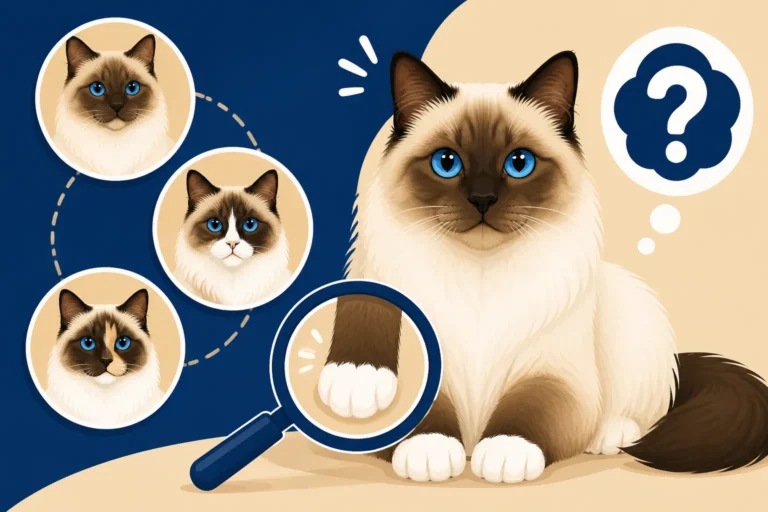
The "gloves" on a Birman are the pure white areas on their front paws, ideally symmetrical and ending in a straight line across the paw. On the back paws, the white extends further up the leg, forming "laces" or "gauntlets," which ideally should also be symmetrical and terminate in a neat, inverted V-shape on the back of the hock. These markings are not just a pretty aesthetic; they are a cornerstone of the Birman breed standard, often accounting for a significant portion of a show cat's judging points. Breeders dedicate generations to carefully selecting pairings in hopes of producing kittens with these exquisite, well-defined markings. It's a hallmark that truly sets the Birman apart, giving them that ethereal, almost mythical appearance.
Why Glove Genetics Are So Unpredictable
You might think that after all these years, breeders would have "cracked the code" for perfect gloves, especially since The Gloving Gene Every Birman Carries Two Copies Of. But here's the kicker: even though every Birman possesses the genetic predisposition for these white markings, the expression of those markings is incredibly variable. It's not a simple dominant or recessive trait where you can easily predict the outcome. Instead, it's influenced by what geneticists refer to as "modifier genes" – a whole orchestra of other genes that fine-tune how much white appears, where it stops, and how neatly it's defined. This is Why Glove Genetics Are Unpredictable in a Birman. A kitten can inherit the gloving gene from both parents, but how those genes manifest can be wildly different, even within the same litter. One kitten might have pristine, perfectly symmetrical gloves and laces, while another might have a tiny splash of white too high on one leg (a "runner") or uneven edges. It's truly a genetic lottery!
The Dream of a Simple Test
Given this unpredictability, it's completely understandable why so many people wish there was a simple genetic test for "perfect gloves." Imagine the relief for breeders, or the certainty for potential pet owners! You could swab a kitten, send it to a lab, and get a clear "perfect gloves" or "mismark" result long before the markings fully develop. This dream stems from the success of genetic tests for specific health conditions like Polycystic Kidney Disease (PKD1) or Feline Hypotrichosis (FOXN1), where a single gene mutation can be identified. However, the complexity of glove patterning means it's not a single switch; it's a dimmer switch controlled by many subtle inputs. The idea of such a test is appealing, but the reality of the science makes it a far more challenging proposition than, say, identifying a carrier for a specific disease.
The Science Behind the Birman's White Markings
To truly understand why a "glove test" doesn't exist, we need to delve a little deeper into the genetic mechanisms at play. It's not just about one gene, but a whole interplay of genetic instructions that dictate where pigment cells (melanocytes) travel during embryonic development.
The KIT Gloving Variant
At the heart of the Birman's white markings lies a specific variant of the KIT gene. This particular mutation, often referred to as the "gloving gene," is responsible for the overall presence of white on the Birman's paws. What's fascinating is that Whether Every Birman Carries Two Copies of the Gloving Gene. This means that every Birman, by definition, has the genetic blueprint for white feet. This is a fixed trait within the breed, distinguishing them from other colorpoint breeds like the Himalayan or Ragdoll, which typically do not have these white markings unless outcrossed. How the Gloving Gene Works in a Birman is primarily by affecting the migration of pigment cells, causing them to "miss" the extremities, resulting in the white areas.
Modifier Genes and Complex Inheritance
So, if every Birman has two copies of the gloving gene, why do their markings vary so widely? This is where the concept of "modifier genes" comes into play. Think of the KIT gloving variant as the main architect, laying down the general plan for white paws. But then, a team of interior designers (the modifier genes) comes in and decides the exact shape, size, and precision of those white areas. These modifier genes can influence:
- Symmetry: Whether the white on the front paws matches perfectly, or if one paw has a higher glove than the other.
- Definition: How crisp and clean the line is where the white meets the colorpoint.
- Extension: How far up the leg the white travels, particularly for the "laces" on the back.
- Bleeding: The presence of small, unwanted flecks of white within the colored points, or colored spots within the white.
Because so many different genes are involved, each contributing a small effect, the inheritance pattern becomes incredibly complex. It’s not as simple as tracking a single gene. There might be dozens of these modifiers, and their combined effect creates the vast spectrum of glove patterns we see in Birmans. This polygenic inheritance is notoriously difficult to predict and, consequently, to test for with a single, simple DNA marker. How the Gloving Gene Interacts With the Point Pattern is also part of this intricate dance, as the overall colorpoint pattern itself is dictated by another set of genes.
Why a Genetic Test for "Perfect" Gloves Isn't Possible (Yet)
Given the intricate dance of the KIT gloving variant and numerous modifier genes, developing a single, predictive "glove test" is currently beyond our scientific grasp. We can test for the presence of the main gloving gene, but that only tells us the cat will have white markings, not what kind of white markings. To create a test for "perfect" gloves, scientists would need to:
- Identify all the modifier genes involved.
- Understand how each modifier gene interacts with the others.
- Quantify the cumulative effect of these interactions.
This is an enormous challenge. While research into feline genetics is always advancing, pinpointing the precise genetic markers for something as nuanced as glove symmetry and length is incredibly complex. For now, the most reliable "test" for glove quality remains the seasoned eye of an experienced breeder.
Practical Approaches to Assessing Birman Gloves
Since a genetic "glove test" isn't a reality, breeders and prospective owners rely on observation and experience to predict and assess these crucial markings. It’s a skill refined over years, blending keen eyesight with an understanding of how kitten coats develop.
A Breeder's Expert Eye
This is where the real art and science of Birman breeding truly shine. Experienced breeders become incredibly adept at evaluating a kitten's gloves from a very young age. They're looking for early indicators, subtle hints that suggest how the white markings will develop. How a Breeder Judges a Birman Kitten's Gloves involves careful examination of symmetry, the cleanness of the lines, and the overall balance of the white on both front and back paws. They know what tiny flaws might grow into larger ones, and which promising beginnings might lead to show-quality markings. This isn't guesswork; it's an educated assessment based on years of observing litters and understanding their pedigrees. They'll also compare a kitten's development against the known patterns in its specific line.
When a Birman Kitten's Gloves Are Final
A Birman kitten is born almost entirely white, with its point colors and white gloves gradually developing over the first few weeks and months. This makes early assessment tricky. The gloves, though present, will continue to define themselves as the kitten grows. What a Birman Kitten's Gloves Change as It Grows is a gradual process. While breeders can get a good idea by eight to twelve weeks, the final judgment often isn't made until the kitten is a few months old, sometimes even older, as the coat fully matures. This waiting period is why breeders often hold back kittens with potential show markings for longer, allowing them ample time to confirm the quality before making commitments to show homes. They need to see those lines solidify, those laces reach their full potential.
The Impact on Price and Show Potential
The quality of a Birman's gloves has a direct and significant impact on its price and its potential for the show ring. A kitten with near-perfect, symmetrical gloves and laces that meet the breed standard precisely will command the highest price, often being reserved for show and breeding homes. These kittens are rare and highly sought after. How Much a Birman Good Enough to Show Costs reflects this rarity and the breeder's dedication. Conversely, a kitten with "mismarked" gloves – perhaps a glove that runs too high, a lace that is uneven, or a small spot of color within the white – will still be a beautiful, healthy Birman, but it will be sold as a "pet quality" cat. Why a Mismarked Birman Is a Pet Price Cat is purely about meeting the aesthetic standards for showing, not about health or temperament. These kittens make equally loving companions and are often available at a more accessible price point.
Life with a Mismarked Birman
It's easy to get caught up in the quest for "perfect" markings, especially when the breed standard emphasizes them so heavily. However, it's crucial to remember that a Birman's value as a companion has absolutely nothing to do with how symmetrical its gloves are.
Embracing Imperfection
A kitten with slightly uneven gloves or a minor marking fault is no less a Birman. It still possesses the gentle, affectionate temperament, the stunning blue eyes, and the silky single coat that are hallmarks of the breed. In fact, many owners find a certain charm in their cat's unique markings, considering them a distinctive feature rather than a flaw. These minor variations do not affect the cat's health, its personality, or its ability to bond deeply with its human family. If anything, embracing a "mismark" can be a wonderful way to welcome a purebred Birman into your home at a lower price point, without compromising on any of the essential qualities that make the breed so beloved. They might not win ribbons, but they'll win your heart just the same.
Health Over Aesthetics
When choosing a Birman kitten, your primary focus should always be on health and temperament, not just aesthetics. While perfect gloves are beautiful, they don't guarantee a healthy cat. A responsible breeder will prioritize genetic health testing for conditions like Hypertrophic Cardiomyopathy (HCM) and Polycystic Kidney Disease (PKD1), and will provide clear documentation of these tests for both parents. The cost savings from a pet-quality mismark can even be reallocated towards crucial things like pet insurance from providers like Healthy Paws, ensuring that your beloved Birman is covered for any unforeseen health issues throughout its life. It's about investing in their well-being, not just their looks. Many top breeders will still ensure their pet-quality kittens have had all their Which Tests Belong on a Birman Panel and that their lineage is clear of known genetic conditions.
The Joy of a "Pet Quality" Birman
A Birman kitten that doesn't quite meet the stringent show standards for its gloves will still bring immense joy to its family. These cats are known for their sweet, docile nature, their tendency to follow you from room to room just to be near you, and their quiet, melodious trills. Whether your Birman has a perfect V-shaped lace or a slight “runner” up its leg, it will still be a magnificent, loyal companion. You'll still want to spoil them with high-quality food and a variety of toys that keep them engaged. They'll still greet you at the door, settle into your lap for a gentle purr, and fill your home with their peaceful presence. The absence of a “glove test” and the unpredictability it highlights simply means that each Birman is truly unique, a little genetic surprise package that brings its own brand of beauty and love into the world.
| Feature | Ideal Birman Gloves (Show Quality) | Mismarked Birman Gloves (Pet Quality) |
|---|---|---|
| Front Paws (Gloves) | Pure white, symmetrical, ending in an even line across the paw. | Uneven length, one higher than the other, slight color intrusion. |
| Back Paws (Laces) | White extending up the leg, forming symmetrical inverted V-shapes. | Laces too high (gauntlets), uneven V-shapes, or no clear V. |
| Symmetry | High degree of symmetry between all four paws. | Noticeable asymmetry between front or back paws. |
| Definition | Crisp, clean lines where white meets point color. | Blurry edges, "bleeding" of white into color, or color into white. |
| Impact on Show | Essential for success in the show ring, higher breeding value. | Generally disqualifies from show, no impact on pet value. |
| Impact on Health | No direct correlation with health or temperament. | No direct correlation with health or temperament. |
| Availability | Rarer, often on longer waiting lists, higher price. | More readily available, often at a lower price. |
Disclaimer
This article is for general informational purposes only and does not constitute professional advice. Laws, prices and regulations vary by location and change over time. Consult a qualified professional for guidance on your specific situation.