Why a Mismarked Birman Is a Pet Price Cat
It can be so confusing when you start looking for a Birman kitten and see such a wide range of prices, often with terms like "pet price" or "mismarked" thrown around. You might worry that a mismarked cat is somehow less healthy or less worthy, but that couldn't be further from the truth. This guide is here to clear up exactly what these terms mean, why markings affect the price, and why a mismarked Birman is every bit as wonderful a companion as their show-quality siblings.
Understanding the Birman Standard and Ideal Markings
When we talk about a Birman, especially in the context of breeding and showing, there's a very specific "look" that judges are seeking. This isn't just about general beauty – it's a carefully defined set of physical characteristics outlined in breed standards by cat registries around the world. These standards exist to preserve the distinct traits of the Birman, from its coat texture to its stunning blue eyes and, of course, those iconic white "gloves" and "laces."
What Defines a "Show Quality" Birman
A show-quality Birman is essentially a cat that adheres very closely to the breed standard. This means a strong, sturdy body with a rectangular build, a broad, rounded head with a Roman nose, and perfectly set ears. Their eyes should be a deep, brilliant blue, and their coat should be silky, medium-long, and free of any woolly undercoat, flowing smoothly with a beautiful ruff around the neck. Beyond these general characteristics, the most distinctive and highly judged features are the white markings on their paws. These specific patterns are what truly set a Birman apart and are the cornerstone of its legendary origin. A "show quality" cat is one that, on paper and in person, embodies these traits to a degree that makes it competitive in the show ring.
The Importance of the "Gloves" and "Laces"
The white markings on a Birman are not just cute little socks; they are referred to as "gloves" on the front paws and "laces" on the back paws, and they are incredibly specific. On the front paws, the white gloves should be perfectly symmetrical and end in a straight line, ideally just above the paw pad. Imagine dipping their little paws into white paint – that's the ideal line. For the rear paws, the white extends higher up the back of the leg, forming what are called "laces." These laces should taper to a point and ideally extend about two-thirds of the way up the hock, again, with perfect symmetry between the two back legs. These markings are not random; they are believed to be part of the breed's mystical origin story, where a sacred temple cat was blessed with white paws as a symbol of purity and divine connection. The legend claims that this specific pattern is a blessing, and breeders strive to honor that.
Why Symmetry is Key in Birman Markings
Symmetry isn't just a preference; it's a critical component of the Birman breed standard, particularly for the gloves and laces. Breeders spend years trying to achieve perfect balance, and it's notoriously difficult. Imagine two front paws where one white glove goes higher up the leg than the other, or where one lace on a back leg is dramatically shorter or shaped differently from its counterpart. These inconsistencies, even minor ones, are considered "mismarks" and are points deducted in a show judging. The ideal is a harmonious, balanced appearance that highlights the unique beauty of the Birman. This pursuit of symmetry is a testament to the dedication of Birman breeders, but also illustrates why perfectly marked cats are so rare and prized. You can learn more about this by reading Why Perfect Birman Gloves Are Almost Impossible to Breed.
What Constitutes a "Mismark" in a Birman
Now that we understand the ideal, let's talk about what makes a Birman "mismarked." It's not about being less beautiful or less healthy, but simply about not perfectly aligning with those very strict show standards. These variations are incredibly common because the genetics behind the white markings are complex and not fully predictable.
Variations in Front Gloves and Their Impact
The front gloves are often the first thing people notice, and variations here are very common. A mismark might involve one glove being significantly higher or lower than the other, creating an uneven line. Sometimes, the white might extend too far up the leg, almost forming a "boot," or conversely, be too minimal, barely covering the paw. You might also see "spots" of color within the white, or areas of white where there shouldn't be, sometimes referred to as "smudges" or "stray white." Each of these deviations, while making the cat unique and endearing, would be considered a fault in the show ring and lead to it being designated a "pet price" cat. For example, a cat with one glove ending neatly at the wrist and the other creeping halfway up the forearm would instantly be classified as mismarked.
Rear Leg "Laces" and "Gauntlets" Explained
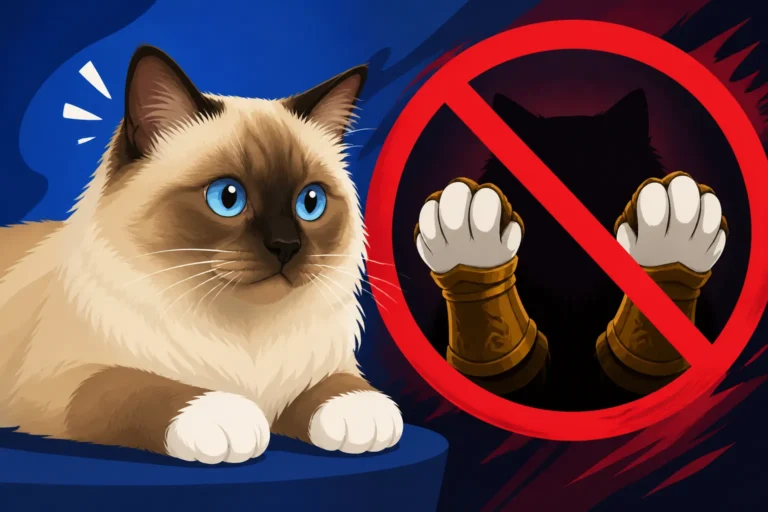
The rear markings, or "laces," have their own set of specific standards and common mismarks. The ideal lace should be a clean, inverted "V" or tapering point, extending roughly two-thirds of the way up the hock. However, many Birmans will have laces that are too short, too long, or uneven between the two legs. A significant mismark on the rear paws is called a "gauntlet," which means the white extends too far up the leg, often past the hock and sometimes even reaching the thigh. This is a considerable deviation from the standard and is a clear disqualifying fault in a show cat. A gauntlet doesn't hurt the cat in any way, nor does it affect its personality; it simply means it doesn't meet the aesthetic ideal for competition. If you're wondering What Laces and Gauntlets Mean on a Birman's Price Tag, this is a key distinction.
Other Common Markings That Deviate from the Standard
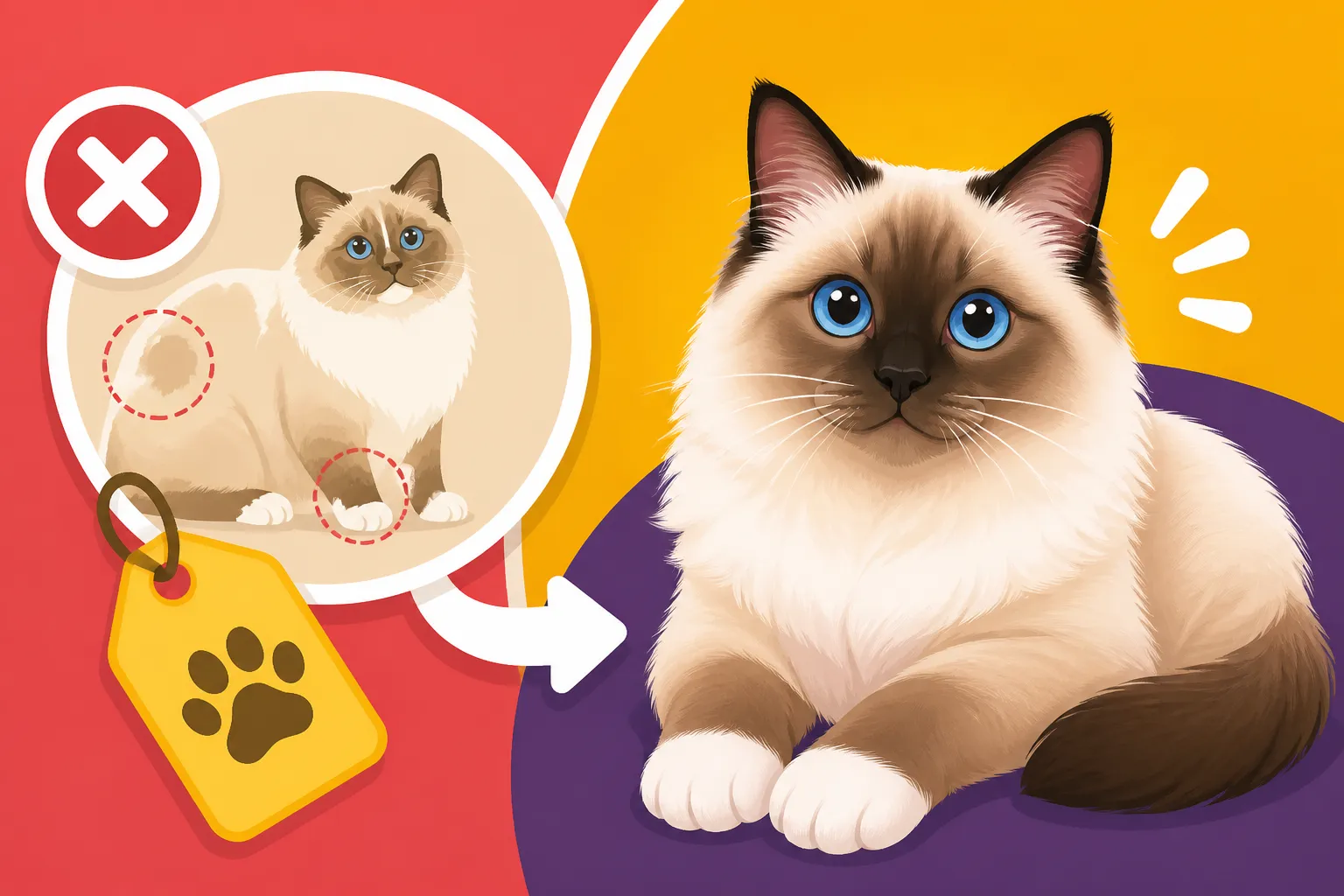
Beyond the gloves and laces, other white markings can classify a Birman as mismarked. Any patches of white on the body, especially on the chest or belly, are considered mismarks, as the Birman's body should be solid point color with no white apart from the paws. Sometimes, a tiny white spot on the nose or chin can also be seen, which would similarly be a fault. Even the shade of the point color (the darker areas on the face, ears, paws, and tail) can play a role. While not a "mismark" in the same way as white patches, a point color that isn't a recognized shade, or is a very unusual dilution, might also place a cat outside of show contention. The overall balance and clarity of these color points are important for the complete Birman aesthetic. For example, if a cat's seal points were mottled rather than solid, it would be a deviation from the ideal.
Here’s a simple table illustrating common marking deviations:
| Marking Feature | Show Standard Ideal | Common Mismarks | Impact on Show Status |
|---|---|---|---|
| Front Gloves | Pure white, symmetrical, ending in a straight line at wrist. | Uneven length, extending too high (boots) or too low, colored spots. | Fault |
| Rear Laces | Pure white, symmetrical, tapering point, 2/3 up hock. | Uneven length, too short or too long (gauntlets), colored spots. | Fault / Disqualification |
| Body White | None (body should be solid point color). | White spots on chest, belly, or flanks. | Disqualification |
| Nose/Chin White | None. | Small white spot on nose or chin. | Fault |
| Point Color Clarity | Clear, distinct, well-defined points (e.g., Seal, Blue). | Muddled, inconsistent, or non-standard point coloration. | Fault |
The Genetics Behind Birman Markings and Variability
It's easy to look at a mismarked Birman and think, "What went wrong?" But the truth is, the genetics that create those stunning, unique markings are incredibly intricate. It's not a simple case of 'on' or 'off'; there's a delicate dance of genes happening beneath the surface, which is why even the most experienced breeders get surprises in a litter.
The Complexities of the Gloving Gene
The white gloves and laces on a Birman are controlled by a specific gene variant, often referred to as the "gloving gene." What makes it fascinating is that every Birman carries two copies of this gene, and it's fixed within the breed. This means that unlike some other breeds where white spotting can be random or caused by different genes, the Birman's gloves are a fundamental part of its genetic makeup. However, the exact expression of this gene – how high the white goes, how straight the line is, how symmetrical it appears – is influenced by a whole host of other genetic factors, environmental conditions, and even developmental stages within the womb. It's not as simple as one gene dictating one perfect outcome. This is why even within the same litter, you can see a range of marking qualities, from near-perfect to distinctly mismarked. If you want to dive deeper, you can explore The Gloving Gene Every Birman Carries Two Copies Of.
Why Predicting Markings is So Difficult
Given the complexity, breeders can't simply pick two perfectly marked parents and expect a litter of identically perfect kittens. While selective breeding over generations certainly improves the chances of getting good markings, there's always an element of unpredictability. Think of it like predicting weather patterns; you can use historical data and current conditions to make an educated guess, but there are always unexpected variables. The interaction between the main gloving gene and various modifier genes means that even with extensive pedigree knowledge and careful pairing, a breeder can still end up with kittens that have uneven gloves, stray white spots, or gauntlets. It's a constant challenge and a true art to try and work towards the ideal, but nature often has its own plans! This is a core reason why Why Glove Genetics Are Unpredictable in a Birman is such a common topic.
The Role of Modifier Genes
So, if the main gloving gene is fixed, what causes all the variation? Enter modifier genes. These are other genes in the cat's DNA that don't directly cause the white markings, but they influence how those markings are expressed. They can tweak the amount of white, the sharpness of the edges, and the symmetry. Imagine you have a basic blueprint for a house (the gloving gene), but then a team of designers (modifier genes) comes in and decides to extend one wall here, shorten another there, and add a window where it wasn't originally planned. These modifier genes are not as well understood or as easily testable as the primary gloving gene, making them even harder for breeders to control. It's a fascinating area of feline genetics, and it highlights why every Birman, even those from champion lines, carries the potential for unique, less-than-perfect, but equally charming markings.
Why Mismarked Birmans Are "Pet Price" Cats
The term "pet price cat" can sometimes sound a bit dismissive, as if these cats are somehow inferior. But in the world of purebred cats, it simply refers to a kitten that is destined for a life as a beloved companion rather than a show champion or a breeding animal. For Birmans, this designation almost always comes down to their markings, not their health or temperament.
Breeder's Investment and Ethical Pricing
Reputable Birman breeders pour an immense amount of time, effort, and financial resources into their breeding programs. This includes expensive health testing for genetic conditions like FOXN1 Is the Birman's Own Genetic Disease and HCM in a Birman Has No DNA Test, Only an Echo, quality nutrition, veterinary care, show entries, and meticulous record-keeping. They also invest in the well-being and socialization of every kitten. The price of a show-quality Birman reflects this significant investment, as it represents years of careful selective breeding aimed at producing kittens that closely meet the breed standard for exhibition.
A "pet price" still covers these fundamental costs and the breeder's dedication. However, because a mismarked kitten won't compete in shows or contribute to improving the breed's conformation (though they might be excellent in other aspects like temperament), their price is typically lower. It's a way for breeders to acknowledge that while the cat is still a high-quality, healthy Birman, it doesn't quite hit the aesthetic benchmarks for show or breeding purposes. It doesn't mean less love, less care, or less Birman spirit for your future companion.
Focus on Health and Temperament over Show Quality
Crucially, "pet price" never means "less healthy" or "poor temperament." A good breeder prioritizes health and temperament above all else. A mismarked Birman will have undergone the same rigorous health checks as its show-quality siblings. They come from parents screened for hereditary diseases, are raised in the same loving home environment, and receive the same early socialization that makes Birmans such wonderful, placid companions.
In fact, many breeders will emphasize that a pet-quality Birman is often the ideal choice for families who simply want a loving companion and have no interest in the competitive show circuit. You get all the wonderful traits of the Birman breed – the gentle nature, the affectionate personality, the stunning blue eyes, and that silky coat – without the premium associated with perfect markings. It’s important to understand that Why a Cheap Birman Is Usually Untested is a red flag, not an indicator of a pet price cat. A reputable breeder will always provide health clearances regardless of marking quality.
The Value a Pet-Quality Birman Brings to a Home
A mismarked Birman offers immeasurable value as a companion. Their slightly imperfect markings often give them a unique charm, making them even more special to their owners. They are still the same sweet, gentle, and intelligent cats renowned for their calm demeanor and devotion to their families. Whether their gloves are perfectly symmetrical or not, they will still follow you from room to room, offer soft trills of affection, and curl up beside you on the sofa.
The joy and companionship a Birman brings are not tied to the precise line of white on their paws. For families looking for a loyal, low-key, and loving cat, a pet-price Birman is often the perfect choice, allowing them to welcome a purebred Birman into their home without the top-tier cost of a show contender. It’s a chance to celebrate the individuality of a beautiful cat that will enrich your life for years to come. These cats embody the very essence of Why a Birman Follows You Without Demanding Anything.
Finding and Choosing a Mismarked Birman Kitten
When you've decided to welcome a Birman into your home, especially a pet-price cat, the process of finding the right kitten is exciting. It's about ensuring you're getting a healthy, well-socialized companion from an ethical breeder, regardless of their markings.
What to Ask a Breeder About Markings
Don't be shy about asking a breeder specific questions regarding their kittens' markings. A transparent breeder will be happy to discuss the unique qualities of each kitten, explaining why certain ones are priced as "pet quality." Ask for photos of all four paws – ideally from different angles – and inquire about any specific variations, like uneven gloves, gauntlets, or stray white spots. A good breeder will clearly articulate the differences and help you understand how they compare to the breed standard. They might even have a kitten whose markings you find particularly charming because of their individuality.
It’s also an excellent opportunity to discuss how they assess markings and when they make the final determination, as a Birman kitten's gloves can change slightly as they grow. Knowing How a Birman Kitten's Gloves Change as It Grows can help you set realistic expectations. This open conversation builds trust and ensures you know exactly what you're getting, without any surprises.
Understanding the Neuter Contract for Pet-Quality Cats
Almost without exception, a mismarked Birman sold at "pet price" will come with a spay/neuter contract. This is a standard practice among responsible breeders and serves several important purposes. Firstly, it protects the integrity of the breed standard by ensuring that cats not meeting conformation ideals are not used for breeding. This helps maintain the quality and health of the Birman gene pool. Secondly, it prevents backyard breeding, where individuals might breed cats without proper health testing, knowledge of genetics, or commitment to the breed's well-being.
The contract will typically require you to have your kitten spayed or neutered by a certain age, often between 4 to 6 months. Some breeders might even perform early spay/neuter before the kitten goes home. Upon proof of spay/neuter, the breeder may then release the cat's full registration papers. This contract is a sign of a responsible breeder who cares deeply about their cats and the future of the breed.
Embracing Imperfection: The Joy of a Unique Birman
Choosing a mismarked Birman is truly about embracing the idea that perfection is in the eye of the beholder. Your cat's slightly asymmetrical gloves or charming gauntlets become part of their individual story and what makes them uniquely yours. Instead of focusing on what might be considered a "fault" in the show ring, you get to celebrate the special characteristics that set your Birman apart.
Many owners of pet-quality Birmans will tell you that they wouldn't trade their cat's "imperfections" for anything. These cats bring just as much love, companionship, and joy into a home as a grand champion. They are a testament to the fact that true beauty lies not in strict adherence to a standard, but in the personality, affection, and bond shared with your feline friend. It's about finding the cat that melts your heart, regardless of what a judge might say about its paws.
Living with and Loving Your Mismarked Birman
Once you bring your mismarked Birman home, you'll quickly realize that their markings truly are just a visual detail. Their health, personality, and the bond you share will be what truly defines your relationship. Caring for a mismarked Birman is no different from caring for any other Birman – it's all about providing a loving environment, good nutrition, and consistent care.
Health and Temperament Remain Paramount
The most important thing to remember is that a mismarked Birman is a healthy Birman, with all the same potential for a long and happy life as its perfectly marked siblings. As mentioned, responsible breeders will conduct all the necessary health screenings for the parents, regardless of whether the kittens are destined for show or pet homes. This includes genetic tests and cardiac screenings, ensuring you're bringing home a cat with the best possible start. If you're concerned about health, be sure to ask your breeder about Which Tests Belong on a Birman Panel.
Their temperament, too, will be the classic Birman: gentle, affectionate, quiet, and devoted. These cats thrive on companionship and will quickly integrate into your family, forming strong bonds with every member. Any variations in markings have absolutely no bearing on their sweet disposition or their overall well-being. This is why many owners swear by Birmans for families with children, as Why a Birman Suits a Household With Children perfectly describes their patient nature.
Grooming and Care for All Birman Coats
A Birman's coat is one of its most stunning features, and it requires consistent care, regardless of the cat's markings. Their silky, medium-long hair, which lacks a woolly undercoat, means they mat far less than many other longhaired breeds. However, regular combing is still essential to keep their coat in pristine condition, prevent tangles, and reduce shedding. Aim for two to three times a week with a good quality comb. You can find excellent grooming tools at places like Chewy, which can help keep their coat smooth and free of mats.
Special attention might be needed for their white gloves, as these can sometimes become discolored if not kept clean. Consider using a low-dust litter to prevent staining on their pristine white paws. The aging process will also affect their point coloration, making them darker, as Why a Birman's Points Darken as It Ages explains, but this is a natural part of their development, not a sign of poor health.
The Undeniable Charm of a Birman, Mismark or Not
Ultimately, the true charm of a Birman lies in its heart, not just its outward appearance. These cats are known for their calm, loving personalities, their intelligence, and their unique way of communicating with soft trills and purrs rather than loud meows. A mismarked Birman brings all of these wonderful qualities into your life. They will be your constant shadow, a comforting presence, and a source of endless joy and quiet affection.
Whether your Birman has a perfect set of gloves or a charming, unique mismark, you are welcoming a truly special companion into your home. Their beauty transcends breed standards, residing in the depth of their blue eyes and the gentle spirit they share so freely. Providing them with a healthy diet and considering pet insurance for peace of mind means you are investing in a long and happy life with your cherished feline friend. The journey with a Birman, regardless of its show-ring status, is one of deep connection and unconditional love.
Disclaimer
This article is for general informational purposes only and does not constitute professional advice. Laws, prices and regulations vary by location and change over time. Consult a qualified professional for guidance on your specific situation.