Why a Birman With Gauntlets Cannot Be Shown
It can be incredibly frustrating for hopeful Birman owners and breeders alike to encounter the specific, sometimes confusing, nuances of show standards, especially when it comes to the breed's distinctive white "gloves" and "laces." Among these, the term "gauntlets" often pops up, denoting a marking that, while unique, disqualifies a Birman from the competitive show ring. This guide will delve into what gauntlets are, why they're not permissible in show cats, and how this detail shapes a Birman's path from kittenhood to a cherished family member.
Understanding Birman Show Standards and the Role of Gloves
The Birman cat is renowned for its striking point coloration combined with its unique white feet, often referred to as "gloves" and "laces." These markings aren't just pretty; they are a cornerstone of the breed standard, meticulously defined and judged in the show ring. For breeders, achieving these perfect markings is a challenging art, and for potential owners, understanding them helps appreciate the subtle differences in a Birman's appearance and price.
The Ideal Birman Glove and Why It Matters
Imagine a Birman's front paws: they should be tipped with pure white, forming a perfectly even "glove" that ends abruptly at or just above the bend of the paw. It's a clean, crisp line, almost as if the cat dipped its paws into a pot of white paint. On the hind legs, the white extends a little further up the hock, ending in a point or an inverted V-shape, which is known as a "lace." The symmetry between all four paws, and the precise length of these markings, is what judges meticulously look for.
This specific pattern is part of the Birman's mystique, rooted in its legendary origins. The story often shared describes a temple cat, Sinh, whose paws remained white after his devotion to a goddess. For a breeder, these markings are not just aesthetic; they are a hallmark of careful breeding and adherence to the established ideal. When evaluating kittens, breeders spend considerable time observing how these white markings develop. You can learn more about the specifics of these front paw markings by reading about What a Birman's Front Gloves Should Look Like.
What Constitutes a Mismarking in Birman Paws
Unfortunately, not every Birman kitten is born with perfect gloves and laces. There’s a wide spectrum of variations, many of which are considered "mismarkings." These can include "runners," where a streak of white extends too far up a leg, or gloves that are uneven, with one paw having a higher white line than another. Sometimes, the white may not be crisp, bleeding into the colored points, or it might be too sparse.
While these variations do not affect a cat's health or wonderful temperament one bit, they do impact its eligibility for the show ring and, consequently, its price. A kitten with even slight mismarkings will typically be sold as a pet-quality cat, often with a neuter contract to ensure it isn't used for breeding purposes that might perpetuate the non-standard markings. Understanding these distinctions is key to knowing what you're looking at when you consider a kitten. If you're curious about the different types of variations, you might find more helpful information on What Counts as a Mismarked Birman.
Deciphering "Gauntlets" in Birman Markings
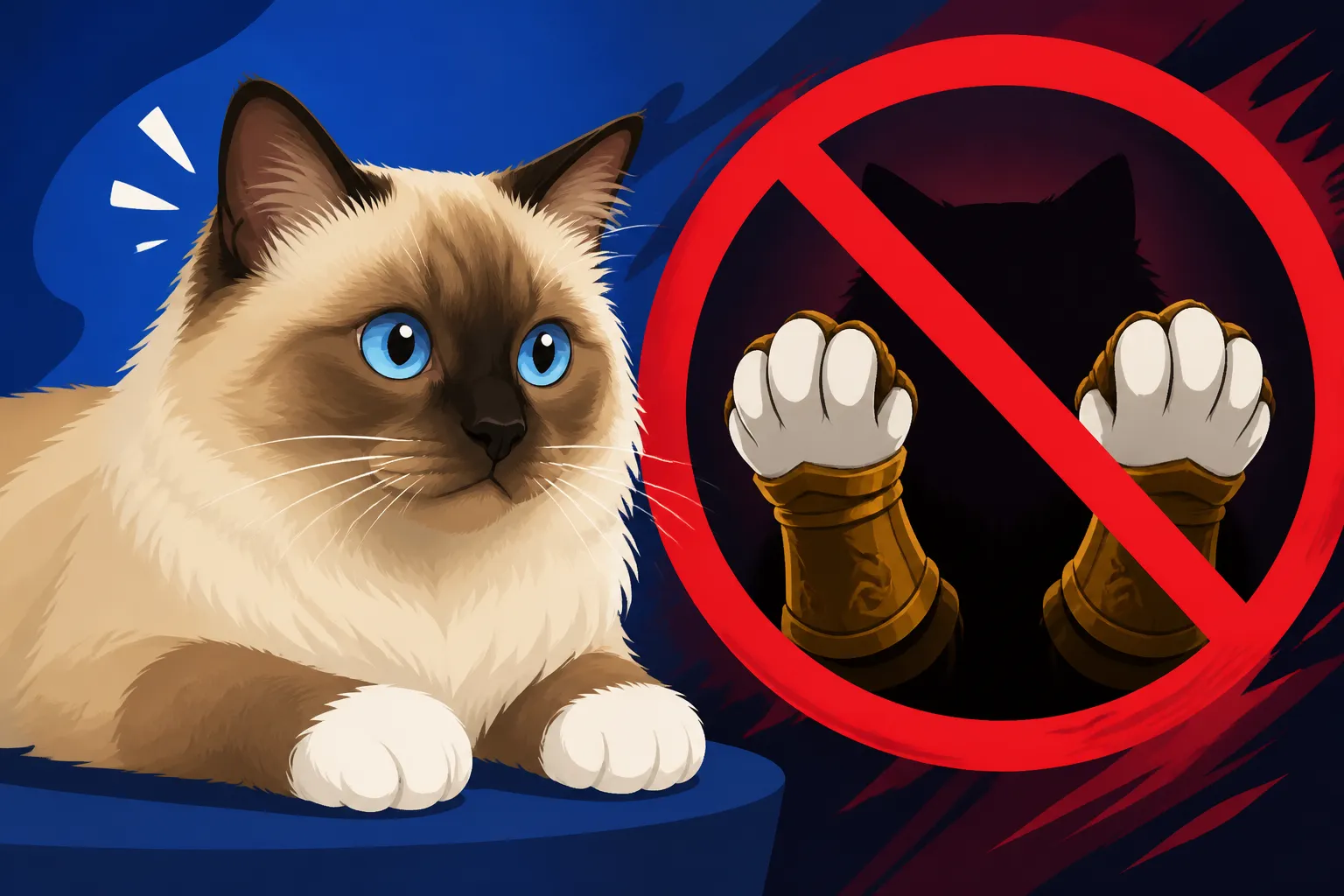
Among the various mismarkings, "gauntlets" hold a particular significance because they represent a significant departure from the ideal Birman standard. It's a term that often causes confusion, but once you understand it, you'll instantly recognize why it's a disqualifying fault in the show ring.
Defining Gauntlets: More Than Just Long White Markings
A "gauntlet" in the Birman world refers to the white marking on the hind paws extending too high up the leg, reaching beyond the hock or appearing as a long, sock-like white patch that goes up towards the thigh. Remember the "lace" we talked about? The ideal lace should be an inverted V-shape on the back of the hind leg, stopping well below the hock, creating a distinct boundary between the white and the colored point.
A gauntlet, on the other hand, lacks this precise, contained definition. It's a broad swathe of white that climbs too far up the leg, erasing the elegant "lace" and disrupting the delicate balance of white and color that defines a show-quality Birman. It gives the impression of the cat wearing long white socks rather than delicate white gloves. The precise endpoint of the desired lace is crucial, and you can visualize it better by reading about Where a Birman's Back Lace Should End.
Why Gauntlets Are a Disqualifying Fault in the Show Ring
The reason gauntlets are a disqualifying fault is straightforward: they contradict the very essence of the Birman breed standard. Every breed standard is a blueprint, a description of the ideal specimen, and for the Birman, the perfectly gloved and laced paws are fundamental. A gauntlet signifies a genetic deviation from this ideal, indicating that the genes controlling white spotting have extended their reach too far.
In the highly competitive world of cat shows, judges are looking for cats that conform as closely as possible to this ideal. A disqualifying fault means the cat cannot be awarded points or titles, regardless of how beautiful or well-tempered it might be otherwise. This strict adherence to the standard is how breed integrity is maintained over generations. It ensures that breeders continue to select for traits that define the Birman, making it distinct from other breeds with white markings. It’s not about the cat being any less beautiful or loving; it’s simply about meeting a very specific, historically established set of physical criteria for showing.
The Breeder's Perspective: Genetics, Expectations, and Outcomes
For a Birman breeder, the journey from mating to a litter of perfectly marked kittens is often filled with hope, anticipation, and sometimes, a little bit of heartbreak. The genetics behind those stunning white gloves and laces are far more complex and unpredictable than many might imagine.
The Unpredictability of Birman Gloving Genetics
Even the most experienced Birman breeders, working with lines known for excellent markings, cannot guarantee that every kitten in a litter will meet the strict show standard. The "gloving gene" itself is present in every Birman, but its expression is influenced by a host of other "modifier genes." These modifiers can dictate the exact length, symmetry, and crispness of the white markings. It's not a simple dominant or recessive trait with a clear-cut outcome. Instead, it's a delicate interplay of multiple genetic factors, which is why you can have kittens in the same litter exhibiting a wide range of glove quality, from show-perfect to those with gauntlets or other mismarkings.
This genetic lottery means that while breeders aim for perfection, they always understand that nature has its own plans. They meticulously track pedigrees and the markings of offspring over generations, hoping to identify patterns and refine their breeding programs. Despite all the effort, the outcome of any given litter can still hold surprises. The complexities of this genetic interaction are fascinating, and you can delve deeper into them by exploring Why Glove Genetics Are Unpredictable in a Birman.
When a Birman Kitten's Gloves Are Judged and Finalized
When Birman kittens are born, they are almost entirely white, and their points (ears, mask, tail, legs) begin to darken as they grow. Similarly, their white gloves and laces also develop and become clearer over several weeks. A breeder doesn't just glance at a newborn kitten and declare its markings. It's a process of observation.
Typically, breeders will get a good sense of the glove quality by the time the kittens are around 8 to 12 weeks old. At this age, the markings are usually quite defined, and while slight refinements might occur as the cat fully matures, the fundamental pattern – including whether a kitten has gauntlets – is generally evident. This is often the point when a breeder makes decisions about which kittens are "show quality," "breeder quality," or "pet quality," and it's also around the time potential owners might start making deposits or choosing their kitten. The definitive moment for assessing these critical markings usually occurs once the kitten is a bit older, as detailed in When a Birman Kitten's Gloves Are Final.
Life for a Birman with Gauntlets: Pet Home vs. Show Ring
So, a Birman kitten has beautiful gauntlets. Does this mean it’s any less of a wonderful companion? Absolutely not! The distinction between a "show cat" and a "pet cat" is purely about meeting arbitrary aesthetic standards for competition, not about inherent value or personality.
The Beauty and Value of a Birman Pet with Gauntlets
A Birman with gauntlets possesses the same gentle, affectionate, and intelligent personality that makes the breed so beloved. They are still stunning cats with their striking blue eyes, silky coats, and beautiful point coloration. Their long white "socks" might not be to show standard, but to a loving owner, they add to the cat's unique charm. These cats are perfectly healthy, have the same playful spirit, and will form just as strong a bond with their human families.
The primary difference lies in their purpose: a Birman with gauntlets will be sold as a "pet-only" cat. This often means they come at a lower price point than a show-quality kitten. For many families, this is an ideal situation—they get all the wonderful qualities of the Birman breed without the premium price tag associated with perfect show markings. It's a fantastic way to welcome a Birman into your home. You can learn more about the pricing of pet-quality Birmans by looking at Why a Mismarked Birman Is a Pet Price Cat.
Navigating a "Neuter Contract" for Pet-Quality Birmans
When you purchase a pet-quality Birman, especially one with a significant mismarking like gauntlets, it will almost certainly come with a "neuter contract." This legally binding agreement stipulates that you, as the new owner, must have the kitten spayed or neutered by a certain age, typically around six to nine months old. The breeder will often require proof from your veterinarian that the procedure has been completed.
Why do breeders do this? It's not to be controlling, but rather to protect the breed standard and their carefully developed lines. By ensuring that cats with disqualifying faults are not bred, they prevent these traits from being passed on and potentially diluting the desired characteristics of the Birman breed. This helps maintain the health, temperament, and appearance standards that make the Birman so special. It's a responsible practice within ethical breeding, ensuring the integrity of the breed for future generations. When stocking up on essentials for your new arrival, remember that online retailers like Chewy offer a wide range of quality cat food, litter, and toys, making it easy to prepare for your kitten's arrival and its future care. More details on these contracts can be found in Why a Mismarked Birman Is Sold on a Neuter Contract.
Beyond Markings: Prioritizing Health and Temperament
While markings are a huge part of the Birman show world, for every pet owner, health and temperament are, quite rightly, the absolute top priorities. A stunning cat isn't much fun if it's constantly sick or has an unmanageable personality.
Genetic Health Testing: A Non-Negotiable for All Birmans
Reputable Birman breeders understand that genetic health is paramount. They invest significant time and resources into health screening their breeding cats for known genetic conditions prevalent in the breed. These include:
- FOXN1 (Hypotrichosis): A condition that causes hairlessness and a compromised immune system in kittens, often leading to a very short lifespan. Carriers show no symptoms, but can pass it on.
- PKD1 (Polycystic Kidney Disease): A progressive kidney disease characterized by cysts on the kidneys.
- HCM (Hypertrophic Cardiomyopathy): A heart condition that causes the heart muscle to thicken, potentially leading to heart failure.
A breeder should always be transparent about these test results for both parents of a kitten. They should provide documentation from veterinary cardiologists for heart scans (echocardiograms) and genetic testing labs for DNA tests. Even if you're not planning to show your Birman, asking for proof of these health clearances is vital. It’s an investment in your cat’s long-term well-being and helps ensure you bring home a healthy companion. Thinking about future veterinary costs is a smart move, and pet insurance providers like Healthy Paws can help cover unexpected medical expenses, giving you peace of mind. A comprehensive overview of necessary tests can be found in Which Tests Belong on a Birman Panel.
The Birman's Beloved Temperament: Unaffected by Markings
One of the most defining and cherished characteristics of the Birman breed is its temperament. These cats are known for being exceptionally gentle, placid, affectionate, and tolerant. They are often described as "dog-like" in their devotion, often following their owners from room to room, but without being overly demanding. They are typically quiet, with a soft, trilling voice rather than a loud meow.
This wonderful temperament is consistent across the breed, regardless of whether a cat has perfect gloves or distinctive gauntlets. A Birman's loving nature, its patience with children, and its ability to get along with other pets are genetic traits far more significant than the length of its white socks. When you choose a Birman, you're choosing a companion that will bring calm and affection into your home for many years. It's this reliable, sweet disposition that makes them such a popular choice for families. High-quality nutrition can also play a role in supporting overall health and vitality, contributing to a happy, well-adjusted cat. For a deep dive into why this breed is so family-friendly, check out Why a Birman Is the Cat Families Are Told to Get.
Here's a comparison to help clarify the visual differences:
| Feature | Ideal Birman Glove and Lace | Birman Gauntlet | Impact on Show |
|---|---|---|---|
| Front Paws | Pure white, evenly tipped, ending crisply at or above paw bend. | White extends too high, unevenly, or up the leg beyond the paw bend. | Minor faults may be penalized; severe faults disqualify. |
| Hind Paws | White "lace" forming an inverted V-shape on the back, stopping well below the hock. | White extends significantly high, often sock-like, going over the hock or towards the thigh. | Considered a disqualifying fault. |
| Symmetry | All four paws should have matching, symmetrical white markings. | Often leads to uneven appearance between paws. | Lack of symmetry is a fault. |
| Breed Standard | Meets the specific aesthetic requirements for show competition. | Deviates significantly from the established aesthetic requirements. | Disqualified from show competition. |
| Pet Quality | Can still be sold as a pet, often at a higher price. | Typically sold as a pet-only cat, often at a lower price. | None – still a wonderful companion! |
At the end of the day, whether a Birman has perfect gloves, delicate laces, or even charming gauntlets, its true value lies in the joy, companionship, and unconditional love it brings to its human family. The show ring has its strict rules, but in the warmth of a loving home, every Birman is a champion.
Disclaimer
This article is for general informational purposes only and does not constitute professional advice. Laws, prices and regulations vary by location and change over time. Consult a qualified professional for guidance on your specific situation.