Who Shipped the First Birmans to France
The Birman cat's origin story is often shrouded in a beautiful, mystical legend of ancient Burma, making it easy to forget that the breed we know today has a very real, albeit somewhat hazy, historical journey to the Western world. Many enthusiasts wonder how these gorgeous cats, with their distinctive white paws and striking blue eyes, actually made their way from the temples of the East to the catteries and homes of Europe. This guide delves into the fascinating, sometimes ambiguous, history of how the first Birmans are said to have been shipped to France, unraveling the tales and known facts behind their initial arrival and establishment.
The Mystical Legend Versus Historical Ambiguity
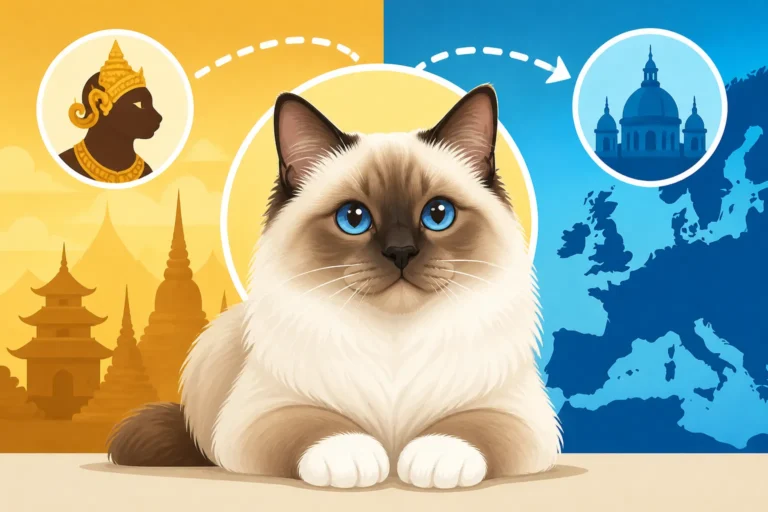
Before we dive into the records (or lack thereof), it's important to acknowledge the rich tapestry of legend that surrounds the Birman. For many, the breed's story begins not with a shipping crate, but with the sacred cat Sinh and the goddess Tsun-Kyan-Kse at the Temple of Lao-Tsun. This romantic narrative paints a vivid picture of how the Birman acquired its striking coat pattern, especially those unique white "gloves" and "laces." It's a tale that speaks to the heart of what makes the Birman so special, imbuing it with an almost divine aura.
The Sacred Cat of Burma Legend
The legend recounts how a priest named Mun-Ha, devoted to the golden goddess Tsun-Kyan-Kse, was murdered by invaders in the temple. His beloved white cat, Sinh, leapt onto his master’s body, and as the priest’s soul ascended, Sinh’s coat transformed. His eyes became sapphire blue, his fur turned golden, and his paws, touching his master, remained pure white, symbolizing purity. This beautiful story is often shared by breeders and owners alike, offering a profound sense of history and spirituality to the breed. It explains, in a mythical sense, why the Birman looks the way it does, linking its physical appearance to a sacred past. While captivating, it doesn't offer any clues about sea voyages or French ports. This legend is a cornerstone of the breed's identity, influencing how we perceive these cats even today, connecting them to an ancient, exotic past that predates any modern historical record. The Birman Is the Sacred Cat of Burma, and the Story Is a Legend provides even more detail on this cherished tale.
Unearthing the Gaps in Early Records
The jump from spiritual legend to verifiable historical fact for the Birman is a bit of a bumpy ride, to say the least. Unlike many modern breeds with meticulously documented pedigrees and precise foundation dates, the Birman's early arrival in the West is characterized by tantalizing fragments and conflicting accounts. There's no single, perfectly clear record detailing who exactly packed the first pair of Birmans onto a boat and where that boat exactly landed. Part of this ambiguity stems from the tumultuous political landscape of early 20th-century Southeast Asia, which made organized record-keeping difficult, and part from the romanticized nature of importing exotic animals at the time.
Many early cat breeders and enthusiasts were driven by passion, not always by rigorous documentation for posterity. Stories were passed down orally, embellished, and sometimes contradictory, making it a challenge to pin down absolute truths. We're often left piecing together narratives from old articles, breeder recollections, and fragmented paperwork, trying to sift through the romanticized versions to find the kernels of historical fact.
The Fabled Journey to France: Auguste Pavie and Major Gordon Russell
Despite the legends and the lack of perfect documentation, a narrative has largely been accepted regarding the Birman's arrival in Europe. It points to France as the primary destination and the early 20th century as the timeframe. Two names frequently emerge in these stories: Auguste Pavie and Major Gordon Russell, both credited with playing pivotal roles in bringing these sacred cats westward.
Auguste Pavie's Role in Birman Importation
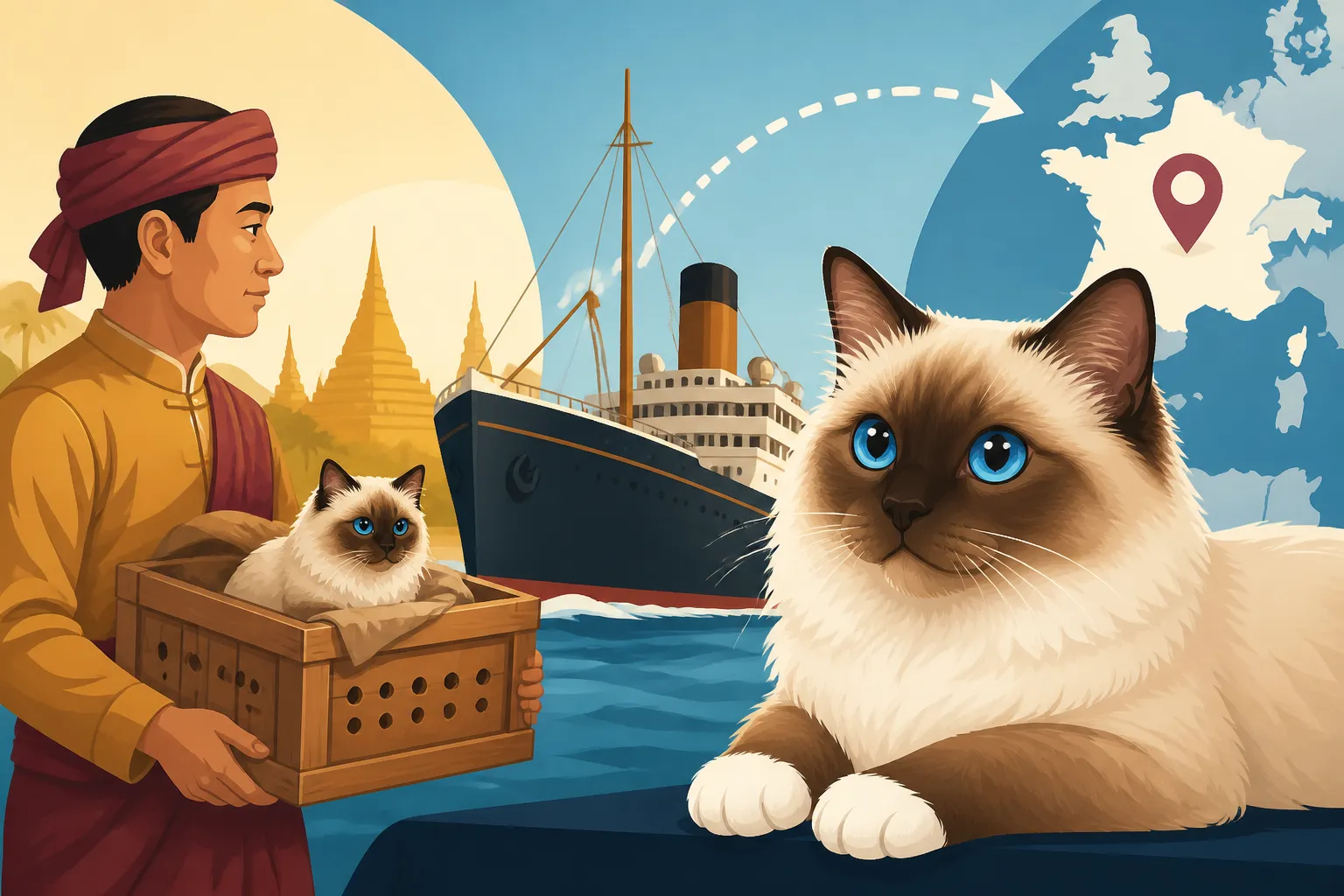
One of the most persistent and widely circulated stories attributes the initial importation of Birmans to France to a gentleman named Auguste Pavie. Pavie was a French diplomat and explorer who served in Indochina during the late 19th and early 20th centuries. His expeditions took him deep into Laos and Cambodia, and by extension, he would have had significant contact with the region that was historically referred to as Burma (now Myanmar). The tale suggests that Pavie was either gifted or managed to acquire a pair of Birmans from a temple in Burma, acknowledging their sacred status.
The popular account states that these cats, a male and a female, were shipped from Southeast Asia to France around 1919. Sadly, the male cat reportedly did not survive the long and arduous sea journey. However, the female, named Sita, arrived safely in France. Crucially, Sita was said to be pregnant and subsequently gave birth to a litter of kittens, ensuring the continuation of the Birman line on European soil. This single, resilient queen became a foundational figure for the entire breed outside of its native land. Her survival and subsequent breeding were absolutely critical, laying the groundwork for all future Birman cats in the West. How a Pair of Birmans Left Burma in 1919 explores this fascinating initial journey in greater detail.
Major Gordon Russell's Contribution
While Auguste Pavie is often cited for the very first pair, another name that frequently comes up is Major Gordon Russell. His involvement often intertwines with Pavie's, or is sometimes presented as a separate, albeit parallel, importation. Major Russell was an English officer stationed in Burma, and like Pavie, he reportedly became enchanted by these temple cats. It's believed that he, too, managed to acquire Birmans and contributed to their presence in the West, though the specifics of his shipment and timeline can be even murkier than Pavie's.
Some accounts suggest that Russell may have been the actual source for the cats Pavie acquired, or that he facilitated a later importation to other European countries like England. Regardless of the exact sequence, the combined efforts of individuals like Pavie and Russell highlight the profound admiration these cats inspired in early Western visitors to Burma. These were not just random street cats; they were sought after, often requiring significant effort and connections to acquire and transport across vast distances. The dedication of these early pioneers was immense, especially given the lack of infrastructure for transporting live animals and the absence of readily available exotic pet supplies, unlike the convenient range of products we can now find on platforms like Chewy.
The Early French Breeding Efforts and Challenges
The arrival of Sita and her kittens marked the true beginning of the Birman breed's establishment in France. However, this was far from an easy process. The early breeders faced immense challenges, from a severely limited gene pool to the complexities of establishing a new, distinct breed standard.
Poupee de Madalpour and the Genetic Bottleneck
Following Sita's arrival and her crucial litter, one name stands out as absolutely central to the Birman's survival and development in France: Poupee de Madalpour. Poupee was one of Sita's kittens, a female who became the matriarch of the French Birman line. Without her, the breed's foothold in Europe might have been incredibly tenuous. It’s hard to imagine what the breed would be like today if Poupee hadn't thrived and reproduced. Who Owned Poupee de Madalpour sheds more light on this pivotal feline.
However, relying on a single breeding female and her progeny meant that the early Birman population in France suffered from an extreme genetic bottleneck. This initial gene pool was incredibly narrow, making the breed susceptible to genetic issues and limiting its diversity. Breeders had to work carefully and strategically to expand the population while maintaining the unique characteristics that defined the Birman. This delicate balance of preservation and expansion was a monumental task, requiring careful selection and, later, strategic outcrossing. What Poupee de Madalpour Passed to Every Birman emphasizes her genetic legacy.
Registering the "Sacre de Birmanie"
The French cat fancy was the first to officially recognize the breed, registering it as the "Sacré de Birmanie" (Sacred Birman) in 1925. This was a critical step, elevating the Birman from an exotic curiosity to a recognized pedigree breed. Registration meant that the breed now had official standards to adhere to, which guided future breeding programs. It provided a framework for consistent traits, ensuring that kittens born from different lines would still conform to the Birman ideal.
However, the early standard was somewhat fluid, and breeders often had to interpret it with a limited understanding of Birman genetics, particularly concerning the distinct gloving pattern. The establishment of this early registry also validated the efforts of those who had worked tirelessly to bring these cats to France and establish them. It gave the breed a formal identity and a pathway to wider recognition, even though the challenges of expanding the gene pool and refining the breed characteristics were still very much ongoing. When France Registered the Sacre de Birmanie marks this significant historical milestone.
Rebuilding and Refining the Birman Breed
The initial establishment of the Birman in France was just the beginning. The breed faced further existential threats, most notably during World War II, which severely decimated the population. This led to further heroic efforts by dedicated breeders to save the "Sacred Cat of Burma."
The Post-War Bottleneck and Outcrossing
The Second World War dealt a devastating blow to many European cat breeds, and the Birman was no exception. By the end of the war, the breed's numbers had dwindled to alarmingly low levels, with some accounts suggesting only a single breeding pair, or perhaps just two cats, were left in France. This was an even more severe bottleneck than the initial importation. It was a terrifying prospect for those who loved the breed, fearing that all their hard work might have been in vain. The Birman Came Out of the War With Two Cats Left illustrates this dire situation.
To save the Birman from extinction, breeders had no choice but to undertake a carefully managed outcrossing program. This involved breeding the surviving Birmans with other long-haired cats, primarily Persians, and possibly some Siamese, to introduce new genetic material and bolster the population. This was a controversial but necessary step, as it risked diluting the unique Birman characteristics. However, it was the only way to ensure the breed's survival. The process was painstakingly slow, requiring multiple generations to breed back to a consistent Birman type, ensuring the re-establishment of the characteristic white gloves, pointed coloration, and gentle temperament. Which Two Cats Rebuilt the Birman highlights the individuals who spearheaded this monumental effort.
The Influence of Other Breeds
The strategic outcrossing meant that the Birman's genetic makeup was inevitably influenced by other breeds. The Persian, with its long, luxurious coat and placid demeanor, contributed significantly, while the Siamese likely reinforced the pointed coloration. These crosses were not simply random; they were carefully selected to complement the Birman's existing traits and to avoid introducing undesirable characteristics. It's a testament to the skill and dedication of those post-war breeders that they were able to restore the Birman's distinct appearance and temperament, rather than simply creating a hybrid.
This period of rebuilding cemented certain traits in the modern Birman, even as it diversified the gene pool. Understanding this history helps us appreciate the resilience of the breed and the foresight of those who worked to preserve it. The careful re-establishment of the breed post-war highlights why modern Birman breeders still prioritize genetic health and diversity, often utilizing resources from trusted suppliers like Chewy for specialized diets and supplements to support their cats' well-being.
The Birman's Journey Beyond France
Once the Birman population in France was stabilized and slowly growing, its captivating charm began to spread across the globe. From its French roots, the breed made its way to other European countries and eventually across the Atlantic to North America, gaining recognition and a dedicated following.
Global Recognition and Popularity
After its re-establishment in France, the Birman started gaining traction in other parts of Europe. Germany and Britain were among the first countries to import Birmans, slowly building their own breeding programs from the French lines. This gradual expansion was crucial for the breed's long-term viability, creating a broader genetic base and more breeders dedicated to its preservation.
The journey to North America followed, with the first Birmans arriving in the United States in the early 1960s. Their striking appearance, coupled with their famously gentle and affectionate temperament, quickly won over American cat fanciers. The breed gained championship status with the Cat Fanciers' Association (CFA) in 1967, a significant milestone that solidified its place among the world's most beloved pedigree cats. Today, the Birman is recognized by most major cat registries globally, a testament to its enduring appeal and the dedication of breeders worldwide. Which Registries Recognize the Birman Today offers a look at its current standing.
Why Its Early History Still Matters Today
The ambiguous yet romanticized origins of the Birman cat continue to be a subject of fascination and discussion among enthusiasts. While the exact details of "who shipped the first Birmans to France" may never be fully clarified with scientific precision, the enduring legends and the heroic tales of their survival and re-establishment speak volumes about the breed's intrinsic value. This historical journey, from sacred temple cat to beloved family companion, underscores the Birman's unique place in the feline world.
Understanding this history also informs current breeding practices, emphasizing the importance of genetic diversity, health screening, and responsible breeding. It reminds us that every Birman today carries the legacy of those few founding cats and the tireless efforts of early breeders. When we welcome a Birman into our homes, we are not just adopting a pet; we are becoming part of a rich, captivating history that began with an adventurous journey from the East to the West, a journey that continues to unfold with every generation. Whether you're researching its history or stocking up on quality food and toys for your current companion, knowing a bit about their roots helps connect you more deeply to your special feline, and resources like Chewy make caring for them much easier than it was for the early pioneers.
Here's a quick look at the major figures associated with the Birman's journey to France:
| Name | Alleged Role | Historical Certainty | Notes |
|---|---|---|---|
| Auguste Pavie | Shipped the first pair of Birmans to France. | High, though specific details are anecdotal | French diplomat, explorer. Female Birman (Sita) arrived pregnant. |
| Major Gordon Russell | Contributed to early Birman imports to Europe. | Moderate, sometimes conflated with Pavie's story | British officer in Burma. Details are less clear-cut than Pavie's. |
| Sita | The foundational female Birman in France. | Very High | Survived the journey, pregnant. Mother of Poupee de Madalpour. |
| Poupee de Madalpour | Key matriarch for establishing the breed in France. | Very High | Daughter of Sita, crucial for the breed's early proliferation. |
Disclaimer
This article is for general informational purposes only and does not constitute professional advice. Laws, prices and regulations vary by location and change over time. Consult a qualified professional for guidance on your specific situation.