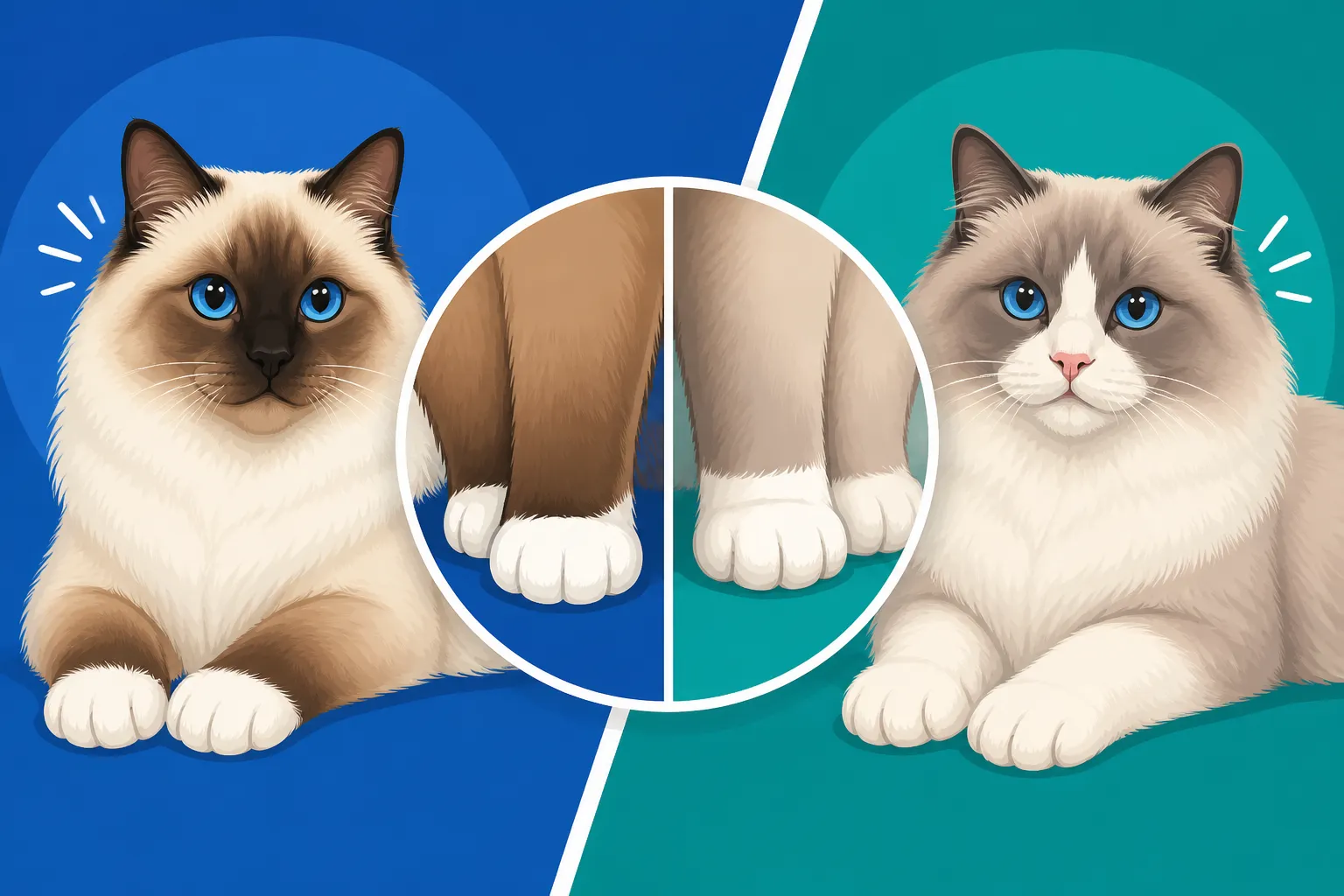
How to Tell a Birman From a Ragdoll by Its Feet
Many cat lovers find themselves completely charmed by the stunning blue eyes and gorgeous, flowing coats of both the Birman and the Ragdoll. It's incredibly easy to confuse these two magnificent breeds at first glance, especially when they share that lovely pointed coloration. But if you're trying to figure out which is which, or perhaps decide which one might be the perfect addition to your family, the first place you should look for a definitive clue is right down at their paws. Their feet, believe it or not, hold one of the most consistent and telling distinctions. This guide will walk you through exactly how to tell a Birman from a Ragdoll, starting with those crucial paw markings.
The Sacred Birman's Distinctive White Gloves and Laces
When you're trying to distinguish a Birman, their paws are truly the undeniable giveaway. Unlike any other pointed breed, the Birman possesses unique white markings on all four feet that are so specific they have their own names: "gloves" on the front paws and "laces" (or sometimes "gauntlets") on the back. This isn't just a random splash of white; it's a genetically determined pattern that is a hallmark of the breed, a feature so central it's woven into their ancient legends.
Understanding the Birman's Genetic Gloving Pattern
The Birman's gloving isn't a fluke; it's the result of a very specific genetic trait. Every Birman cat carries two copies of the special gloving gene, and this gene is what dictates the presence and general pattern of those characteristic white feet. It's what makes a Birman a Birman, distinguishing it from other pointed breeds like the Siamese or even the Ragdoll, which, while often having white feet, don't have this exact genetic blueprint for gloving.
Breeders spend years carefully selecting cats to ensure these markings adhere as closely as possible to the strict breed standard. They're not just aiming for white paws, but for a particular shape, length, and symmetry that defines the Birman's unique aesthetic. It’s a delicate balance, and achieving those perfect markings can be quite challenging, making well-gloved Birmans particularly prized. You can dive deeper into the science behind this unique trait by reading about The Gloving Gene Every Birman Carries Two Copies Of.
The "Gloves" on the Front Paws
Let's talk about those front paws first – the "gloves." On a Birman, the ideal front gloves should be pure white, symmetrical, and stop at a very distinct, even line right at the carpal joint (that's the "wrist" or bend) of the paw. Think of it like a perfectly tailored, short white glove that ends abruptly and cleanly. There should be no streaking up the leg, no uneven patches, just a pristine white marking that looks almost painted on.
When a judge or a keen eye is evaluating a Birman, the first thing they often look at is the quality and symmetry of these gloves. Unevenness, where one glove extends higher or lower than the other, is considered a fault. A perfectly gloved Birman is a thing of beauty, a testament to careful breeding, and a clear identifier of the breed. It's no wonder that breeders put so much effort into these markings; they truly are What Judges Look For on a Birman's Paws First.
The "Laces" and "Gauntlets" on the Back Paws
Moving to the back paws, the Birman features what are called "laces." These are also white, but instead of stopping abruptly like the front gloves, they ideally extend up the back of the hind leg in a tapering V-shape or a pointed, symmetrical "lace" design. This lace should run up the hock (the ankle joint) and end in a distinct point, often referred to as an inverted V. Again, symmetry between the two hind legs is highly desired.
Sometimes, you might hear the term "gauntlets." A gauntlet occurs when the white marking on the hind paw extends too far up the leg, past the hock, covering more than just the "lace" area. While still white, this is generally considered a mismark and a fault in the show ring, as it deviates from the ideal, delicate lace pattern. The distinction between a perfect lace and a gauntlet is a subtle but important one in the Birman world, and it can actually influence a kitten's price. To understand this better, you might want to look into What Laces and Gauntlets Mean on a Birman's Price Tag.
Ragdoll's White Markings: More Variation, Less Definition
Now, let's turn our attention to the Ragdoll. Ragdolls are famous for their stunning blue eyes, large size, and incredibly docile, "floppy" temperament. They are also pointed cats, and many Ragdolls do indeed have white on their paws. However, this is where the critical difference lies: the nature and pattern of their white markings are fundamentally different from the Birman's genetically defined gloves and laces.
Common Ragdoll Patterns with White Feet
Ragdolls come in several patterns, and two of them frequently feature white on the feet: "mitted" and "bi-color." A mitted Ragdoll will have white paws, often extending up the hocks, sometimes with a white chin and a white blaze on the forehead. A bi-color Ragdoll takes it a step further, with white extending up the legs, chest, and belly, usually with a distinctive inverted V marking on the face. Both can be absolutely gorgeous, and the white certainly adds to their appeal.
However, the key takeaway is that these white markings, while present, lack the precise, symmetrical, and genetically "fixed" pattern of the Birman's gloves and laces. The edges of the white on a Ragdoll's paws are often softer, less defined, and can vary significantly from cat to cat, even within the same litter. There isn't that same sharp, clean cut-off that you see on a Birman's front gloves, nor the specific V-shaped lace on the back.
The Lack of the Birman's Specific Gloving Gene in Ragdolls
This difference isn't just cosmetic; it's genetic. Ragdolls do not carry the specific KIT gloving variant that is unique to the Birman breed. While Ragdolls have genes that produce white spotting, it's a different set of genes that manifests in a broader, more varied expression of white. This means that a Ragdoll, even one with extensive white on its feet, will never truly have the "gloves" and "laces" in the precise, symmetrical, and clearly delineated fashion that a Birman does.
This genetic distinction is why, despite superficial similarities, these two breeds are truly separate. The Birman's gloving is a signature trait, almost like a brand, passed down through generations. The Ragdoll's white feet, while beautiful, are more akin to a "stocking" or "mitten" pattern that can be found in various other breeds, just happening to be a defining feature of certain Ragdoll patterns.
How Ragdoll White Markings Tend to Appear
When you observe a Ragdoll's white markings, you'll generally notice they are more expansive and less contained than a Birman's. For instance, a mitted Ragdoll's white may extend higher up the leg, almost like long stockings, and the line where the white meets the point color can be somewhat blurry or feathered, rather than the crisp line seen on a Birman. On the hind legs, a mitted Ragdoll might have white running up the hock, sometimes referred to as "boots," but it won't have the distinct, symmetrical inverted V or tapering point that defines the Birman's "lace."
Bi-color Ragdolls, of course, have even more white, often covering most of their legs, chest, and belly. Here, the sheer amount of white makes the distinction even clearer – a Birman's white is restricted to the paws and the laces, never extending broadly across the body. So, while both breeds can feature white paws, the how and where of that white is vastly different, making it a reliable indicator once you know what to look for.
Side-by-Side Comparison: A Closer Look at the Paws
Let's lay it all out there. When you have both a Birman and a Ragdoll in front of you, focusing on their paws will quickly clear up any confusion. It’s like looking at two different pieces of art – both beautiful, but with distinct styles and techniques. The precision of the Birman's gloving stands in stark contrast to the broader, often more flowing white markings of the Ragdoll.
The Distinct Lines of a Birman's Gloves vs. Ragdoll's Mitten
Imagine drawing a line where the white fur meets the colored fur on the paws. For a Birman's front "gloves," that line should be sharp, clean, and incredibly well-defined. It’s like a sculptor carefully carved the boundary. This crispness is paramount to the Birman breed standard. Any fuzziness or unevenness is a deviation, though common in pet Birmans.
Now, look at a Ragdoll's white "mittens" or "stockings." While lovely, the boundary where the white meets the point color is typically softer, sometimes feathered or less rigidly defined. It might blend more gently into the leg color rather than stopping with an abrupt, clean break. This difference in line quality is a crucial visual cue. Breeders and judges pay meticulous attention to these lines, as they are a key part of evaluating a Birman's conformity to the breed standard.
Symmetry and Consistency in Birman Gloving
Symmetry is a non-negotiable aspect of the Birman's gloving. The white gloves on the front paws should be of equal height and shape, and the laces on the hind paws should mirror each other perfectly. It’s a genetic trait that breeders strive to perfect, and any significant asymmetry is considered a fault. A Birman whose gloves are noticeably different in height or whose laces are uneven would likely not be considered a top show contender.
Ragdolls, on the other hand, don't have this same stringent requirement for symmetry in their white markings. While a balanced pattern is aesthetically pleasing, minor variations in the extent or shape of the white on a Ragdoll's paws are perfectly normal and don't count against them in the same way they would a Birman. Their white markings are, in a sense, allowed to be a bit more individual and free-form.
The Absence of "Laces" in Ragdolls
This is perhaps the simplest and most definitive point of differentiation for the hind legs. While a mitted Ragdoll will have white on its back paws, often extending up the hocks, it will not have the characteristic, tapering, inverted V-shaped "laces" that are unique to the Birman. Ragdolls typically have a more general white "boot" or "stocking" on their hind legs, which can be lovely, but it lacks the specific definition and pattern of a Birman's lace.
You'll never look at a Ragdoll's hind leg and see that distinct, V-shaped white marking rising symmetrically up the back of the hock in the same way you would on a Birman. This specific "lace" pattern is genetically tied to the Birman and is one of the most reliable features to look for when you're trying to distinguish between the two breeds.
| Feature | Birman (Sacred Cat of Burma) | Ragdoll |
|---|---|---|
| Front Paws | Pure white "gloves," symmetrical, ending at carpal joint with a sharp, clean line. | White "mittens" or "socks," often less defined edges, can extend higher or be more irregular. |
| Hind Paws | White "laces" that taper up the back of the hock in a distinct V-shape or point. | White "boots" or "stockings," typically a more general white marking up the hock, no distinct "laces." |
| Coat Type | Single coat, silky, less prone to matting. | Dense, plush, medium-long coat, often described as rabbit-like. |
| Body Build | Medium to large, sturdy, long and rectangular, graceful but substantial. | Large, heavily boned, long and muscular, famously "floppy" when held. |
| Nose Profile | Distinctive Roman nose, gently curved bridge. | Broad, flat top of the head with a gentle scoop in the profile. |
| Eyes | Rounder, deep sapphire blue. | More oval, vivid blue. |
| Temperament | Gentle, quiet, devoted, prefers proximity to being a lap cat. | Extremely docile, affectionate, "floppy," enjoys being held and is often a true lap cat. |
| Vocalization | Soft trills, quiet, not prone to loud meows. | More vocal than Birman, soft chirps and gentle meows, rarely loud. |
Beyond the Feet: Other Distinguishing Physical Traits
While the feet are a dead giveaway, Birmans and Ragdolls have other subtle, yet important, physical differences that can help you tell them apart. It’s like comparing two pieces of fine china from different regions; both are beautiful, but their shapes, glazes, and patterns have distinct regional characteristics if you know what to look for.
Body Type and Size Differences
Both Birmans and Ragdolls are large, substantial cats, but their body types have distinct nuances. The Birman is generally a medium-to-large cat with a long, sturdy, rectangular body. They possess a graceful elegance, with medium-boned legs and a well-muscled frame. They might appear substantial but often have a more refined look compared to the Ragdoll. A fully grown Birman tom cat can be quite imposing, but often still retains an agile quality. You can get a sense of their full stature by looking into How Long a Birman Is Nose to Tail.
The Ragdoll, on the other hand, is known for being truly massive. They are one of the largest domesticated cat breeds, famous for their heavy boning, broad chests, and muscular build. They are substantial, often described as having a "heavy" or "lumbering" gait, and their sheer size contributes to their famously placid, unhurried demeanor. If you're comparing two adult males, the Ragdoll will typically outweigh and out-bulk a Birman, sometimes quite significantly. Discover more about their growth in How Heavy a Full Grown Birman Tom Gets.
Facial Features: Nose, Ears, and Eye Shape
The facial features of these two breeds also offer clues. A Birman is characterized by its distinctive "Roman nose" – a gently curved bridge without a sharp break. Their eyes are typically quite round and set fairly wide apart, giving them a sweet, almost innocent expression. Their ears are medium-sized, set wide apart, and have rounded tips, blending smoothly into the contours of their head. Understanding What a Birman's Roman Nose Should Look Like is a key identifier.
Ragdolls tend to have a broader, more wedge-shaped head with a gentle scoop to their profile, lacking the pronounced "Roman" arch of the Birman. Their eyes are typically more oval than round, although still large and expressive, always a striking blue. Ragdolls generally have medium-sized ears, also set wide apart, but they might appear slightly more proportionate to their larger head size. Both breeds are celebrated for their vivid blue eyes, but there are subtle differences in their shape. For more detail, you can check Which Eye Color a Birman Must Have.
Coat Texture and Maintenance
Both breeds boast beautiful, long, flowing coats, which contributes to the initial confusion. However, there's a significant difference in their texture and, consequently, their grooming needs. The Birman has a single, silky coat, meaning it lacks a dense undercoat. This is a blessing for owners, as it makes their coat remarkably less prone to matting than many other long-haired breeds. It feels incredibly soft and luxurious to the touch and tends to run through your fingers easily. This unique characteristic is why No Undercoat Is What Makes a Birman Easy to Groom.
Ragdolls, by contrast, have a dense, plush, semi-long to long coat that often feels like rabbit fur. While it's also soft and relatively easy to manage for a long-haired cat, it does tend to be a bit more prone to matting, especially in high-friction areas like the armpits or britches, because of that density. This difference in coat structure means that while both need regular grooming, a Birman might get away with slightly less intensive combing than a Ragdoll. If you're curious about the specifics, check out How a Birman's Coat Differs From a Ragdoll's. You can find excellent quality combs and brushes for both coat types on sites like Chewy.
Temperament and Personality Clues
Beyond their physical appearance, the Birman and Ragdoll, while both renowned for their gentle dispositions, have distinct personality traits that set them apart. It's like comparing two sweet, friendly people – both lovely, but one might be more reserved while the other is more outwardly effusive.
The Birman's Gentle, Devoted, Yet Independent Nature
Birmans are often described as the "gentle giants" of the cat world, but with a quiet dignity. They are incredibly devoted to their families, often forming strong bonds with one or two primary caregivers. They love to be near you, following you from room to room like a shadow, often settling on the sofa next to you or at your feet. They are present, engaged, and quietly affectionate, but rarely demanding. They enjoy being part of the action but aren't typically "in your face" for attention.
They thrive on companionship and routine, and their placid nature makes them excellent family pets. They're not usually lap cats in the traditional sense; they prefer to be next to you rather than on you, observing and offering silent support. This makes them wonderfully calming companions. If you've ever wondered why they always seem to be right there, but not quite on your lap, you can explore A Birman Would Rather Be Near You Than On You. Their desire for proximity without constant physical demand is a key Birman trait.
The Ragdoll's Docile, Floppy, and Highly Affectionate Demeanor
Ragdolls earned their name for a reason: when you pick them up, they tend to go completely limp and "flop" into your arms, much like a child's ragdoll toy. This famous docility is a cornerstone of their personality. They are incredibly affectionate, often seeking out laps to curl up on and relishing being carried around. Ragdolls are typically more interactive and demanding of attention than Birmans, often initiating play or nudging for pets.
They are known for their profound trust and patience, making them exceptionally good with children and other pets. If you're looking for a cat that will happily recline in your lap while you watch TV or purr loudly as you stroke its head, a Ragdoll might be exactly what you're picturing. They often enjoy being the center of attention and will make their presence known in a loving, gentle way. To understand the differences in their lap-sitting tendencies, check out Whether a Birman Is a Lap Cat.
Vocalization Differences
When it comes to communication, both breeds are generally considered less vocal than, say, a Siamese. However, there are subtle distinctions. Birmans are known for being exceptionally quiet. They rarely let out a full, loud meow. Instead, they often communicate with soft, melodic trills or chirps. It’s a gentle, almost musical sound that you might have to lean in to hear. They aren't generally ones to demand food with insistent cries or loudly announce their presence. You might find this trait explored in The Small Trill a Birman Uses Instead of a Meow. They might follow you around, quietly expressing their desire for company, rather than vocally. If a Birman is truly hungry, it often waits patiently, as highlighted in Why a Birman Never Wakes You for Food.
Ragdolls, while not boisterous, tend to be a bit more vocal than Birmans. They will use a variety of soft meows, chirps, and purrs to communicate their needs or express affection. They might greet you at the door with a gentle meow, or use a soft vocalization to ask for food or playtime. While still far from the boisterousness of some breeds, a Ragdoll is more likely to engage in a "conversation" with you than a Birman.
Why the Confusion? Shared Ancestry and Appearance
It's completely understandable why these two breeds are so often mistaken for one another. They share several striking features that immediately draw people in, making it tricky for the untrained eye to tell them apart without a careful examination of those distinctive paws.
Similarities in Pointed Coloration and Blue Eyes
The most obvious shared trait is their pointed coloration. Both Birmans and Ragdolls exhibit the "pointed" gene, meaning their body is a lighter color, with darker "points" on their ears, face mask, paws (excluding the Birman's gloves), and tail. This is the same genetic trait seen in Siamese cats, giving both breeds that elegant, color-contrasted appearance. Whether it's seal point, blue point, chocolate point, or lilac point, this pattern is a fundamental part of their charm.
Adding to this visual similarity are their eyes. Both Birmans and Ragdolls are famous for their stunning, deep blue eyes. This eye color is directly linked to the same genetic pathway that produces the pointed coat pattern. The intensity of the blue can vary, but it's always that captivating shade that truly makes them stand out. It's often the first thing people notice and admire, and it's a huge contributor to the initial confusion between the two breeds. This shared eye color is discussed further in Which Eye Color a Birman Must Have.
Shared Traits from Outcrossing History
The history of both breeds also contributes to some superficial resemblances. The Birman breed faced near extinction after World War II, and to rebuild its numbers and genetic diversity, careful outcrossing with other longhaired breeds, particularly Persians, was necessary. This influx of Persian genetics contributed to the Birman's luxurious coat and some of its placid temperament.
While the Ragdoll's origins are a bit more shrouded in mystery, it's also believed to have some Persian (or Persian-type cat) influence in its early development, especially considering its long coat and docile nature. This shared, albeit sometimes indirect, genetic influence from Persian lines can create certain commonalities in their overall look and even some aspects of their temperament. Understanding how breeds like the Birman were rebuilt after the war can shed light on these connections, as detailed in Which Longhairs Rebuilt the Birman After 1945.
The Importance of Breeder Documentation
In today's world, with careful breeding and official registries, distinguishing between a purebred Birman and a purebred Ragdoll is straightforward if you're acquiring from a reputable source. Reputable breeders for either breed will provide comprehensive documentation for their kittens. This includes pedigree papers, registration certificates from recognized cat associations (like CFA, TICA, FIFe), and health testing results for the parents.
These documents are your guarantee of a kitten's lineage and breed. If a kitten is advertised as a Birman but lacks the correct gloving, or is sold without papers, it's a red flag. Similarly, a Ragdoll breeder will be transparent about their cat's patterns and health clearances. Always ask for these papers, and don't be afraid to verify them. This transparency eliminates any guesswork and ensures you know exactly which wonderful breed you are bringing into your home. Reputable breeders are a treasure, and they understand the importance of clear, verifiable records.
Making the Right Choice for Your Home
Deciding between a Birman and a Ragdoll, once you understand their differences, truly comes down to which personality and lifestyle fit best with your own. Both are exceptional companion animals, but they offer slightly different experiences.
Considering Lifestyle for Birman vs. Ragdoll
If you're someone who appreciates a quiet, devoted companion that enjoys being in the same room but isn't constantly demanding physical attention, the Birman might be your ideal match. They thrive in calm environments and are content to observe and offer gentle affection. They often do well in households where people might be home, but perhaps working quietly, and they're less likely to interrupt. They prefer proximity and companionship over being a constant lap cat. If you want to know more about the best fit, you can find insights in Who the Birman Actually Suits.
On the other hand, if you dream of a cat that will happily drape itself across your lap, enjoy being carried, and actively seek out physical affection, the Ragdoll's famously "floppy" and docile nature might be more up your alley. They tend to be more interactive and will often initiate play or nudge for pets. They are incredibly tolerant and patient, making them fantastic choices for families with gentle children or other pets who enjoy a more overtly affectionate feline friend.
Grooming Commitments
While both are long-haired breeds, their coat types result in different grooming needs. The Birman's single, silky coat is famously low-maintenance for a long-haired cat. Three combings a week are usually sufficient to keep it tangle-free and prevent mats, thanks to the lack of a dense undercoat. They shed, of course, but often less dramatically than breeds with heavy double coats. This ease of grooming is a major plus for many owners. The topic of Why a Birman Mats Far Less Than It Looks Like It Should goes into more detail. For all your grooming tool needs, consider looking at a broad selection on Chewy.
The Ragdoll, with its dense, plush, semi-long coat, will generally require a bit more attention. While still relatively easy compared to a Persian, daily or every-other-day combing is often recommended to prevent mats, especially during shedding seasons or in areas like the britches and armpits. Their coat's density means loose fur can get trapped more easily, leading to tangles if not regularly removed.
Health Considerations Specific to Each Breed
When choosing any purebred cat, understanding potential breed-specific health concerns is crucial. While both breeds are generally healthy, there are some differences. Birmans, for example, have a known predisposition to Hypertrophic Cardiomyopathy (HCM), a heart condition, and Polycystic Kidney Disease (PKD), though the latter is largely being bred out through genetic testing. Reputable Birman breeders routinely screen their breeding cats for these conditions.
Ragdolls also have a predisposition to HCM, and responsible breeders screen for this as well. They can also be prone to urinary tract issues. Regardless of the breed you choose, always select a breeder who openly discusses potential health issues, provides health certificates for their breeding cats, and offers a health guarantee for their kittens. A truly ethical breeder prioritizes the health and longevity of their cats above all else. This proactive approach ensures you're bringing home the healthiest possible companion.
Disclaimer
This article is for general informational purposes only and does not constitute professional advice. Laws, prices and regulations vary by location and change over time. Consult a qualified professional for guidance on your specific situation.