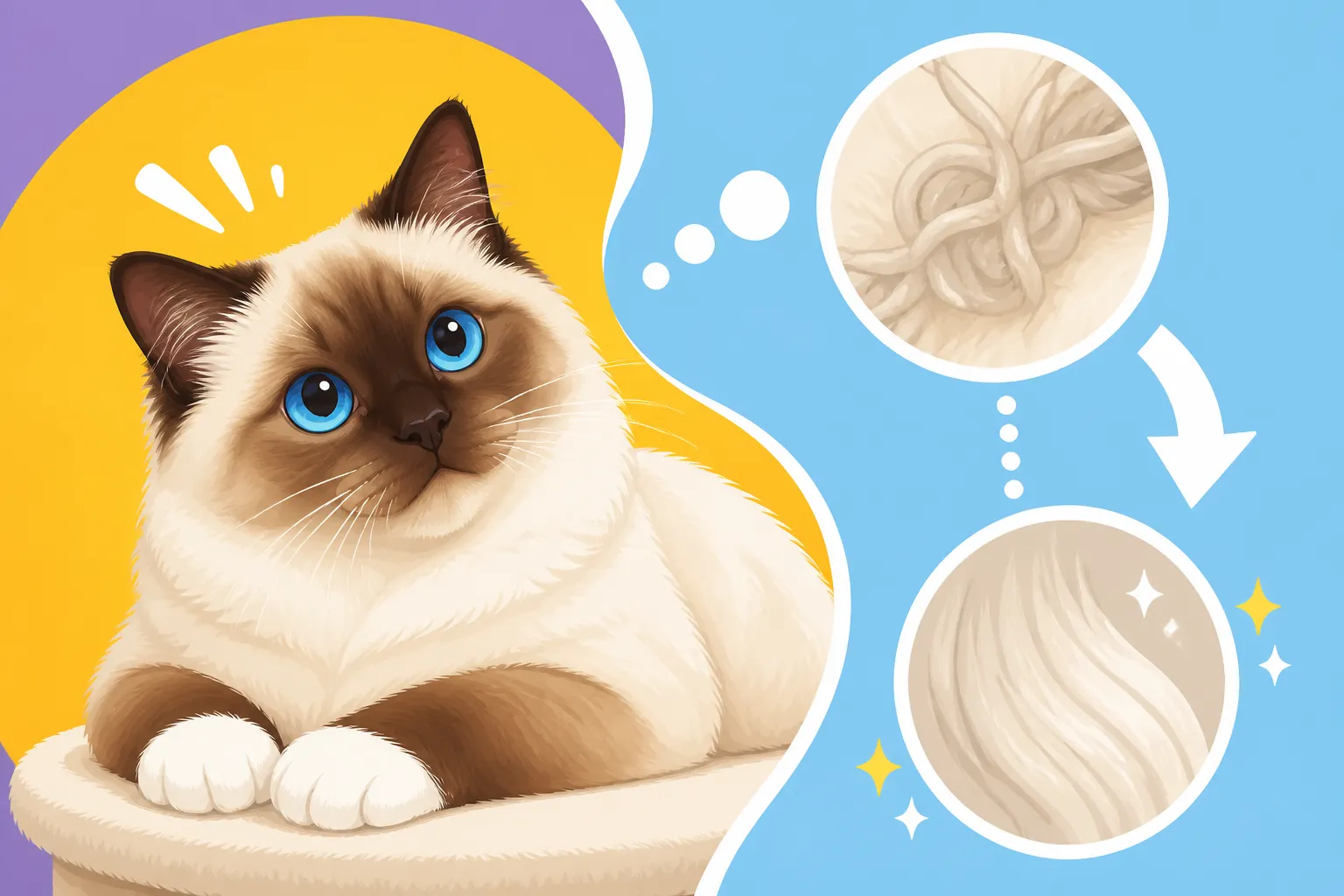
Why a Birman Mats Far Less Than It Looks Like It Should
It’s a common sight: a Birman cat, with its flowing, luxurious coat, looking like a fluffy cloud just waiting to tangle into a matted mess. Many new Birman owners, or those just admiring the breed, often assume that such a magnificent longhaired cat must demand hours of daily grooming to stay pristine. But here's the beautiful secret that surprises so many: a Birman mats far less than its appearance suggests, and in this guide, we'll dive deep into why that is, and how to keep that stunning coat in tip-top shape with less effort than you might imagine.
The Unique Structure of the Birman Coat
When you first lay eyes on a Birman, you might think you're looking at a grooming nightmare. That long, silky fur, the majestic ruff, the glorious plume of a tail – it all screams "high maintenance." However, the Birman's coat has a distinct characteristic that sets it apart from many other longhaired breeds, making it surprisingly easy to care for. This difference isn't just cosmetic; it's fundamental to its low-matting nature.
The All-Important Single Coat
Unlike breeds such as the Persian or some Maine Coons, the Birman possesses what is known as a single coat. What does this mean in practical terms? It means there's no dense, woolly undercoat lurking beneath those beautiful guard hairs. Think about it: many longhaired cats develop mats because their fine, downy undercoat sheds and gets trapped by the longer, coarser guard hairs. This creates felt-like knots, especially in high-friction areas like armpits, behind the ears, or on the belly. Without that thick underlayer, the Birman simply doesn't have the same internal mechanism for mat creation. This singular layer of fur allows loose hairs to fall out more easily, rather than clinging to the coat and forming tangles. It's a game-changer for daily care and a huge relief for owners who might have dreaded endless brushing sessions. This single coat is also why No Undercoat Is What Makes a Birman Easy to Groom.
The presence or absence of an undercoat makes a world of difference. Imagine trying to comb through two layers of fabric that are constantly trying to stick together; that's essentially what a double-coated cat presents. Now imagine combing through just one smooth, flowing layer. The difference in resistance is immediate and obvious. For the Birman, this translates into a coat that allows combs to glide through with minimal snagging, reducing both the time spent grooming and the potential for discomfort for your feline friend. It's truly one of the Birman's most remarkable, and often understated, features.
Why Silky Texture Matters
Beyond being a single coat, the Birman's fur boasts a wonderfully silky texture. If you've ever run your fingers through a Birman's coat, you'll know exactly what I mean – it feels incredibly soft and fine, almost like human hair, but without being excessively thin. This silkiness is another key player in its low-matting reputation. The individual hairs are smooth and fine, meaning they don't have the rough, barbed, or coarse texture that can cause hairs to lock together and form mats. Instead, they tend to slide past each other. This is quite different from the thicker, more cotton-like or woolly coats you might find in some other longhaired breeds, where the texture itself contributes to tangling.
This smooth, silky quality is especially noticeable around the ruff and tail, where the fur is longest and most voluminous. You might expect these areas to be prime matting zones, but the natural slipperiness of the Birman's hair helps to prevent this. It allows the coat to move fluidly, both with the cat's movements and during grooming. When you use a comb, the silky strands separate cleanly, rather than clinging and pulling. This makes the grooming experience much more pleasant for both you and your Birman. In fact, understanding What Makes a Birman's Coat Silky Rather Than Woolly is crucial to appreciating its low-maintenance nature.
The Length and Density Deception
From a distance, a Birman can look incredibly dense and long-haired, leading many to believe that such a coat must be a breeding ground for tangles. And yes, the fur is indeed long, particularly around the neck (forming that beautiful ruff), the britches, and the tail, which often boasts a magnificent plume. However, this perceived density is somewhat deceptive. While the fur flows freely and gives an impression of volume, it's not actually packed as thickly as some other breeds with shorter, but much denser, undercoats. The individual hairs are fine, and there's a certain airiness to the coat rather than a heavy, compacted feel.
This combination of length and fineness means that while loose hairs are present, they are less likely to become intertwined and knotted deeply within the coat. Instead, they tend to sit on the surface or work their way out with regular movement or light grooming. It's like having a sheer, flowing curtain rather than a thick, insulated blanket. The visual impact is one of lushness and abundance, but the underlying structure is built for ease of movement and minimal friction between strands. This is partly why How Long a Birman's Coat Actually Is doesn't necessarily translate into grooming difficulty.
Understanding Why the Birman Resists Matting
The lack of an undercoat and the silky texture aren't just minor details; they are the fundamental reasons why the Birman's coat remains so manageable. It's a masterclass in natural engineering, demonstrating how specific genetic traits can profoundly impact daily care requirements. Let's delve a bit deeper into the mechanics of this resistance.
The Absence of a Dense Undercoat
This point truly cannot be overstated. A dense, woolly undercoat is the primary culprit behind matting in many longhaired cat breeds. This undercoat consists of very fine, downy hairs that are designed to provide insulation. While essential for warmth, these hairs readily shed, and when they do, they often get caught up in the longer, coarser guard hairs. This creates a tangled web that compacts into mats, especially when moisture, friction, or static electricity are involved. Imagine trying to comb through cotton wool that's been woven into longer strands – it quickly becomes a matted mess.
The Birman simply doesn't have this problem. Because its coat lacks this insulating layer, shed hairs have fewer opportunities to get trapped and entwined. They are more likely to fall away from the body naturally, or be easily removed with a gentle comb. This is why Why a Single Coat Mats Less on a Birman is such a critical factor in their ease of care. Without the continuous shedding and trapping cycle of an undercoat, the Birman's coat remains light, free-flowing, and remarkably resistant to the kind of tight, painful mats that plague owners of double-coated longhairs.
The Guard Hairs and Their Role
The Birman's guard hairs are the stars of its coat. These are the longer, visible hairs that give the coat its length, color, and overall appearance. In Birmans, these guard hairs are exceptionally fine and soft, contributing directly to the silky texture we discussed earlier. Unlike some breeds where guard hairs can be coarse or even wiry, the Birman's are smooth and relatively uniform in diameter. This smoothness is crucial because it reduces the friction between individual hairs. When hairs slide past each other rather than clinging, they are far less likely to knot or snag.
Think of it like this: if you have a bunch of smooth, polished threads, they'll untangle easily. If you have threads with many tiny barbs or rough spots, they'll grab onto each other and form knots. The Birman's guard hairs are much closer to the former. They are strong enough to provide protection and form the beautiful drape of the coat, but delicate enough in texture to prevent the stubborn interweaving that leads to matting. Even in areas of high movement, like around the legs or under the chin, these silky guard hairs maintain their integrity surprisingly well, resisting the urge to felt together.
Genetic Factors in Coat Maintenance
While we can observe the physical characteristics of the Birman's coat, it's important to remember that these traits are deeply rooted in their genetics. The Birman's specific genetic makeup dictates the type of hair follicles it produces, the growth cycle of its fur, and the absence of a dense undercoat. These aren't accidental traits; they are the result of careful breeding over generations, preserving and enhancing the distinctive coat qualities that make the Birman so unique.
Essentially, the genes that code for "long, silky, single coat" are fixed within the Birman breed. This genetic predisposition means that Birmans are designed to have a low-matting coat. It's not just luck; it's inherent to their breed standard and genetic heritage. This genetic predisposition is also why How Two Cats in 1945 Shaped the Birman's Health and What a Narrow Founder Base Left in the Birman are important aspects of understanding the breed's development, including its coat characteristics. Breeders focus on maintaining these desirable coat traits, ensuring that future generations continue to inherit this easy-care quality. When considering a Birman, you're investing in a cat whose very DNA contributes to a more manageable grooming routine.
How Birman Grooming Differs from Other Longhaired Breeds
If you've ever owned a Persian or a Ragdoll, or even just seen the grooming requirements for these breeds, you might approach the Birman with a sense of dread. However, the Birman's unique coat structure means that its grooming needs are distinctly different, and often far less demanding, than its fluffy cousins. It's a breath of fresh air for owners who want the beauty of a longhaired cat without the constant battle against mats.
Less Frequent Combing, More Effective Results
For many longhaired breeds, daily combing is not just recommended, it's often essential to prevent mats from forming. Neglect even for a day or two can lead to serious tangles that are difficult and painful to remove. With a Birman, this intense schedule simply isn't necessary. Due to the single, silky coat, shed hairs are less likely to become trapped, meaning you can often get away with combing your Birman two to three times a week. This frequency is usually more than enough to remove loose fur, stimulate the skin, and keep the coat looking its best.
When you do comb a Birman, the process is usually quick and efficient. The comb glides through the silky hair with ease, picking up loose fur without resistance or pulling. This isn't to say you should skip grooming entirely, but rather that the effort required is significantly less. This consistent, yet infrequent, routine is incredibly effective in preventing mats from taking hold. The key is consistency, even if that consistency means every other day rather than every single day. For more on this, check out Three Combings a Week Is Enough for a Birman.
Contrasting with the Persian's Demands
To truly appreciate the Birman's low-matting coat, it helps to compare it to a breed like the Persian. Persians are renowned for their incredibly thick, dense double coats, which include a very heavy, woolly undercoat. This undercoat is prone to felting, and without diligent, often daily, grooming, a Persian can develop severe mats very quickly. These mats can pull on the skin, cause discomfort, restrict movement, and even lead to skin infections. Many Persian owners find themselves needing professional grooming appointments or even sedated shaves to deal with unavoidable matting.
The Birman, by contrast, offers a vastly different experience. The absence of that problematic undercoat means the constant fight against felted fur is simply not part of the Birman owner's life. While a Persian owner might spend upwards of an hour a day meticulously combing through layers of fur, a Birman owner can often achieve a perfectly groomed coat in 10-15 minutes, a few times a week. This stark difference in grooming requirements highlights just how unique and user-friendly the Birman's coat truly is. It's why Why a Birman Needs Three Combings Where a Persian Needs Seven is such a practical distinction.
Comparing to Ragdoll and Maine Coon Coat Types
While not as demanding as the Persian, other popular longhaired breeds like the Ragdoll and Maine Coon also have different coat characteristics that lead to more matting potential than the Birman. Ragdolls, for instance, have a plush, semi-longhaired coat that is also prone to matting, especially in high-friction areas. They generally have a soft undercoat, though not as dense as a Persian's. Maine Coons have a shaggy, uneven coat with a fair amount of undercoat, particularly in winter, which can also mat if not regularly combed.
Here's a quick comparison of longhaired coat types:
| Breed | Coat Type | Undercoat Density | Matting Tendency | Grooming Frequency |
|---|---|---|---|---|
| Birman | Single, Silky | None | Low | 2-3 times/week |
| Persian | Double, Dense | Very High | Very High | Daily, often hours |
| Ragdoll | Semi-Long, Plush | Medium | Medium | Daily to every other day |
| Maine Coon | Double, Shaggy | Medium to High | Medium | Several times/week |
As you can see from the table, the Birman consistently ranks as one of the easiest longhaired breeds to groom when it comes to preventing mats. This is not to say that Ragdolls or Maine Coons are inherently difficult to care for, but rather to emphasize the Birman's distinct advantage. Their coat is truly a blessing for owners who love the longhaired look but prefer a more relaxed grooming routine. Understanding How a Birman's Coat Differs From a Ragdoll's really clarifies the ease of Birman grooming.
Essential Grooming Practices for a Mat-Free Birman
While the Birman's coat is low-maintenance, it's not no-maintenance. Regular, gentle grooming is still vital to keep that glorious fur healthy, shiny, and completely mat-free. The good news is that these practices are usually quick and enjoyable for both you and your cat, especially when you use the right tools and techniques.
Choosing the Right Tools
The key to successful Birman grooming lies in using tools that complement its silky, single coat. Forget harsh brushes or deshedding tools designed for dense undercoats; these can actually damage a Birman's delicate guard hairs. Instead, opt for tools that will glide smoothly and collect loose fur without pulling or tearing.
My go-to recommendations include:
- Metal Comb: A good quality, medium-toothed metal comb with rounded teeth is your best friend. It should be able to get through the length of the fur without snagging. This is what you'll use for the bulk of your combing, gently working through the coat section by section. For specific advice, consider Which Comb Gets Through a Birman's Ruff Without Pulling.
- Soft Bristle Brush: A soft bristle brush can be used after combing to smooth down the fur and add shine. It's also great for stimulating blood flow to the skin, which promotes a healthy coat. Think of it as a finishing touch.
- Flea Comb: While not for mats, a flea comb can be useful for delicate areas around the face or for checking for any tiny debris that might catch in the finer fur.
Avoid slicker brushes if possible. While they are invaluable for many double-coated breeds, the wire pins of a slicker brush can be too harsh for a Birman's silky guard hairs, potentially causing breakage or discomfort. Similarly, aggressive deshedding tools are overkill for a coat without an undercoat and can pull out healthy fur. Remember, less is often more with a Birman's coat. This is critical because Why a Slicker Tears a Birman's Silky Guard Hairs.
The Art of Gentle Combing
Combing a Birman should be a pleasant bonding experience, not a wrestling match. The key is to be gentle, systematic, and consistent. Start when your Birman is a kitten to get them accustomed to the routine. Most Birmans, with their placid nature, will quickly come to enjoy the attention.
Here's a step-by-step approach:
- Find a Calm Time and Place: Choose a moment when your Birman is relaxed, perhaps after a nap or a meal. A quiet spot where you both feel comfortable is ideal. Many Birmans enjoy being groomed on a lap, or on a soft blanket on a table.
- Start with the Easiest Areas: Begin with areas where your cat is least sensitive, typically the back or sides. Work in small sections, always combing in the direction of hair growth.
- Address Longer Fur: Move to the ruff, the britches, and the tail. These areas have the longest fur, but remember, the silky texture still makes them manageable. Take your time, holding the hair near the skin with one hand while combing with the other to minimize pulling if you encounter a tiny tangle.
- Check for Any Resistance: If your comb snags, stop immediately. Don't pull. Gently work the comb through the area with short, light strokes until the tangle loosens. If it's a persistent snag, it might be the start of a mat (though rare for Birmans!), which we'll cover next.
- Finish with Praise and a Treat: Always end on a positive note. A small treat and some loving words will reinforce the positive association with grooming.
Remember, the goal is to gently remove loose hair and prevent any tangles before they can even think about forming. This routine should feel relaxing for your Birman, not stressful.
Focusing on Trouble Spots (Even for Birmans)
While Birmans are generally mat-resistant, there are still a few areas where you might find a slight tangle or a tiny knot, simply due to natural friction or movement. These aren't usually true "mats" in the Persian sense, but rather small snags that are easily brushed out if caught early.
The most common areas to keep an eye on are:
- Behind the Ears: This is a common spot for tangles in many cats, often due to scratching or collars. The fur here can be finer.
- Armpits/Legs: Areas where legs rub against the body during movement can sometimes develop friction tangles.
- Britches (Pants): The long fur on the back of the hind legs can occasionally snag, especially if your Birman is particularly active or prone to sitting in messy spots.
- Tail Plume: While usually free-flowing, very long tail fur can sometimes develop minor snags if the cat steps on it or if it gets caught under furniture.
When combing, pay a little extra attention to these zones. Gently run your metal comb through them, feeling for any resistance. If you find a small tangle, separate the hair with your fingers first, then gently comb it out from the ends, working your way up to the skin. Early detection is always key, even with a low-matting coat. This will help you address Where a Birman's Few Mats Form before they become an issue.
Debunking Common Myths About Birman Coat Care
The sheer volume and length of a Birman's fur often lead to assumptions and myths about its care. It's easy to look at that majestic coat and jump to conclusions, especially if you're used to other longhaired breeds. However, by understanding the Birman's unique coat structure, we can dispel many of these misconceptions.
The Illusion of High Maintenance
This is perhaps the biggest myth surrounding the Birman's coat. People see the flowing fur, the impressive ruff, and automatically assume it requires hours of dedicated grooming every day, similar to a show Persian. This couldn't be further from the truth. As we've established, the absence of a dense undercoat is the game-changer. While the coat looks high maintenance, its internal structure allows for surprisingly easy upkeep.
Many owners are shocked to discover how little effort is actually needed to keep their Birman's coat in beautiful condition. It’s an illusion created by the visual aesthetic rather than the physical reality of the hair. This misunderstanding often deters potential owners who are looking for a beautiful, affectionate companion but worry they don't have the time for intensive grooming. The reality is, a Birman offers the best of both worlds: stunning longhaired beauty with a genuinely manageable grooming routine. Don't let the looks deceive you into thinking a Birman will be a constant battle against tangles!
Why Daily Brushing Isn't Always Necessary
Another common belief is that all longhaired cats need daily brushing. While this holds true for many breeds, it's not strictly necessary for the Birman. In fact, over-brushing with the wrong tools could even be detrimental, potentially causing static, breakage, or irritating the skin. Because their single coat releases shed hairs so efficiently, a thorough combing two or three times a week is generally perfectly adequate for most Birmans.
Of course, if your Birman particularly enjoys the attention, or if they are shedding more heavily during seasonal changes, you can certainly increase the frequency. But it should be a choice based on your cat's needs and enjoyment, not a rigid requirement born from fear of mats. For a healthy, indoor Birman, those few sessions a week are usually sufficient to remove loose fur and prevent any tangles. This allows for more time for cuddles, play, or simply enjoying your Birman's quiet company. It highlights how the common advice for longhairs doesn't always apply to this unique breed.
When the Coat Looks Matted but Isn't
Sometimes, a Birman's coat might appear to have a mat, especially if you see a clump of fur. However, often what looks like a mat is simply a collection of shed hair that has caught on the outer layer, or a temporary tangle from rolling around. Because the Birman's coat doesn't "felt" easily, these are usually loose and easily brushed out with a gentle comb or even just your fingers.
A true mat, in other breeds, is a dense, compacted knot that pulls on the skin and is difficult, if not impossible, to comb through without causing pain. With a Birman, what you might perceive as a mat is almost always a superficial tangle. You can often test this by gently trying to pull the "mat" apart with your fingers; if it separates easily or loosens with a few gentle strokes of a comb, it was never a true, stubborn mat. This distinction is important for new Birman owners to understand, as it can save a lot of unnecessary worry. It reinforces the idea that the Birman's coat is genuinely different and more forgiving.
Beyond the Comb: Diet and Environment for Coat Health
While regular combing is essential, a truly healthy, mat-resistant coat starts from within. What your Birman eats and the environment they live in play a significant role in the luster, strength, and overall condition of their fur. Think of grooming as the finishing touch on a canvas that's already been prepped with good nutrition and a comfortable home.
Nutritional Support for a Lustrous Coat
A high-quality diet is paramount for a beautiful coat. Just like our own hair and skin, a cat's fur reflects its internal health. Look for cat foods that list real meat as the first ingredient and are rich in animal-based protein. These provide the essential amino acids necessary for strong, healthy hair growth. Many premium cat foods offer excellent nutritional profiles.
Beyond protein, essential fatty acids, particularly Omega-3 and Omega-6, are crucial for coat health. These fats contribute to a shiny, soft coat and help maintain skin health, reducing dryness and flakiness that could indirectly lead to coat issues. Many quality cat foods include these, often from sources like fish oil or flaxseed. If your Birman's coat seems dull or dry, your vet might recommend a supplement. A healthy, well-nourished coat will naturally be stronger, less prone to breakage, and less likely to develop even minor snags. Remember that How Many Calories a Birman Needs to Hold Its Coat is also important to maintain overall health, which includes coat condition.
The Role of Hydration
Water is often overlooked when we talk about coat health, but it's incredibly important. Just like healthy skin needs to be hydrated, healthy hair relies on proper internal moisture. Cats, by nature, don't always drink enough water, especially if they are primarily on a dry kibble diet. This is where wet food can be a game-changer, as it provides a significant portion of a cat's daily water intake.
Ensure your Birman always has access to fresh, clean water. Consider offering multiple water bowls in different locations, or investing in a cat drinking fountain, as many cats prefer flowing water. Good hydration helps keep the skin supple and the hair shafts strong and moisturized, making the coat more resilient and less prone to brittleness or static, which can contribute to tangles. A well-hydrated cat is less likely to have a dry, brittle coat that could break and knot.
Environmental Factors and Coat Condition
Your Birman's living environment also impacts its coat. Several factors can either support or detract from its healthy appearance:
- Indoor Living: Birmans are generally indoor cats, which protects their coats from external elements like dirt, burrs, harsh weather, and parasites that can all contribute to matting and damage. An indoor environment keeps their fur cleaner and less exposed to potential tangles.
- Humidity: Extremely dry indoor air, especially in winter with heating systems running, can cause static electricity in your cat's fur. Static can make hairs stand on end and cling to each other, potentially leading to more tangles. A humidifier can help.
- Cleanliness: A clean home means a cleaner cat. Less dust and debris in the environment means less material to get caught in your Birman's long fur. Regularly vacuuming and cleaning bedding helps keep their coat free from external contaminants.
- Temperature: While Birmans have a single coat, they adapt well to indoor temperatures. However, extreme cold can sometimes cause their points (ears, face, paws, tail) to darken, and very cold environments might encourage the growth of a slightly denser coat to compensate, though this is rare in typical household settings. Their coat is not designed for harsh outdoor temperatures, so Why a Coat With No Undercoat Is Not Warm underscores the importance of an indoor environment.
By providing a balanced diet, ensuring good hydration, and maintaining a clean, comfortable indoor environment, you're giving your Birman the best possible foundation for a healthy, vibrant, and effortlessly mat-free coat. And don't forget the power of good Omega fatty acids; understanding Why Omega Oils Matter for a Birman's Coat can make a real difference.
Addressing the Rare Mat: When Trouble Strikes
Despite the Birman's excellent mat-resistant coat, occasional small tangles can still occur. This might happen after a particularly energetic play session, if your cat rolls in something sticky, or simply in those friction-prone areas we discussed. The key is to address these minor issues promptly and gently, preventing them from escalating into anything more serious.
Identifying the Start of a Mat
For Birmans, what often looks like a mat is usually a small clump of shed fur or a minor tangle. A true mat feels dense, firm, and often pulls on the skin. You'll notice it when your comb gets stuck and won't glide through. It's usually small, unlike the large, felted areas seen on other breeds. The most common places, as mentioned, are behind the ears, in the armpits, on the belly, or on the britches.
When combing, if you feel any resistance, stop and investigate. Gently part the fur with your fingers to see if it's just loose hair, or if the strands are truly interlocked. Early detection is your best defense against even the smallest of Birman tangles. Don't wait for it to become bigger or tighter; these minor snags are usually very easy to resolve if caught quickly. Ignoring them, even for a Birman, can eventually lead to something more stubborn.
Gentle Techniques for Mat Removal
If you do encounter a small tangle, remember to be patient and gentle. Never yank or pull the comb through a snag, as this will hurt your cat and make them fearful of grooming.
Here’s a safe approach for a Birman’s coat:
- Isolate the Tangle: Gently separate the matted area from the surrounding healthy fur. You can hold the fur close to the skin at the base of the mat to prevent pulling on the skin as you work.
- Use Your Fingers First: Try to gently tease apart the tangle with your fingertips. Often, for a Birman, this is enough to loosen the intertwined hairs.
- Apply a Detangling Spray (Optional): A cat-safe detangling spray can help lubricate the hairs and make them easier to separate. You can find these at pet stores or from online retailers like Amazon.
- Work from the Ends: Using your metal comb, start at the very tip of the tangle and work a few hairs out at a time. Gradually work your way closer to the skin, using short, gentle strokes. Think of it as slowly unweaving the knot.
- Small Sections: Don't try to tackle the whole tangle at once. Work on very small sections, patiently.
- Never Cut with Scissors Pointing at Skin: If you absolutely must cut a mat (which should be a last resort for a tiny, stubborn one), always use blunt-nosed scissors and slide the comb under the mat, between the mat and the skin. Then, cut above the comb. This creates a barrier to protect the skin. For Birmans, cutting is very rarely necessary due to the ease with which their coats detangle.
With a Birman, most tangles are superficial and respond well to this gentle, patient approach. The key is to be consistent with your regular combing so these don't even get a chance to form.
When to Seek Professional Help
While the vast majority of Birman coat issues can be handled at home, there are times when professional help from a groomer or a veterinarian is advisable. This is especially true if:
- The Mat is Large or Tight: If a rare mat does become very dense, large, or is pulling tightly on the skin, attempting to remove it yourself could cause pain or injury to your cat. Professional groomers have specialized tools and techniques to remove mats safely and efficiently.
- Your Cat is Uncooperative: If your Birman becomes stressed, agitated, or aggressive during grooming attempts, it's best to let a professional handle it. They are experienced in handling difficult cats and can minimize stress for your pet.
- The Mat is in a Sensitive Area: Mats near the ears, eyes, or genitals are particularly tricky and sensitive. A professional can address these areas with greater precision and safety.
- Skin Irritation or Sores: If the mat has caused underlying skin irritation, redness, or even open sores, it's a veterinary concern. The vet can treat the skin issue and safely remove the mat, often with sedation if necessary.
Don't feel like a failure if you need to call in the cavalry for a stubborn tangle. The health and comfort of your Birman are paramount. A good professional groomer will also be able to offer advice on your specific Birman's coat needs and demonstrate proper techniques.
Lifelong Coat Care: Adapting to Your Birman's Age
Just like humans, a Birman's needs change over its lifespan. From the soft, developing fur of a kitten to the slightly coarser, less elastic coat of an elder, understanding these transitions will help you adapt your grooming routine and keep your Birman comfortable and looking fabulous throughout its twelve to sixteen years.
Kitten Coat to Adult Splendor
Birman kittens are born pure white, and their points (ears, face, paws, tail) gradually darken as they grow. Their kitten coat is incredibly soft and fluffy, but also quite fine. During this stage, introducing a gentle grooming routine is crucial. Short, frequent sessions with a soft brush and a fine-toothed comb will get them accustomed to being handled and groomed, setting them up for a lifetime of positive grooming experiences. Even though their coat won't mat easily, establishing this routine early makes adult grooming a breeze.
As they mature into their adult coat, which can take up to three years to fully develop, the fur will become longer, silkier, and more voluminous, especially around the ruff. Continue with the established gentle combing routine, focusing on consistency rather than intensity. This gradual transition means you won't suddenly be faced with a dramatically different coat overnight; you'll have plenty of time to adapt as your kitten grows into its full adult splendor. This is also when How a Birman Kitten's Gloves Change as It Grows is apparent.
Navigating the Golden Years
As your Birman enters its senior years (typically around 10-12 years old), you might notice subtle changes in its coat. The fur might become slightly drier, a little less lustrous, or perhaps a bit coarser in texture. Mobility issues, such as arthritis, can also make it harder for an older Birman to reach and groom certain areas of its body, especially its back, hips, and tail. This is where your role in assisting with grooming becomes even more important.
You might need to increase your combing frequency slightly, or spend a bit more time on those hard-to-reach areas your Birman can no longer manage on its own. Be extra gentle, as an older cat might have sensitive skin or joints. Use a very soft brush and a wide-toothed comb to avoid any discomfort. Pay close attention to areas that could mat if neglected, such as the lower back, britches, and under the tail. Caring for an Old Birman That Cannot Reach Its Back becomes a real consideration here. Providing a soft, comfortable surface for grooming and making it a relaxing, bonding time is crucial for your aging companion.
The Impact of Health on Coat Quality
Throughout a Birman's life, its coat can be a good indicator of its overall health. A sudden change in coat texture, excessive shedding, dullness, or the development of unexpected mats (even for a Birman) can sometimes signal an underlying health issue. For example:
- Thyroid problems (hyperthyroidism): Can lead to a greasy, dull, or poor-quality coat.
- Kidney disease: Can result in a dry, unkempt coat.
- Parasites: Fleas, mites, or other external parasites can cause scratching, skin irritation, and consequently, coat damage or matting.
- Nutritional deficiencies: If a cat isn't absorbing nutrients properly, or its diet is inadequate, its coat will often be the first thing to suffer, appearing dull or brittle.
- Stress: High levels of stress can sometimes manifest in excessive grooming (overgrooming), or conversely, a lack of grooming, leading to a matted or unkempt appearance.
If you notice any significant changes in your Birman's coat quality that aren't easily explained, or if mats develop unusually, it's always a good idea to consult your veterinarian. They can help diagnose any underlying health issues and provide appropriate treatment or dietary recommendations. A healthy Birman will naturally have a healthy, beautiful, and easy-to-manage coat.
Disclaimer
This article is for general informational purposes only and does not constitute professional advice. Laws, prices and regulations vary by location and change over time. Consult a qualified professional for guidance on your specific situation.