Which Point Colors CFA Accepts in a Birman
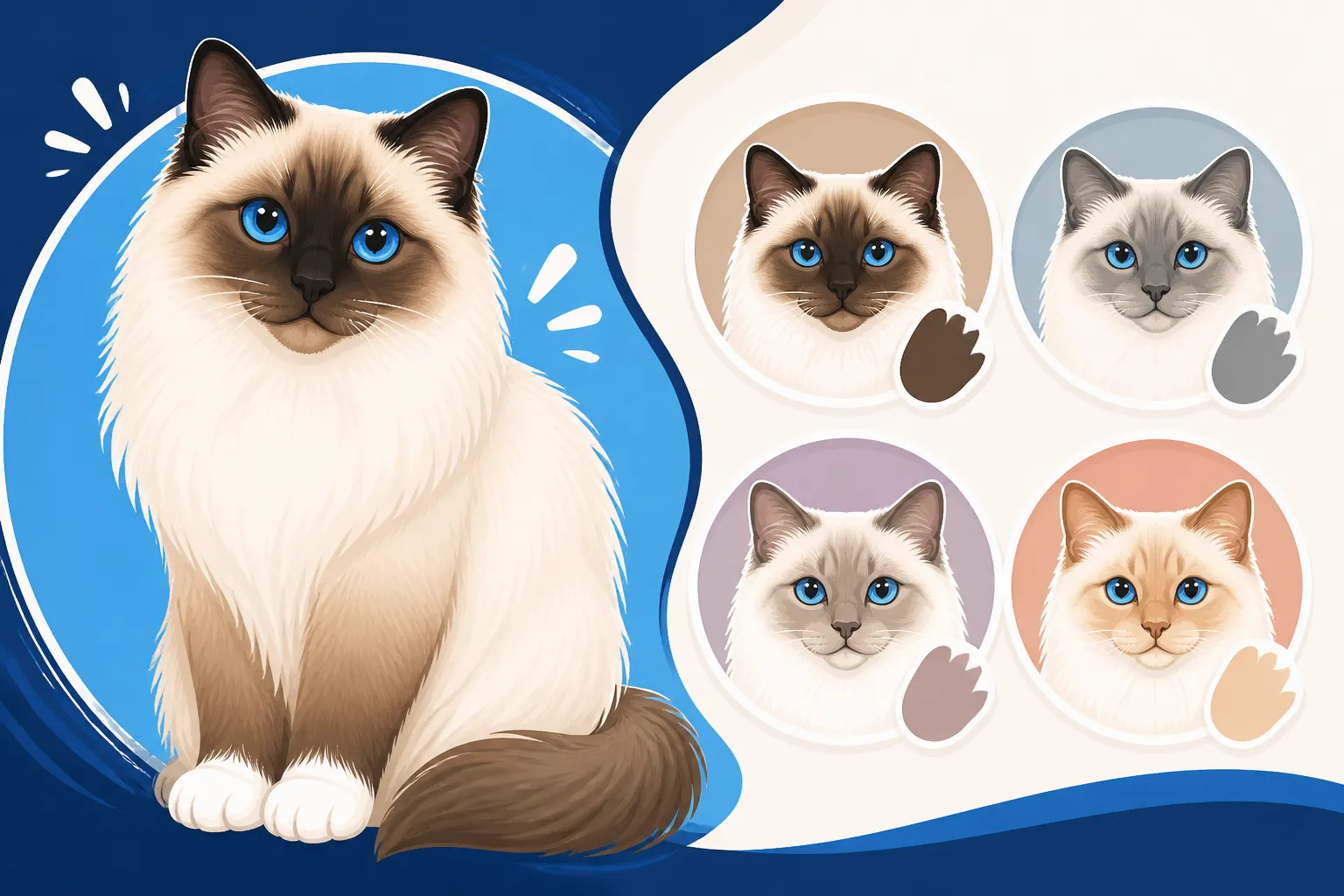
A Birman’s blue eyes and white gloves may catch your attention first, but the darker points are what identify its color variety. Seal, blue, chocolate, lilac, red and cream are the main point colors, with tortie and lynx patterns adding further recognized combinations. This guide explains how those terms fit together and why color alone does not establish that a cat is a CFA-registered Birman.
How CFA Birman point colors work
The difference between a point color and a pattern
A Birman is a pointed cat: its face, ears, legs and tail are darker than its pale body. The shade on those areas is its point color. Seal, blue, chocolate, lilac, red and cream describe that shade; they are not separate breeds.
A pattern describes how color is distributed within the points. A solid point has a relatively even color, while a lynx point has tabby markings such as stripes on the face and legs. Tortie points have patches of two colors, typically involving red or cream alongside another point color. A cat can therefore be described by both its point color and its pattern.
The distinction matters when someone is trying to identify a kitten from a photo or breeder listing. “Blue” names the point color, while “lynx” describes a tabby pattern. If you are learning the breed’s broader appearance, Which Point Colors the Birman Standard Allows offers a useful companion topic, and How a Birman’s Point Color Is Registered explains why registration wording may look more specific than everyday color descriptions.
The white gloves are a separate feature
Birman gloves are the white markings on the paws. They are a defining breed feature, but they are not a point color. A seal-point Birman, for example, has dark brown points and white feet; a blue-point Birman has slate-blue points and white feet.
The gloves also should not be confused with the paler body coat. The body and points create the color contrast, while the gloves are distinct white markings on the feet. A cat’s point color does not tell you whether its gloves are even, correctly placed or show-quality. Those details are judged separately under the breed standard.
That is why color labels alone can be misleading in online listings. A seller might use a familiar color name accurately while leaving out important details about registration, pedigree or markings. For a closer look at the white markings, see How a Birman’s Gloves Are Scored and Why a Birman Is Always Pointed and Never Solid.
The main Birman point colors accepted by CFA
The traditional color names refer to recognizable shades on the points. The table below gives a practical overview. Individual cats can vary in how light or dark they appear, and lighting, age and temperature can affect what you see in photographs.
| Point color | Typical appearance on the points | What to keep in mind |
|---|---|---|
| Seal | Deep brown, often appearing nearly black on the face or tail | The body is usually a warm pale cream to fawn shade |
| Blue | Cool slate-blue or gray | Blue is a dilute form of the darker seal coloring |
| Chocolate | Warm milk-chocolate brown | It is generally softer and lighter than seal |
| Lilac | Pale, cool gray with a pinkish or beige cast | Lilac is a dilute form of chocolate |
| Red | Warm orange-red shades | The color may vary across the face, legs and tail |
| Cream | Pale, soft cream or buff | Cream is a dilute form of red |
Seal and blue points
Seal point is one of the most familiar Birman color varieties. Its points range from rich brown to very dark brown, while the body is typically a lighter cream or fawn. The contrast can become more noticeable as a kitten matures, so a young seal-point kitten may not look as dark as an adult.
Blue point has a cooler, softer appearance. Its points are slate-blue or gray rather than brown, and the body usually remains pale. People sometimes describe a blue point as gray, but “blue” is the conventional cat-color term. A photo taken in warm indoor light can make blue points look browner, so natural daylight is often more useful when comparing colors.
Both colors still require the rest of the Birman picture: pointed coloring, blue eyes and white gloves. If you are comparing a Birman with another pointed breed, How to Tell a Birman From a Ragdoll by Its Feet can help explain why the paw markings matter as much as the point shade.
Chocolate and lilac points
Chocolate points are generally warmer and lighter than seal points. Their brown shade is often likened to milk chocolate, though the comparison is approximate. The color may be clearest on the ears, face, legs and tail, particularly once the kitten’s points have developed.
Lilac points are a diluted form of chocolate coloring. They tend to look pale and cool, sometimes with a pinkish or beige cast. Depending on lighting and the individual cat, a lilac point can be difficult to distinguish from a very light blue point in a quick phone photo. Looking at several areas of the coat in consistent light is more reliable than judging a single image.
These subtle differences are one reason breeder descriptions and registration records can be useful when identifying a kitten. The coat continues to develop, and a very young kitten may not yet show its adult shade clearly. For more on how the colors become visible, read How a Birman Kitten’s Points Come In.
Red and cream points
Red points have warm orange or reddish tones, while cream points are softer and paler. As with other point colors, the shade can look different from one part of the cat to another. A red point may appear stronger on the face or tail, for instance, while the body remains much lighter.
Cream is related to red through dilution, meaning the color is softened. It should not be mistaken for the pale body coat shared by many Birmans. Look at the colored areas—the ears, face, legs and tail—rather than relying on the overall impression of a light-colored cat.
These colors may be harder to assess from a single image, especially when a kitten is young or the photo has strong yellow or blue lighting. If you are checking a breeder’s description, ask for clear pictures and the cat’s registration details rather than assuming that a color word in an advertisement confirms CFA status.
Tortie and lynx patterns
Tortie points combine colors
A tortie-point Birman has patches or flecks of two colors in its points, generally involving red or cream alongside another point color. For example, a seal-tortie point combines seal coloring with red or cream areas. The pattern can be uneven, and the mixture may show most clearly on the face, legs or tail.
Because the color is patchy, tortie points do not always look like a neat two-tone pattern. One cat may have obvious contrasting patches, while another has smaller areas that are easy to miss in a photograph. The combination can also be described with a base color, so a registration or pedigree entry may use a longer name than a casual listing.
Tortie is a pattern description, not an additional single point shade. The same distinction applies to other color-and-pattern combinations: the first part tells you about the underlying color, and the second tells you how the markings appear. Whether a Tortie Point Birman Is Recognized explores the variety in more detail.
Lynx points have tabby markings
Lynx-point Birmans have tabby markings within the colored points. These can include stripes or lines on the face and legs, and they may be especially noticeable around the eyes and forehead. The pale body and white gloves remain part of the Birman’s overall appearance.
A lynx point is not simply a cat with any faint striping. The term describes a recognizable pattern in the points, paired with a color such as seal, blue, chocolate or another accepted shade. That is why a description may combine terms—for example, “blue lynx point”—rather than using “lynx” on its own.
Photos can make these markings hard to interpret. Shadows, camera processing and the kitten’s developing coat can make faint stripes look stronger or weaker than they are. If a particular color or pattern matters for registration, ask the breeder how it is recorded rather than relying only on a short social-media caption. For a closer comparison, see Whether a Tabby Point Birman Is Recognized.
Identifying an accepted color without confusing it with registration
Age and lighting can change what you see
Birman kittens are born very pale, and their points develop as they grow. A kitten’s first coat may not make its eventual color obvious, particularly for softer shades such as lilac and cream. As the coat develops, the face, ears, legs and tail can provide clearer clues.
Temperature can also influence how dark a pointed cat’s coat appears. Cooler areas of the body tend to develop darker coloring, and an adult coat may look different from a kitten’s. Seasonal conditions and indoor lighting can make comparisons tricky, so avoid treating one photograph as definitive. Why a Birman’s Point Color Deepens With Age and Why a Birman Living Somewhere Cold Gets Darker explain these changes in more depth.
If you are looking at a kitten, compare multiple photos taken in natural light and ask what color the breeder expects to record. A color name is a helpful starting point, not a guarantee that the kitten’s final coat will match your impression of a picture.
Color does not prove CFA registration
A cat can look like a Birman and have a familiar point color without being registered with CFA as a Birman. Registration depends on the organization’s rules and the cat’s documentation, not just its coat. A seller’s description such as “CFA color” should not replace pedigree and registration paperwork.
When checking a breeder’s information, ask which registry issues the kitten’s papers and what color is recorded there. You can also ask to see the relevant documents and confirm that the registered name, breed and identifying details match the kitten. If you want to understand why pedigree matters beyond appearance, Which Registries Recognize the Birman Today provides related context.
Color can still be useful in everyday care. For example, a pale body and white feet may make litter dust or staining more noticeable, but they do not call for special treatment just because the cat is a particular point color. Routine grooming supplies are a practical purchase rather than a registration issue; some owners shop through retailers such as Chewy when replacing basic combs or paw-cleaning supplies. Chewy is not a source of CFA classification, however, so check registry details with the breeder or relevant registry. If you are choosing litter for a white-footed cat, Which Litter Suits a White Gloved Cat covers the practical considerations.
Disclaimer
This article is for general informational purposes only and does not constitute professional advice. Laws, prices and regulations vary by location and change over time. Consult a qualified professional for guidance on your specific situation.