Which Kittens Rebuilt the Birman After the War
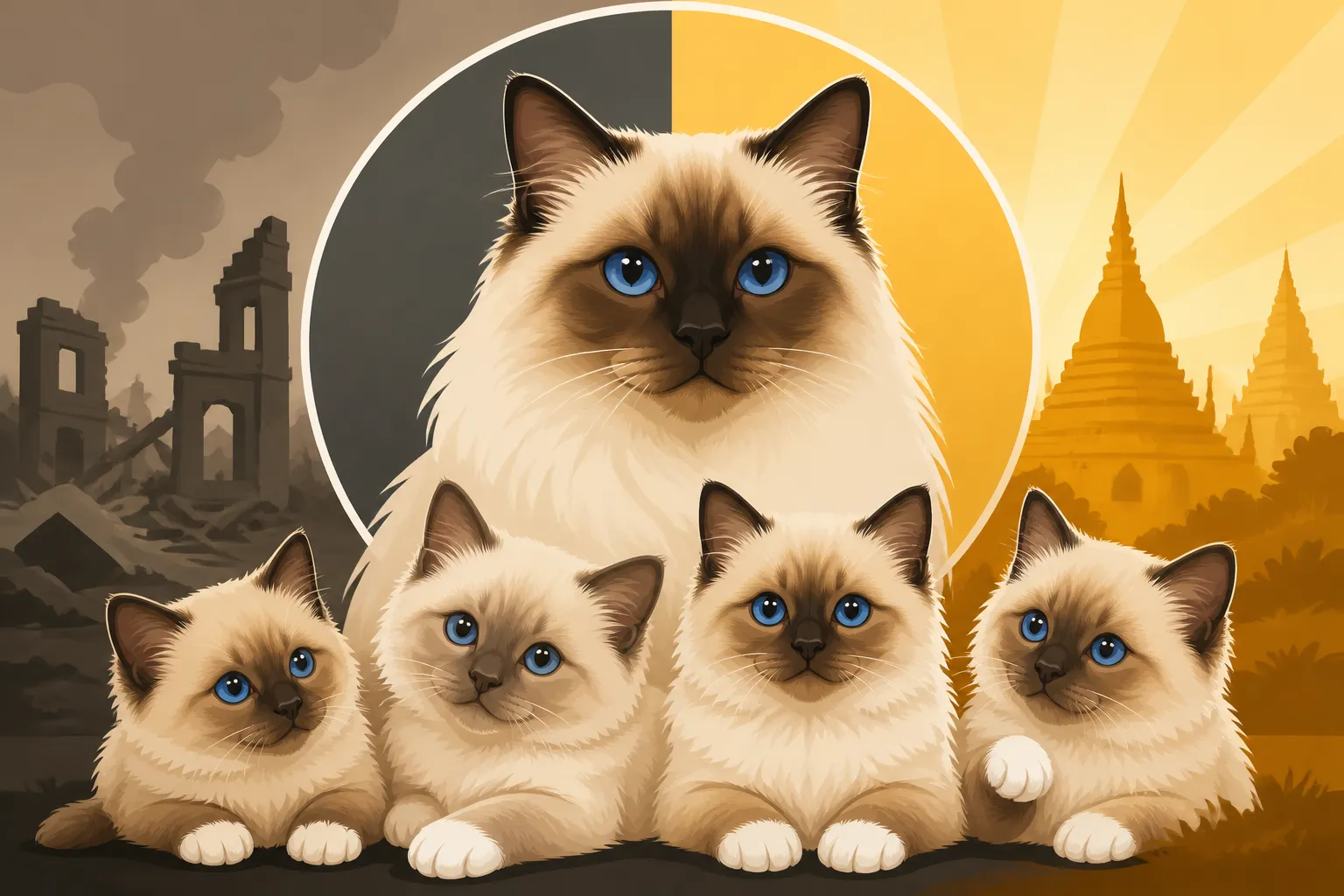
The Birman nearly disappeared in Europe during the Second World War, leaving breeders with a tiny foundation from which to rebuild the breed. The story is often reduced to two surviving cats, but the kittens that followed—and the careful outcrossing behind them—were just as important. Here’s what is known about those early litters and how they helped restore the Birman.
The cats at the center of the postwar recovery
Orloff and Xenia de Kaabaa were the foundation pair
Accounts of the Birman’s postwar recovery commonly name two surviving cats: Orloff and Xenia de Kaabaa. They are remembered as the essential foundation pair in France after the war, when the breed’s numbers had fallen so drastically that simply mating surviving Birmans together could not reliably rebuild a healthy population.
That means the phrase “the kittens that rebuilt the Birman” can be a little misleading. The kittens were not a single, well-documented group that restored the breed all at once. Instead, the recovery depended on offspring from a very small number of surviving cats, followed by further matings and outcrosses over multiple generations.
Names and details in breed histories are not always presented consistently. Some accounts focus on the two adult survivors; others describe the kittens and later crosses more generally. The broad point is clearer than a complete kitten-by-kitten roster: Orloff and Xenia provided the starting point, but their descendants needed careful breeding before the Birman could again be established as a recognizable, sustainable breed.
For a wider look at why so much depended on so few cats, see The Birman Came Out of the War With Two Cats Left and Which Two Cats Rebuilt the Birman.
The first litters were a beginning, not a finished breed
A small litter could increase the number of cats, but it could not immediately restore the full Birman population. A recovering breed needs enough unrelated or carefully managed bloodlines to reduce the risks of repeatedly breeding close relatives. It also needs kittens that can carry forward the features breeders are trying to preserve, including the pointed coat, white gloves, and characteristic overall type.
Picture a breeder with only a handful of suitable cats. Even if a litter contains several healthy kittens, the breeder cannot simply pair every kitten with a sibling or parent and expect the population to become robust. Each generation has to be considered as part of a longer plan. That is why the postwar story is about successive generations, not just the first litter.
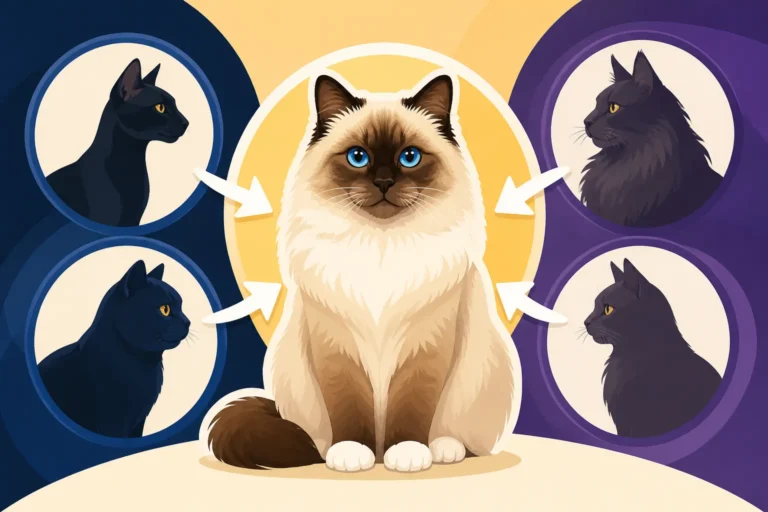
The kittens born to or descended from the surviving cats helped keep the Birman going. But some of the cats used in those early generations were not pure Birmans. Breeders used other longhaired cats to expand the available breeding stock, then selected and bred their descendants toward Birman type. Which Longhairs Rebuilt the Birman After 1945 looks more closely at those outcrosses.
How breeders used kittens and outcrosses to rebuild the breed
Outcrossing increased the number of available breeding cats
When a breed’s population becomes extremely small, outcrossing can offer a practical route to recovery. In the Birman’s postwar rebuilding, breeders used other cats—often described in breed histories as longhairs such as Persians, with Siamese also mentioned in accounts of the breed’s development—to widen the available pool.
This did not mean that every kitten from an outcross was automatically considered a Birman. An outcross kitten might have some of the appearance breeders wanted, but appearance alone could not establish that it met the breed’s developing type or could contribute reliably to future generations. Breeders had to choose which cats to retain and how to pair them.
Outcrossing also involved trade-offs. It could supply useful genetic variety and increase the number of cats available for breeding. At the same time, it could introduce traits that breeders did not want to retain, or produce kittens whose appearance did not match the Birman standard. The work was not simply “add another breed and the Birman returns”; it required selection over several generations.
A quick way to understand the process is to separate the roles of the cats involved:
| Part of the recovery | What it contributed | Why it mattered |
|---|---|---|
| Orloff and Xenia de Kaabaa | The surviving Birman foundation | Their descendants gave breeders a starting point |
| Outcross cats | Additional breeding stock and genetic variety | The surviving Birman population was too small to rebuild on its own |
| Selected offspring | Traits breeders wanted to preserve | Not every kitten was suitable for continuing the line |
| Later generations | Increasingly consistent Birman type | Repeated selection helped the breed become recognizable again |
Selecting kittens meant balancing appearance and ancestry
Breeders rebuilding a breed cannot make decisions from photographs or coat color alone. A kitten might show attractive points or white feet yet still be a poor choice for a particular breeding plan. Conversely, a kitten that did not look perfectly finished as a youngster might have valuable traits or ancestry that made it worth considering.
With the Birman, the challenge was especially delicate because its distinctive white gloves are an important feature. Breeders had to work toward consistent markings while also managing the broader shape, coat, and color pattern of the breed. Kittens from early recovery matings could vary, and their adult appearance did not always make their future breeding value obvious when they were very young.
That is one reason it is difficult to answer the title question with a neat list of famous kitten names. The historical significance belongs to the kittens and descendants that carried the lines forward, not necessarily to a small set of individually celebrated animals. The most useful account follows the breeding process: the surviving pair, the outcrosses, and the selected offspring that helped make later generations more consistent.
The first generations were not instantly purebred again
The phrase “pure Birman litters resumed” can sound as if the breed returned to normal in one step. In practice, breeders needed time to produce generations that met the expected type and came from breeding plans recognized as sufficiently established. That involved careful choices about which descendants to mate and which traits to retain.
This distinction matters because a kitten can be part of the story of rebuilding without being considered a purebred Birman in the same way as a later kitten from established Birman lines. The early generations helped bridge the gap between a dangerously small surviving population and a breed that could again be maintained through planned breeding.
The recovery was therefore gradual. Breeders were not simply restoring a label; they were trying to preserve the Birman’s identity while bringing the population back from the brink. When Pure Birman Litters Resumed and How Long the Birman Took to Breed True Again explore those stages in more detail.
What the surviving cats’ descendants changed
A small foundation shaped the modern breed
When a modern breed descends from a very small number of foundation cats, those ancestors can have a lasting influence. The Birman’s recovery made the choices breeders faced unusually consequential: the surviving cats and selected outcross descendants contributed to the lines from which later Birmans were developed.
That history does not mean every Birman today is closely related in the everyday sense of being a sibling or first cousin. Generations of breeding have passed. It does mean that a narrow starting population can leave a long shadow in a breed’s ancestry, particularly when many later cats trace back to a limited group of founders.
A small foundation also makes it important to distinguish visible breed traits from genetic diversity. A line can look consistent while still having a limited ancestral base. For readers interested in that longer-term consequence, How Two Cats in 1945 Shaped the Birman's Health explains why the postwar bottleneck matters beyond the historical rescue story.
The story is about persistence as much as pedigree
It is tempting to imagine a dramatic moment when one litter appeared and the Birman was saved. The actual story is less tidy and more human: breeders had to work with scarce animals, choose among variable kittens, and keep making decisions that supported the breed across generations. There was no guarantee that every litter would produce the qualities they hoped to preserve.
The kittens mattered because they gave breeders choices. A kitten could carry forward desirable features, contribute a new combination of traits, or help make a line more viable. Yet each choice had to be considered in the context of the population as a whole. A beautiful kitten was not enough if the mating plan created other problems; a useful breeding cat had to fit into a longer strategy.
That is why the postwar Birman history is best understood as a rebuilding effort rather than a single rescue litter. Orloff and Xenia de Kaabaa are remembered as the foundation pair, but the kittens and descendants produced through subsequent breeding—and the outcross cats that supported that work—made recovery possible. Why Birman Breeders Had to Outcross covers the reasoning behind those decisions.
What to take away from the kitten story
There is no simple, complete list of rebuilding kittens
If you are searching for the names of every kitten that helped rebuild the Birman after the war, you may find that accounts emphasize different details. The clearest shared outline is that two surviving cats, commonly identified as Orloff and Xenia de Kaabaa, formed the core of the postwar foundation. Their descendants and selected outcrosses were then used over successive generations.
It is more accurate to describe the recovery as a chain of breeding decisions than to credit one named litter with restoring the breed. The kittens mattered, but so did their parents, the outcrosses, and the breeders’ choices about which cats should reproduce. Without that wider context, the story can make the process sound much faster and simpler than it was.
The best short answer is this: the Birman was rebuilt by kittens descended from the surviving foundation pair, alongside offspring from carefully chosen outcrosses. Those cats were bred and selected over time until Birman type could be established again.
The history explains why responsible breeding looks beyond appearance
The postwar recovery also offers a useful lesson for anyone thinking about cat breeding today. Maintaining a breed is not only about producing kittens that look right. Breeders have to consider ancestry, health, temperament, and the long-term strength of the population. A narrow founder base makes those considerations especially important.
For prospective owners, the story is a reminder to ask thoughtful questions about a kitten’s background and the breeder’s approach. Historical accounts cannot tell you the health status of an individual cat, and ancestry alone is not a guarantee of future health. But a breeder who can explain their lines, their goals, and how they make breeding decisions is giving you a clearer picture than someone who talks only about appearance.
The Birman’s survival was not the work of one miraculous litter. It was the result of surviving cats, selected kittens, carefully managed outcrosses, and generations of persistence. That is what made it possible for the breed to return after the war.
Disclaimer
This article is for general informational purposes only and does not constitute professional advice. Laws, prices and regulations vary by location and change over time. Consult a qualified professional for guidance on your specific situation.