Why Birman Breeders Had to Outcross
A Birman’s graceful white gloves can make the breed seem as though it has always had a settled, carefully documented history. It hasn’t. The Second World War left European Birman breeding with an extremely narrow base, so breeders used outcrosses to rebuild the population and restore healthy, recognizable cats. Here’s why that decision was necessary, what it involved, and what it means for the breed today.
Why Birman breeders faced a crisis after the war
The surviving population was too small to rebuild on its own
The Birman’s early history in Europe is often told through a handful of cats and catteries. Whatever the details of the breed’s earliest origins, its European population was already limited before the Second World War. The war then disrupted breeding programs, separated people from their animals, and left very few cats available to continue the lines.
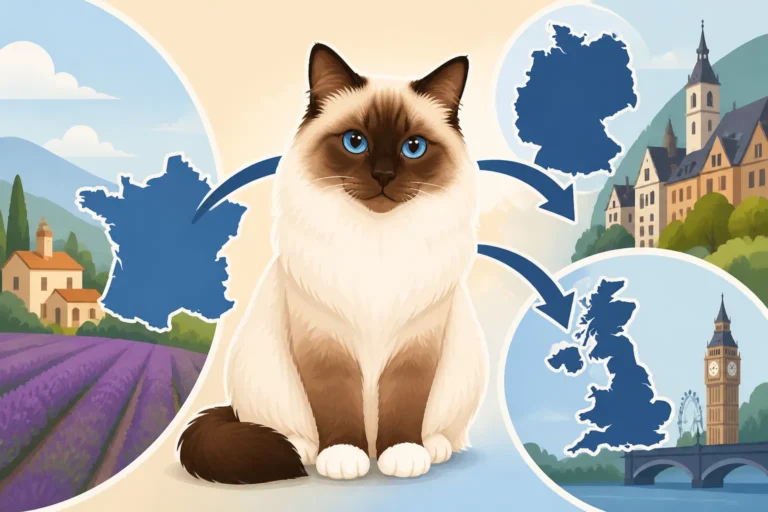
The breed is often described as having been reduced to two surviving cats in France. That phrase captures the scale of the crisis, but it can make the rebuilding sound simpler than it was. Breeders were not starting with two cats that could produce a lasting, healthy population by themselves. They were facing a tiny and closely related pool, with few options for pairing cats without further narrowing the gene base.
A population can’t be sustained just because a few cats remain. Breeders need enough unrelated or less-related animals to make pairings over multiple generations. Otherwise, they risk concentrating inherited problems along with desired traits, and they have limited room to make careful choices about health, temperament, and type. A few survivors could preserve a trace of the breed, but they could not immediately restore a robust breeding population.
The postwar emergency is explored further in The Birman Came Out of the War With Two Cats Left and How Two Cats in 1945 Shaped the Birman's Health. Those histories help explain why breeders could not simply resume normal breeding with the cats already on hand.
Repeatedly pairing close relatives would have created serious risks
When a breed’s population is very small, breeders may feel pressure to mate whatever cats are available. But repeated close-relative pairings can raise the chance that kittens inherit two copies of harmful recessive variants. They can also reduce genetic diversity, leaving future breeders with fewer options for avoiding health problems while maintaining the breed’s defining features.
That does not mean every kitten from a close mating will be unhealthy, or that every outcross will produce healthy kittens. Genetics is not that tidy. The concern is population-wide: when the same limited set of ancestors appears repeatedly in pedigrees, the overall gene pool can become more restricted, and inherited traits—both wanted and unwanted—may become more common.
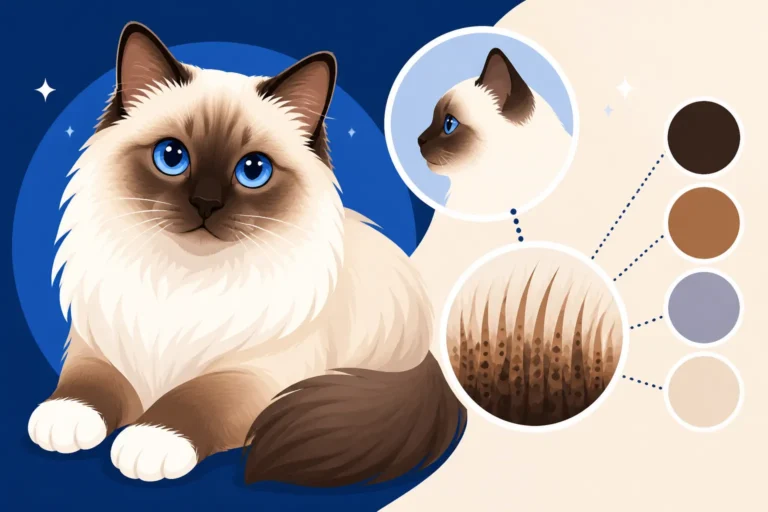
Breeders also needed to preserve the Birman’s recognizable identity. They were not trying to create an entirely different cat. They needed to expand the breeding base while retaining the traits associated with the Birman, including its colorpoint pattern, blue eyes, long coat, and white feet. That was a balancing act, not a quick fix.
For more on the longer-term consequences of a small founding population, see What a Narrow Founder Base Left in the Birman and How Narrow the Birman's Founder Base Really Was.
What outcrossing meant in practice
Breeders used other cats to widen the pool
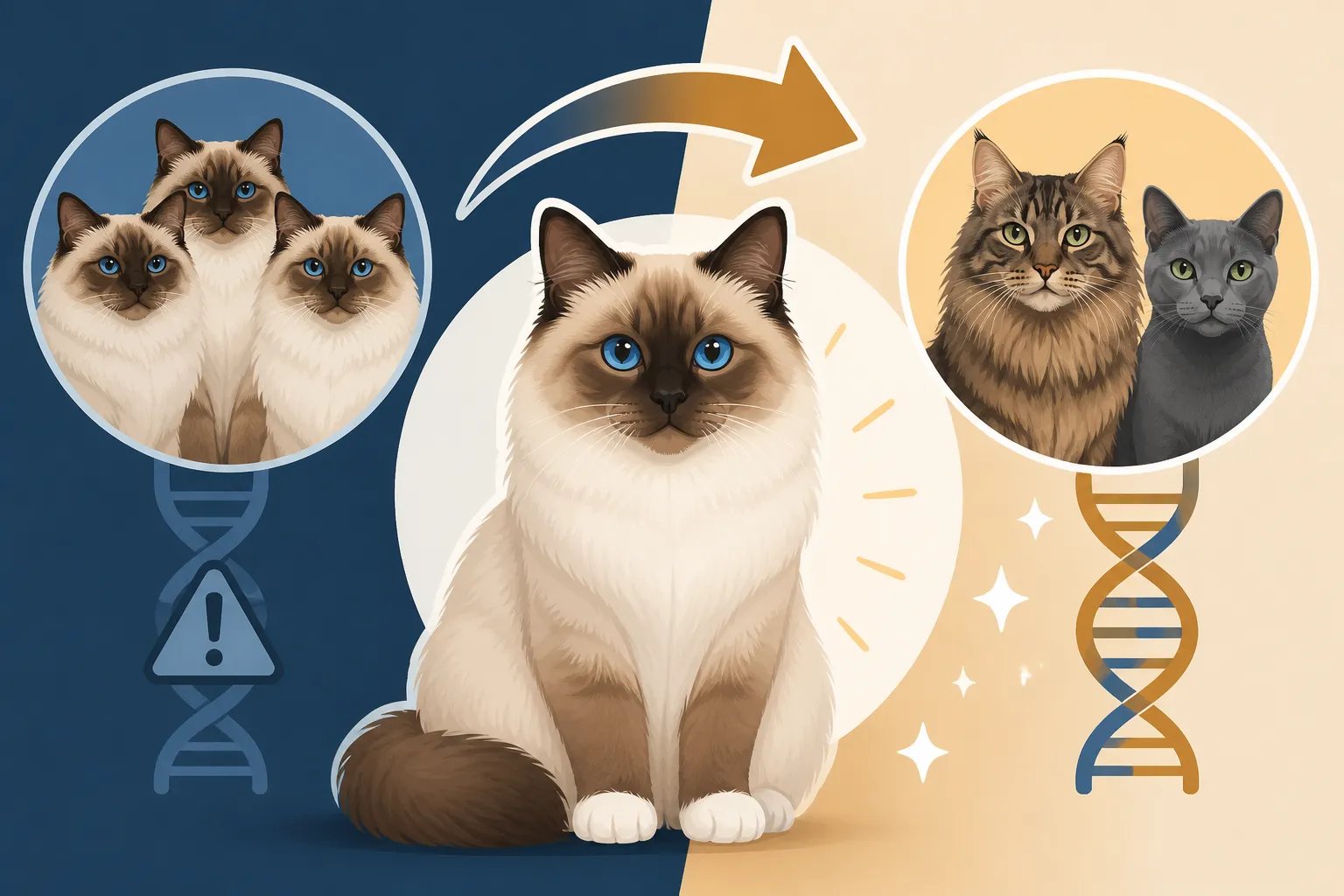
Outcrossing means mating a cat from one breed or population with a cat outside that breeding line. In the Birman’s postwar recovery, breeders used other cats to increase the number of available ancestors and make it possible to continue breeding without relying only on the few remaining Birmans.
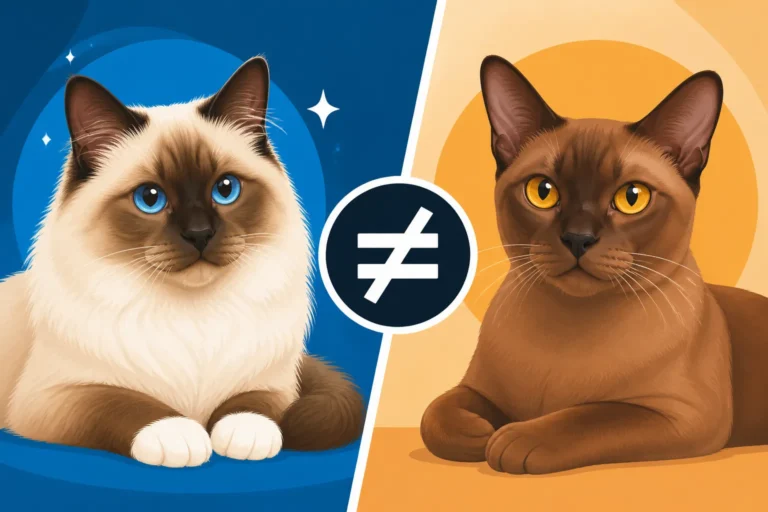
Accounts of the reconstruction commonly name Persians and Siamese among the breeds used in outcrossing. The exact details of individual matings and lines are not always presented consistently, so it is unwise to imagine one uniform plan followed by every breeder. The broad point is clearer: the surviving Birman population was too small, and cats from outside the remaining lines helped rebuild it.
Those outcrosses offered more than a way to increase kitten numbers. They gave breeders additional genetic material and more possible pairings. At the same time, they brought variation that breeders would have to manage. Some kittens might not have the coat, body, markings, or other characteristics expected of a Birman. Rebuilding meant selecting carefully over successive generations, not simply crossing two cats and declaring the problem solved.
The postwar work is covered in Which Longhairs Rebuilt the Birman After the War and Which Breeds Were Crossed In to Save the Birman. These histories describe the broad role of outcrossing without suggesting that every modern Birman has an identical mix of ancestry.
It took selection across generations to restore the breed
An outcross is only the beginning of a breeding process. If breeders want to preserve a recognizable breed, they must assess kittens and later generations for both health and the traits that define the breed. That means making choices over time: which cats are suitable to breed, which pairings offer useful diversity, and which traits should be retained or discouraged.
A kitten from an outcross might resemble a Birman in some ways and differ in others. Some characteristics can appear immediately; others may be harder to predict. Breeders then have to decide whether a cat contributes something valuable to the recovery effort and whether it is appropriate to use in the next generation. The work is gradual because a stable breed type cannot be recreated in one litter.
This also explains why the breed did not simply return to its prewar state overnight. Breeders had to rebuild a population, then continue selecting toward the Birman’s established appearance and characteristics. It is a useful reminder that breed history is not just a story of beautiful cats; it is also a story of choices made under pressure, with consequences that can continue for generations.
For a closer look at how outcrossing affected the breed, read What the Outcrossing Brought Into the Birman and Whether the Birman's Gene Pool Has Widened Since.
| Postwar challenge | Why it mattered | How outcrossing helped |
|---|---|---|
| Very few surviving breeding cats | The remaining population could not support many independent pairings | Added cats from outside the limited Birman lines |
| Close relationships among available cats | Repeated close matings could increase the risk of inherited problems | Created more potential combinations for breeders to consider |
| Need to preserve Birman type | New ancestry could introduce traits that did not match the breed | Allowed gradual selection for recognizable Birman characteristics |
| Uncertain long-term genetic variety | A small founding group can shape a breed for generations | Expanded the ancestry available to later breeding decisions |
What the outcrosses changed and what they did not
Outcrossing added options, not a guarantee of health
It is tempting to treat outcrossing as a magic reset button. It isn’t. Introducing new ancestry can widen a population’s genetic options, but it does not automatically remove all inherited disease risks or guarantee that every line will be healthy. Outcomes depend on the cats used, the traits they carry, and the breeding decisions made afterward.
A broader ancestry can give breeders more choices when planning matings. That matters because responsible breeding involves more than selecting for coat color or appearance. Breeders also need to consider health history, temperament, and the relatedness of potential parents. Having more possible pairings can make those decisions less constrained than they would be in a tiny closed population.
But the history of outcrossing does not mean a prospective owner can assume that every modern Birman line has the same health profile. Lines differ, and responsible breeders should be able to discuss the health information relevant to their cats. A buyer can ask what health screening is performed, whether records can be reviewed, and how the breeder makes decisions when a result or family history raises a concern. Which Results a Birman Breeder Must Put in Writing offers useful context for those conversations.
Some outcross traits were selected out while others remained
Outcrossing can introduce characteristics that breeders do not want in the finished breed. A cat may have ancestry that helped broaden the population but may not itself match the desired appearance. Breeders can select subsequent generations for the established Birman type, gradually reducing the prominence of traits that do not fit their goal.
That selection process does not mean every characteristic from an outcross disappears. Inherited traits can be complex, and some genetic contributions may remain in a breed even when they are not visible in an individual cat. Appearance alone cannot reveal a full pedigree or predict every inherited health risk.
It is also important not to turn the Birman’s postwar history into a simplistic claim that today’s cats are “part Persian” or “part Siamese” in a fixed, measurable way. The breed’s rebuilding involved historical outcrosses, followed by generations of selection and breed development. The ancestry of an individual cat is best understood through its documented pedigree, not assumptions based on the breed’s general history.
What the history means for Birman owners today
Ask about the individual line, not only the breed story
The postwar reconstruction is valuable context, but it is not a substitute for learning about the kitten or adult cat in front of you. If you are speaking with a breeder, ask about the parents’ health, the tests or examinations relevant to that line, and how the breeder keeps and shares records. A responsible answer should be clear and specific, rather than relying on the vague assurance that the breed has been around for a long time.
You can also ask how the breeder considers relatedness when planning a litter. That question connects directly to the breed’s narrow historical base, but it does not require you to become a genetics expert. You are looking for evidence that breeding decisions are thoughtful, documented, and focused on more than appearance.
If you are adopting an adult Birman, ask for available veterinary records and family information. Not every rescue or rehoming situation will have a complete pedigree, and that does not make the cat any less worthy of a home. It simply means you and your veterinarian may need to make health decisions based on the information that is available.
Make the transition home easier with practical preparation
A move can be a lot for a cat, even one with a calm reputation. Before bringing a Birman home, ask what food the cat currently eats and what litter it is used to. Keeping those familiar at first can make the change less abrupt. If you need to switch products, doing so gradually and watching the cat’s appetite and litter habits can help you spot a problem early.
It can also help to have the basics ready before arrival: a quiet resting place, food and water bowls, a suitably sized litter box, a comb, and a secure carrier. If you are comparing places to buy ordinary supplies, Chewy is one retailer some owners use to check product availability alongside local pet shops. The important part is choosing items that suit your cat and confirming any food or care changes with your veterinarian when needed.
For a newly arrived cat that seems unsettled, avoid changing everything at once. A familiar food, a predictable feeding spot, and a quiet room can make the first days easier. You can look at Chewy’s listings when planning a restock, but check product labels and compare them with what your breeder or veterinarian recommends rather than buying based on a breed label alone.
That same practical approach applies to grooming and routine care. A Birman’s coat may look high-maintenance, but regular gentle combing is usually more useful than a dramatic grooming overhaul. If you need to replace a comb or stock up on a familiar food, Chewy can be one option to compare with other retailers; your cat’s comfort, tolerance, and veterinary needs should guide the choice.
The reason Birman breeders had to outcross is ultimately straightforward: the surviving population was too small to rebuild safely and sustainably using only the remaining cats. Outcrossing gave breeders more options, while careful selection across generations helped re-establish a recognizable breed. That history is neither a reason to distrust every modern Birman nor proof that every line is identical. It is a reason to value thoughtful breeding, clear records, and informed care.
Disclaimer
This article is for general informational purposes only and does not constitute professional advice. Laws, prices and regulations vary by location and change over time. Consult a qualified professional for guidance on your specific situation.