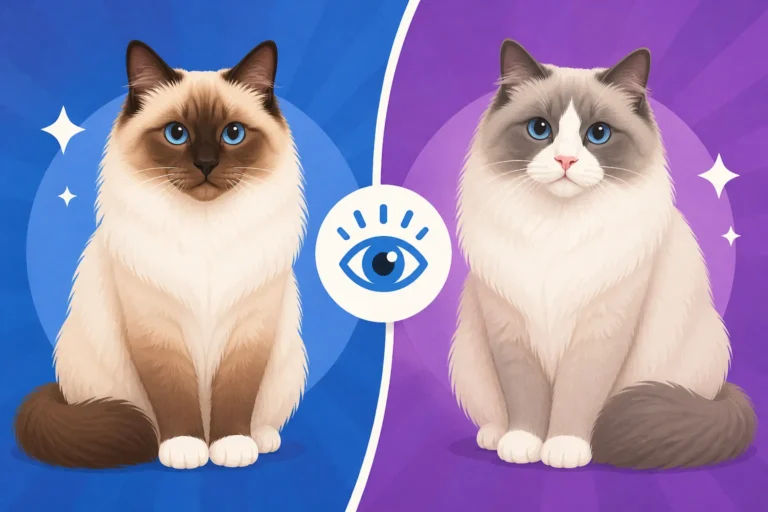
Whether a Tabby Point Birman Is Recognized
A cat may have the Birman’s blue eyes, colorpoint coat and white gloves, yet show striped markings on its face and legs. That can make its breed status confusing: “tabby point” may be accepted by one registry and treated differently by another. This guide explains what the label means, how recognition varies, and what to check on a cat’s pedigree.
What tabby point means on a Birman
Tabby point describes the pattern, not a separate breed
A tabby point Birman has darker, striped markings on the colorpoint areas of its body, usually the face, ears, legs and tail. The rest of the coat is lighter, and the cat retains the Birman’s characteristic white feet, often called gloves. The same pattern may also be called lynx point in some countries or by some registries.
“Tabby point” does not mean the whole cat has a typical all-over tabby pattern. The stripes are most visible on the points, where the coat color is concentrated. The body remains pale by comparison, although its shade can deepen with age, temperature and other factors. The colorpoint effect itself is part of the Birman’s recognizable appearance; Why a Birman Is Always Pointed and Never Solid explains that feature in more detail.
The exact appearance can vary. A seal tabby point, for example, has dark brown markings that may show clear tabby stripes. A blue tabby point has cooler gray-blue markings. In both cases, the overall pattern is still colorpoint, with the tabby pattern showing most strongly in the darker areas.
Tabby point is different from tortie point
A tortie point Birman has patches of two colors in its points, often a combination of a base color and red or cream. A tabby point has stripes or other tabby patterning in the points. Some cats can have both tabby and tortie patterning, and their color descriptions may include more than one term.
These labels can sound like fine distinctions when you are simply admiring a kitten, but they matter when you are checking a pedigree or show entry. A breeder might call a cat “lynx point” in everyday conversation while its registration paperwork uses a different color name—or does not recognize that color in the breed at all.
The Birman’s white gloves are a separate part of its appearance from the point pattern. A cat can have visible stripes and still have the characteristic white feet. To understand how the white markings are evaluated, see How a Birman's Gloves Are Scored and Why the Birman Legend Explains the White Gloves for related background.
Is a tabby point Birman officially recognized
Recognition depends on the registry
There is no single worldwide authority that sets every Birman color rule. Cat registries publish their own standards, and the accepted colors can differ between organizations and countries. As a result, a tabby point Birman may be recognized for registration or showing by one organization but not accepted in the same way by another.
It helps to separate three questions that are often mixed together:
- Can the cat be registered as a Birman?
- Is its color or pattern listed as accepted by that registry?
- Can it compete in a particular show class under that registry’s rules?
A “yes” to one does not automatically mean a “yes” to all three. A cat may have Birman ancestry and paperwork but be ineligible for a particular color class. Conversely, a registry might accept the color pattern while still requiring the cat to meet the breed’s other standards, including its body type, coat, eye color and white markings. Which Point Colors the Birman Standard Allows is a useful companion when you are comparing accepted colors.
| Question | What to check |
|---|---|
| Is the cat registered as a Birman? | The registry name and the breed recorded on its pedigree |
| Is tabby or lynx point accepted? | That registry’s current Birman color list and standard |
| Is the cat eligible for a show class? | The show rules and class descriptions for that registry |
| Does the seller’s color label prove registration? | No. A color description is not the same as a pedigree |
Because standards can be revised, check the registry’s own published rules rather than relying only on an old forum post, breeder advertisement or retailer category. A listing on Chewy, for example, could use a familiar color description for shoppers, but a retail label does not establish whether a cat is recognized by a breed registry. The same applies to descriptions on other pet-product sites or classified listings.
“Recognized” can mean different things in different settings
A breeder may use “recognized” to mean that the color is an accepted Birman variety in a registry. A show exhibitor may mean that a cat can compete in a specific class. A pet owner may simply mean that the cat looks like a Birman and has papers. Those meanings overlap, but they are not interchangeable.
If you are considering a kitten, ask the breeder which organization registered the parents and which organization will issue the kitten’s pedigree. Then ask for the exact registered color names, not just “tabby point” or “lynx point.” If showing matters to you, confirm directly with the relevant registry or show organization that the color is accepted for the intended class.
A product or adoption listing can be useful for describing appearance, but it is not a substitute for registration records. Chewy’s product categories, for instance, are designed for shopping rather than judging breed standards. Treat a listing’s color wording as a casual description unless it is backed by pedigree paperwork and the relevant registry’s rules.
How to verify a cat’s color and pedigree
Start with the paperwork, not the photo
Photos can help you notice stripes, point color and white markings, but they rarely settle registration questions. Lighting can make blue points look gray or nearly charcoal, and a kitten’s markings can become more distinct as it matures. Angles and filters can also make white feet appear uneven or obscure small markings.
Ask to see the pedigree and identify the registry that issued it. Check that the cat is recorded as a Birman, and look for the color designation entered by the registry. If the wording differs from the breeder’s description, ask for an explanation. The difference may be a harmless everyday-versus-official naming issue, or it may point to a genuine question about whether the color is accepted.
It is also reasonable to ask whether the breeder’s description refers to a registered color, a visual pattern, or a pet-market label. Those distinctions are especially useful if you hope to show or breed the cat. Which Registries Recognize the Birman Today offers background on why the issuing organization matters.
Ask specific questions before choosing a kitten
Instead of asking only, “Is this a recognized tabby point Birman?” try questions that lead to checkable answers:
-
Which registry issued the parents’ pedigrees?
Get the organization’s name and confirm that the documents identify the cats as Birmans. -
What color is recorded on the pedigree?
Ask for the official wording. A breeder’s preferred term may not match the registry’s label. -
Does that registry accept this color for Birmans?
Check the registry’s standard or contact it directly if the color list is unclear. -
Is the kitten eligible for registration and for showing?
These can be separate issues, so ask both questions if show participation matters. -
Can I see the relevant paperwork?
A responsible breeder should be able to explain the records and answer questions about what they mean.
A breeder who says “it is recognized everywhere” without naming the registry is not giving you enough information to verify the claim. Similarly, a Chewy listing or a seller’s online post can help you understand the appearance being described, but neither replaces a pedigree or a registry’s written standard.
Look at the whole Birman, not only the stripes
Tabby markings alone do not confirm that a cat is a Birman. The breed’s overall appearance includes a colorpoint coat, blue eyes and white gloves, along with a characteristic body and head type. An animal can resemble a Birman without having verified Birman ancestry, and a pedigree can clarify what a photograph cannot.
The pattern itself can also be less obvious in a young kitten or in a photo taken under warm indoor lighting. If you are unsure whether you are seeing tabby markings, ask for clear photographs in natural light and the cat’s registered color details. How a Birman Kitten's Points Come In gives more context on how point coloration develops as kittens grow.
When a retailer’s description differs from a breeder’s or registry’s wording, focus on the source and purpose of the label. Chewy may be useful for shopping-related categories, but its labels should not be treated as a breed-standard decision. For that, the registry’s records and rules are the relevant references.
What to do if the answer is still unclear
Contact the registry that issued the pedigree
If the breeder’s answer and the paperwork do not line up, contact the registry named on the pedigree. Give them the registered breed and color, and ask whether that color is recognized for Birmans under their rules. If you are asking about show eligibility, include the show organization or event rules as well.
This is more reliable than trying to infer official status from a search result, social media post or product listing. It also helps you avoid a common misunderstanding: the same cat may be described differently in casual conversation, registered under a specific color code, and treated differently for show purposes.
If the kitten has no pedigree, you can still describe its appearance accurately, but you may not be able to verify that it is a registered Birman. A cat with blue eyes, pointed markings and white feet may look very convincing; those traits alone do not prove documented ancestry. How to Tell a Birman From a Ragdoll by Its Feet can help with visual comparisons, but appearance is not a replacement for registration records.
Decide what recognition means for your plans
If you are choosing a companion, the most important things may be the cat’s health, temperament, care needs and whether its history is represented honestly. Formal color recognition may matter less to you than knowing what the paperwork says and what the breeder can substantiate.
If you plan to show the cat, register a litter or continue a breeding program, confirm the rules before making a decision. A kitten’s color may be attractive and perfectly suitable as a pet even if a particular registry does not accept it for a show class. The practical question is not simply whether tabby point Birmans exist, but whether the specific registry and purpose you care about recognize that color.
So, a tabby point Birman may be recognized, but recognition is registry-specific. Check the organization named on the pedigree, verify the color against its Birman standard, and distinguish official registration from the descriptive language used by breeders or retailers.
Disclaimer
This article is for general informational purposes only and does not constitute professional advice. Laws, prices and regulations vary by location and change over time. Consult a qualified professional for guidance on your specific situation.