How a Birman Differs From a Ragdoll on Sight
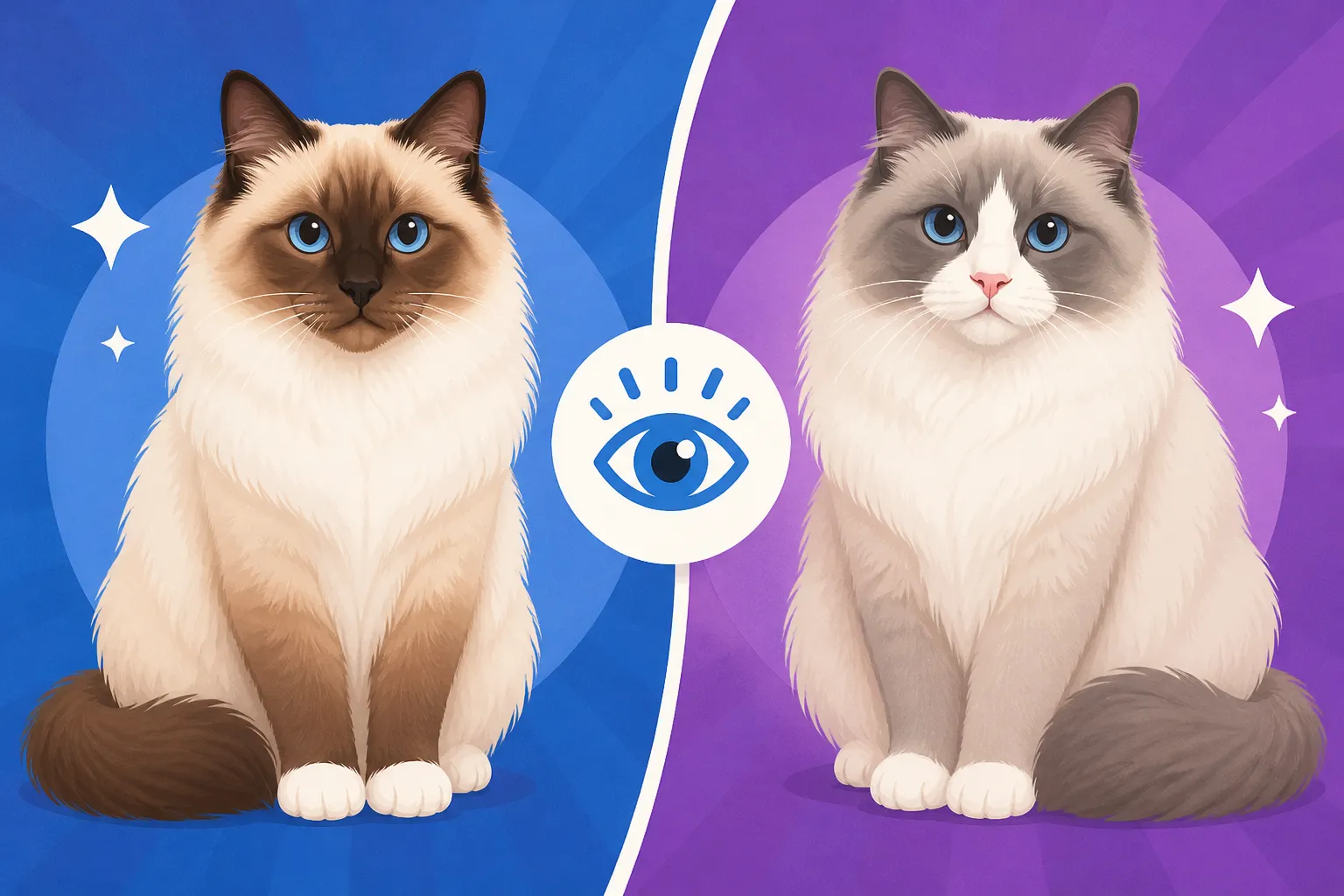
A Birman and a Ragdoll can look remarkably alike: both have blue eyes, pointed coats, and soft, semi-long fur. That resemblance makes quick identification tricky, especially in kittens or photos. The most useful clues are the white markings on the paws, the cat’s overall build, and the shape of its face—but no single feature proves a cat’s breed.
Start with the paws and coat pattern
Birman gloves are the clearest clue
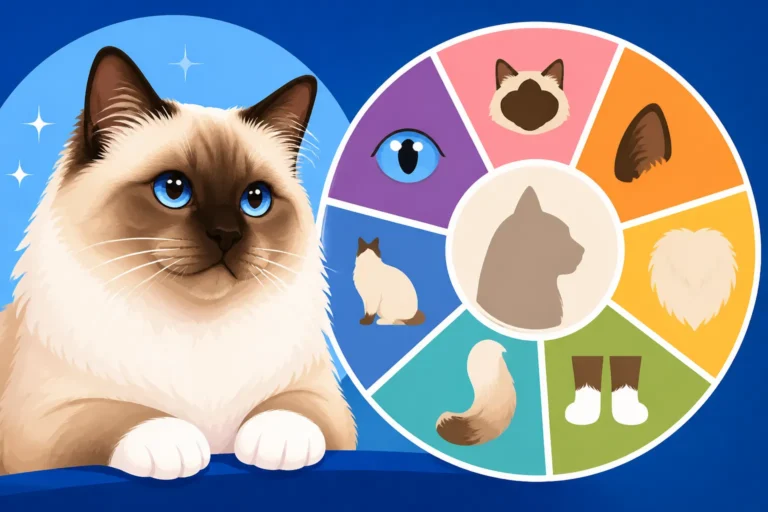
A Birman’s signature feature is its white feet, traditionally called gloves. The white should appear on all four paws, while the rest of the coat follows a colorpoint pattern: darker coloring on the face, ears, legs, and tail, with a lighter body. On the front paws, the white marking generally ends in a neat line across the foot. On the back paws, the white may extend farther up the heel into a tapered marking called a lace.
That pattern can be an excellent clue when you’re looking at an adult cat with all four feet visible. Still, real cats don’t always have perfectly symmetrical markings. A Birman can have uneven gloves or a lace that does not reach the ideal point; imperfect markings don’t automatically mean the cat is another breed. For show-specific details, see How a Birman's Gloves Are Scored.
Ragdolls can also have white paws, particularly in the mitted pattern, so “white feet” alone are not enough to identify a Birman. Look at how the markings relate to the rest of the cat’s pattern. A mitted Ragdoll may have white mittens, a white chin, and a strip of white running along the belly. A bicolor Ragdoll often has a prominent white inverted V on the face, as well as more extensive white on the body. A colorpoint Ragdoll, meanwhile, may have no white markings at all.
For a closer look at the most useful paw differences, How to Tell a Birman From a Ragdoll by Its Feet explores what to check beyond simply spotting white toes.
Compare the whole pattern, not just one patch of white
Both breeds come in several point colors, and overlapping colors can make coat color a poor shortcut. Seal, blue, chocolate, and lilac points, for example, can appear in both breeds. The pattern and distribution of white are often more informative than whether the points look brown, gray-blue, or pale.
Birman standards call for the characteristic white gloves. Ragdolls are recognized in colorpoint, mitted, and bicolor patterns, which means the amount and placement of white can vary considerably. If a cat has a conspicuous white facial blaze or a large white chest and belly, that can fit a Ragdoll pattern more readily than the usual Birman appearance. But markings can be irregular, and a photograph may hide important details.
Color can still help when considered alongside the paws and build. The Birman’s body is usually pale compared with its points, though the shade can deepen with age and other influences. To see which colors are accepted for the breed, explore Which Point Colors the Birman Standard Allows. Treat that information as one piece of the identification puzzle, rather than a color-only test.
Look at the body and face
A Ragdoll usually has a larger, more substantial frame
Ragdolls are generally larger and more substantial-looking than Birmans. They often have a broad chest, a long body, and a strong overall appearance. Birmans are medium-sized cats with a balanced build: not delicate, but typically less imposing than a mature Ragdoll. When the two cats are standing side by side, the difference in size and body mass may be easier to notice than it is in separate photos.
There’s an important catch: young cats have not finished growing. A kitten or adolescent Ragdoll may look smaller than an adult Birman, and coat volume can make a cat seem bigger than its actual frame. A very fluffy Birman may also look more substantial in a portrait than it does when you see its body moving around the room. Use size as supporting evidence, not a deciding rule. For a fuller discussion of the difference in stature, see Why a Birman Is Smaller Than a Ragdoll.
Photographs are especially unreliable for judging scale. A cat close to the camera can look enormous; one photographed beside a large piece of furniture can look small. If you’re comparing pictures, pay more attention to the feet, face, and body proportions than to apparent size alone.
Check the profile, but don’t expect a dramatic difference
A Birman is often described as having a Roman nose: a gently rounded or convex profile rather than a sharply straight line. It’s a subtle feature, best assessed from the side. A clear profile photo can help, but the angle, lighting, and individual cat all affect how the nose looks. The nose alone cannot confirm breed. Why a Birman's Roman Nose Is Judged in Profile explains what that feature means in a breed-standard context.
The faces of both breeds can look soft and rounded, particularly when their ruffs are full. A Birman’s expression is generally framed by a balanced head and medium features. Ragdolls may look broader or more substantial in the head, in keeping with their larger build, but there is individual variation. Don’t expect every Birman to have one unmistakable face shape or every Ragdoll to look identical.
Eye color is not a reliable way to separate them. Both breeds are known for blue eyes, and the exact shade can vary from cat to cat. A pale blue eye doesn’t settle the question, nor does a deep blue one. Look at the markings and outline of the whole cat instead.
Compare fur, outline, and proportions
Both have soft semi-long coats, but the texture can differ
At a glance, both breeds have the flowing coat associated with longhaired or semi-longhaired cats. A Birman’s coat is typically described as silky and relatively easy to comb, with a ruff around the neck and longer fur on the tail. Its coat may lie closer to the body than a Ragdoll’s fuller-looking coat, which can give the Birman a more defined outline.
A Ragdoll’s coat can look plush and abundant, particularly around the neck and hindquarters. Coat fullness varies with age, season, and the individual cat, so a neat-looking Ragdoll or a particularly fluffy Birman can complicate the comparison. Also, grooming and coat condition affect appearance. A cat that has recently been brushed may look sleeker; mats or shedding can change the outline. For a more detailed comparison of coat texture and appearance, see How a Birman's Coat Differs From a Ragdoll's.
If you’re checking a cat in person, watch how the coat moves rather than judging only its volume. A silky coat may fall in a smoother line, while a fuller coat can create a softer, rounder silhouette. Neither observation is conclusive, but together with the paw markings and body shape, it can help.
Judge proportions while the cat is standing or walking
A standing view can reveal features that a face-on portrait hides: the length of the body, the shape of the legs, and where any white markings continue. If possible, observe the cat walking naturally rather than trying to pose or handle it. A photo of all four paws—especially the backs of the hind legs—can be more useful than a close-up of the face.
When comparing proportions, bear in mind that the coat can obscure the body. A thick ruff can make the neck seem shorter, and long fur around the legs can hide how much of the paw is white. Perspective can also distort the outline. A side view taken at the cat’s level is generally more helpful than a shot from above.
For an at-home comparison, note each feature rather than reaching a conclusion from the first impression:
| Feature | Birman clue | Ragdoll clue |
|---|---|---|
| White paws | White gloves on all four feet are characteristic | White feet may occur in the mitted pattern |
| Hind-leg markings | A tapered white lace may extend up the back of the hind foot | White markings depend on the pattern and may include a belly stripe |
| Face markings | Usually point-colored, without a large white facial blaze | Bicolor cats often have a white inverted V |
| Body | Medium-sized and balanced | Often larger and more substantial |
| Coat outline | Silky, often with a smoother fall | Frequently looks fuller or more plush |
| Eye color | Blue | Blue |
Use the table as a set of clues, not a checklist that guarantees a result. A Ragdoll’s mitted feet can look Birman-like, and a cat with mixed ancestry may combine features from both breeds.
Identify the cat responsibly
Use several clues and allow for uncertainty
The strongest visual identification comes from a combination: all-four-paw gloves, a typical Birman pattern, a medium balanced build, and a silky coat can point toward a Birman. A larger frame, a mitted or bicolor pattern, and a fuller-looking coat can point toward a Ragdoll. But there is no single visual feature that makes identification certain.
Age matters, too. Kittens may not yet show their adult proportions or full coat, and their developing points can change the overall impression. A cat seen in a shelter or online listing may also be a mix, even if it resembles a pedigree breed. In those cases, “Birman-like” or “Ragdoll-like” may be more accurate than a confident breed label.
If you’re deciding whether to adopt or buy, ask what evidence supports the breed identification. Pedigree records from a reputable registry are more informative than appearance alone. A DNA test may offer clues about ancestry, but it should not be treated as a substitute for documented pedigree when a specific registered breed is important to you.
Make the comparison practical at home
If you’re comparing two cats in person, keep it simple. First, look at all four paws, including the back of the hind legs. Next, check the face for extensive white markings. Then step back and compare the cats’ proportions, while remembering that age and camera perspective can mislead. Finally, consider coat texture and fullness as supporting clues.
For a cat that won’t sit still, take a few clear photos in natural light rather than trying to restrain it. A side view, a front view, and a picture of each set of paws can help you revisit details later. If you need basic grooming supplies to part the coat gently and inspect the markings, retailers such as Chewy may be one place to look; choose a simple comb that suits the cat’s coat and introduce it calmly.
Keep the experience low-pressure. A cat doesn’t need to be held upside down to inspect its feet, and forcing a nervous animal can make the task harder for everyone. If you’re already caring for the cat, a routine weigh-in and regular grooming can also help you notice changes in body condition or coat health. Chewy is one possible source for a pet scale or grooming tools, though a veterinary clinic can advise you on what is appropriate for your individual cat.
Ultimately, appearance is useful for narrowing down possibilities, not for proving ancestry. If breed identity affects adoption paperwork, breeding decisions, or a purchase, ask for records and verify them with the relevant organization. For everyday companionship, though, the visual distinction matters less than whether the cat’s needs, temperament, and care requirements fit your home. If you’re weighing those broader differences, Whether a Birman and a Ragdoll Behave Alike is a useful next read.
Disclaimer
This article is for general informational purposes only and does not constitute professional advice. Laws, prices and regulations vary by location and change over time. Consult a qualified professional for guidance on your specific situation.