Who Orloff and Xenia de Kaabaa Were
When people encounter the names Orloff and Xenia de Kaabaa in a Birman pedigree, they can sound like early breeders or aristocratic owners. They were cats: the pair most often credited with helping rebuild the Birman breed in France after the Second World War. Their story matters, but it is also easy to oversimplify.
Who Orloff and Xenia de Kaabaa were
The names belonged to cats, not breeders
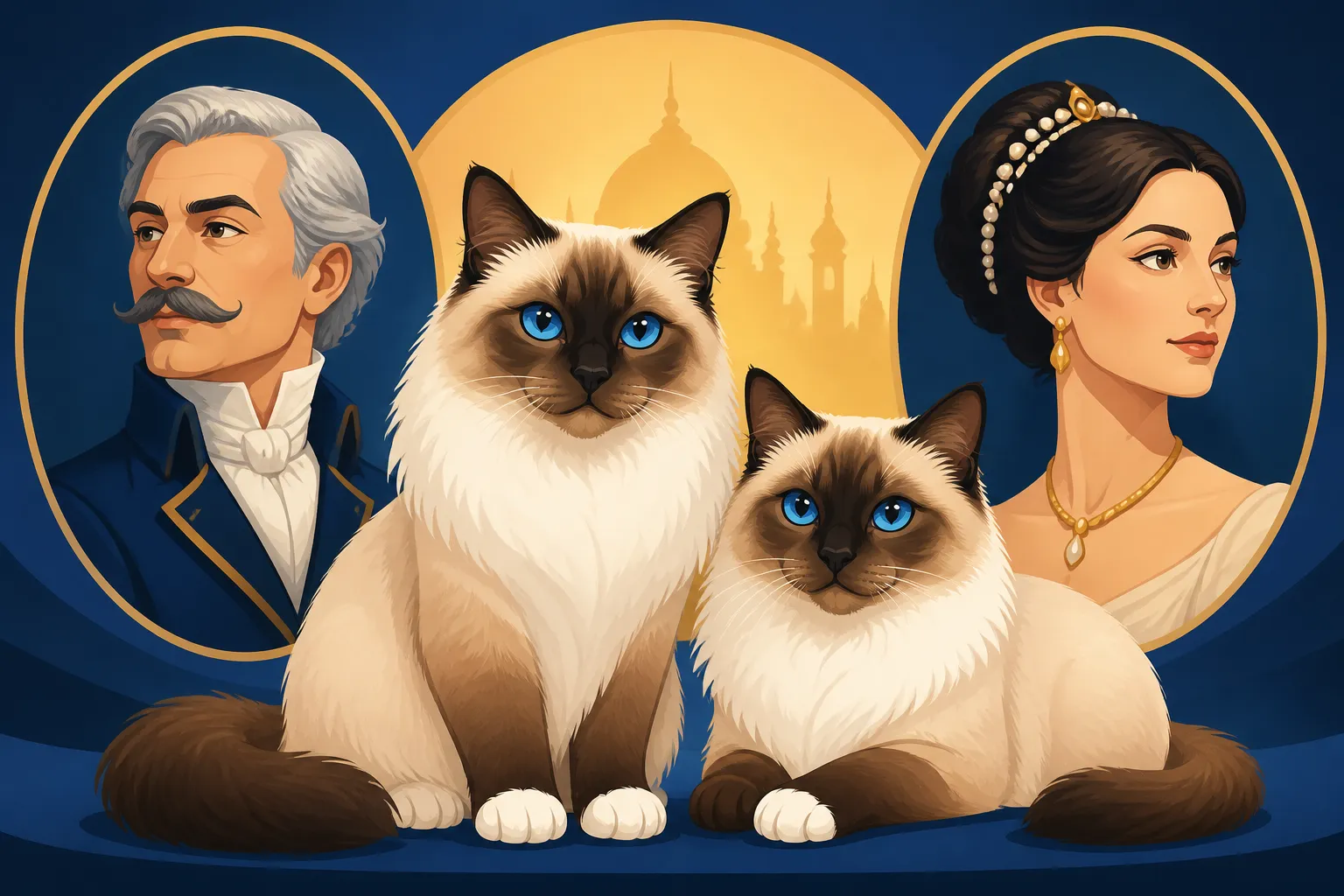
Orloff and Xenia de Kaabaa are remembered as the two Birman cats left after the Second World War who helped form the foundation of the breed’s postwar recovery. Orloff is generally identified as the male and Xenia as the female. The name “de Kaabaa” is part of Xenia’s name as it appears in accounts of the breed’s history; it is not the name of one of the two cats’ human co-founders.
That distinction is useful because histories of the Birman often move quickly between cats, catteries, owners and breeders. A reader can see “Orloff and Xenia de Kaabaa” and reasonably assume the names refer to a couple who saved the breed. They do not. They are the cats at the center of the familiar postwar founder story.
The accounts commonly agree on their importance, while offering less consistent detail about the pair’s exact circumstances, ownership and breeding records. It is best to treat the broad point as the established story and be cautious with unusually precise claims that are not supported by a pedigree or a reliable breed-history record. For a wider look at the breed’s wartime losses, see How Many Birmans Survived the Second World War.
Why two cats became such important figures
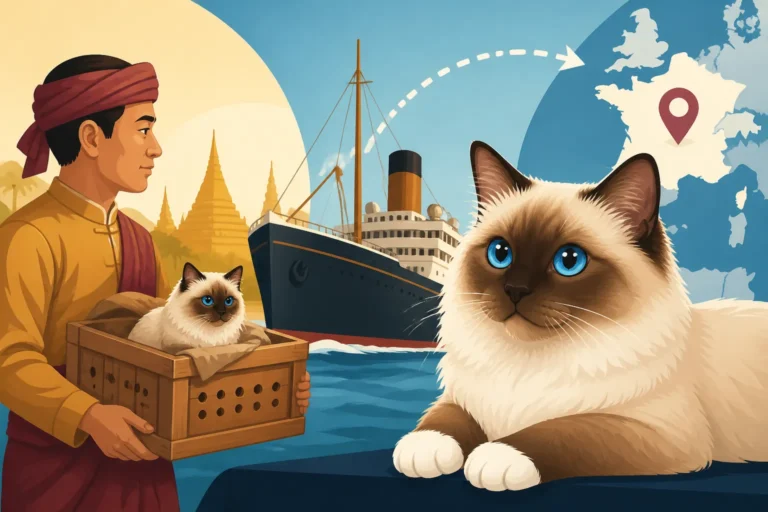
The Birman was already an established breed in Europe before the war, but wartime conditions disrupted breeding programs and left the breed’s population dangerously small. In the familiar account, Orloff and Xenia de Kaabaa were the only surviving Birmans available to rebuild the postwar population. With so few cats to work from, breeders faced an immediate problem: two animals alone could not produce a healthy, sustainable population without careful breeding and additional cats.
That is why the story is not simply “two cats had kittens and the breed continued.” The pair were the foundation of a longer recovery effort. Breeders had to increase the number of cats while retaining the Birman’s defining appearance and temperament, and they used carefully chosen outcrosses as part of that work. The cats’ names became shorthand for the narrow starting point from which the postwar breed was rebuilt.
The phrase “two surviving Birmans” should not be read as proof that every later Birman was a direct, unbroken descendant of only those two cats. The population’s recovery involved outcrossing and subsequent generations of selection. The pair are central to the story because they represent the tiny surviving Birman base, not because they alone explain every branch of modern pedigrees. The Birman Came Out of the War With Two Cats Left explores that broader history.
| Name | What the name refers to | Why it matters | What not to assume |
|---|---|---|---|
| Orloff | A male Birman in the postwar founder account | He is one of the two cats commonly credited with helping restart the breed | That every modern Birman descends from him through an uninterrupted line |
| Xenia de Kaabaa | A female Birman in the same account | She is the other cat most often named in the recovery story | That “de Kaabaa” identifies a human breeder rather than part of her name |
| The pair together | The small Birman population available after the war, as described in breed histories | Their limited numbers explain why outcrossing became necessary | That two cats by themselves could restore a healthy breed population |
How the Birman was rebuilt after the war
The founder pair could not be the whole breeding plan
Breeding from a very small population creates practical and genetic challenges. If breeders simply mated close relatives generation after generation, the risk of inherited problems and reduced genetic diversity could increase. At the same time, the goal was not to produce cats that merely looked vaguely similar to Birmans. Breeders wanted to retain the breed’s recognizable features, including its pointed coat, blue eyes and white feet.
Outcrossing offered one way to increase the number of available breeding cats. In broad terms, breeders introduced cats from other longhaired breeds and then selected later generations for Birman traits. This was a demanding process: the offspring of an outcross would not automatically match the Birman standard, and preserving the breed’s characteristic markings required careful selection over multiple generations.
The details can be complicated, and simplified versions sometimes make it sound as if one particular cross instantly restored the breed. It did not. The rebuilding involved repeated breeding decisions, assessment of offspring and a gradual return to consistent Birman type. For a closer account of the cats and breeds involved, see Which Longhairs Rebuilt the Birman After 1945 and Which Breeds Were Crossed In to Save the Birman.
Why the breed needed time to breed true again
A cat breed is not re-established just because a few kittens look right. Breeders need to produce enough cats that reliably pass on the desired traits, while maintaining a population that can continue without depending on one or two closely related animals. That takes generations, not a single successful litter.
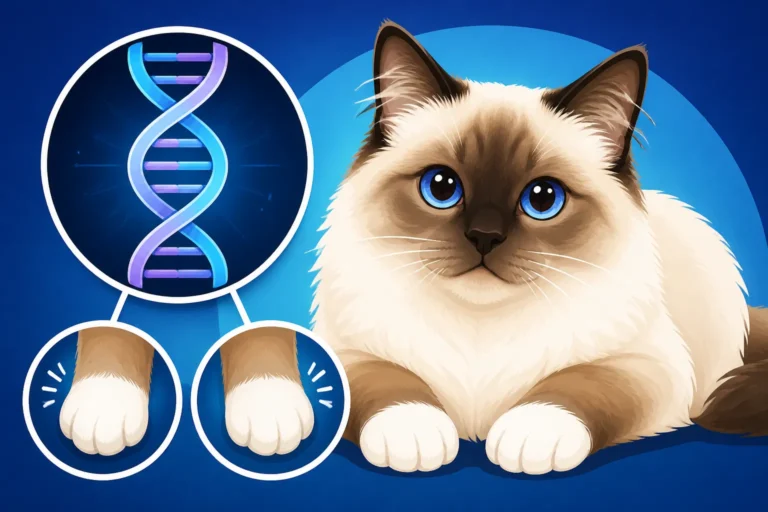
In the Birman’s case, the desired appearance also includes details that can be difficult to reproduce consistently. The white gloves and rear laces are especially distinctive, but the markings can vary between littermates. A kitten from Birman lines may have gloves that are too high, uneven or otherwise different from the ideal. That variability is one reason the breed’s recovery required selection over time rather than a quick return to its prewar numbers.
The breeding history is therefore both a story of survival and a reminder that a breed’s appearance can conceal a complicated ancestry. The postwar cats and their descendants helped restore the Birman, but the process also left a lasting influence on the breed’s genetic background. The history is covered in more detail in How Two Cats in 1945 Shaped the Birman's Health and What the Outcrossing Brought Into the Birman.
What Orloff and Xenia tell us about Birman ancestry
They symbolize a narrow founder base
Orloff and Xenia de Kaabaa matter because they make the Birman’s postwar bottleneck easy to understand. A “founder base” means the small group of animals that contributed to a population’s later generations. When that group is extremely small, many future cats may share ancestry, even when their pedigrees look different several generations later.
This does not mean that every Birman today is genetically identical, or that a pedigree can be reduced to two names. Later outcrosses and breeding choices added complexity. But when a population restarts from so few cats, the descendants can share more ancestry than people might expect. That is one reason breeders pay attention to pedigrees and health testing rather than relying on appearance alone.
For prospective owners, the history is a reason to ask thoughtful questions, not a reason to panic. A narrow historical founder base does not tell you that a particular kitten is ill or destined to develop a disease. It does explain why responsible breeding decisions and transparent health information are important. The broader background is discussed in What a Narrow Founder Base Left in the Birman and Whether the Birman's Gene Pool Has Widened Since.
Their story is not the same as a complete pedigree
It is tempting to think of Orloff and Xenia as the sole ancestors of all Birmans, but that phrasing leaves out the role of the outcrosses and later breeding generations. A pedigree is a record of named ancestors; a breed’s genetic history is the larger story of which animals contributed to the population and how their descendants were selected.
The distinction matters when comparing a historical account with a modern breeder’s paperwork. A breeder should be able to explain a kitten’s documented pedigree and provide relevant health information for the parents. The story of Orloff and Xenia gives context for the breed’s recovery, but it does not replace the records for an individual cat. For more on the historical foundation, see Which Two Cats Rebuilt the Birman and Why Post War Outcrossing Was Unavoidable for the Birman.
It is also worth remembering that romantic retellings can blur the difference between documented history and a compelling narrative. Orloff and Xenia are significant even without embellishment: their names are attached to the small surviving Birman population from which a determined breeding effort began. The careful version of the story is more informative than a claim that two cats alone recreated the breed in a single generation.
What a prospective Birman owner can take from this history
Ask about the individual cat, not only the breed legend
If you are choosing a Birman kitten, the postwar story can make a breeder’s answers about ancestry and health feel especially relevant. Ask to see the pedigree and discuss what health screening is appropriate for the line. A responsible breeder should be willing to explain the paperwork in plain language and distinguish between tests performed on a particular cat and general information about the breed.
You can also ask how the breeder evaluates temperament, how kittens are raised and what support is provided after they go home. Those practical details tell you more about the kitten in front of you than a dramatic summary of the breed’s past. Historical significance and responsible modern breeding are connected, but one does not guarantee the other.
If you are comparing breeders, look for clear answers rather than sweeping assurances. “Our cats have never had a problem” is not as useful as specific records and an explanation of what the breeder does to make informed breeding decisions. A Birman’s gentle reputation and attractive markings should not distract from ordinary questions about veterinary care, socialization and family history.
Keep the history in perspective
Orloff and Xenia de Kaabaa are important because they represent how precarious the Birman’s survival became after the war. Their story also explains why the breed’s postwar recovery involved outcrossing and careful selection. It is a meaningful part of Birman history, but it should not be used as a shortcut for judging every modern cat or every breeder.
For a new owner, the useful takeaway is modest and practical: the breed has a complicated history, and a good breeder should be comfortable discussing it without turning it into a sales pitch. Look for documented information about the kitten and its parents, ask what health measures are relevant, and make decisions based on the individual cat’s needs. The founder story can deepen your appreciation of the breed, while the day-to-day reality of responsible care begins with the cat who comes home with you.
Disclaimer
This article is for general informational purposes only and does not constitute professional advice. Laws, prices and regulations vary by location and change over time. Consult a qualified professional for guidance on your specific situation.