How the Gloving Gene Interacts With the Point Pattern
A Birman’s white gloves and darkening points can look like parts of one unusual color pattern, but they come from different genetic instructions. That distinction helps explain why a kitten can be born nearly white, develop darker ears and tail as it grows, and still keep white feet. This guide breaks down how the gloving gene and point pattern work together.
Two genetic instructions create the Birman look
The gloving gene affects white markings
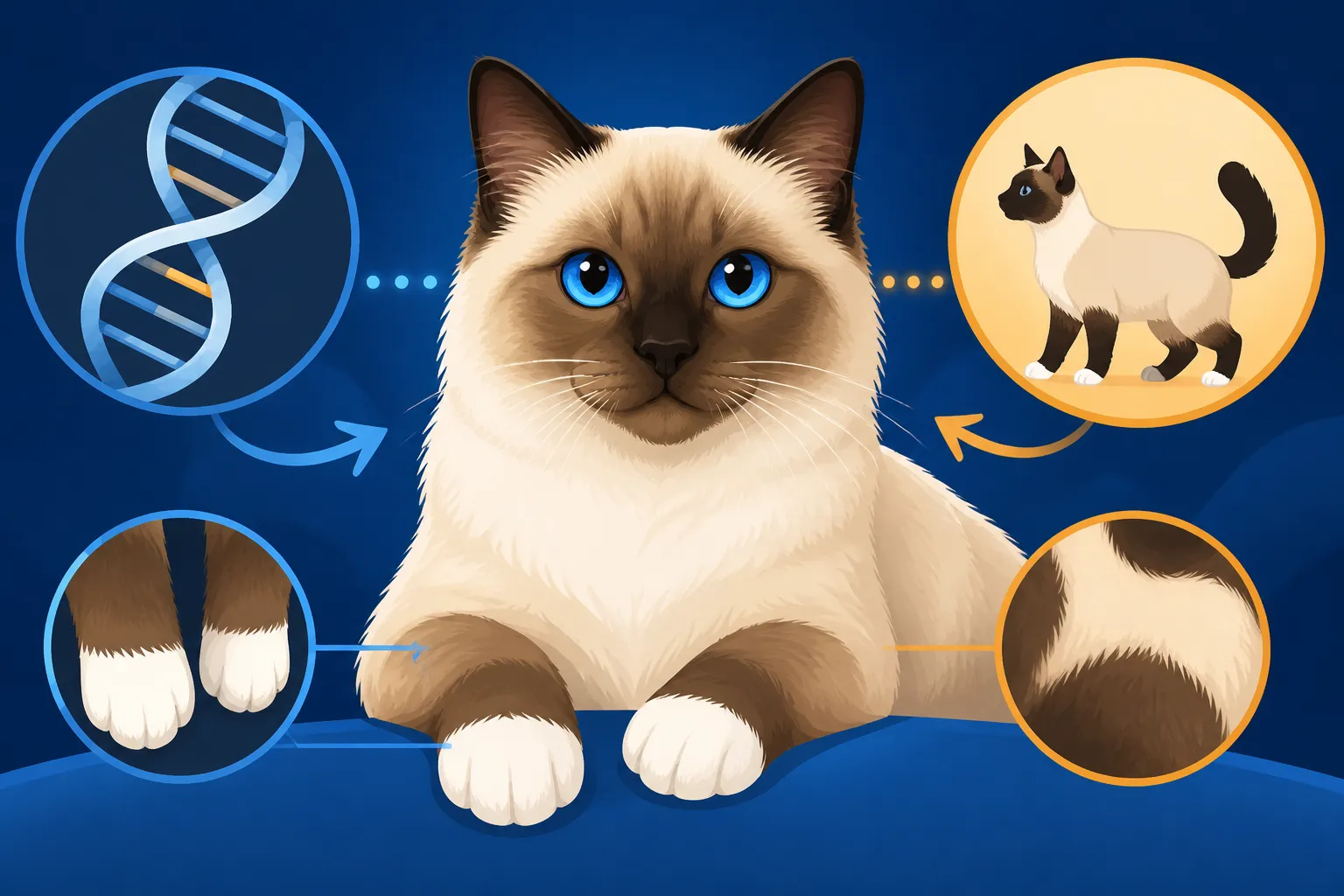
The Birman’s characteristic white feet are associated with a variant in the KIT gene. This is often called the gloving variant because it is linked to the white markings on the paws. It is separate from the gene responsible for the breed’s pointed coat pattern.
A Birman’s gloves are not simply lighter versions of its colored points. The white areas are markings, while the points are parts of the coat where pigment develops more strongly. That difference is why the paws can remain white even when the face, ears, legs, and tail gradually become darker.
For a closer look at the genetic role of this variant, see What the KIT Gloving Variant Does and How the Birman Gloving Variant Was Identified.
The point pattern affects where coat color develops
The Birman’s pointed pattern is associated with a temperature-sensitive form of the TYR gene. In practical terms, pigment develops more visibly in cooler parts of the body. The face, ears, feet, and tail are typically cooler than the central torso, so they develop darker coloring as the kitten grows.
This helps explain why Birman kittens are born mostly white or very pale. Before birth, the warm environment of the mother’s body limits visible pigment development. After birth, cooler areas begin to show the points, while the warmer body remains lighter. The changes happen gradually rather than appearing all at once.
The point pattern is not what makes the gloves white. A pointed coat can exist without Birman-style gloves, and white markings can arise through other genetic routes in other cats. The Birman’s distinctive appearance comes from the combination of its pointed coat and its characteristic paw markings. The title Why Every Birman Is Always Pointed and Never Solid explores the pointed pattern in more detail.
Different genes, different jobs
It can help to think of the two traits as separate instructions that operate on the same cat. The point-pattern instruction affects where coat pigment becomes more visible. The gloving instruction is associated with the white markings on the paws. Together they create the familiar contrast of colored points above white feet.
| Feature | Main genetic association | What you see |
|---|---|---|
| Point pattern | Temperature-sensitive TYR variant | Darker color on cooler areas such as the face, ears, legs, and tail |
| White gloves | KIT gloving variant | White markings on the paws |
| Pale body coat | Point-pattern expression across warmer areas | A lighter torso compared with the points |
| Overall Birman appearance | Combined expression of these traits | A pointed, pale-bodied cat with white feet |
The table is a simplified guide, not a complete explanation of every gene that can influence coat appearance. Other inherited factors can affect shade, contrast, and the exact shape of markings.
How the two traits appear as a Birman kitten grows
A kitten can be born pale without being unmarked
A newborn Birman may look almost entirely white, so it is easy to wonder whether the points or gloves will develop normally. The pale appearance is an expected part of the point pattern. The kitten’s coat is not yet showing the same visible pigment contrast it will have later.
The white gloves are also present as part of the kitten’s markings, even when the rest of the coat gives little visual contrast. As pigment begins to appear in cooler areas, the difference between the colored legs and white paws becomes easier to see. That is why a very young kitten’s appearance does not always give a clear picture of its finished coat.
The gradual change is described further in How a Birman Kitten's Points Come In. It is useful to distinguish this normal color development from the development of the white markings: the point color can deepen, but the gloves are not points waiting to darken.
Points deepen while the gloves remain white
As the kitten matures, its face mask, ears, legs, and tail usually become more clearly colored. The body often stays lighter by comparison, although the overall shade can change with age and environment. The paws remain visually distinct because the white markings are governed by the gloving trait rather than by the temperature-sensitive point pattern.
This difference can be confusing when a young cat’s gloves seem less sharply defined than an adult’s. Sometimes the contrast is simply easier to see once the surrounding coat has developed more color. That does not mean the point pattern has created the white, or that the white markings are changing into points.
A coat’s final appearance can take time to settle, and individual cats may vary in shade and contrast. If you are comparing a kitten with photos of adult Birmans, remember that lighting, coat length, and camera settings can also make the white and colored areas look different.
Point color and glove shape are not the same measure
A Birman’s point color may be seal, blue, chocolate, lilac, or another recognized color, but the color name does not determine whether its gloves are evenly shaped. Similarly, a cat may have a strongly colored face and tail while its white markings differ in size or placement from the ideal show pattern.
The genetic presence of a gloving variant does not mean every paw will look identical. Markings can vary in their edges and extent. Breeders and judges assess the visible pattern, while the genetic explanation describes the inherited basis associated with the trait. Those are related questions, but they are not interchangeable.
For more on why individual markings differ, read Why Birman Gloves Vary Despite the Fixed Gene. It helps clarify why a shared breed trait does not produce perfectly matching paws in every cat.
What inheritance can and cannot tell you
Birman gloves are a breed trait, not a coat-color switch
The gloving variant is commonly described as fixed in the Birman breed, meaning that Birman cats are understood to carry two copies of the gloving-associated variant. This is why the trait is closely associated with the breed. It does not mean the gloves are painted onto the coat in exactly the same shape in every kitten.
The point pattern follows a different genetic pathway. A Birman’s pointed appearance is not caused by the gloving variant, and the white feet are not caused by the point-pattern gene. The traits are inherited together within the breed’s overall genetic background, but each contributes a different part of the visible pattern.
The distinction matters when people discuss whether a kitten is “losing” its gloves as its points come in. The paws may look more contrasted as nearby fur darkens, but the development of point color does not turn the white markings into colored fur. How the Gloving Gene Works in a Birman offers more detail on how the trait is described genetically.
A DNA result does not grade a cat’s paws
A genetic test can provide information about a specific variant, but it cannot tell you whether a cat’s gloves will meet a particular show standard. A result about the KIT variant is not a photograph of the paws, a prediction of exact marking boundaries, or a guarantee that all four feet will be symmetrical.
This distinction is useful for prospective owners. If you are choosing a kitten as a companion, the appearance of the gloves may be a matter of personal preference rather than a health concern. If you are considering showing or breeding, ask the breeder how the kitten’s markings are being assessed and what documentation is available. The visible pattern and genetic paperwork answer different questions.
Likewise, a kitten’s point color and glove shape should not be treated as a reliable shortcut for assessing its health or temperament. Coat traits describe appearance and inheritance; a veterinarian evaluates health, and a responsible breeder should be willing to discuss the broader care and history of the line.
The point pattern does not make white feet a health warning
White paws are a normal and defining feature of the Birman’s appearance. Their presence alone is not a sign that something is wrong. Nor does the pointed pattern mean that a cat’s white gloves need special medical treatment.
Routine paw checks are still worthwhile for any cat. Look between the toes for debris, check the nails, and notice whether your Birman suddenly resists having a paw touched. A new limp, swelling, discharge, or persistent licking deserves attention because it may indicate an injury or another problem—not because the cat has white gloves.
If litter dust or staining is making the white fur look dingy, address the cause gently rather than using harsh whitening products. Some owners compare low-dust litter choices through retailers such as Chewy, but the best option is one your cat will use comfortably and that does not irritate its paws. A soft cloth and plain water may be enough for minor surface dirt; ask your veterinarian before using a cleaning product on irritated skin.
Understanding and caring for the pattern at home
Judge the coat in natural light
Indoor lighting can change how point colors appear. Warm bulbs may make pale fur look creamier, while dim rooms can make blue or lilac points seem darker. If you are documenting a kitten’s coat or comparing photos, use consistent natural light and take pictures from similar angles.
Avoid drawing conclusions from one image. A phone camera may brighten the white feet, deepen the dark points, or blur the edges between colors. A clear view of all four paws is more useful than a tightly cropped picture of one foot, especially if you are trying to understand how the markings differ.
If you are buying a kitten, ask to see the kitten in person when possible and to view recent photos of its paws. The coat can change as the kitten matures, and photos are helpful context rather than a guarantee of its eventual show appearance. The related guide Which Modifier Genes Affect a Birman's Gloves discusses why visible markings can vary despite the breed’s characteristic genetic background.
Keep the white feet clean without overdoing it
The white fur can show litter dust or everyday grime more readily than darker areas. A practical approach is to keep the litter area clean, choose litter that does not cling heavily to the coat, and check the paws during routine grooming. You do not need to bathe the whole cat just because the feet have picked up a little dust.
When comparing litter options on Chewy or another retailer’s site, look for clear information about dust and texture rather than choosing a product simply because it is marketed for white coats. If your Birman’s paws seem sensitive, or if redness appears between the toes, stop experimenting with scented or treated products and ask your veterinarian for advice.
A fine comb can help separate coat around the feet, but avoid pulling at knots or using scissors close to the skin. Chewy may be one place to browse basic grooming tools, while your veterinarian or groomer can advise you if a mat is tight or the skin looks irritated. For a cat that dislikes paw handling, make checks brief and calm: touch one paw, reward the cat, and continue another time rather than turning grooming into a struggle.
Keep expectations realistic as the coat matures
A Birman’s points and gloves tell two different parts of its coat story. The points become more visible in cooler areas as the kitten grows, while the white gloves remain a distinct marking associated with the KIT gloving trait. The color contrast may sharpen over time, but the two traits do not merge into a single genetic instruction.
That is the simplest way to make sense of the pattern: TYR is associated with the pointed distribution of pigment, while KIT is associated with the Birman’s white gloves. Their combined appearance gives the breed its familiar look, but neither gene alone explains every detail of an individual cat’s coat.
For additional background, see Why Every Birman Has Two Copies of the Gloving Gene and How the Birman Gloving Variant Interacts With the Point Pattern. Together, these topics help separate what is inherited from the way the finished markings look in an individual Birman.
Disclaimer
This article is for general informational purposes only and does not constitute professional advice. Laws, prices and regulations vary by location and change over time. Consult a qualified professional for guidance on your specific situation.