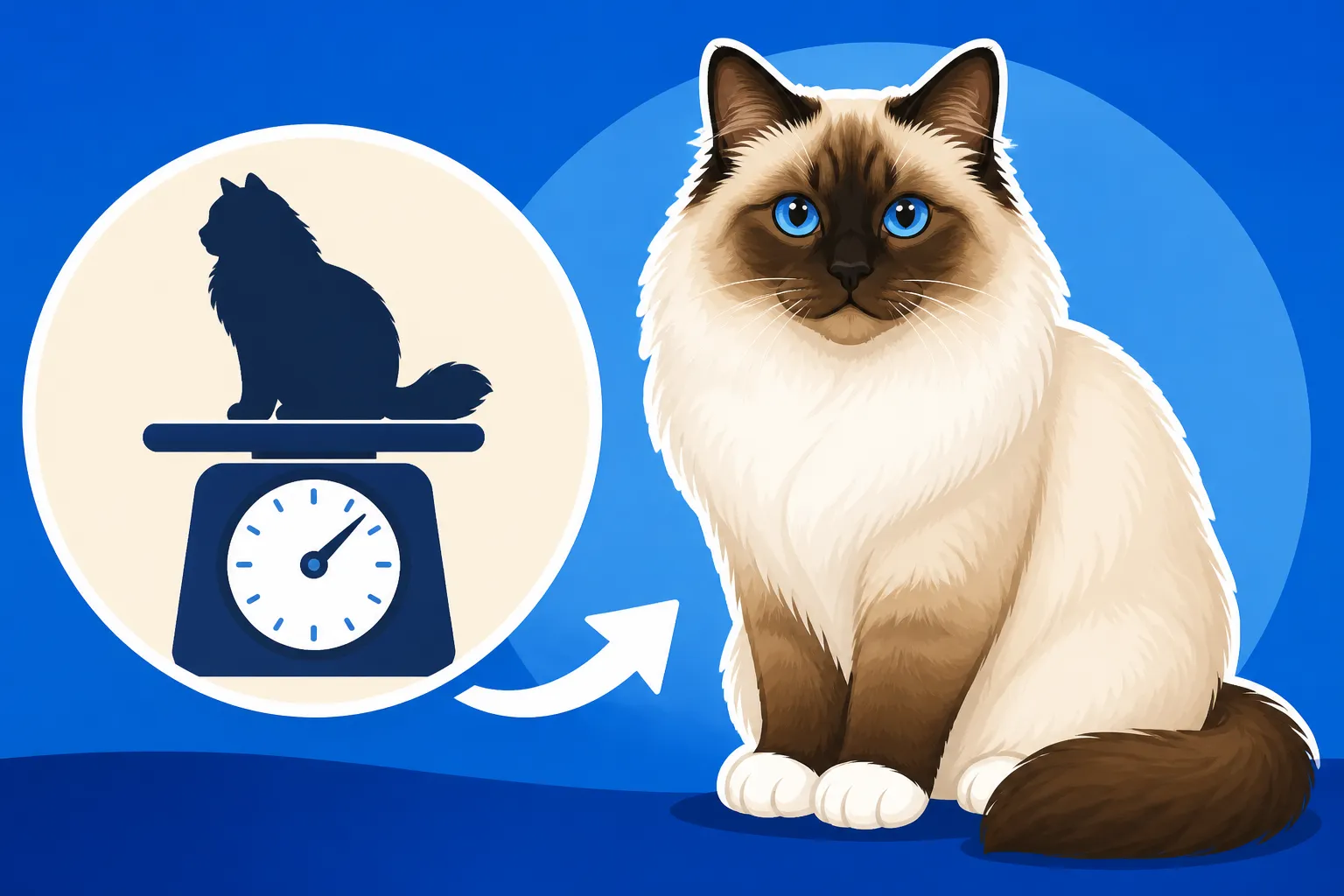
How Heavy a Full Grown Birman Tom Gets
A full-grown male Birman often weighs about 10 to 15 pounds, though some healthy cats fall outside that range. The tricky part is that a Birman’s long frame and thick-looking coat can make weight hard to judge by sight. This guide explains what the numbers mean, when a tom is fully grown, and how to tell whether his weight suits his build.
How much a full-grown Birman tom weighs
The typical adult male range
A mature Birman tom commonly weighs around 10 to 15 pounds, or roughly 4.5 to 6.8 kilograms. That’s a useful general range, not a pass-or-fail test. Two healthy males can have noticeably different builds, and a cat near the upper end is not automatically overweight.
Birmans are medium-to-large cats with a substantial, elongated body. A male may look bigger than a shorter or finer-boned cat at the same weight, while his coat can make his outline seem broader still. If you are trying to assess your own cat, compare his weight with his frame and body condition—not with a number you saw online or the weight of another Birman.
A tom weighing less than 10 pounds may be perfectly healthy if he is still growing or has a smaller frame. Likewise, a cat above 15 pounds may need an individual assessment rather than an automatic diet. If his weight is changing unexpectedly, or he seems unwell, ask your veterinarian to assess him.
Why some males weigh more than others
Genetics, frame size, muscle, age, activity, and neuter status can all affect a cat’s weight. A larger-framed male may naturally carry more mass than a smaller one, even when both have a visible waist and ribs that are easy to feel beneath a light layer of tissue. Muscle also weighs more than fat, so an active, solidly built cat can weigh more without having excess body fat.
Birman males may continue filling out after they have reached their apparent adult height and length. Their coat and ruff can also change how substantial they look through the seasons. A cat who appears especially fluffy in winter has not necessarily gained fat; use the scale and a hands-on check to separate coat from body condition.
For more context on how a Birman’s body develops, see Why a Birman Takes Three Years to Finish and How Much Smaller a Birman Queen Finishes. Females are generally lighter than males, but sex alone still cannot tell you whether an individual cat is at a healthy weight.
| What you notice | What it may mean | What to do |
|---|---|---|
| Your adult tom is within the usual range and has a defined waist | His weight may suit his frame | Keep tracking his weight and body condition |
| He is outside the usual range but looks and feels proportionate | His build may differ from the average | Ask your vet to assess his individual body condition |
| His weight is rising steadily without an obvious reason | Food intake, activity, or a health issue may be involved | Record the trend and discuss it with your vet |
| He is losing weight unexpectedly | Illness or another change may be affecting him | Arrange a veterinary check rather than waiting for a target weight |
| His ribs are difficult to feel and his waist is hard to see | He may be carrying excess body fat | Ask your vet about a safe feeding and activity plan |
When a Birman tom is fully grown
Adult-looking does not always mean fully finished
A Birman may look like a grown cat well before he has finished filling out. Height and length can appear settled while his body continues to develop in proportion and muscle. That gradual maturation is one reason a young male’s current weight should not be judged against the expected weight of a fully mature adult.
Kittens and adolescents also have changing needs. A young cat may be lean and lanky during one stage, then become more solid as he matures. That does not mean every increase is healthy, though: a quick upward trend alongside a less visible waist deserves attention, particularly if food portions or treats have also crept up.
If your Birman is still young, track the pattern instead of trying to rush him toward an adult number. Your vet can help interpret his growth in relation to age, frame, and body condition. The guide How Long a Birman Is Nose to Tail may also help you understand why a long-bodied cat can appear larger than the scale alone suggests.
Why weighing once is not enough
A single weigh-in is only a snapshot. It does not show whether your cat has been stable, gradually gaining, or losing weight. Regular measurements make those changes easier to spot—especially because a long coat can hide a slowly widening waist.
Try weighing your cat on the same scale under similar conditions. If he will sit still, a pet scale can be convenient. Another option is to weigh yourself, then weigh yourself holding your cat, and subtract your own weight. This method may be less precise if either of you moves, so repeat it a couple of times and use the same approach each time. When comparing equipment through retailers such as Chewy, focus on whether the scale has a stable platform and displays small changes clearly.
Write down the date and result, and bring the record to routine veterinary visits. You do not need to weigh him every day; a consistent schedule that your vet considers appropriate is more helpful than frequent readings that cause stress. If the number changes sharply or your cat is eating, drinking, or behaving differently, contact your vet rather than waiting for the next scheduled weigh-in.
How to tell whether his weight suits his body
Look and feel beneath the coat
The scale tells you how heavy your Birman is; it cannot tell you by itself whether that weight is appropriate. A body-condition check adds useful context. Looking from above, you should generally be able to make out a waist behind the ribs. From the side, the abdomen should not hang heavily, though the exact outline varies between cats.
Gently feel his ribs with your fingertips. They should be possible to find without pressing hard, but they should not feel sharply prominent. If you cannot feel them through the coat and tissue, or if there is little shape to the waist, excess body fat may be a concern. If the ribs, spine, or hips are conspicuous, or he seems to have lost muscle, that also warrants a closer look.
A silky coat can confuse the visual check in both directions. It may create the impression of a broad body even when the cat is lean, or conceal gradual weight gain around the middle. For a more detailed hands-on approach, see Finding a Birman's Waist Under That Ruff and What a Birman's Long Rectangular Frame Should Weigh. Your veterinarian can show you how to assess his condition without relying on appearance alone.
Watch for changes in everyday movement and grooming
Weight changes can show up in daily habits before they become obvious in photos. A cat who is gaining excess weight may be less inclined to jump, play, or groom hard-to-reach areas. He may also struggle to keep his rear or back tidy. These signs can have other causes, including pain or illness, so do not assume that weight is the only explanation.
Pay attention to the trend in his weight alongside his routine. Is he moving less? Does he stop grooming his back? Is his appetite different? Has he begun leaving food, or does he seem unusually hungry? Notes like these help your vet distinguish a feeding issue from a medical problem.
If a Birman who once groomed comfortably begins to leave his coat untidy, it is worth checking both his weight and his mobility. Why an Overweight Birman Stops Grooming Itself explains one possible connection, but a change in grooming should not be treated as proof of obesity.
Keeping a healthy Birman weight manageable
Measure meals and be mindful of extras
A quiet cat may not make it obvious when he is eating more than he needs. Measuring meals helps you know what he is actually getting, rather than estimating from a scoop or topping up a bowl whenever it looks low. Follow the feeding guidance for his food as a starting point, then ask your vet to tailor portions to his age, activity, body condition, and health.
Treats count too. A few small extras offered throughout the day can add up, especially in a cat who spends much of his time indoors. If several people in the household feed him, agree on who gives treats and how much, so well-meaning family members do not unknowingly double the daily allowance.
A predictable feeding routine can make portions easier to manage. Why a Birman Does Better on a Fixed Feeding Time offers related guidance, while How Quickly Treats Show on a Birman's Long Frame is useful if snacks are becoming a regular part of the day. Chewy may be one place you compare food or feeding supplies, but the right portion should be based on your cat and veterinary advice, not a product listing alone.
Make changes gradually and involve your vet
If your tom needs to lose weight, avoid sharply cutting his food or trying to make him drop weight quickly. Cats need a carefully managed plan, and rapid weight loss can be dangerous. Your veterinarian can help set a suitable goal and adjust feeding safely, particularly if your cat has another health condition or is already older.
Small, sustainable changes are often easier to maintain than a dramatic overhaul. You might measure meals more carefully, reduce unplanned treats, or add short play sessions that suit your cat’s energy and mobility. The point is not to push a Birman into strenuous exercise, but to create a routine that encourages comfortable movement.
If he is underweight or losing weight, do not simply offer more food and hope the problem resolves. Dental discomfort, digestive trouble, and other health issues can affect appetite and body weight. A vet can check for an underlying cause and advise what to do next. A sudden shift in weight—up or down—is more important than whether your cat happens to fall just outside a general breed range.
Disclaimer
This article is for general informational purposes only and does not constitute professional advice. Laws, prices and regulations vary by location and change over time. Consult a qualified professional for guidance on your specific situation.