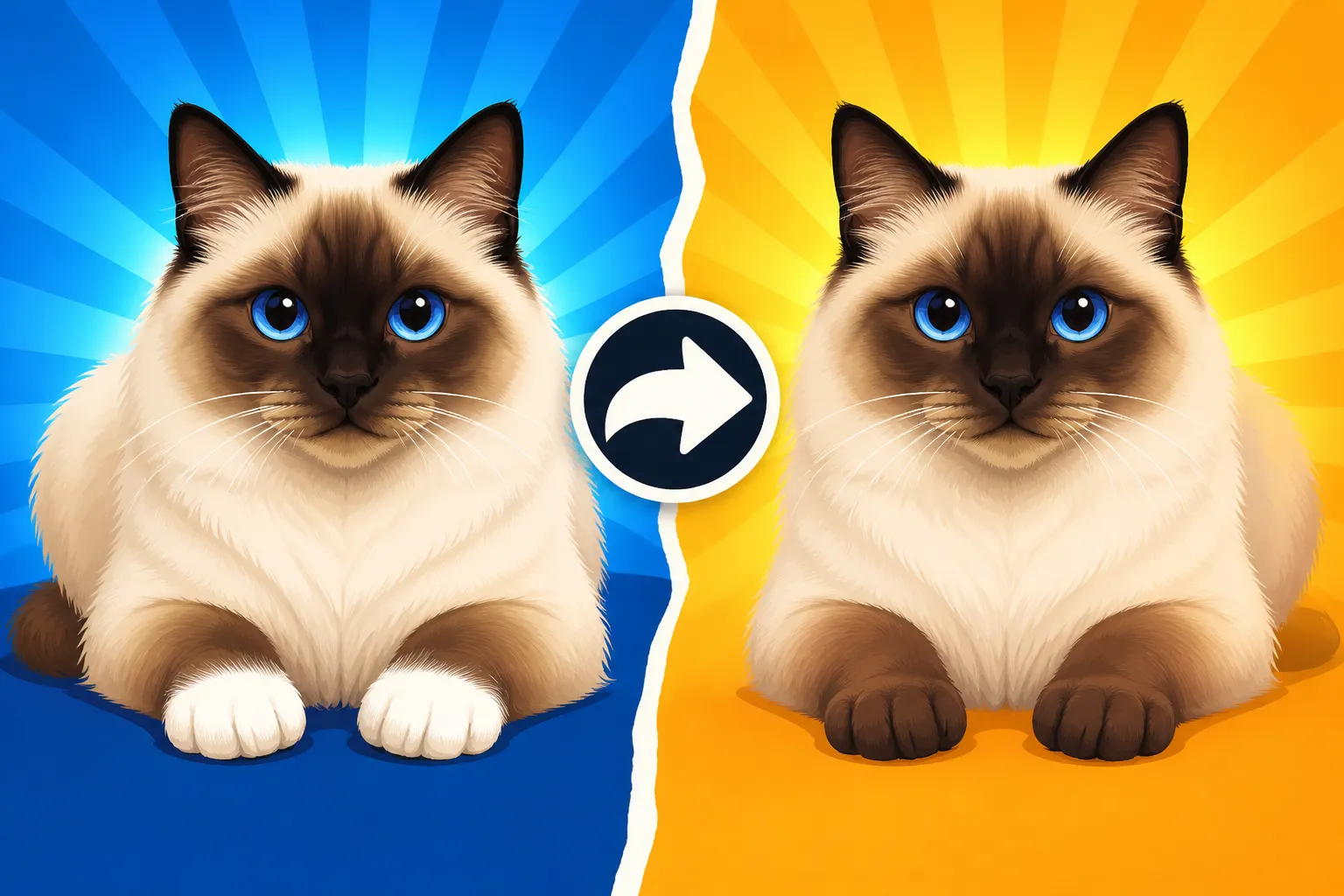
What a Birman Would Look Like Without Its Gloves
A Birman’s white gloves are so distinctive that it is hard to picture the breed without them. But remove the white markings in your mind and the cat does not become a different colorpoint breed: its blue eyes, pale body, dark points, and silky coat would still be there. This guide explains what would change, what would stay, and why the gloves matter so much.
What a Birman Might Look Like Without White Gloves
The paws would show point color instead of white
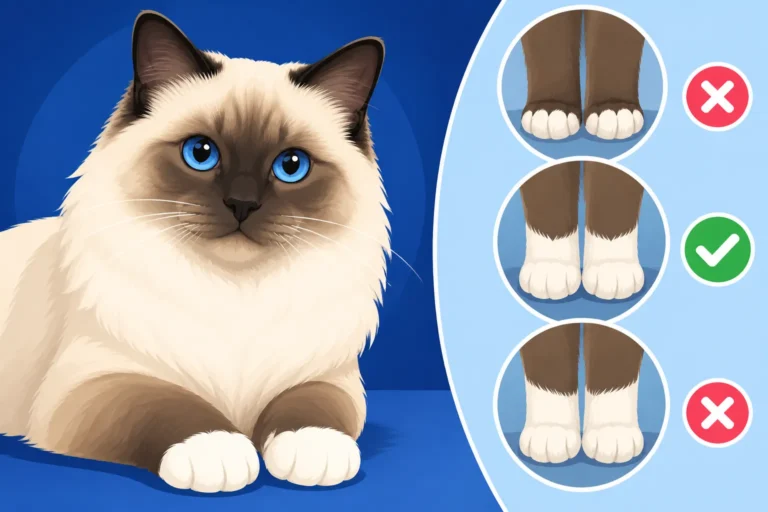
A Birman without gloves would most likely have paws that blend into the darker color on its legs. In a seal point, for example, the feet could look dark brown; in a blue point, they might appear slate blue. The exact shade would depend on the cat’s point color and the way that color develops across its coat.
That change would make the lower legs look visually continuous, rather than ending in crisp white feet. The cat’s silhouette and proportions would remain the same. It would still have the Birman’s medium-sized, sturdy body, broad face, rounded blue eyes, and full tail plume. The difference would be most obvious when the cat was standing, walking, or stretching a paw across a dark surface.
The white markings are not simply pale fur that happens to grow on the feet. They are a defining part of the breed’s appearance, linked to the genetic variant described in What the KIT Gloving Variant Does. A no-glove Birman is therefore a useful thought experiment, but not a straightforward prediction of how an ordinary Birman would look if its feet happened to lose color.
The classic contrast would be less dramatic
The white gloves give a Birman a strong visual contrast: dark points above, white feet below. Without that contrast, the eye might travel more continuously from the face and ears down the legs. The cat could look more like a conventional colorpoint longhair at first glance, especially in a photograph where the paws are partly hidden.
That does not mean its whole appearance would be plain. The face mask, colored ears, legs, and tail would still frame a lighter body. Its blue eyes would remain one of the most noticeable features, and the coat would still have the characteristic Birman texture. The overall effect might simply feel less sharply defined, with fewer obvious boundaries between the lower legs and paws.
Think of two cats standing side by side: one with white feet and one with colored feet. The gloved cat’s paws can look like bright little markers against the floor. The other cat’s feet would visually recede into its points. The difference may sound small, but it changes the balance of the whole color pattern.
It would not automatically look like another breed
A Birman without white feet might bring to mind other colorpoint cats, but resemblance is not the same as breed identity. Colorpoint coats occur in multiple breeds, and several breeds can have long fur, blue eyes, or dark extremities. A cat’s appearance is shaped by a combination of traits, not one marking alone.
The Birman’s coat texture, body type, head shape, expression, and pattern all contribute to its look. Its coat is generally silky rather than woolly, as explored in What a Birman's Coat Texture Should Be. The contrast between those traits and the white paws helps make the breed recognizable, but the gloves are not its only distinguishing feature.
A no-glove hypothetical also should not be confused with a cat that merely has unusual white markings. The standard Birman pattern includes specific white feet, while other cats may have unrelated white patches or socks. The resemblance can be superficial even when the genetics and breed background are different.
What Would Stay the Same
The colorpoint pattern would still frame the face and body
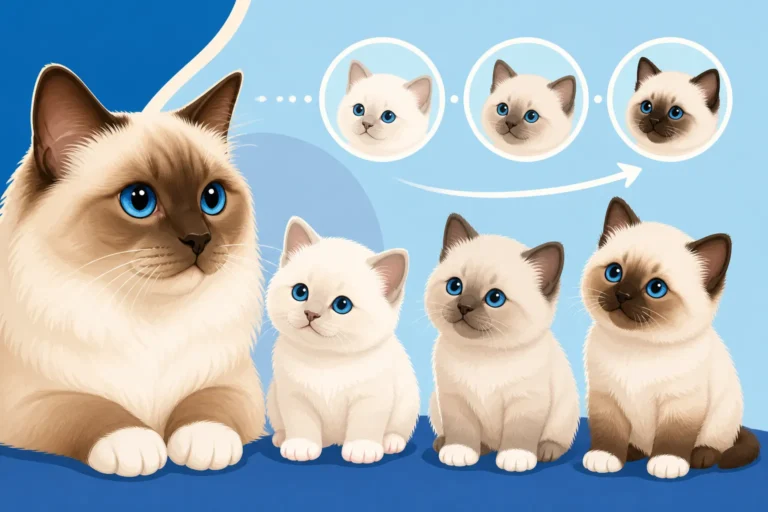
The Birman’s colorpoint pattern would remain: the points are darker than the body, with color concentrated on areas such as the face, ears, legs, and tail. The body is usually lighter, though its shade can change with age and conditions. Removing the gloves in this imagined version would not erase the points or turn the cat into a solid-colored one.
Point color also varies. Seal, blue, chocolate, lilac, red, cream, and tortie patterns are among the recognized possibilities in different breed systems. For a closer look at the accepted colors, see Which Point Colors CFA Accepts in a Birman. Whatever the point shade, the imagined no-glove cat would retain the same basic contrast between its lighter body and darker extremities.
The face would still carry much of the cat’s expression. Its dark mask would surround those blue eyes, and its ears and tail would continue the color pattern. From across a room, you might still recognize a Birman-like cat by its coloring and shape; up close, the unmarked feet would be the feature that most challenges the familiar picture.
The blue eyes and silky coat would remain
The gloves do not create the Birman’s blue eyes or its long, flowing coat. Those are separate parts of the breed’s appearance. A Birman without white feet would still be expected to have the same striking blue-eyed look and a coat that lies smoothly over the body rather than puffing out like a dense woolly layer.
That texture affects how the coat moves. When a Birman walks, the fur around its body and tail can sway gently, while the point colors keep the face and extremities visually defined. Without white paws, the coat might seem more uninterrupted, but it would not become shorter, curlier, or heavier just because the gloves were absent.
The breed’s origin is often discussed through both historical accounts and later breeding, and its appearance reflects a long-developed combination of traits. What Genetics Say About the Birman's Origin offers useful context for separating the breed’s history from the popular stories attached to it. Either way, the white gloves became central to the look people recognize today.
Its personality and care needs would not change because of its feet
A different-looking paw pattern would not, by itself, change a cat’s temperament, grooming needs, or nutritional needs. A no-glove Birman would still need routine coat care, clean water, suitable food, and regular veterinary attention. The markings are an appearance trait, not a reason to expect different behavior.
For owners, the practical difference would mostly be visual. White feet can show litter dust or staining more readily than dark feet, so some people pay extra attention to the litter area and paw cleanliness. If you are comparing low-dust litter options, Chewy’s product listings can help you check materials and features; the cat’s comfort and litter habits matter more than choosing a product marketed for white paws.
The same applies to grooming tools. A comb suited to a fine, silky coat is more helpful than a harsh tool meant to strip dense undercoat. Chewy can be one place to compare comb styles, but the important thing is choosing a gentle tool and introducing it gradually. A Birman’s temperament may make grooming feel easy, but it still helps to keep sessions short and calm.
Why the Gloves Matter to the Birman’s Identity
The markings are part of the breed’s defining pattern
The gloves are not an incidental fashion detail. They are a core part of the visual pattern that distinguishes the traditional Birman look. That is why a cat with colored paws can appear unusual even if its body, face, eyes, and coat otherwise resemble a Birman closely.
The gloving trait is treated as fixed in the breed’s genetic makeup, as discussed in Why the Gloving Variant Is Fixed in the Birman. That does not mean every cat’s white markings look perfectly identical. The width, height, and symmetry of the white areas can vary, which is why two Birmans can have noticeably different-looking feet despite sharing the characteristic pattern.
That variation is part of what makes the gloves so easy to scrutinize. One cat may have neat, evenly placed front gloves, while another may have a marking that extends higher or looks less balanced. Why Birman Gloves Vary Despite the Fixed Gene explains why a fixed gloving trait does not make every paw marking identical.
The paws help distinguish a Birman from similar-looking cats
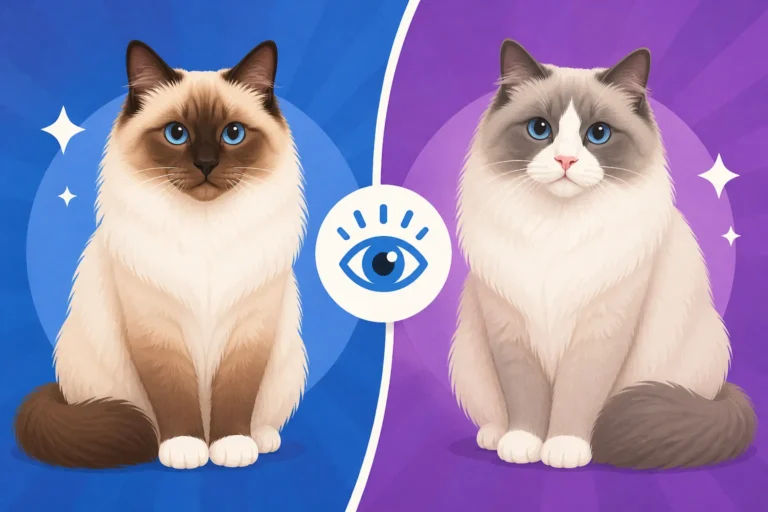
When people compare a Birman with a Ragdoll or another pointed longhair, they often focus on size, coat, head shape, and temperament. But the feet offer an especially quick visual clue. The Birman’s white gloves are a defining feature, while other breeds may have different white patterns or none at all. For a broader comparison, see How to Tell a Birman From a Ragdoll by Its Feet.
This distinction matters because white paws alone do not make a cat a Birman. A Snowshoe, for example, can also have white markings, but those markings belong to a different breed pattern. Why a Snowshoe's White Markings Are Not Birman Gloves helps clarify why two cats can both have white feet without sharing the same breed identity.
In the imagined no-glove version, the cat would lose one of the easiest clues for recognizing a Birman. It might still have a similar head, coat, points, and blue eyes, but a viewer would need to consider the full set of traits rather than relying on the paws. That is true of breed identification generally: a single visual feature is rarely enough to establish a cat’s background.
| Feature | Typical Birman appearance | Imagined Birman without gloves |
|---|---|---|
| Paws | White, contrasting with the colored legs | Colored to blend more closely with the points |
| Eyes | Blue | Blue |
| Body coat | Lighter than the points | Lighter than the points |
| Face, ears, legs, and tail | Darker point coloring | Darker point coloring |
| Coat texture | Silky, medium-long coat | Silky, medium-long coat |
| Overall impression | Strong contrast from white feet | More continuous color down the legs |
A cat without visible gloves may have a different explanation
If you meet a cat that looks like a Birman but has fully colored feet, there are several possibilities. It may be a mix, a similar-looking colorpoint cat, or a cat whose appearance has been described imprecisely. A photograph can also hide the paws, distort color, or make white markings difficult to see under certain lighting.
It is best not to assume that a cat is a Birman—or not a Birman—based on one detail alone. Breed documentation and reliable history provide more useful evidence than a quick visual guess. Even then, appearance can be complicated by variation, and a cat’s ancestry may not be obvious from a snapshot.
The contrast of the gloves is also affected by how clean and bright the feet are. If litter dust or staining makes white paws look dull, that does not mean the cat has lost its markings. For owners trying to keep the feet clean, Chewy’s litter descriptions can be compared for dust and tracking features, while any persistent discoloration or skin irritation is better discussed with a veterinarian. A cat-safe product should never be chosen solely because its packaging promises a whiter coat.
The Short Answer on a Birman Without Gloves
It would be a colorpoint cat with a less distinctive finish
Without white gloves, a Birman would still have the traits that create its broader appearance: blue eyes, a pale body, darker points, and a silky coat. The paws would likely look darker and more integrated with the legs, making the pattern feel less sharply outlined. The cat could still look elegant and unmistakably colorpoint, but the familiar white-footed finish would be missing.
The change would be most noticeable when the paws were visible. From a distance, the face mask and blue eyes might still make the cat look Birman-like. At close range, the colored feet would make people pause, because those white markings are such a memorable part of the breed.
The gloves are more than decoration
The white feet do not define every part of a Birman, but they are central to the breed’s recognizable pattern. They sit alongside the body shape, coat texture, points, and eye color to create the look people associate with the breed. Imagining a Birman without them makes clear how much a small area of white fur can change a cat’s overall visual balance.
So, what would a Birman look like without its gloves? It would still have a lighter body, darker points, blue eyes, and a silky coat—but its paws would blend into its legs, and the cat would lose one of the most distinctive features of the classic Birman appearance.
Disclaimer
This article is for general informational purposes only and does not constitute professional advice. Laws, prices and regulations vary by location and change over time. Consult a qualified professional for guidance on your specific situation.