Why the Gloving Variant Is Fixed in the Birman
A Birman’s white gloves look like a simple coat marking, but they have a specific genetic basis. The gloving variant is described as fixed in the breed, which can sound as if every cat must have identical feet. It does not. Here’s what “fixed” means, how the trait is inherited, and why glove shape and symmetry can still vary from one Birman to another.
What it means for the gloving variant to be fixed
Fixed means common in the breed gene pool
In genetics, a variant is called fixed when it has become the usual form of a gene in a population, rather than one option among several. For the Birman, the variant associated with the breed’s characteristic white gloves is considered fixed in the established breed population. In practical terms, breeders expect a purebred Birman to carry the gloving variant.
That statement describes a breed population, not a promise that every cat with a Birman-like appearance has the same ancestry or genetic results. A cat may resemble a Birman without being a pedigreed Birman, and an individual’s ancestry can affect what a genetic test finds. “Fixed” is therefore best understood as a description of the breed’s gene pool, not a visual test or a guarantee about every cat labelled a Birman.
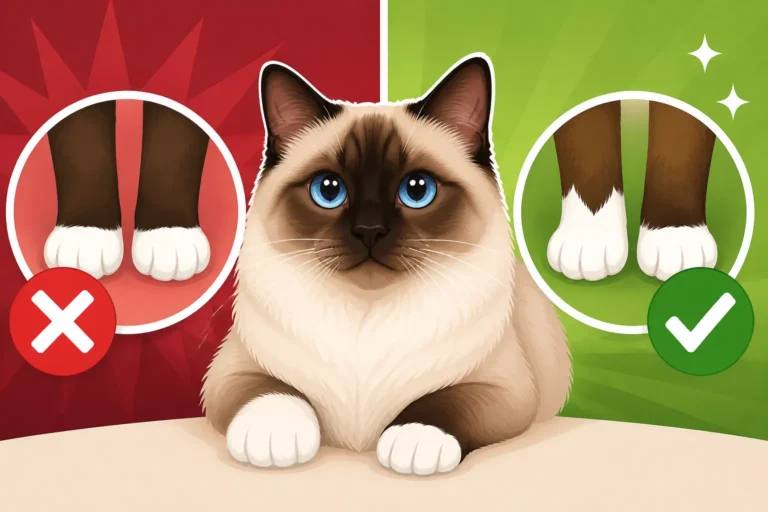
It also does not mean that every Birman has feet that look exactly alike. The variant is associated with the presence of gloves, while the height, outline, and symmetry of those markings can differ. A Birman may have the expected white paws but still have markings that a show judge considers uneven or imperfect.
The variant is associated with the KIT gene
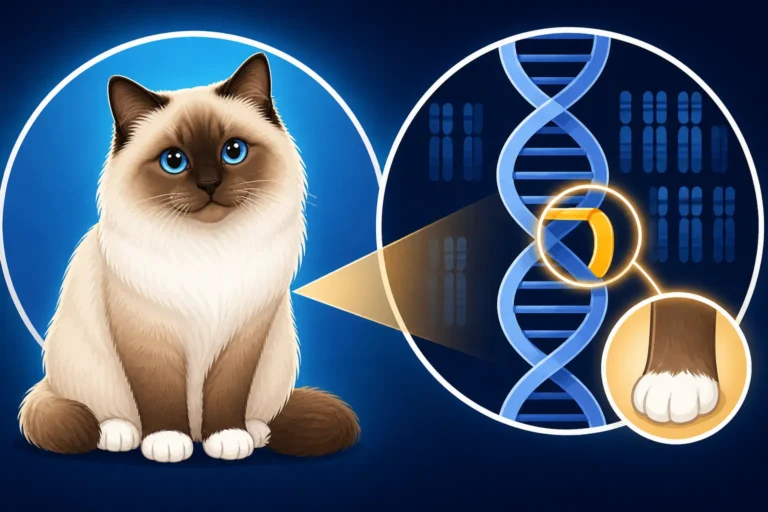
Birman gloving is associated with a variant in the KIT gene. KIT plays a role in the development and distribution of pigment-producing cells. When those cells do not develop or distribute in the usual way in particular areas, the coat in those areas can appear white.
This is a different question from whether the cat has the general appearance of a pointed breed. Point coloration, blue eyes, and white feet are distinct features, even though they come together in the Birman’s familiar look. Understanding that distinction helps explain why a cat can have dark points and blue eyes while its paws remain white.
The breed’s white markings are also not simply a matter of “more white” or “less white” appearing randomly. The inherited gloving trait provides the genetic basis for the characteristic pattern, while other influences help shape how that pattern is expressed. For more on the breed’s defining marking, see The Gloving Gene Every Birman Carries Two Copies Of and What the KIT Gloving Variant Does.
Fixed does not mean every genetic detail is identical
A breed can have a common, defining variant while still carrying other genetic differences across its population. “Fixed” refers to the particular variant being discussed; it does not mean every Birman has the same complete genetic makeup, the same family history, or identical coat markings.
This is a useful distinction when reading about breed genetics. A trait can be typical of a breed without every visible detail being perfectly predictable. The gloving variant is a foundation for the white-foot pattern, but it does not act like a stencil that produces matching paws in every kitten.
For background on how the gloving variant became characteristic of the breed, Why the Gloving Variant Is Fixed in the Birman and Where the KIT Gloving Variant Sits in the Genome offer related angles on its history and location.
How Birman gloves are inherited
A recessive pattern needs the relevant copies
Birman gloving is commonly described as a recessively inherited trait: the expected gloving pattern is associated with a cat inheriting the relevant variant from both parents. That helps explain why breeders pay attention to pedigrees and how a mating may affect the traits seen in a litter.
When the variant is established throughout a breed population, both parents are expected to pass it on to their kittens. In a typical purebred Birman mating, the kittens are therefore expected to inherit the genetic basis for gloving. That does not mean a breeder can predict the exact white line on each paw. The inherited basis of the trait and the final shape of the markings are not the same thing.
It is also important not to assume that a visual check can confirm a cat’s genotype. White paws alone do not tell you which specific variant is present, and a cat with unusual-looking markings cannot be genetically assessed by appearance alone. If the question matters for breeding or ancestry, a qualified veterinary genetics professional or an appropriately accredited testing laboratory can help interpret the options.
A breed-defining trait is not the same as a simple outcome
People sometimes hear “the variant is fixed” and conclude that every kitten must have perfect show gloves. That is a leap too far. A kitten may inherit the genetic basis for Birman gloving and still develop markings that are too high, uneven, or otherwise different from the show ideal.
The distinction is similar to inheriting the capacity for a recognizable pattern versus inheriting a perfectly consistent version of it. The genetic variant contributes to the pattern, but other genetic and developmental influences can affect where the white ends. That is why littermates can share the same parents and breed background yet have noticeably different paws.
For a closer look at the inheritance pattern, see Why Every Birman Has Two Copies of the Gloving Gene and How the Birman Gloving Variant Was Identified. The key takeaway is that genetic inheritance can support the presence of the marking without making its exact outline predictable.
Why gloves vary even when the variant is fixed
Other genes can influence the markings
A fixed variant does not work in isolation. Other genes, sometimes described as modifiers, can influence the amount, placement, or symmetry of white markings. Their combined effects help explain why one Birman’s gloves may look neat and balanced while another’s appear higher or more irregular.
Imagine two kittens from the same litter. Both have the breed’s expected genetic basis for gloving, but one has front gloves that end at a similar height and rear markings that form clear laces. The other has one front glove that reaches farther up and a rear marking that looks less defined. That difference does not automatically mean one kitten lacks the gloving variant. It can reflect the way several influences come together during development.
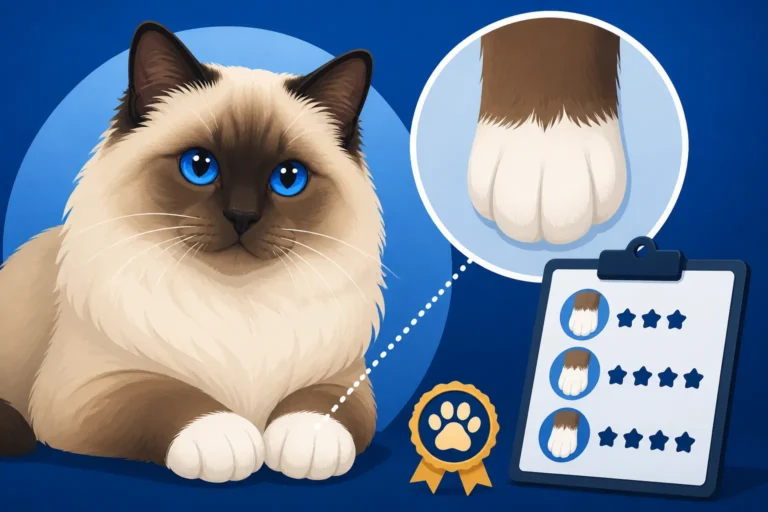
These variations matter especially to breeders and people interested in showing cats, because breed standards evaluate the visible markings as well as the general appearance. A genetic variant can be widespread in the breed while show-quality symmetry remains difficult to achieve. That is why glove appearance is judged on the cat itself, not inferred from its pedigree alone.
Development affects the final visible pattern
A kitten’s markings take shape as it develops. Breeders may look at a young Birman’s paws to assess how the gloves are forming, but early observations do not remove all uncertainty about the final pattern. The visible white areas can be assessed as the kitten grows, and small differences can become more apparent as the coat develops.
The markings are not something an owner can improve through grooming, diet, or washing. Grooming can keep the coat clean and comfortable, but it cannot move the edge of a glove or make two paws genetically symmetrical. That can be frustrating for someone who has fallen in love with a kitten’s appearance and is hoping for a particular show pattern. It is also why a responsible breeder should explain that exact glove placement cannot be promised from a kitten’s early appearance.
For practical detail on how markings are evaluated, read How a Birman's Gloves Are Scored, Why a Birman's Front Gloves Must End Evenly, and Which Modifier Genes Affect a Birman's Gloves. These topics help separate the inherited trait from the standards used to judge its appearance.
| Question | What “fixed” helps explain | What it does not guarantee |
|---|---|---|
| Is gloving expected in a purebred Birman? | The variant associated with gloving is established in the breed population | That every cat with a Birman-like appearance has verified Birman ancestry |
| Will every kitten have white gloves? | Typical Birman inheritance supports the expected pattern | That every kitten’s markings will meet the show ideal |
| Will littermates have matching paws? | Kittens may share the breed’s genetic basis for gloving | Identical height, shape, or symmetry |
| Can appearance confirm a genetic result? | Visible gloves are consistent with the breed trait | A definitive genotype or ancestry result |
What the fixed variant means for owners and breeders
For pet owners, imperfect gloves do not mean a health problem
For a pet owner, the most important point is that glove symmetry is a coat-pattern question, not a measure of a Birman’s health, temperament, or ability to be a companion. A cat with uneven gloves can still be a healthy, affectionate Birman. Show standards and pet suitability are different things.
It is understandable to wonder whether unusual markings mean that a kitten is not a “real” Birman. Markings can be one part of identification, but they are not a substitute for trustworthy pedigree information. If you are choosing a kitten, ask the breeder about registration, parentage, and the documents that accompany the kitten rather than relying on a photograph of its paws.
This is especially useful when browsing listings, where lighting, pose, and image editing can make markings look more symmetrical than they are. A breeder should be willing to discuss what is known about the kitten and avoid guaranteeing a show outcome that cannot be predicted with certainty. For more on how visual markings are assessed, see Why Gloves Vary Despite the Fixed Gene.
For breeders, selection still matters
A fixed variant does not make breeding decisions irrelevant. Breeders may still consider glove shape, symmetry, the wider health of their lines, temperament, and soundness when planning matings. Because the variant is widely established in the breed, the challenge is generally not simply to introduce gloving, but to produce the desired expression while making responsible choices about the whole cat.
Trying to select for one visible feature alone can narrow attention too much. A breeding decision should consider a cat’s overall quality and welfare, not just whether its gloves look especially tidy. Genetic tests, pedigree records, veterinary care, and honest communication all play different roles; none can replace the others.
A breeder discussing gloving should be able to explain the limits of prediction in plain language. It is reasonable to ask how the parents’ markings compare, what the breeder expects in the litter, and whether the kitten is being sold as a pet or with show potential. A careful answer will distinguish an informed estimate from a promise.
The simplest way to read the phrase
When you see that the gloving variant is fixed in the Birman, read it as: the genetic variant associated with the breed’s characteristic white gloves is established in the breed population. Do not read it as: every Birman must have perfectly identical gloves, or every kitten can be assigned a show-quality outcome at birth.
The trait is part of what makes the Birman distinctive, but its visible expression still varies. That balance—shared genetic foundation, individual differences in the paws—is why the breed can be recognizable without every cat looking like a copy of the next one.
If you are researching a specific kitten or planning a breeding, focus on reliable pedigree and test information where relevant, and ask a knowledgeable breeder or veterinary professional to explain what the evidence does and does not show. The gene gives useful context; it does not answer every question about a cat’s ancestry or future markings.
Disclaimer
This article is for general informational purposes only and does not constitute professional advice. Laws, prices and regulations vary by location and change over time. Consult a qualified professional for guidance on your specific situation.