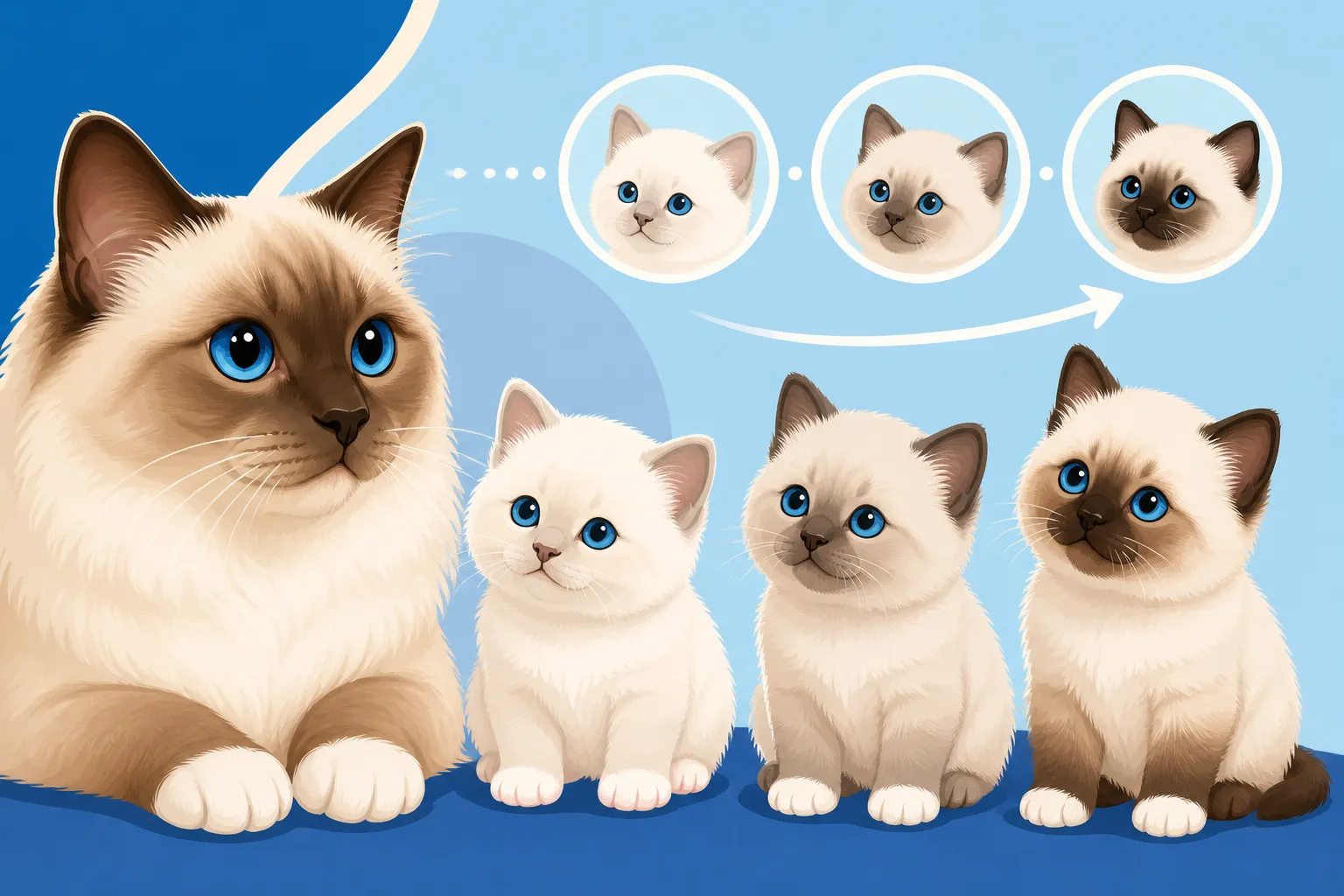
How Early Birman Kittens Show Their Points
A Birman kitten can look almost entirely white at birth, leaving new owners wondering whether its seal, blue, chocolate, or lilac points will ever appear. That pale start is normal: the kitten’s characteristic color develops gradually as cooler parts of its body darken. Here’s what to expect, when markings usually become visible, and how to tell normal development from a reason to ask your vet.
Why Birman kittens are born so pale
The temperature-sensitive coloring behind the change
Birman coat color is a form of temperature-sensitive colorpointing. A genetic mechanism affects pigment production differently in warmer and cooler areas of the body. Inside the mother, a kitten stays warm throughout, so it is born very pale—often looking nearly white.
After birth, its body begins experiencing different temperatures across its surface. The cooler extremities gradually develop more pigment, while the warmer torso generally remains lighter. This is why the ears, face, tail, and lower legs tend to show color before the body does. It’s also why the markings don’t arrive all at once or in a perfectly even pattern.
This process is normal, not a sign that a kitten is dirty or that its coat has been damaged. For a fuller explanation of the pale newborn stage, see Why Every Birman Kitten Is Born Pure White. The change is gradual, so a kitten may look noticeably different from one week to the next without anything being wrong.
The usual order in which points become visible
The first hints of color are often subtle: a faint shadow on the ears, a smudge around the nose, or a little shading at the tail tip. As the kitten grows, these areas become more distinct. The face mask can take time to fill in, and the paws may be especially tricky to assess because Birman kittens also have their signature white gloves.
There isn’t one exact day when every kitten’s points appear. Littermates can develop at different rates, and the shade may be difficult to judge under indoor lighting or in photographs. A warm room, a soft cream coat, or a very light point color can make early shading seem less obvious. For a timeline focused specifically on the first visible markings, read When a Birman's Points Start to Show and How a Birman Kitten's Points Come In.
| Area | What you may notice first | What to keep in mind |
|---|---|---|
| Ears | A faint tan, gray, or darker cast | Early shading may be subtle and uneven |
| Nose and face | A small patch or light mask | The mask often becomes clearer with time |
| Tail | Darkening near the tip or along the tail | Lighting can make the shade look stronger or weaker |
| Legs and paws | Color above or around the white feet | White gloves make the point color harder to assess |
| Body | A gradual change in the pale coat | The body usually stays lighter than the points |
Point color is not always easy to identify early
At first, a seal point kitten and a blue point kitten may both appear to have very soft, cool-toned shading. Chocolate and lilac points can be even more difficult for an untrained eye to distinguish when the kitten is young. The amount of visible contrast also depends on the lighting: a warm lamp can make pale brown tones look stronger, while daylight may reveal cooler gray or cream shades.
A kitten’s early appearance is a clue, not a final color verdict. Breeders use pedigree information and experience alongside the developing coat, and official registration descriptions may reflect the recognized color categories rather than a casual impression of a newborn’s markings. If color terminology is confusing, How a Birman's Point Color Is Registered explains why the recorded color can matter as the kitten matures.
What to expect as the kitten grows
The first weeks and months
During the first weeks, the points may appear as soft shading rather than sharply defined patches. The face, ears, and tail often provide the clearest early clues, but even those areas can change in tone over time. At this stage, comparing weekly photographs is more useful than deciding from a single picture. Try to take them in similar natural light, against a plain background, and without filters.
As the kitten gets older, its point pattern becomes easier to recognize. The white gloves may also become clearer, but glove quality and point color are separate aspects of the coat. A kitten can show developing colored points while its white markings are still changing in appearance as the paws grow. For that reason, a photo of tiny feet at birth is not a reliable way to predict exactly how the gloves will look later. See Why a Birman Kitten's Gloves Are Clearest at Eight Weeks for more on assessing those markings.
Breeders commonly wait until kittens are older before making firm decisions about placement or show potential. A young kitten’s appearance is still developing, and the final impression depends on more than one early coat snapshot. If you’re choosing a kitten, ask the breeder how they describe the color and what they can realistically tell you about its expected development. Why Birman Kittens Are Sold Late covers why early weeks are important beyond coat color alone.
Why points can keep deepening
A Birman’s points don’t necessarily stop changing once the first markings have appeared. Coat shade can deepen as the cat matures, and environmental temperature can influence how much contrast is visible. A cat living in a cooler environment may develop darker points than one kept in a warmer setting. Seasonal changes can also affect how the coat looks, though the amount of change varies from cat to cat.
Age matters too. A kitten’s soft first markings may become richer and more defined over the months and years ahead. That doesn’t mean every Birman follows the same color timeline or ends up with exactly the shade its owner expected from the earliest photos. For the longer view, see How Many Years a Birman's Points Take to Finish Darkening and Why a Birman's Points Darken as It Ages.
It’s best not to try to manipulate a kitten’s coat color by making its surroundings unusually cold or hot. A kitten needs a comfortable, safe environment, not temperature changes designed to influence markings. Keep the home at a suitable temperature, provide a cozy place to rest, and let the coat develop naturally.
How to follow point development without overreading it
Take consistent photos and note the changes
If you’re curious about how your kitten’s color is developing, take a clear photo every week or two during the early months. Use similar lighting and angles, and include the face, tail, and paws. This makes gradual changes easier to spot than relying on memory. It can also help you explain what you’re seeing if you have a question for the breeder or veterinarian.
Write down observations rather than conclusions. For example, “the ears look slightly darker this week” is more useful than deciding that the kitten’s final color has changed. Indoor lighting, camera exposure, and the color of nearby surfaces can all affect how pale or dark the coat appears in pictures. If you share photos with the breeder, ask whether the lighting makes the point shade look different from what they see in person.
The same approach can help you distinguish normal coat development from a sudden change. Gradual darkening on the expected areas is generally part of colorpoint development. A new patch of hair loss, redness, crusting, swelling, or a change in the skin is different; it deserves attention as a possible health issue rather than being assumed to be a point-color change.
Keep the kitten’s care routine comfortable
Healthy development depends on ordinary kitten care, not special coat treatments. Follow your veterinarian’s guidance on feeding, preventive care, and checkups. If you’re comparing food options, Chewy can be one place to browse kitten formulas, but choose a diet based on your veterinarian’s advice and the kitten’s individual needs. Food won’t determine whether a kitten is seal point or blue point.
A warm, secure resting area is useful for comfort, but there’s no need to buy anything intended to alter coat shade. When looking for bedding or other basic supplies, Chewy is one retailer you may compare with local pet shops; focus on easy-to-clean, kitten-safe options rather than products making color promises. Avoid dyes, whitening products, or topical treatments unless a veterinarian specifically recommends them.
For day-to-day care, keep notes about eating, activity, and growth alongside your coat photos. If you’re shopping for a brush or other grooming basics, Chewy may offer a convenient way to compare options, but a young kitten’s needs are simple: gentle handling and a short, positive introduction to grooming. The coat’s changing color is usually a visual curiosity, not a problem that needs intervention.
When to ask a breeder or veterinarian
Normal variation versus a health concern
Some variation in the timing and depth of point color is expected. One kitten may show a darker tail before its face becomes obvious; another may have clear ear shading while the tail still looks pale. These differences alone do not necessarily indicate a problem. A breeder familiar with the kitten’s parents and relatives can often help explain what is typical for that line.
Contact a veterinarian if a color change comes with signs that suggest a skin or general health issue. Examples include persistent itching, sores, scaling, swelling, discharge, patches of missing fur, poor appetite, unusual tiredness, or failure to gain weight as expected. Coat color cannot diagnose a health condition, so it’s better to describe the signs and have the kitten assessed than to assume the change is simply part of its colorpoint pattern.
If you have concerns before bringing a kitten home, ask the breeder what color they currently identify, how they reached that assessment, and whether the kitten has had its routine veterinary checks. A responsible answer should leave room for uncertainty when the kitten is young. The goal is not to guarantee the precise shade of every developing point, but to understand what is known and what may become clearer with age.
What a healthy development conversation should cover
A useful conversation about color should distinguish coat appearance from health and from show or registration standards. Ask which areas are already showing pigment, whether the breeder expects the points to deepen, and when they feel confident describing the kitten’s color. If you’re evaluating a kitten for a particular reason, such as a show prospect, ask what can and cannot be assessed at its current age.
It can also help to ask how the breeder describes the white gloves separately from the colored points. The two features are both part of the Birman’s appearance, but one does not predict the other perfectly. A kitten’s developing face and tail may offer clues about point color, while its paws still need to be assessed on their own as they grow.
Most of all, remember that the pale newborn coat is part of the Birman’s normal beginning. The color arrives gradually, the pace varies, and the finished adult coat may look richer than the first signs suggested. A little patience—and a few well-lit photos—will tell you more than trying to make a final call from a newborn’s nearly white coat.
Disclaimer
This article is for general informational purposes only and does not constitute professional advice. Laws, prices and regulations vary by location and change over time. Consult a qualified professional for guidance on your specific situation.