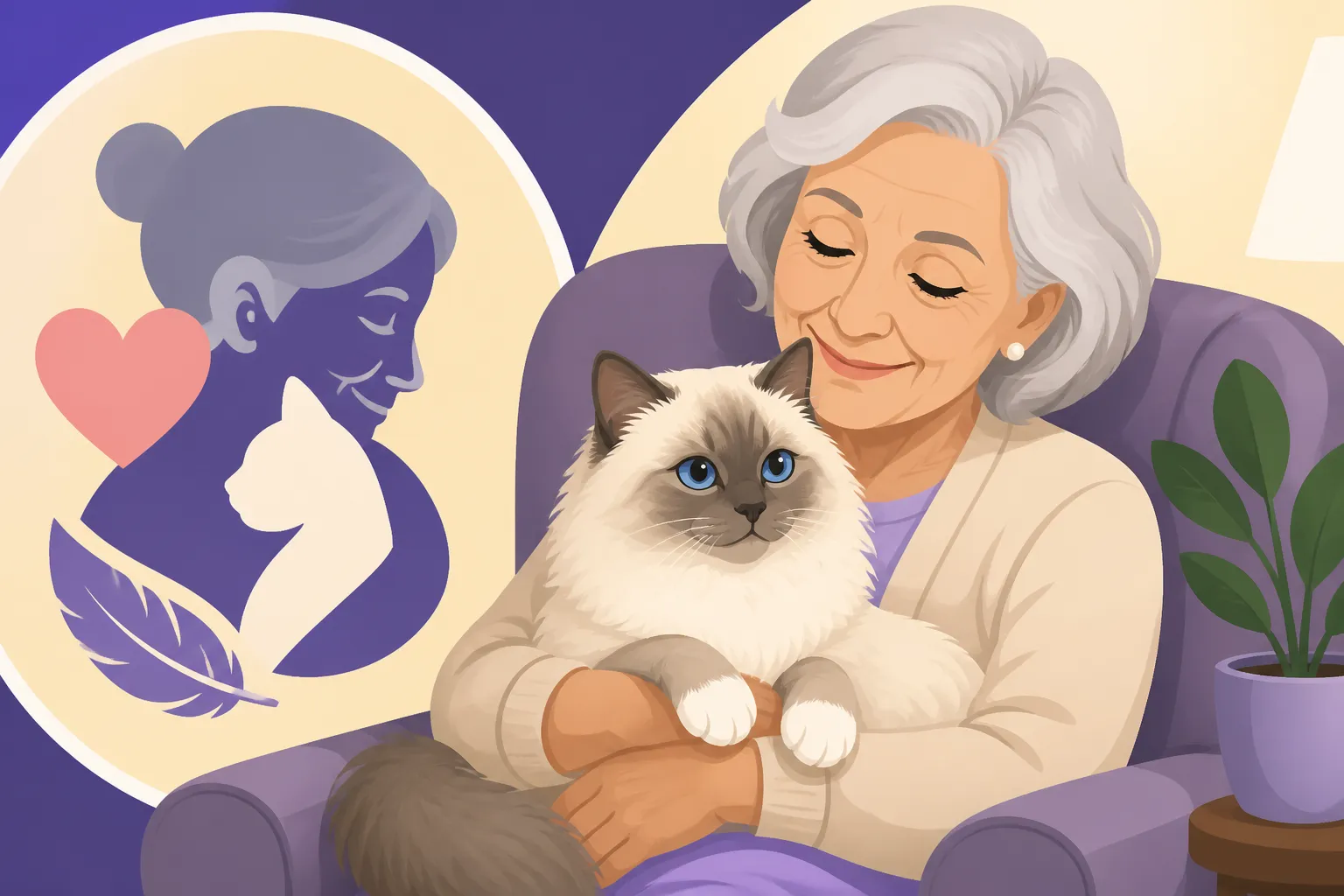
Why a Quiet Undemanding Birman Suits an Older Owner
A cat that stays close without demanding constant entertainment can be a lovely companion, especially when a household is quieter or daily routines are changing. But a Birman’s calm reputation does not mean every cat is low-maintenance or suited to every older adult. This guide explains what living with a Birman is really like, where the breed may fit well, and what to plan for before bringing one home.
Why a Birman can suit an older owner
Quiet company without constant demands
Birmans are often described as gentle, people-oriented cats. Many enjoy being in the same room as their person, resting nearby while someone reads, watches television, or works around the house. That kind of companionship can feel comforting without requiring a cat to be carried or entertained all day. For some older owners, the appeal is precisely that the cat is present but not usually noisy or insistent.
“Quiet,” though, does not mean silent or uninterested. A Birman may greet you, make a small sound to get your attention, or follow you from the kitchen to the living room. It may also decide that your lap is an excellent place to nap. Individual personalities vary, so it is worth spending time with a prospective cat and asking its caregiver how it behaves at home. The breed’s reputation is a starting point, not a guarantee.
A Birman may suit someone who wants an affectionate companion but prefers a gentler pace than a highly vocal, constantly active cat. If you are comparing temperaments, Why the Birman Is Called the Middle Cat offers a useful look at the breed’s commonly described balance between more energetic and more laid-back cats.
A companion that can settle into a calm household
Many Birmans enjoy routine and familiar company. A predictable home with regular mealtimes, a favorite resting place, and a person who is around for at least part of the day can be reassuring. A Birman might settle beside you while you have breakfast, nap on a chair nearby in the afternoon, and come looking for company in the evening.
That closeness can be a benefit, but it is also a responsibility. A Birman is not a decorative cat that can be left alone for long stretches without considering its social needs. Someone who travels frequently, spends most days away, or is planning a major change in living arrangements should think carefully about who will provide regular company and care. Why a Quiet Undemanding Birman Suits an Older Owner is one perspective on this fit, while Why a Birman Should Not Be Left in an Empty House explores why companionship matters.
A calm cat can also be a better match for a quieter home than a pet that needs vigorous play throughout the day. Still, Birmans need interaction and play, even if they tend to enjoy it in short, gentle sessions. A wand toy moved slowly across the floor, a soft toy to bat around, or a few minutes of attention can add welcome activity without turning the house into an obstacle course.
Friendly does not mean comfortable with everything
A Birman may be sociable, but every cat has its own preferences. Some welcome visitors; others take time to warm up. Some enjoy being petted for long stretches; others prefer to sit close without being picked up. It is sensible to let the cat choose how much contact it wants rather than assuming that a gentle breed will tolerate any handling.
This matters if grandchildren, visiting carers, or other household members will interact with the cat. A cat that can walk away and retreat to a quiet bed is more likely to feel secure. Children should be shown how to approach calmly, avoid chasing, and support the cat’s body if it needs to be lifted. The guide Why a Birman Tolerates a Toddler Better Than Most discusses temperament around young children, but supervision and respect for the cat’s boundaries remain essential.
What day-to-day care actually involves
Grooming that is manageable but still regular
The Birman’s semi-long coat can look like a major grooming commitment, yet many owners find it easier to maintain than a dense, woolly coat. Regular combing helps catch loose hair and prevent small tangles, especially around the ruff, under the legs, and behind the ears. A short session several times a week is often easier on both cat and person than waiting until knots have formed.
For an older owner, the practical question is not simply how much grooming the cat needs, but whether the routine is comfortable to do. Reaching down to a cat on the floor or holding a comb for a long time may be tiring if you have arthritis, reduced grip strength, or shoulder discomfort. Grooming the cat on a stable, comfortable surface can help, provided the cat is relaxed and cannot fall. Some owners break the routine into a few brief sessions rather than trying to comb the entire coat at once.
You can also build grooming into quiet time together. Let the cat sniff the comb, start with a few gentle strokes, and stop before either of you becomes frustrated. If you are ordering a comb, nail clippers, or other supplies online, Chewy may be a convenient place to browse options, but choose tools suited to a fine coat and your own comfort. No Undercoat Is What Makes a Birman Easy to Groom explains why the coat may be less demanding than it first appears.
Feeding, litter, and everyday lifting
Most care tasks are simple individually, but the daily routine adds up. A Birman needs appropriate food, fresh water, a clean litter box, and regular observation. Measured meals can make it easier to notice a change in appetite, while keeping water bowls in convenient locations may help the cat drink and make refilling less awkward for you.
Litter is often the most physically demanding chore. A full tray can be heavy to lift, and reaching into a low-sided box may aggravate back or knee pain. A litter scoop with a comfortable handle, a tray placed where you can reach it safely, and a manageable cleaning routine can make a real difference. Avoid putting the litter box somewhere inconvenient for either of you; a cat may stop using it reliably if access is difficult or the area feels unsafe.
When shopping for food, litter, and routine supplies, delivery from a retailer such as Chewy can reduce the need to carry bulky bags home. That convenience is helpful only if you can store supplies safely and keep the cat’s food and litter within easy reach. A small, stable container or a delivery schedule that avoids overstocking may be more practical than keeping heavy bags on the floor.
Activity and companionship without overdoing it
A Birman does not need a large house, but it does need safe opportunities to move, explore, and play. Cats benefit from climbing or perching options, yet a senior owner does not have to create a towering cat gym. A low, stable perch beside a window, a sturdy scratching post, and clear walking paths can provide enrichment without adding trip hazards.
Play can be adapted to different energy levels. Sit in a comfortable chair and move a wand toy along the floor, or toss a soft toy a short distance. If bending or reaching is difficult, choose toys with longer handles and avoid placing small objects where you have to repeatedly crouch to retrieve them. A few short play sessions are often more realistic than expecting either person or cat to sustain a long session.
A Birman may also benefit from another source of company if its owner is away for substantial periods, but adding a second pet is not automatically the answer. Cats need compatible temperaments, careful introductions, and additional care. Why a Birman Needs Company More Than Stimulation and Why a Birman Does Better With a Companion Than a Toy discuss the social side of the breed; the right arrangement depends on the individual cat and household.
Planning for health, mobility, and support
Routine veterinary care is part of ownership
A quiet cat can be easy to live with, but quietness should not be mistaken for proof that it is healthy. Cats may show discomfort subtly, and changes in habits can be easy to miss when a cat is naturally placid. Keep an eye on appetite, drinking, litter-box habits, grooming, movement, and interest in people. A noticeable change is worth discussing with a veterinarian rather than waiting for it to become dramatic.
Before adopting, ask about the cat’s medical history, vaccination and preventive-care records, and any known conditions. Plan how you will get the cat to appointments: a carrier that is easy to open, a reliable ride, or a trusted person who can help may all be important. A Birman’s affectionate nature does not remove the need for routine examinations and dental care.
The following checklist can help turn a general plan into a practical one:
| Need | What to plan | Why it helps |
|---|---|---|
| Veterinary visits | Identify a clinic and arrange transport | Avoids scrambling when an appointment is needed |
| Grooming | Keep a suitable comb somewhere easy to reach | Makes short, regular sessions more realistic |
| Litter | Choose an accessible location and a manageable tray | Reduces strain and helps the cat use it comfortably |
| Food and water | Place bowls where you can refill them safely | Supports a consistent routine |
| Backup care | Ask a trusted person about occasional help | Covers illness, travel, or temporary mobility problems |
Make the home comfortable for both of you
A cat-friendly home should also be easy for its owner to move around in. Keep paths between the bed, food, water, litter, and favorite resting place clear. Avoid placing bowls or toys where they could become tripping hazards, and choose stable furniture that will not slide when a cat jumps onto it.
Consider the cat’s access to favorite spots as its mobility changes. A low step or ramp may help a cat reach a sofa or bed without a high jump. If you have difficulty bending, raised bowls may be more comfortable for you to manage, but make sure the setup is stable and appropriate for the cat. Small adjustments made before they are urgently needed can reduce stress for both of you.
The same principle applies to your own support network. A neighbor, family member, or pet sitter who can help with a vet trip or a heavy delivery may make ownership more manageable. If you use Chewy for bulky essentials, plan where parcels will be left and how you will move them indoors. Convenience works best when it does not create another awkward lifting task.
Choose the individual cat, not just the breed description
A calm adult Birman may be a more predictable match for an older owner than a young kitten, whose energy, training needs, and eventual temperament are still developing. An adult cat’s behavior is easier to observe: you can ask whether it likes brushing, how it responds to visitors, whether it enjoys being picked up, and what kind of routine it already knows.
A kitten can still be a good choice for someone who has the time and support to manage its early months. But kittens can be energetic, climb into places you did not expect, and need patience while they learn household rules. If you are choosing between ages, consider your daily energy, ability to supervise, and access to help—not only the appeal of bringing home a young cat.
Wherever you adopt or buy, be candid about your household and ask for a careful match. A breeder, rescue, or rehoming organization should be willing to discuss personality, health history, and the cat’s needs. Who the Birman Actually Suits can help you think through the broader lifestyle fit, while Why a Quiet Undemanding Birman Suits an Older Owner focuses on the appeal of a quieter companion.
Questions to ask before bringing a Birman home
About temperament and routine
Ask how the cat behaves during an ordinary day, not only how it acts during a brief visit. Does it seek company, sleep nearby, or prefer to stay in a separate room? Is it comfortable with combing and nail handling? Does it hide when someone new enters the house? Practical details like these help you picture daily life more accurately than a broad label such as “gentle.”
Find out what the cat is used to eating and how it uses the litter box. Keeping the familiar routine at first can make a move less stressful. Ask what toys it enjoys and how much play it usually seeks. A cat that likes low-key interaction may be a comfortable companion, but it still needs attention and a safe, engaging environment.
If the cat has lived with other pets or children, ask what those interactions were actually like. “Good with dogs” can mean many things, from calmly sharing a room with one quiet dog to actively seeking canine company. The more specific the answers, the better you can judge whether the cat’s history matches your home.
About practical help and future changes
Think through what would happen if you were temporarily unwell or needed to leave home. Who could feed the cat, clean the litter box, or take it to the veterinarian? Having a backup person is sensible for any pet owner, and especially useful if mobility, health, or transportation may be unpredictable.
Also consider whether your living situation might change. A move to a smaller home, a change in household members, or longer periods away can affect a cat that depends on familiar routines and company. A plan does not need to predict every possibility; it simply needs to identify people and arrangements you can turn to.
Finally, be realistic about the full commitment. A Birman can offer years of calm companionship, but it will need care through kittenhood, adulthood, and old age. Grooming needs may change, veterinary visits may become more frequent, and you may eventually need to help the cat reach places it once managed alone. Why a Birman Is the Cat People Keep After a Baby Arrives speaks to the breed’s reputation for fitting into family life, but every household still needs a plan for changing needs.
A Birman may be a wonderful match for an older owner who wants a gentle, sociable cat and can provide steady companionship. The best fit is not simply the quietest cat or the prettiest coat; it is an individual whose needs, habits, and health are compatible with your home and support system.
Disclaimer
This article is for general informational purposes only and does not constitute professional advice. Laws, prices and regulations vary by location and change over time. Consult a qualified professional for guidance on your specific situation.