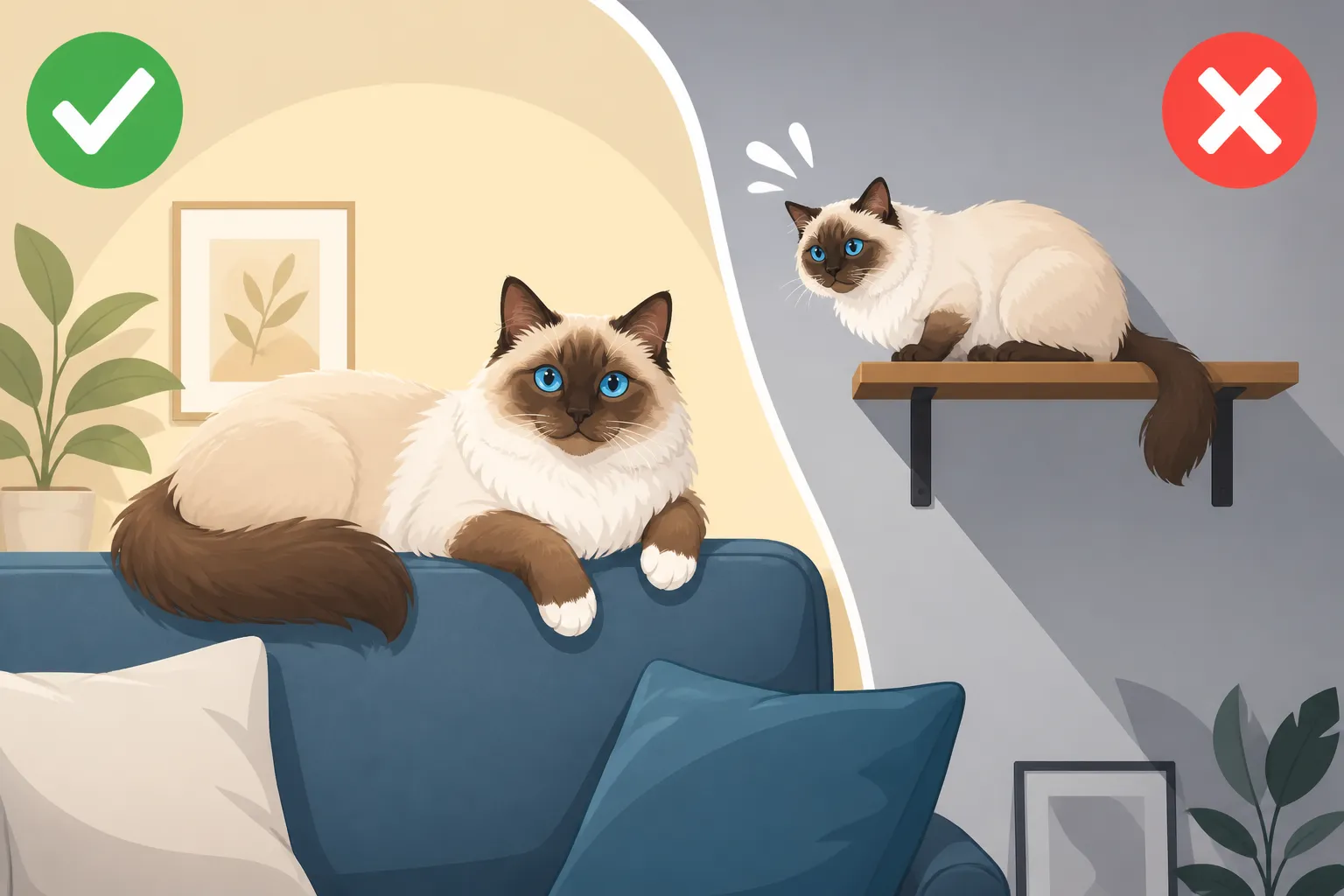
Why a Birman Prefers a Sofa Back to a Wall Shelf
It’s a common scene in many cat households: you’ve meticulously installed those chic wall shelves, envisioning your feline friend gracefully leaping from one to the next, surveying their kingdom from on high. But then you watch, and watch, and your gorgeous Birman just… doesn't bother. They might glance up, perhaps even jump onto the back of the sofa, but those beautifully mounted wall shelves? Untouched. This guide is here to unravel why your placid Birman might prefer a cozy spot on the back of your favorite armchair or the sofa, rather than scaling the heights you’ve prepared, and how you can create vertical spaces they’ll actually adore.
Understanding the Birman's Nature: Why High Perches Aren't Their Priority
Birmans are often described as the "gentle giants" of the cat world, a perfect blend of the affectionate, people-oriented nature of some breeds and the calm, laid-back demeanor of others. They are known for their sweet, docile, and famously undemanding personalities. This foundational temperament plays a huge role in their preferences for vertical space.
Think about it: some cats are adrenaline junkies, seeking the highest vantage point to hunt imaginary prey or escape perceived threats. They thrive on the thrill of the climb. Not so much with our Birmans. They are inherently less driven by that intense, high-energy instinct. Instead, their joy often comes from being near you, observing the household bustle from a comfortable, safe distance, rather than needing to be above it all. This isn't to say they don't appreciate a good view, but their motivation for getting there is vastly different.
The Birman's Undemanding and Observant Personality
Unlike some more vocal or "in-your-face" breeds, a Birman often expresses affection and contentment through quiet companionship. They’re the cats that will follow you from room to room, settling softly nearby, perhaps draped across your desk chair or curled up on the rug at your feet. They enjoy being part of the family action, but rarely feel the need to be the center of it. This means their instinct to survey their domain from the absolute highest point simply isn't as strong as it might be in, say, a Siamese or an Abyssinian. They don't have that "king of the mountain" mentality ingrained quite as deeply.
Their preference for proximity means a sofa back, often nestled against a warm human or close to the focal point of family activity, is far more appealing than an isolated shelf high on a wall. It’s about comfort, warmth, and connection, not just elevation. Why a Birman Follows You Without Demanding Anything highlights this beautifully. They're content to be a quiet shadow, a comforting presence, and a sofa back offers that perfect balance of being slightly elevated for a good view without being detached from the human sphere.
Contrasting the Birman with More Athletic Breeds
If you've ever lived with a cat that climbs the curtains or walks along the picture rails, you'll know the difference. Breeds like the Bengal, for example, are renowned for their athleticism and insatiable desire to climb and explore vertical spaces. For these cats, wall shelves are an absolute dream, providing essential physical and mental stimulation. They are built for it, they crave it, and they truly use every inch of vertical territory.
The Birman, however, sits firmly in the middle ground when it comes to activity levels. The Birman Sits Between the Siamese and the Persian, inheriting the placid temperament of the Persian more than the boisterous energy of the Siamese. They enjoy play, certainly, but it's often a gentler, more sustained kind of play, not quick bursts of extreme acrobatics. While they might engage with a wand toy, they're not typically going to scale the fridge or perform daring leaps between narrow perches. This fundamental difference in their inherent energy and play style explains why those high-up, athletic wall shelves often go unused. They simply don't possess the same genetic programming or personality drive for that kind of vertical exploration.
The Birman's Physical Build and Movement Style
Beyond personality, a Birman's physical characteristics also play a significant role in their preference for more accessible, less intimidating vertical spaces. These aren't dainty, lightweight cats built for extreme agility and aerial stunts. They possess a sturdy, substantial build that makes certain types of climbing less appealing or even less comfortable.
Imagine trying to gracefully navigate a narrow tightrope when you have a longer, more rectangular body. It's just not as natural or effortless.
A Longer, Sturdier Frame
Birmans are known for their substantial, rectangular bodies. They are a medium-to-large breed, with males often weighing in at 10-15 pounds and queens slightly less. This isn't the lithe, slender build of a Siamese or the compact, cobby shape of a British Shorthair. Their length means that maneuvering in tight, elevated spaces or making precise, high-impact jumps can be less appealing. A wide, stable surface like a sofa back offers ample room to stretch out, turn around, and feel secure.
When considering a wall shelf, think about the landing space. If it’s narrow, a Birman might hesitate. Their longer bodies need more room to land safely and comfortably, and many decorative wall shelves simply don't provide that. They are built for grace, yes, but more in their flowing movement across a floor than in acrobatic leaps through the air. How Much Height a Birman Bothers to Jump For emphasizes that while they can jump, their motivation and comfort zone are often limited to mid-height, stable surfaces.
Preference for Stable, Wide Surfaces
A Birman appreciates stability. Their placid temperament means they're not often looking for thrills or challenges in their environment. A wobbly shelf, a narrow perch, or a surface that might shift under their weight would be a definite turn-off. The back of a sofa or a wide, sturdy window perch offers a reassuringly solid foundation. They can curl up, stretch out, or simply relax without worrying about their footing.
This preference for stability also ties into their generally calm and relaxed approach to life. They aren't constantly seeking to test their physical limits. Instead, they seek comfort and security. A soft blanket on the sofa back, allowing them to survey the room while feeling safe and supported, is often their idea of bliss.
Why Extreme Climbing Isn't a Birman's Forte
While a Birman can certainly jump onto a kitchen counter or a tall dresser, sustained, extreme climbing isn't typically their forte. They don't have the same drive to reach the highest point of a room purely for the sake of it. Their playful energy is more often directed towards chasing toys on the floor, engaging in gentle wrestling with a companion cat, or batting at a wand toy that stays within their comfortable reach. Why a Birman Plays Gently further illustrates this aspect of their physical interaction with their environment.
This means that while a cleverly designed cat tree with multiple levels and ramps might be appreciated, a series of small, high, disconnected wall shelves might just feel like too much effort for too little reward in their eyes. They prefer ease of access and comfort over challenging climbs.
Creating a Birman-Friendly Vertical Space
So, if those wall shelves aren't getting the attention you hoped for, what can you do to provide your Birman with satisfying vertical opportunities that align with their nature and build? It's all about understanding their preferences and designing with their comfort in mind.
You want to offer elevated spots that are stable, easily accessible, and provide a good vantage point without requiring daredevil acrobatics. This means focusing on gentle inclines, wide platforms, and surfaces that are part of the main living area.
Opting for Sturdy, Multi-Level Cat Trees
Cat trees are a fantastic solution, provided you choose the right kind. For a Birman, look for trees that:
- Are exceptionally sturdy: No wobbling! A heavy base and thick posts are key.
- Have large platforms: Enough space for them to stretch out fully and feel secure.
- Feature ramps or steps: Rather than relying solely on large jumps between levels, ramps make ascent and descent easier and more appealing. How Tall a Birman's Cat Tree Should Be isn't just about height, but accessibility too.
- Are placed strategically: Near a window, or in a room where you spend a lot of time, so they can observe you.
A well-chosen cat tree acts like a "vertical sofa," offering elevated comfort without the precariousness of wall shelves. They can often be found in a wide variety of styles and sizes on platforms like Amazon, ensuring you can find one that fits both your Birman's needs and your home's aesthetic.
Cozy Window Perches and Radiator Beds
Birmans absolutely adore a good view, especially if it's accompanied by warmth and comfort. Window perches that attach securely to the windowsill or wall are often a huge hit. Look for those with a wide, padded surface where they can stretch out and watch the world go by. The sunbeam streaming through the window often makes these spots irresistible.
Similarly, radiator beds or hammocks that hook onto a radiator provide a warm, slightly elevated spot during colder months. It’s another example of how a Birman prioritizes comfort and warmth alongside elevation. These are easy to install and offer immediate appeal, aligning perfectly with their desire for soft, warm, and stable perches.
Maximizing Existing Furniture
You've already seen that your Birman loves the sofa back. Lean into this! Ensure your sofa is positioned so they can comfortably jump onto the back. If you have armchairs, consider placing a soft blanket or a small, low pet bed on the backrest. These are familiar, scent-marked spaces that offer the perfect blend of height and security.
Bookshelves, dressers, or sturdy side tables can also be excellent "mid-height" perches. Just make sure they are stable and clear of any breakable items. A soft mat or cushion on top makes them even more inviting. The key is that these surfaces are easily accessible with a moderate jump, rather than requiring a challenging climb. Where a Birman Prefers to Perch is often somewhere that allows them to be involved in the action without being on the floor, but also without being completely out of reach.
Here’s a quick overview of suitable vertical options for your Birman:
| Vertical Option | Birman Appeal | Key Considerations |
|---|---|---|
| Sofa Back | Familiar, soft, close to owners, stable, mid-height. | Ensure stability, clear space for jumping. |
| Sturdy Cat Tree | Multiple levels, good views, ramps/steps for easy access. | Large platforms, heavy base, appropriate height. |
| Window Perch | Sunbeams, bird watching, comfortable padding. | Wide enough, secure attachment, clear view. |
| Radiator Bed | Warmth, cozy, slightly elevated, stable. | Safe for cat, clear space, secure fitting. |
| Lower Shelves/Bookcases | Mid-height, stable, can be padded for comfort. | Ensure stability, remove fragile items, easy jump height. |
Practical Alternatives to Wall Shelves for Your Birman
Even if your Birman isn't scaling your wall shelves, there are plenty of other ways to provide mental and physical enrichment that appeals to their specific temperament. It’s about understanding what truly motivates them and creating an environment that caters to those needs.
Remember, Birmans are intelligent and appreciate interaction, but they prefer it on their terms – gently and calmly.
Ground-Level and Mid-Height Play
Since extreme vertical play isn't their primary driver, focus on enriching their environment at ground level and mid-height. This can include:
- Wand Toys: These are fantastic for engaging their hunting instincts without requiring huge leaps. Which Toys Suit a Birman That Plays Quietly often involve feathers or soft targets that they can stalk and pounce on. Keep the play session gentle and interactive, allowing them to "catch" the toy regularly to build confidence.
- Puzzle Feeders: While some Birmans might ignore complex puzzles, a simpler treat ball or a feeder that requires some paw manipulation can be mentally stimulating. Which Puzzle Feeder Suits a Birman should be easy to understand and reward their efforts quickly, avoiding frustration.
- Tunnel Systems: Birmans often enjoy exploring tunnels, which provide a sense of security and a fun way to navigate their space. These can be placed on the floor or even incorporated into a lower-level cat tree setup.
It's all about providing opportunities for engagement that match their calm demeanor and physical capabilities.
Prioritizing Companionship and Quiet Engagement
More than elaborate cat structures, a Birman truly thrives on companionship. If you're out a lot, consider a second cat to keep them company, as Birmans tend to do better with a friend than as an only cat. Even if you have just one Birman, simply being in the same room, offering a gentle stroke, or having a quiet chat makes a huge difference.
Their happiness often comes from feeling secure and loved within their human family. So, while wall shelves might look impressive, the back of your sofa, with its inherent comfort and proximity to you, will almost always win out for your beloved Birman.
Observing Your Birman's True Preferences
Ultimately, the best way to understand your Birman's needs is to observe them. Watch where they choose to sleep, where they perch when you’re home, and how they react to different toys and spaces. You might find that the highest point they truly covet is the top of a sun-drenched laundry basket, or the cozy nook behind your head on the sofa.
Don't be disheartened if your carefully installed wall shelves remain pristine. It just means your Birman is being true to their gentle, undemanding nature. By providing them with comfortable, stable, and accessible elevated spaces, you'll create a home environment where they feel safe, cherished, and perfectly content, even if their favorite perch is just the back of the sofa.
Disclaimer
This article is for general informational purposes only and does not constitute professional advice. Laws, prices and regulations vary by location and change over time. Consult a qualified professional for guidance on your specific situation.