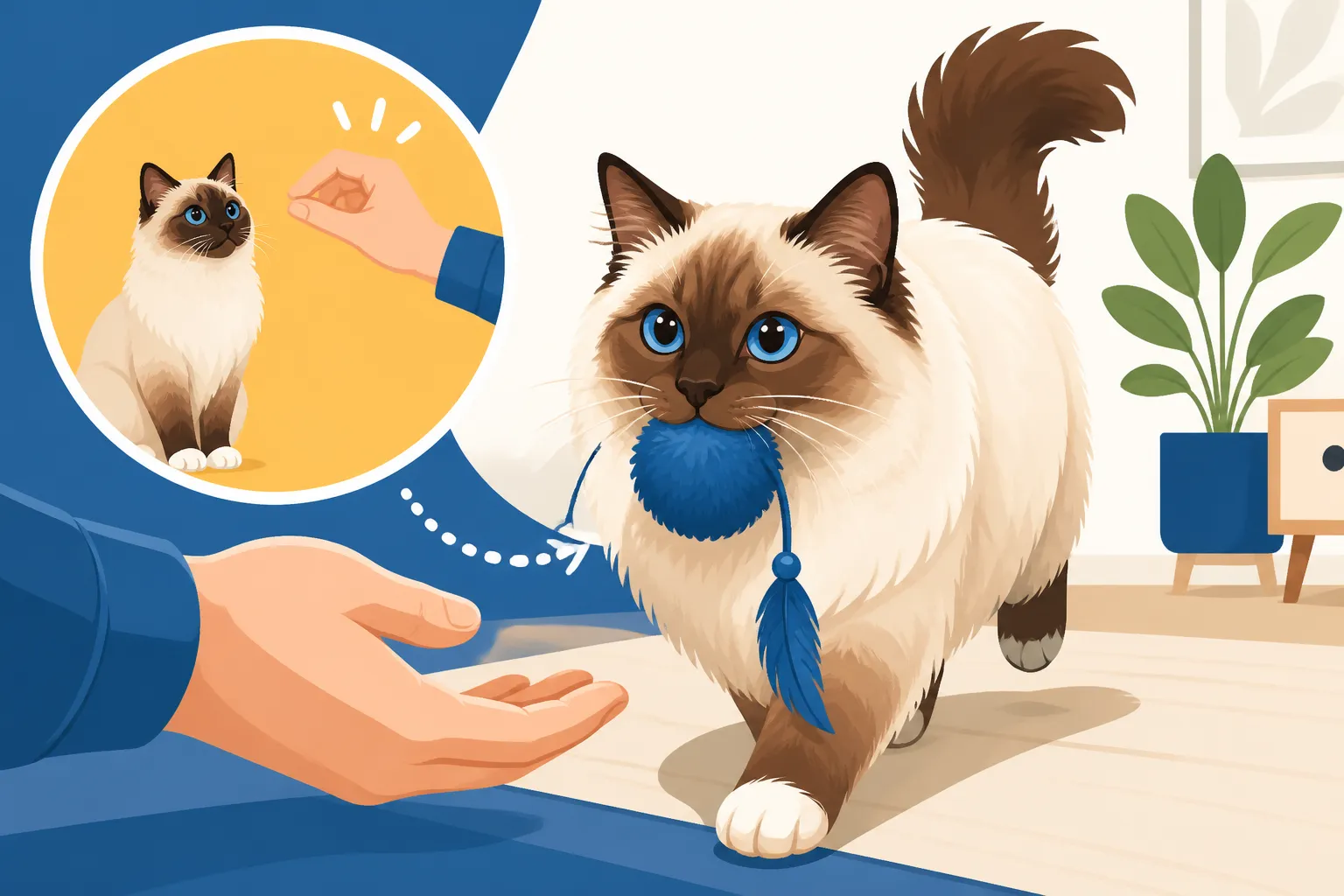
Teaching a Birman to Bring Something Back
Many Birman owners, charmed by their cat's serene demeanor and quiet presence, might assume that active games like 'fetch' are reserved for more boisterous breeds or even dogs. You might find yourself watching your beautiful Birman glide gracefully across the room and think, "There's no way I could get them to bring a toy back!" But I'm here to tell you that this gentle, affectionate breed has a surprising capacity for interactive play, and teaching your Birman to retrieve can be one of the most rewarding ways to deepen your bond. This guide will walk you through the steps, expectations, and joys of turning your elegant companion into a playful retriever.
The Birman's Natural Inclination Towards Play and Connection
It's easy to misunderstand a Birman's quiet nature. They aren't the boisterous, demanding types that constantly cry for attention or zip around like little furry rockets. Instead, their affection often manifests as a calm, steadfast companionship. They'll follow you from room to room, perch quietly nearby, and offer subtle nudges or a soft purr. This deep desire for connection is actually a huge asset when it comes to teaching them new games, including retrieval. They might not seem as overtly playful as some breeds, but their need for engagement is very real.
Understanding the Birman's Play Style
Birmans generally prefer a gentle, interactive play style rather than solitary, high-energy antics. They aren't typically the cats that will spend hours wrestling with a catnip mouse on their own. Instead, they thrive on games that involve you. Think of it like a collaborative activity. They enjoy the shared experience, the verbal encouragement, and the physical interaction. This is why many Birman owners find that wand toys are a huge hit, as they allow for a back-and-forth dynamic. They are less likely to tear up furniture during a wild zoomie session, and more likely to quietly observe before engaging. This gentle approach means you won't need to push them into frenzied activity; instead, you'll tap into their desire for shared moments. For more on what keeps them happy, you might enjoy How Little Play a Birman Needs to Stay Content.
When considering play, it’s also important to remember that a Birman's placid temperament often means they play with their claws in. They're not prone to roughhousing or aggressive play. This soft approach makes them wonderful companions for families, and it also means that retrieving a toy is a natural extension of their gentle interactions. They won't likely pounce and destroy the toy in a fit of predatory glee; rather, they'll often carry it delicately. This characteristic means you can focus more on the training aspect and less on managing overly boisterous behavior.
Why a Birman Responds to Interaction Over Solitary Toys
Your Birman thrives on connection. Unlike some cats who are perfectly happy batting a ball around by themselves for extended periods, a Birman often sees toys as a means to an end: an opportunity for quality time with their favorite human. If you've ever noticed your Birman bring a toy to you, drop it, and then look expectantly, you've already witnessed their natural inclination towards shared play. This isn't just about the toy; it's about the interaction it facilitates.
Think about it from their perspective. A solitary toy might be mildly interesting for a few minutes, but a toy that involves you, your attention, and your praise? That's gold. This is precisely why teaching 'bring it back' works so well with Birmans. It's an activity that directly involves you, creating a strong positive association. They aren't just playing with a toy; they're playing with you. This intrinsic motivation for companionship is the cornerstone of successful retrieval training with a Birman. They might not demand your attention with loud meows, as you'd learn in How a Birman Shows Affection Without Making Demands, but they certainly appreciate it.
The Foundation for Teaching "Bring It Back"
Before you even think about tossing a toy, it's crucial to lay some groundwork. Just like any good training, success comes from understanding your cat's preferences and setting them up for victory. This isn't about forcing them to do something they don't want to do, but rather about guiding their natural instincts in a fun and rewarding way. Remember, Birmans are intelligent and sensitive creatures; they respond best to patience and positive reinforcement.
Choosing the Right "Retrieve" Toy
The toy itself is far more important than you might think. Birmans can be a bit particular; as discussed in Why a Birman Walks Past Most Toys, they're not always impressed by every squeaky, crinkly, or feather-laden gadget out there. For retrieval, you need something lightweight enough for them to carry comfortably in their mouth, but also something they find intrinsically interesting. Think about small, soft toys like crinkle balls, lightweight fabric mice, or even a crumpled piece of paper. The goal is for them to want to pick it up and hold it.
Avoid anything too large, too heavy, or too awkward for their jaws. Some Birmans adore the simple satisfaction of batting a crinkle ball around, which makes these excellent candidates. You might find a great selection of these on sites like Amazon, allowing you to experiment without a huge investment. Observe which toys your Birman already shows a preference for. If they have a favorite small toy they sometimes bat around, that's an ideal starting point. It's often about finding that perfect balance of intrigue and ease of handling.
The Importance of Timing and Positive Reinforcement
With a Birman, positive reinforcement isn't just a good idea; it's essential. This breed is highly motivated by praise and affection, perhaps even more so than by treats, as highlighted in Why Praise Motivates a Birman More Than Food. Every successful step, no matter how small, should be met with enthusiastic verbal praise, a gentle stroke, or a favorite tiny treat. The timing of this reinforcement is critical: it needs to happen immediately after the desired action. If you wait too long, your Birman won't associate the reward with the specific behavior you're trying to encourage.
Consistency is also key. Short, frequent training sessions are far more effective than long, drawn-out ones. Five minutes, two or three times a day, is often ideal. Stop before your Birman loses interest, leaving them wanting more. This keeps the experience positive and fun, reinforcing that playing 'bring it back' with you is a delightful activity. Patience, a happy tone, and quick rewards will be your best tools in this process. You're not just teaching a trick; you're building a communication bridge.
Step-by-Step Guide to Teaching Your Birman to Retrieve
Okay, now for the fun part! This isn't a race, and every Birman learns at their own pace. Be prepared for some adorable missteps and plenty of gentle encouragement. Remember that Birman kittens, like all young cats, have a natural curiosity and playfulness that makes them receptive to learning, as noted in How a Birman Kitten Plays Gently, and this behavior often continues into adulthood.
Starting with the Toss and Engage
Begin in a quiet room with minimal distractions. Choose that perfect, lightweight toy you’ve identified.
- Get their attention: Hold the toy up, wiggle it slightly, and talk to your Birman in an excited, happy voice. Make it sound like the most fascinating object in the world.
- The short toss: Toss the toy just a very short distance away – literally a foot or two. You want it close enough that they don't have to expend much effort to reach it.
- Encourage pursuit: As you toss, say an encouraging phrase like "Get the toy!" or "Go fetch!" in that same happy tone.
- Celebrate their engagement: If they bat at it, go to it, or even just look at it with interest, shower them with praise. "Good kitty! So smart!" This first step is all about getting them interested in the chase. Don't worry about them bringing it back yet; focus on getting them to interact with the toy after you've thrown it. You're building a positive association with the toss itself.
Encouraging the Return and Reward
This is where the 'bring it back' part really begins. Your Birman might pick up the toy after your short toss, but then wander off with it, or simply drop it where it landed. Here's how to guide them:
- Entice them closer: If they pick up the toy, immediately get down to their level a short distance away. Pat your lap, offer a treat, or use your happy, inviting voice to call them to you. "Come here, sweetie! Bring it to mommy/daddy!"
- The gentle trade: When they come close with the toy, or even if they just approach you while still holding it, offer a treat or rub them gently. Many Birmans will naturally drop the toy to take the treat or enjoy the petting. The moment they drop it near you, even accidentally, give enthusiastic praise and a reward.
- Repeat, repeat, repeat: This step requires the most patience. Don't grab the toy from their mouth; let them drop it. The act of them voluntarily releasing it to you is key. Some cats respond well to a second, identical toy. If they hold onto the first, gently toss the second one a short distance. Often, they'll drop the first to chase the second, allowing you to reward the drop and pick up the original. You can find multi-packs of these small, soft toys on Amazon, which can be very useful for this stage. Remember, the goal is for them to associate bringing the toy back to you with positive outcomes.
Gradually Extending the Distance
Once your Birman consistently brings the toy back to you from a short distance and drops it for a reward, you can start to increase the challenge.
- Incremental steps: Instead of tossing it two feet away, toss it four feet. Then six feet. Go slowly. If your Birman gets confused or stops bringing it back, reduce the distance again. It's better to make the steps small and ensure success than to push too far too fast.
- Vary the location: Once they're consistent in one room, try moving to another. This helps generalize the behavior, so they understand "bring it back" isn't tied to a specific spot.
- Introduce a verbal cue: As they are consistently bringing the toy back and dropping it, start saying a clear cue like "Drop it!" just as they are about to release the toy. Over time, they'll associate the verbal cue with the action.
- Fade the treats: Once they are reliably retrieving and dropping the toy, you can start to fade the food treats, replacing them with more verbal praise and petting. Keep some treats on hand for particularly good retrieves or when you introduce a new challenge. Remember, Birmans are often highly motivated by your attention, so your enthusiastic praise is a powerful reinforcer, as is your connection, which is explored further in Why a Birman Follows You Without Demanding Anything.
Common Challenges and Troubleshooting
Even with the most placid and cooperative Birman, you might encounter a few hiccups on your retrieval training journey. Don't get discouraged! These are common, and with a little understanding and adjustment, you can usually work through them.
When Your Birman Just Watches the Toy
This is perhaps the most common scenario for Birman owners starting retrieval training. You toss the toy, full of enthusiasm, and your elegant Birman simply sits there, perhaps blinking slowly, as if to say, "And what, precisely, was the point of that?" This isn't a sign of defiance; it's often a lack of understanding or a disinterest in that particular toy.
First, re-evaluate your toy choice. Is it truly engaging? Is it too heavy, too large, or simply not interesting enough? Consider trying a different type of toy. As mentioned, Which Toys Suit a Birman That Plays Quietly can offer some good ideas. Sometimes, a simple piece of crumpled aluminum foil is more enticing than an expensive cat toy. Second, make the toss more engaging. Wiggle the toy, drag it along the floor for a moment, then toss it. Make it look like prey darting away. If they still don't move, go over to the toy yourself, pick it up, and bring it back to where you started, acting as if you're demonstrating the game. Avoid forcing them. Keep it light, keep it fun, and ensure your enthusiasm is palpable. Remember, you're looking for that spark of curiosity, not instant obedience.
The Birman Who Brings it Back, But Doesn't Drop It
Another common situation is the Birman who proudly carries the toy back to you, perhaps even rubs against your legs, but then clutches the toy firmly in their mouth, refusing to let go. You might find yourself gently trying to pry it from their jaws, which is something we want to avoid. This is usually because they haven't quite grasped the 'drop' part of the equation, or they're enjoying the possession too much!
The key here is the "gentle trade" technique discussed earlier. Have a highly desirable treat ready. The moment they arrive with the toy, hold the treat near their nose. Most cats will instinctively open their mouth to take the treat, thus dropping the toy. The instant they drop it, give enthusiastic praise and the treat. If they are very possessive, try luring them to drop it into an open box or basket that you hold, making it clear they are 'giving' it rather than you 'taking' it. Patience is crucial here. Never chase them for the toy, as this can turn it into a game of keep-away. Instead, make dropping it the most rewarding part of the whole process. Over time, and with consistent practice, they'll understand the full sequence of the game. For other ways to engage their minds, you could look into Which Tricks a Birman Learns.
Keeping the Game Fresh and Engaging
Birmans are creatures of habit, but even they can get bored if the game never evolves. Once your Birman is a proficient retriever, you'll want to keep the game interesting to maintain their enthusiasm.
- Introduce new toys: Rotate their toys. Bring out a new lightweight toy for retrieval sessions to add novelty. You can find a vast array of small cat toys on Amazon that can keep things interesting.
- Vary the reward: While Birmans love praise, occasionally surprising them with a favorite soft treat or a short burst of wand play after a successful retrieve can reinvigorate their interest.
- Play hide-and-seek: Instead of tossing the toy, "hide" it in plain sight just around a corner or under a cushion. Encourage them to "find the toy" before bringing it back. This adds another layer of mental stimulation.
- Involve another person: If you have family members who are equally patient and enthusiastic, take turns tossing and receiving the toy. This can make the game even more dynamic and prevent your Birman from associating the game solely with one person. Remember, Birmans enjoy shared activities, and keeping the game fresh ensures it remains a cherished bonding experience, allowing them to continue playing well into their later years, as explored in Why a Birman Keeps Playing Into Middle Age.
Teaching your Birman to bring something back is more than just a trick; it's a testament to the deep bond you share. It's a journey of patience, understanding, and shared joy that celebrates the unique, gentle spirit of this incredible breed.
Disclaimer
This article is for general informational purposes only and does not constitute professional advice. Laws, prices and regulations vary by location and change over time. Consult a qualified professional for guidance on your specific situation.