How Many Points a Birman’s Gloves Are Worth
A Birman’s white gloves are not a small finishing detail in the show ring: under the CFA standard, they account for 20 points out of 100. That can make a noticeable difference when cats are otherwise closely matched. Here’s what those points cover, how judges look at each paw, and why a beautiful Birman can still have a fault in its gloves.
How many points Birman gloves are worth
The CFA standard assigns 20 points to gloves
In the Cat Fanciers’ Association standard, gloves are worth 20 of the Birman’s 100 points. That is a substantial share of the total—enough to make the markings an important part of a judge’s assessment alongside the cat’s head, body, coat, color, eye color, and overall condition.
The number describes the weight given to the feature in the standard, not a guaranteed deduction. A judge does not necessarily subtract a fixed amount every time a glove is uneven or too high. The actual assessment depends on what is visible, how serious the fault is, and the cat’s overall presentation.
If you are comparing standards from different registries, check the rules for the specific show. Organizations may organize or describe their standards differently, so the CFA allocation should not automatically be treated as the score breakdown everywhere. For a fuller look at the scorecard, see How the Birman Standard Divides Its Hundred Points.
Twenty points does not mean gloves are judged in isolation
A cat can have very attractive gloves and still lose ground elsewhere. Judges assess the whole Birman: its type, coat, color, eye color, condition, and how well it represents the breed. The glove score matters, but it is not a stand-alone ranking of the cat.
It is also useful to think of the 20 points as emphasis rather than a promise about the final result. Two cats with similar overall quality may be separated by their markings, while a cat with a small glove fault might still be competitive if it excels in other important areas. The exact comparison depends on the cats in the ring and the standard being applied.
| Show consideration | What it generally means |
|---|---|
| Glove allocation under the CFA standard | 20 points out of 100 |
| Front paws | White gloves should be even and end at a similar height |
| Hind paws | White laces should extend up the back of each leg and finish neatly |
| Overall judgment | Gloves contribute to the whole assessment; they do not determine it alone |
| Registry rules | Check the show’s governing standard for its wording and scoring |
What judges look for on a Birman’s paws
Front gloves should look balanced
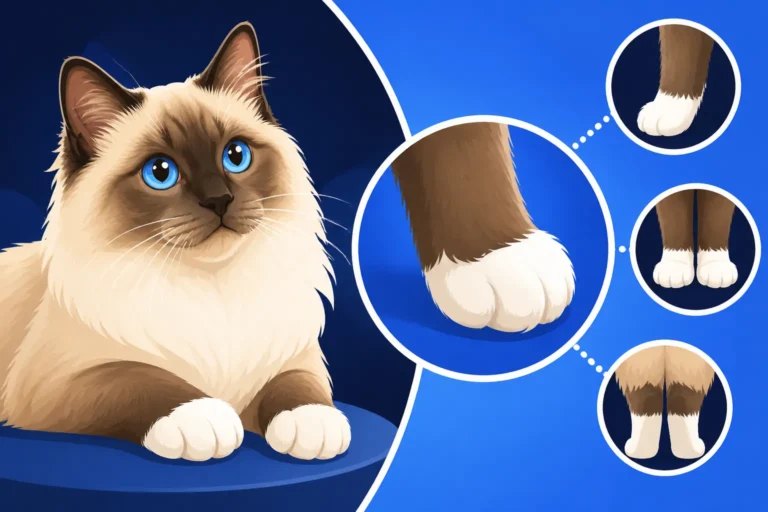
The front gloves are the white markings on the cat’s forepaws. A judge looks at whether they are clear, neat, and reasonably even with one another. The goal is not simply to have white fur on both feet; the markings should create a balanced appearance when the cat is standing naturally.
For example, imagine one front glove ending just above the toes while the other climbs noticeably farther up the leg. Both paws are white, but the difference in height can make the pair look uneven. The judge may also notice if the white marking extends too far, stops too low, or has an irregular edge.
The cat’s stance matters when you are trying to assess the gloves at home. A paw can look different when it is tucked under the body, turned outward, or partly hidden by long fur. This is one reason a photograph can be misleading: angle, lighting, and posture can make markings seem more even or more uneven than they are in person. The front-paw detail is explored further in Why a Birman's Front Gloves Must End Evenly.
Hind laces have their own shape and placement
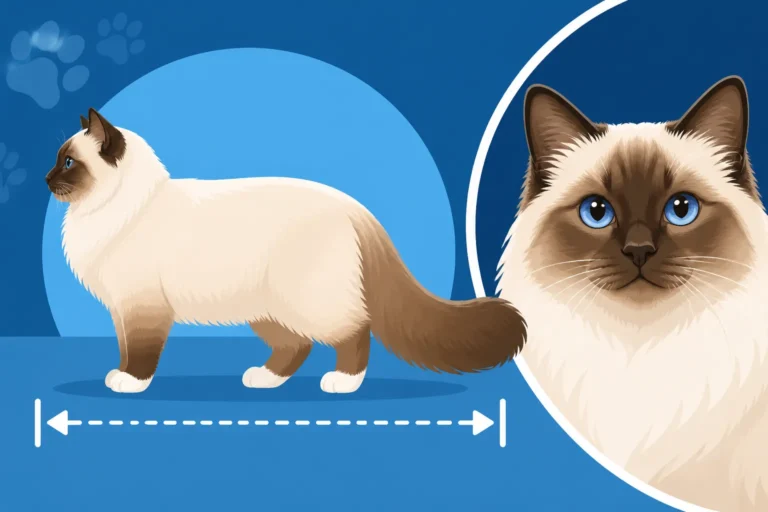
The white markings on a Birman’s hind legs are often called laces. Rather than looking like simple white socks, they extend up the back of the hind legs and should form a tidy, well-defined finish. Judges look at their length, placement, shape, and how well the two sides correspond.
A lace that climbs too high, ends abruptly, or differs noticeably from the other hind leg may affect the impression of balance. A marking that looks attractive from one side of the cat can also be less convincing when viewed from behind or at another angle. That is why careful in-person examination matters more than judging a single posed image.
The precise ideal and the seriousness assigned to a variation depend on the applicable standard and the cat’s markings. If you are learning to assess a kitten or preparing for a show, compare all four paws while the cat is standing and moving naturally. How High a Birman's Lace Should Run and What Judges Look For on a Birman's Paws First offer useful related detail.
Why a Birman can have a glove fault
The markings are more complicated than simply being white
Birman gloves are a defining breed feature, but getting a neat, symmetrical set is not as simple as selecting two cats with attractive paws and expecting every kitten to match. Inheritance plays a role, but the precise extent and shape of markings can vary among littermates.
That means two kittens from the same litter may have different glove heights, lace shapes, or degrees of symmetry. One may appear especially balanced, while another has a marking that is too high or uneven. This is a frustrating reality for breeders and buyers who have fallen in love with a particular kitten but hoped its markings would meet show expectations.
The difference between a recognizable Birman glove and a show-quality glove is important. A cat may have the breed’s characteristic white feet and still have markings that do not meet the ideal closely enough for top competition. For more on why the results can vary, see Why Glove Genetics Are Unpredictable in a Birman and Whether a Birman Glove Can Be Bred to Order.
Some faults are more serious than others
Not every variation has the same consequence. A small difference between two gloves may be less noticeable than a large mismatch, an irregular marking, or a lace that departs clearly from the expected shape. Judges assess the marking in context, and the governing standard determines how a particular fault is treated.
Some standards distinguish between faults that reduce a cat’s score and faults that can disqualify it. Do not assume that every imperfect glove means a cat cannot compete, or that a cat with attractive markings automatically qualifies for a high placement. For show eligibility and exact wording, consult the rules for the registry hosting the competition. Which Glove Faults Disqualify a Birman explains why it is worth separating a penalized marking from a disqualifying one.
Buyers should also remember that a show fault does not make a cat less deserving of a good home. Many Birmans with uneven or imperfect gloves make affectionate, healthy companions. If you are choosing a pet rather than a show prospect, temperament, health information, and responsible care should matter far more than whether every white marking is symmetrical.
How to assess gloves fairly
Look at all four paws in person
If you are evaluating a Birman for a show, or simply trying to understand its markings, look at every paw rather than relying on a front-facing photograph. Check the two front gloves together, then compare the hind laces. View the cat standing, and if possible, watch it walk so you can see how the markings sit when the legs are in motion.
Clean, well-kept paws make assessment easier, but grooming cannot change the underlying pattern. A comb can separate the fur so you can see where white marking ends, and a damp cloth can remove ordinary surface dirt. Keep the routine gentle: repeated scrubbing or products intended to whiten fur are not a substitute for natural markings and may irritate the skin.
For basic grooming supplies, owners might keep a suitable comb and pet-safe wipes on hand, purchased wherever they normally shop, including Chewy. The goal is simple cleanliness and comfort—not trying to alter the glove pattern.
Ask which standard and purpose apply
If a breeder describes a kitten as show quality, ask which registry’s standard they are using and what they mean by that description. Ask how the gloves and laces were assessed, and whether the kitten’s markings are considered suitable for show, breeding, or pet placement. A clear conversation is more useful than vague assurances that the gloves will “even out.”
Gloves can become easier to assess as a kitten grows, but buyers should not treat future changes as guaranteed. Ask the breeder to explain what they can see now, what may still develop, and what is uncertain. If you are preparing a cat for a show, the show’s rules and an experienced Birman exhibitor can help you understand how markings are typically evaluated.
At home, keep paw care practical. Trim claws when needed, check between the toes, and avoid trying to cut or dye fur to create a more symmetrical appearance. A clean coat can help the markings show clearly, but the judge is assessing the cat’s natural pattern. Chewy or another pet retailer may be convenient for replacing everyday grooming basics, but no grooming product can turn a marking fault into a perfect glove.
The short answer: under the CFA standard, Birman gloves are worth 20 points out of 100. Judges look at the balance and shape of the front gloves and hind laces, while considering those markings as part of the cat’s full assessment. For a particular show, always check the registry’s own standard.
Disclaimer
This article is for general informational purposes only and does not constitute professional advice. Laws, prices and regulations vary by location and change over time. Consult a qualified professional for guidance on your specific situation.