Which Glove Faults Disqualify a Birman
A Birman can have the breed’s blue eyes, pointed coat, and unmistakable white feet yet still be penalized in the show ring for glove markings that miss the standard. The tricky part is that a serious fault and a formal disqualification are not always the same thing. This guide explains what judges look for, which faults may disqualify, and how rules can vary by registry.
What judges mean by correct Birman gloves
Birman gloves are the white markings on all four paws. They are not simply decorative socks: their placement, shape, and symmetry are part of the breed’s distinctive appearance. Judges assess the markings against the standard used at that particular show, so it helps to know the rules before interpreting a result or evaluating a kitten.
For a closer look at the judging process, see What Judges Look For on a Birman's Paws First and How a Birman's Gloves Are Scored.
The front gloves should be even
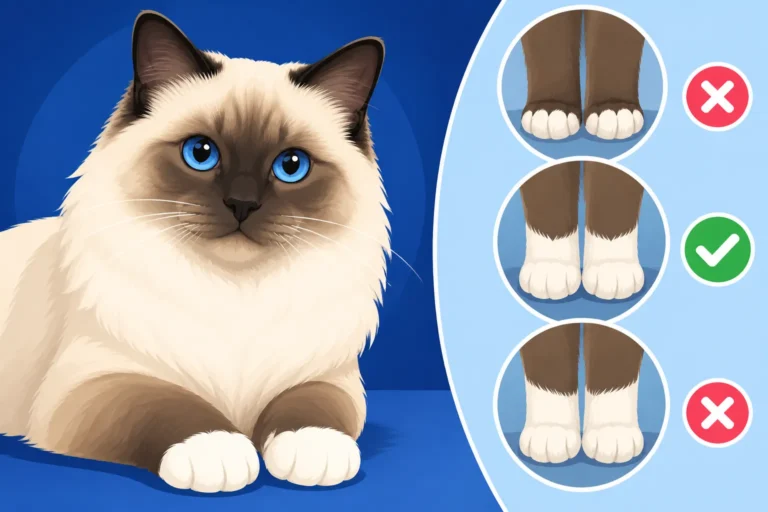
On the front paws, the white should cover the toes and end in a reasonably even line across the paw. A glove that climbs much higher on one foot than the other can be a visible fault. So can a sharply irregular edge that makes one marking look noticeably different from its opposite.
“Even” does not mean that every hair has to form a ruler-straight border. Judges assess the overall pattern and how it looks on the cat’s feet. A small difference may be treated as a fault rather than a disqualification, depending on the standard and how pronounced it is. The details of this feature are explained in Why a Birman's Front Gloves Must End Evenly.
The distinction matters when someone says a cat has “bad gloves.” That phrase could describe a minor unevenness, a substantial marking error, or a fault that a particular registry treats as disqualifying. Ask which standard is being applied and what the judge actually recorded.
The hind laces should follow the back of the paw
The white marking on each hind foot may extend up the back of the foot in a shape commonly called a lace or gauntlet. Its height and outline matter: a lace that is very short, uneven, or extends too far up the leg may be penalized. The ideal is not simply “more white is better.” The marking needs to fall in the right place.
A cat might have tidy front gloves but laces that differ markedly from one hind foot to the other. That imbalance can affect the overall impression even if all four feet have white. For more detail on the shape, see How High a Birman's Lace Should Run.
The way the markings look can also change as a kitten grows. White areas are present early, but a young kitten’s paws and proportions are still changing, and a breeder’s early assessment is not the same as a final show evaluation. How a Birman Kitten's Gloves Change as It Grows explains why early predictions should be treated with care.
Glove faults that may lead to disqualification
There is no single universal list that applies identically at every cat show. Registries publish their own standards, and the wording and consequences can differ. A fault that is penalized under one standard may be treated more severely under another. Always check the current standard for the registry and class in which the cat will be judged.
White outside the permitted areas
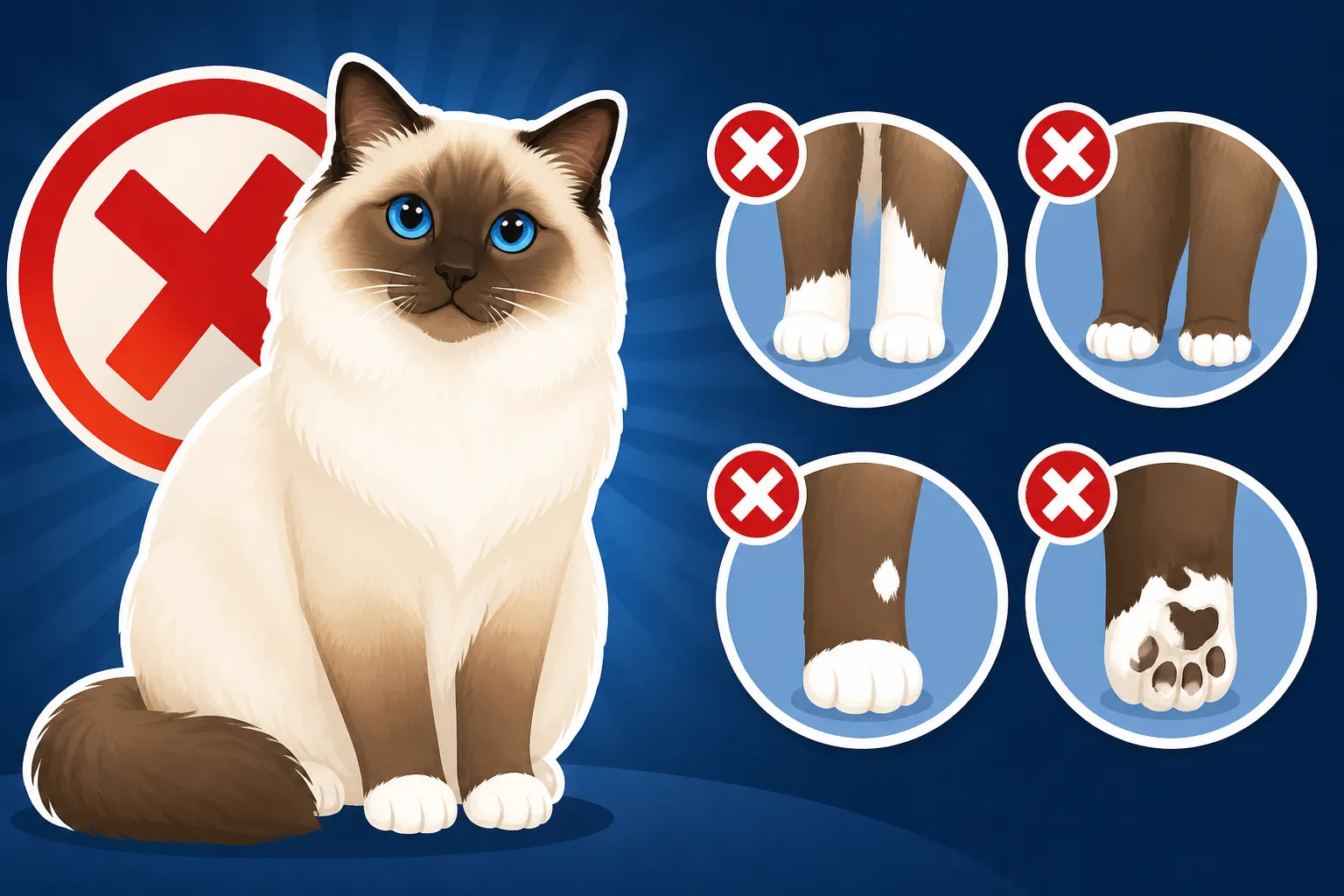
A Birman’s white gloves are intended to be confined to the feet. White markings that extend beyond the permitted glove area, such as onto a leg or elsewhere on the body, may be a serious problem. Some standards may classify particular forms of white outside the feet as a disqualification; others may describe the issue differently.
The exact location and nature of the marking matter. A bit of white hair at the edge of a glove is not automatically equivalent to a clearly separate white patch higher on the leg. A judge examines the cat in person and applies the relevant rule, rather than relying on a photo or a casual description.
This is one reason a kitten’s appearance in a photograph should not be treated as a guaranteed show verdict. Lighting, coat position, and the angle of the paw can disguise where a marking begins or ends. If a breeder describes a marking as a disqualification, ask which registry rule they mean and whether they can show you the wording.
Colored markings within a white glove
A distinct spot or patch of point color inside an otherwise white glove can conflict with the required pattern. Whether it amounts to a disqualification or a lesser fault depends on the standard’s wording and the appearance of the marking. Do not assume that every tiny shadow, stain, or darker hair is a colored spot: coat condition and lighting can make an area look different in a quick inspection.
If you are assessing a kitten, look at the paws when the cat is relaxed and the coat is clean and dry. Avoid stretching or twisting the legs to get a better view. A breeder or experienced judge can help distinguish a true marking from a temporary smudge or an optical effect.
Missing or severely misplaced gloves
A Birman without the required white on all four paws may not meet the breed standard. Some registries or class rules can treat a missing glove as disqualifying, while others may describe the issue through their broader standard and judging system. The degree of missing white matters too: a nearly bare paw and a glove that is simply uneven are not necessarily judged in the same way.
A pronounced mismatch can also be more serious than a small difference. For instance, one front paw with a high glove and the other with a low glove may be penalized, but that does not automatically mean the cat is formally disqualified. The phrase “disqualified for its gloves” should be used only when the applicable rules actually say that the specific condition warrants disqualification.
| Paw marking issue | How it may be viewed | What to check |
|---|---|---|
| Front gloves end at noticeably different heights | Often a fault or penalty | The standard’s guidance on symmetry and the judge’s written notes |
| Hind laces are uneven or incorrectly shaped | May be penalized, especially if pronounced | The standard’s description of hind-foot markings |
| White extends beyond the permitted foot area | May be a serious fault or disqualification | The exact registry wording and the location of the white |
| Colored spot within a white glove | May be a fault or disqualification | Whether the mark is true coat color and how the rule defines it |
| One or more gloves are absent or substantially incomplete | May prevent the cat from meeting the standard | The show’s disqualification rules and class eligibility |
This table is a guide to the kinds of issues to ask about, not a substitute for the rulebook. Standards can differ, and a judge’s decision applies to the cat as presented at that show.
Faults, penalties, and disqualifications are different
The word “fault” is often used casually to cover anything that is not ideal. In show judging, however, a fault, a penalty, and a disqualification can have different consequences. Understanding the terms prevents a disappointing result from being mistaken for a formal ruling that applies everywhere.
A fault does not always disqualify a cat
A fault is a feature that falls short of the ideal described by a breed standard. A judge may deduct points or rank the cat below another Birman with better markings. The cat may still be eligible to be judged and may still earn recognition, depending on the class and competition.
For example, slightly uneven front gloves may count against an otherwise strong cat without making it ineligible. A show judge considers the full standard, not just the feet. Body type, coat, color, head, eye color, and condition may all contribute to the overall assessment.
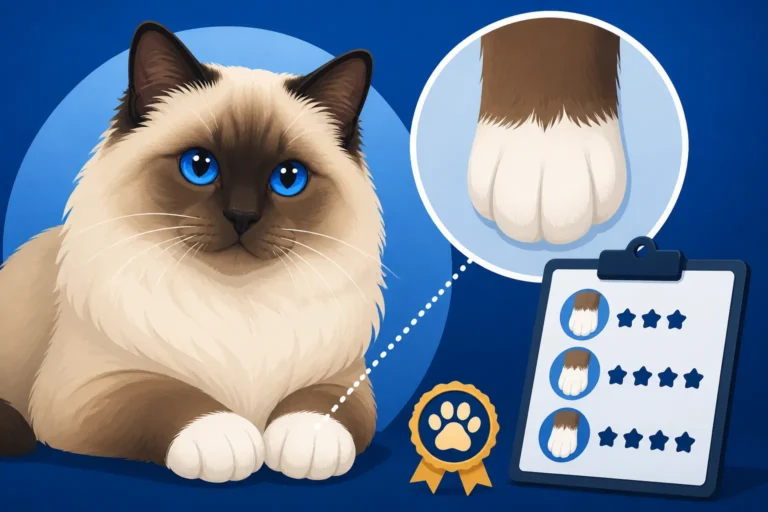
This is why two people can honestly describe the same markings differently. One may call them “wrong,” while a judge records a specific fault and continues judging the cat. To understand how much weight a particular feature carries, compare the marking with How a Birman's Gloves Are Scored and the actual standard in use.
Disqualification is a rule-based outcome
A disqualification is not just a particularly harsh penalty. It means that a rule in the applicable standard or show regulations makes the cat ineligible for the relevant award or further competition. The stated reason should be precise, rather than a general comment that the gloves are poor.
If a cat is disqualified, ask which written rule was applied and whether the decision was recorded on the judging sheet. This is especially helpful when the issue involves a borderline marking, a suspected colored spot, or white outside the feet. A clear explanation can distinguish a formal disqualification from a judge’s ordinary assessment of a fault.
People considering a show kitten should also remember that a breeder’s prediction is not a guarantee. Glove markings can be difficult to predict from the parents, even when both have attractive feet. Whether Show Marking Can Be Predicted From Birman Parents and Why Glove Genetics Are Unpredictable in a Birman offer useful context on why careful breeding cannot promise perfect symmetry.
The registry and class matter
Before entering a show, identify the registry, the class, and the relevant standard. A cat may be judged under different rules at different events, and a description found online may not reflect the exact wording currently used by the show organization. Ask the show secretary or consult the official standard rather than relying on a breeder’s shorthand.
This also matters when comparing show results. A judge’s note from one organization cannot always be translated directly into another organization’s terminology. If a Birman is described as “not show quality,” that may refer to a breeder’s assessment, a specific show standard, or simply a preference for more symmetrical markings. It does not necessarily mean the cat has been formally disqualified.
What owners and kitten buyers can do
Glove markings are set by genetics and development, not grooming. You cannot brush a glove into the correct shape or make a mismarked paw eligible by washing it. Still, careful observation and good questions can help you understand what you are seeing and avoid unrealistic expectations.
Inspect the paws calmly and consistently
When looking at a Birman’s feet, check each paw separately, then compare the front pair and hind pair. Look for where the white ends, whether any marking extends beyond the foot, and whether the laces appear reasonably balanced. Use good natural light and view the paws from more than one angle.
Do not force a kitten to hold still for repeated examinations. A short, calm look is more useful than turning the experience into a wrestling match. If you are preparing a cat for shows, ask an experienced breeder or mentor to help interpret the markings in person. A close-up image may be useful for discussion, but it cannot replace an examination under show conditions.
Everyday paw care is separate from show marking. Keep the coat clean, check for litter or debris between the toes, and use products intended for cats if cleaning is genuinely needed. If you buy basic grooming tools through Chewy or another retailer, choose simple items appropriate for a cat’s coat and follow the label rather than using human whitening products or harsh cleaners. Cleanliness cannot change the underlying pattern.
Ask precise questions before choosing a kitten
If you are speaking with a breeder, ask whether the kitten is being placed as a pet or considered for showing, and what that assessment is based on. Ask which registry’s standard they use, whether the kitten’s markings are still developing, and whether any specific fault has been identified. “Are the gloves good?” is less useful than asking about the height of the front gloves, the hind laces, and any white or color outside the expected areas.
A pet-quality Birman can be a wonderful companion even if its markings do not meet a show ideal. A show fault does not mean the cat is unhealthy, poorly bred, or less affectionate. If the kitten is intended for companionship, focus on health, temperament, socialization, and responsible breeding practices rather than expecting four perfectly matched feet.
If you need litter or routine coat-care supplies, Chewy may be one place to compare available options, but the product itself will not correct a marking fault. Avoid using powders, dyes, or bleaching products to alter a cat’s paws for presentation. They can irritate the skin and misrepresent the cat’s natural coat.
Keep show expectations realistic
Even experienced breeders can be surprised by how markings develop and how a judge interprets them. A promising kitten may grow into an adult whose gloves look less balanced than expected, while a pet kitten may have attractive markings without being selected for a show program. When a Birman Kitten's Gloves Are Final is a helpful companion read if you are trying to understand timing.
If a show result disappoints you, request the written assessment and compare it with the correct standard. That gives you something concrete to learn from rather than leaving you with the vague impression that a judge simply “didn’t like” the cat’s feet. For routine cleaning supplies, Chewy can be considered alongside other retailers, but no grooming product can make a disqualifying pattern acceptable under a show rule.
Disclaimer
This article is for general informational purposes only and does not constitute professional advice. Laws, prices and regulations vary by location and change over time. Consult a qualified professional for guidance on your specific situation.