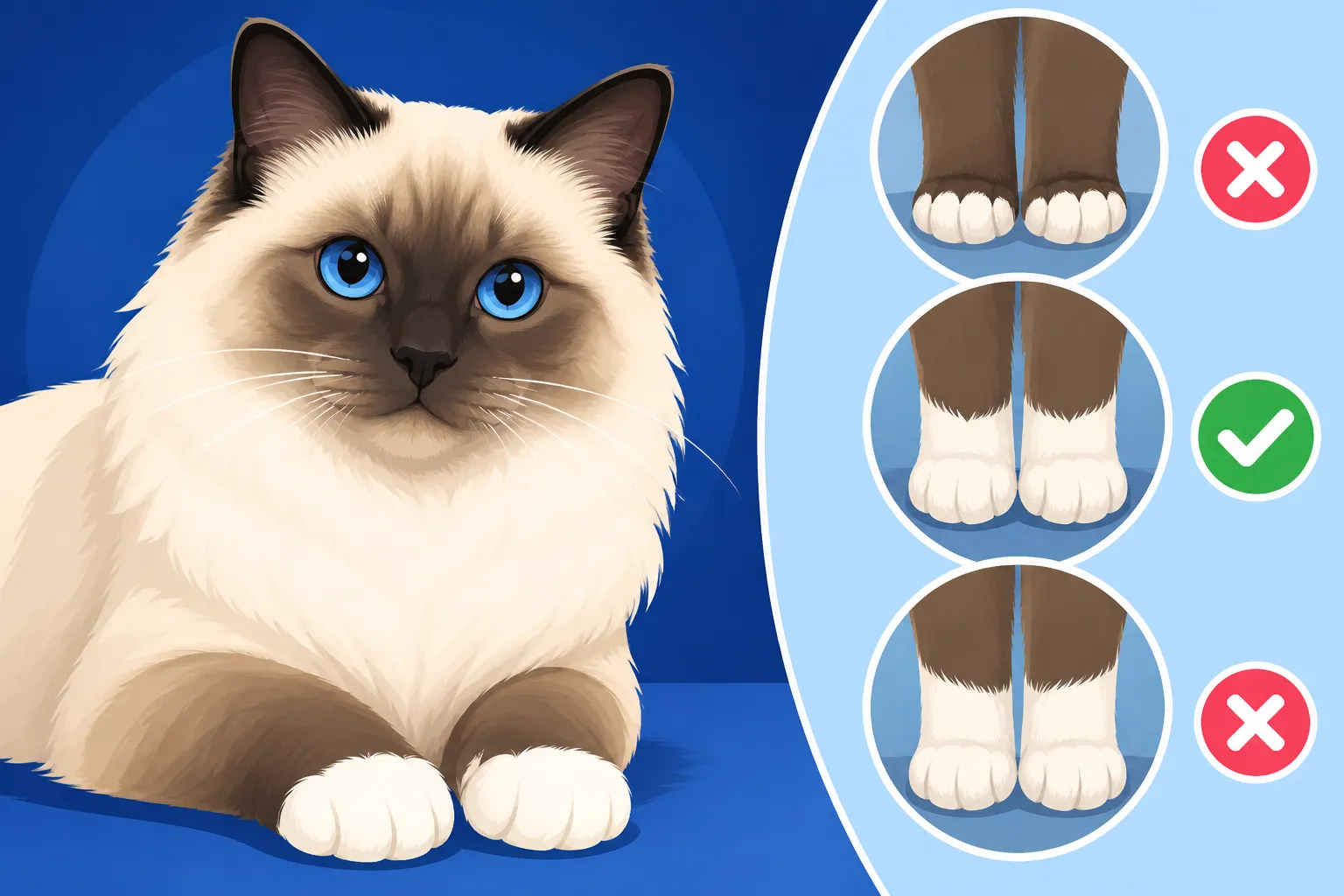
How High a Birman’s Lace Should Run
A Birman’s rear-leg lace is the white marking that climbs the back of the hock, and its height can make a real difference in the cat’s overall balance and show appearance. But there is no useful one-size-fits-all measurement: judges look at the lace’s shape, endpoint, symmetry, and relationship to the rest of the markings. This guide explains what to look for and what not to mistake for a fault.
What a Birman’s lace is meant to look like
The lace is the white marking on the back of the hind leg
A Birman’s “lace” is the upward extension of the white marking on the back of each hind foot. The white area covers the paw like a glove, then travels up the rear of the lower leg and ends in a point. That pointed upper ending is why the marking is also described as an inverted V or a lace.
The front feet have gloves too, but they are assessed differently. A front glove should end evenly across the foot, while the rear marking is expected to rise farther along the back of the leg. If you are trying to understand the whole pattern, How a Birman's Front Gloves Should Look explains the front markings in more detail.
A common source of confusion is looking only at the white area from the side. The lace is specifically on the back of the hind leg, so a side-on view may make it seem shorter, wider, or less pointed than it is. Check the rear of both legs when the cat is standing naturally, and look for the white marking to narrow toward its endpoint.
There is no universal height in inches
People often ask whether a Birman’s lace should reach a particular point on the leg, or whether a certain number of inches is considered correct. In practice, a fixed measurement is not a very helpful way to assess it. Cats differ in size and leg proportions, and coat length can make the apparent endpoint look higher or lower.
The useful visual standard is that the lace should extend up the back of the hock and finish in a distinct point, ideally with a corresponding marking on the other hind leg. The point should not look like a broad, blunt patch, and the white should not appear to climb so far that it becomes an unrelated area of white on the thigh. For a closer explanation of the endpoint, see Where a Birman's Back Lace Should End.
This is why an online photo can leave an owner or prospective buyer uncertain. A stretched leg, a turned paw, a long coat, or a bright patch of light can change how high the marking seems. The question is less “How many inches?” and more “Does the white marking form the expected pointed extension, in the right place, and does it look balanced with the other leg?”
| Feature | What to look for | Common point of confusion |
|---|---|---|
| Location | White extends up the back of the hind leg | Side views can hide the rear marking |
| Endpoint | A clear, pointed finish | A broad patch can look like a point from one angle |
| Height | Extends up the hock without looking disconnected | Leg length and coat can alter visual proportions |
| Balance | Both hind markings look reasonably alike | Perfect mirror-image markings are uncommon |
| Assessment | Judge the marking on a standing cat from more than one angle | A single photo may distort the apparent height |
How judges and breeders assess lace height
Shape, endpoint, and balance matter together
Lace height is only one part of the assessment. The marking’s shape and finish matter too. A lace that reaches a suitable height but ends in a wide, blunt edge may not look as desirable as one with a cleaner pointed finish. Likewise, a well-shaped lace on one leg can look less balanced if the other side has a very different pattern.
“Symmetrical” does not necessarily mean the two legs must be identical down to every hair. White markings are biological patterns, not paint applied with a stencil. Instead, a judge or experienced breeder looks at whether the pair works together visually: Do both laces rise in a similar area? Do they taper in a similar way? Does one look dramatically higher or broader than the other?
The whole set of markings matters as well. A Birman is judged as a complete cat, not as two isolated white patches. The rear laces are considered alongside the front gloves, coat, body, head, and overall presentation. How a Birman's Gloves Are Scored offers more context on why the markings are important without making the lace the only thing that counts.
A natural stance gives the fairest view
For a meaningful assessment, let the cat stand squarely on a level surface. A cat with one hind foot pulled forward, a bent hock, or its weight shifted to one side can make the laces look uneven. A relaxed stance is more useful than holding a leg up, because pulling or twisting the leg can stretch the coat and distort the apparent boundary.
Check the markings from the back, then from a slight angle. The rear view shows where the lace sits and whether the pair seems balanced. A side view can help you see the slope and endpoint. If you are assessing a kitten, take more than one look over time rather than making a firm judgment from a single picture; posture and developing coat can affect what you see.
For a prospective show cat or kitten, ask the breeder to show both hind legs clearly in person if possible. A photo taken close up with one leg nearer the camera can exaggerate differences. Why Birman Gloves Have to Be Seen, Not Photographed explains why pictures are useful for an initial look but can be misleading when judging fine details.
Common lace faults and misleading impressions
A lace that looks too high or too low in a photo
Perspective is one of the biggest reasons a lace can seem to start or finish in the wrong place. If a hind leg is angled toward the camera, the white area may appear broader. If the cat is sitting with its hocks tucked underneath, the upper endpoint can disappear into the surrounding coat. Long hair can also blur the boundary between white marking and colored point.
Lighting adds another complication. White fur can blend into a pale background, while shadows may make the endpoint look sharper or more irregular than it is. A phone camera may also distort proportions when it is held close to the cat. Before deciding that a lace is unusually short or high, look at the cat standing naturally and compare views of both legs.
Avoid judging from a picture where the paws are hidden, the legs are crossed, or the cat is being held in an awkward position. If a seller or breeder provides only a single cropped image, ask politely for a clear view of the rear legs while the kitten is standing. That request is especially reasonable if the markings are part of your decision about a show prospect.
Uneven markings are not always easy to interpret
A noticeable difference between the two rear laces can affect the visual balance of the markings. However, “uneven” can mean several things: one lace may reach higher, one may be wider, or one may have a less distinct point. Those differences should not be confused with a change in the underlying leg shape or a patch of coat that simply lies differently.
When markings are assessed for a show, the relevant standard and the judge’s overall evaluation matter. A particular imperfection does not automatically tell you everything about the cat’s quality, health, or suitability as a companion. Why an Uneven Birman Glove Is a Show Fault discusses how marking faults are viewed in a show context, while How a Breeder Judges a Birman Kitten's Gloves describes why breeders are careful about making early predictions.
A kitten’s markings can be difficult to evaluate with the confidence an adult cat allows. Ask the breeder what they see and whether the kitten is being considered as a pet or show prospect, but treat any prediction as an assessment rather than a promise. Even experienced breeders cannot guarantee every detail of how markings will appear as a cat matures. Why Glove Genetics Are Unpredictable in a Birman explains why the presence of the breed’s characteristic markings does not make every individual pattern identical.
Checking lace markings without damaging the coat
Use gentle handling and avoid trying to reshape the white area
A lace is a marking, not a grooming style. Trimming the surrounding fur will not change where the white marking begins or ends, and shaving or clipping to create a sharper point is not a sensible way to improve it. It can damage the appearance of the coat, irritate the skin, and leave the cat uncomfortable without changing the underlying pattern.
If you need to inspect the marking, let the cat stand on a nonslip surface and use a calm voice. Move around the cat rather than repeatedly lifting or twisting its legs. A fine-toothed comb can help separate the coat gently if the endpoint is hidden, but there is no need to comb aggressively or pull at the white hairs.
For routine coat care, use tools designed for a cat’s coat and introduce them gradually, especially if the Birman is not accustomed to handling its legs. Chewy is one place owners may browse for basic combing supplies, but choose a tool based on its suitability and gentleness rather than expecting any grooming product to alter a marking. If you are unsure whether a patch is simply coat pattern or a skin concern, ask your veterinarian rather than trying a stain remover or topical product.
Keep show preparation separate from changing the marking
Before a show, owners may want the white feet and lower legs to look clean and well kept. That is different from trying to change the lace’s height or outline. Brush out loose debris gently, keep the coat dry and tidy, and use only products that are appropriate for cats and accepted under the relevant show rules. Avoid human whitening products, household cleaners, or anything that could irritate the skin if licked.
If a Birman’s white feet are repeatedly becoming dirty, look at everyday causes such as litter dust, damp floors, or a coat that needs routine attention. Chewy may offer a way to compare cat combs or litter options, but the right choice depends on your cat’s needs, not on the hope of correcting a marking. A sudden change in the skin or coat deserves veterinary attention rather than cosmetic treatment.
Most importantly, do not let a lace measurement become the whole story of your cat. A high, low, narrow, or asymmetrical lace may affect show evaluation, but it does not make a loving companion less of a Birman. If you are buying a kitten, ask for honest information about the markings, the breeder’s expectations, and the kitten’s registration paperwork. If you already share your home with a Birman, a relaxed look at the markings is usually all the inspection needed. Chewy can be useful when you are shopping for routine grooming basics, but no comb, shampoo, or other supply can alter the cat’s natural lace pattern.
Disclaimer
This article is for general informational purposes only and does not constitute professional advice. Laws, prices and regulations vary by location and change over time. Consult a qualified professional for guidance on your specific situation.