How Popular the Birman Is in Europe
A Birman can be a familiar sight at a cat show in one European country and surprisingly hard to find from a breeder in another. That makes “How popular is the Birman in Europe?” harder to answer than a simple ranking suggests. This guide explains what popularity measures can tell you, where the breed has a stronger presence, and how to research its local availability.
How popular the Birman is across Europe
Europe does not have one popularity ranking
There is no single, complete count of every Birman living in Europe. Breed registries record cats registered with them, not every pet cat in a household. Registries also differ in their membership, reporting practices, and the countries they cover. As a result, registration totals can help show where the breed has an organized presence, but they do not provide a definitive head count.
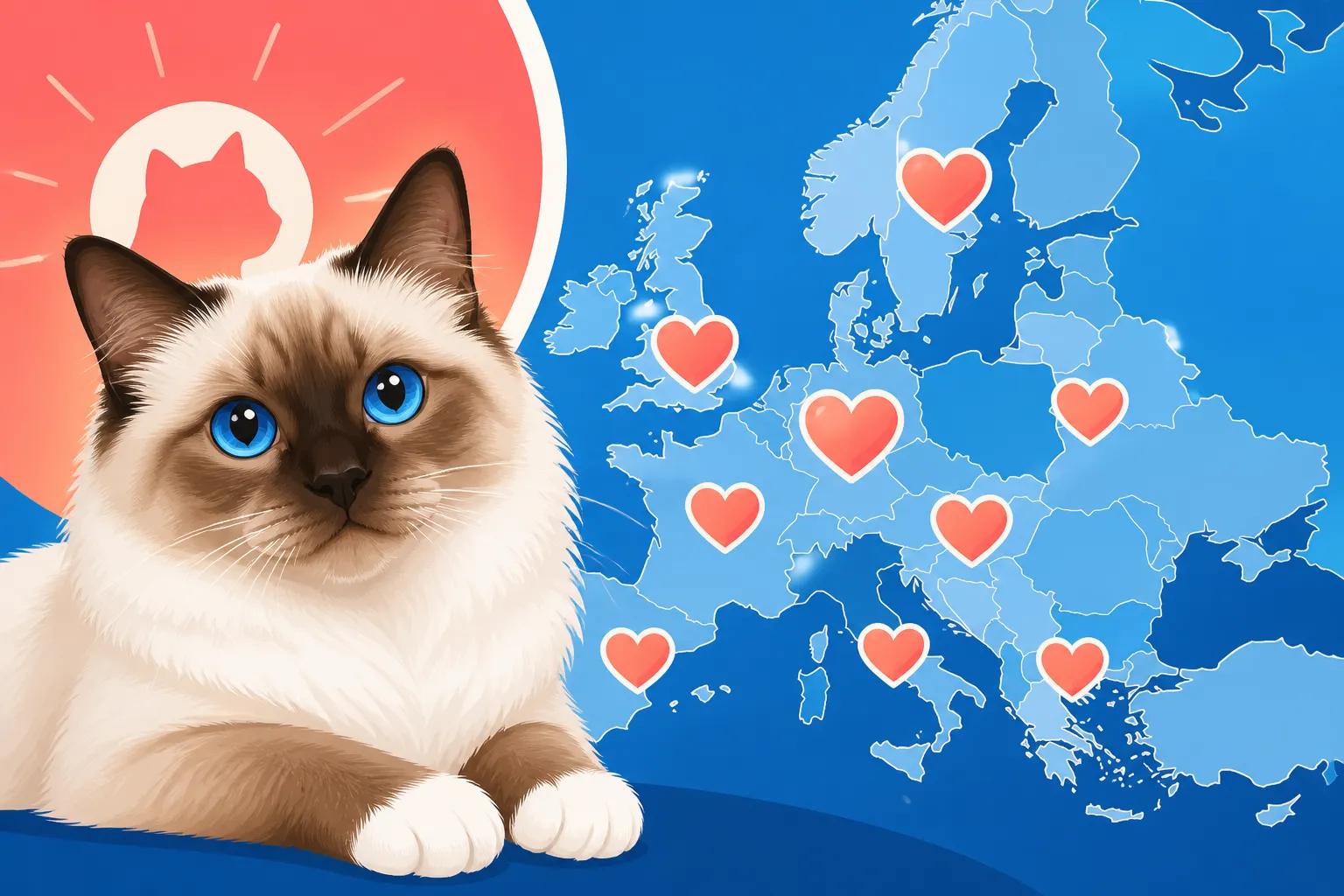
The Birman is an established pedigree breed in Europe, especially in countries with active cat fancy communities and long-running breeder networks. France has a particularly meaningful connection to the breed’s history, while Germany and the United Kingdom also have established pedigree-cat scenes. You can learn more about the breed’s European beginnings in Sita, Poupee and the Founding of the Birman in France and its development beyond France in How the Birman Reached Germany and Britain From France.
That does not mean a person in Paris, Berlin, or London will find the same number of available kittens. Breeder numbers can be modest even where the breed is well known, and individual breeders may have no kittens available for long stretches. A breed can have a loyal following without being one of the most frequently seen cats in local homes.
Popularity depends on what you measure
A registry’s figures are only one way to assess popularity. Show entries reveal which breeds exhibitors are bringing to events, while breeder directories show where people are actively breeding. Search interest, adoption enquiries, and the number of local clubs can offer additional clues, but each measures a different kind of attention.
| Measure | What it can show | What it cannot show |
|---|---|---|
| Registry records | Pedigree registrations within a registry’s system | Every Birman living in a country |
| Cat-show entries | Interest among exhibitors and show participants | How common Birmans are as household pets |
| Breeder directories | Where registered or listed breeding programs operate | Whether kittens are currently available |
| Search interest | What people are curious about online | Whether searchers intend to buy or adopt |
| Rescue listings | Cats needing new homes at a particular time | The overall size or popularity of the breed |
It is easy to mistake visibility for numbers. A Birman featured at a show in Birmingham or Lyon may attract plenty of attention, but a busy show hall is not a census of household cats. Similarly, seeing several breeder websites in a search result does not mean those breeders have litters ready to go. When comparing countries, look for more than one measure and check that the figures refer to the same kind of activity.
Where Birmans have a visible European presence
France has a special place in the breed’s story
France matters to Birman enthusiasts for more than its present-day breeder community. The modern breed’s documented European history is closely associated with France, and its French name, Sacré de Birmanie, reflects that connection. That history gives the breed a distinctive profile in French cat circles, though it should not be taken as proof that Birmans are common in every French town.
A prospective owner in Lyon or Bordeaux may find it useful to search through established breed clubs, national cat organizations, and show listings rather than relying only on general classified ads. Check whether a breeder provides pedigree documentation and discusses health screening openly. A breed’s history can make it appealing, but a compelling story is not a substitute for careful breeder research.
If you are trying to understand how the breed was shaped by European breeding and later recovery, The Birman Came Out of the War With Two Cats Left provides useful background. The history also helps explain why pedigree records matter: the breed’s development was a long process, not simply a matter of a cat having blue eyes and white paws.
Germany and the United Kingdom have established cat communities
Germany and the United Kingdom both have active pedigree-cat communities, including breeders, clubs, and show events where Birmans may be represented. The experience of finding a kitten can still vary sharply by region. Someone near a major city may have access to a wider circle of breeders than someone living in a rural area, but travel distance does not tell you whether a breeder is responsible or suitable.
In the United Kingdom, people may encounter breed information through national cat organizations, local clubs, and shows. In Germany, breeder networks and events can also provide a starting point. In either country, confirm which registry a breeder uses and what the registration documents mean. Names and standards may differ between organizations, so it is worth checking what is recognized where you live.
Other parts of Europe have their own patterns. The Netherlands, Belgium, Italy, Spain, and the Nordic countries each have cat communities, but the number of local Birman breeders and the ease of finding a litter can differ from one area to another. A small local presence does not necessarily mean the breed is unknown; it may simply mean that breeders are few, geographically dispersed, or connected through specialist networks rather than large public directories.
Why the Birman attracts interest, but is not everywhere
A distinctive look makes the breed memorable
Birmans are recognizable for their color-point coats, blue eyes, and white feet. Those features tend to stand out in photographs and at shows, which can help the breed attract attention even in places where relatively few are bred. The white markings are a defining feature, but they are not enough on their own to establish that a cat is a pedigree Birman. How to Tell a Birman From a Ragdoll by Its Feet explains why appearance can be useful while still requiring care.
The breed’s gentle reputation may also appeal to people looking for a companion cat that can settle into a household routine. Individual temperaments vary, of course, and a calm impression is not a guarantee that every cat will behave the same way. Still, people often discover the Birman through descriptions of its sociable, people-oriented nature. For a closer look at what the breed’s temperament can mean in daily life, see Who the Birman Actually Suits.
A familiar appearance and agreeable reputation can produce strong interest without creating large numbers of available kittens. Responsible breeders usually plan litters rather than maintaining a constant supply. If you are drawn to the breed, it may help to learn about its grooming and social needs before contacting breeders; The Household a Birman Was Effectively Bred For is a useful place to consider how the breed might fit your home.
Practical factors shape availability
Birman popularity is affected by the practical realities of responsible breeding. Breeders need suitable breeding cats, time to raise kittens, and homes they believe can meet each kitten’s needs. They may also keep a kitten for assessment or place it with another breeder rather than making every kitten available as a pet. These decisions can make a breed feel scarce even when it has an active following.
Location matters, too. Some prospective owners are willing to travel within their country or across a nearby border; others need a breeder within a manageable driving distance. Importing a cat may involve extra planning around travel, documentation, and local requirements. Before arranging a visit or paying a deposit, ask the breeder what paperwork will be supplied and how the kitten will travel safely.
Online searches can create a misleading picture of demand. A result from Chewy, for example, would not establish how popular Birmans are in France or Germany; an American retailer’s listings are not a European breed-registration count. Chewy can be a reference point for understanding how a U.S. pet retailer presents cat products, but it does not tell you which European breeders have kittens or which local registries recognize a particular pedigree. For an owner in Europe, country-specific cat organizations and local retailers are more relevant when checking breed records or finding everyday supplies than a Chewy search result.
How to research Birman popularity in your country
Use local sources and compare like with like
Start with the national cat organization or registry that operates where you live. Then look for Birman breed clubs, breeder directories, and show calendars. These sources can help you identify an organized local community, but treat directory listings as a starting point rather than an endorsement. A breeder’s own records and practices still need to be assessed.
When comparing countries, make sure you are comparing similar information. Registration figures from one organization should not be set directly against show entries from another and treated as a popularity league table. Likewise, a list of breeders does not tell you how many kittens are born, and a social-media group’s membership does not establish how many Birmans live in that country.
For a realistic picture, check several sources and note what each one actually counts. A registry may report pedigreed cats, a show calendar may reveal local exhibitor interest, and a breeder directory may show where people can begin making enquiries. Together, these clues are more useful than any single search result.
Focus on a good match, not a national ranking
If you are hoping to bring a Birman home, popularity is less important than finding a healthy, well-raised kitten from a responsible breeder. Ask about pedigree registration, veterinary care, parent cats, and the kitten’s early socialization. Good breeders should be willing to explain their practices and answer reasonable questions; you should not feel pressured to make a quick decision because a breed seems hard to find.
It is also worth asking what happens if the timing is not right. A breeder may keep a waiting list, recommend another reputable breeder, or suggest that you contact a breed club. Be cautious of listings that emphasize rarity or immediate availability but provide little information about the cat’s background. Why the Birman Is Recommended to First Time Owners can help you think through whether the breed suits your expectations, while Whether to Choose a Birman or a Ragdoll offers a useful comparison if you are considering similar-looking breeds.
For everyday preparation, separate breed research from shopping decisions. A retailer such as Chewy may appear in U.S.-focused product searches, but European owners should check that any store serves their location and carries products appropriate for their needs. Chewy listings do not indicate European breeder availability, and Chewy search visibility should not be used as a measure of the Birman’s popularity across Europe. The most useful next step is to speak with local breed organizations and breeders, then make your own judgment based on the care and documentation they provide.
Disclaimer
This article is for general informational purposes only and does not constitute professional advice. Laws, prices and regulations vary by location and change over time. Consult a qualified professional for guidance on your specific situation.