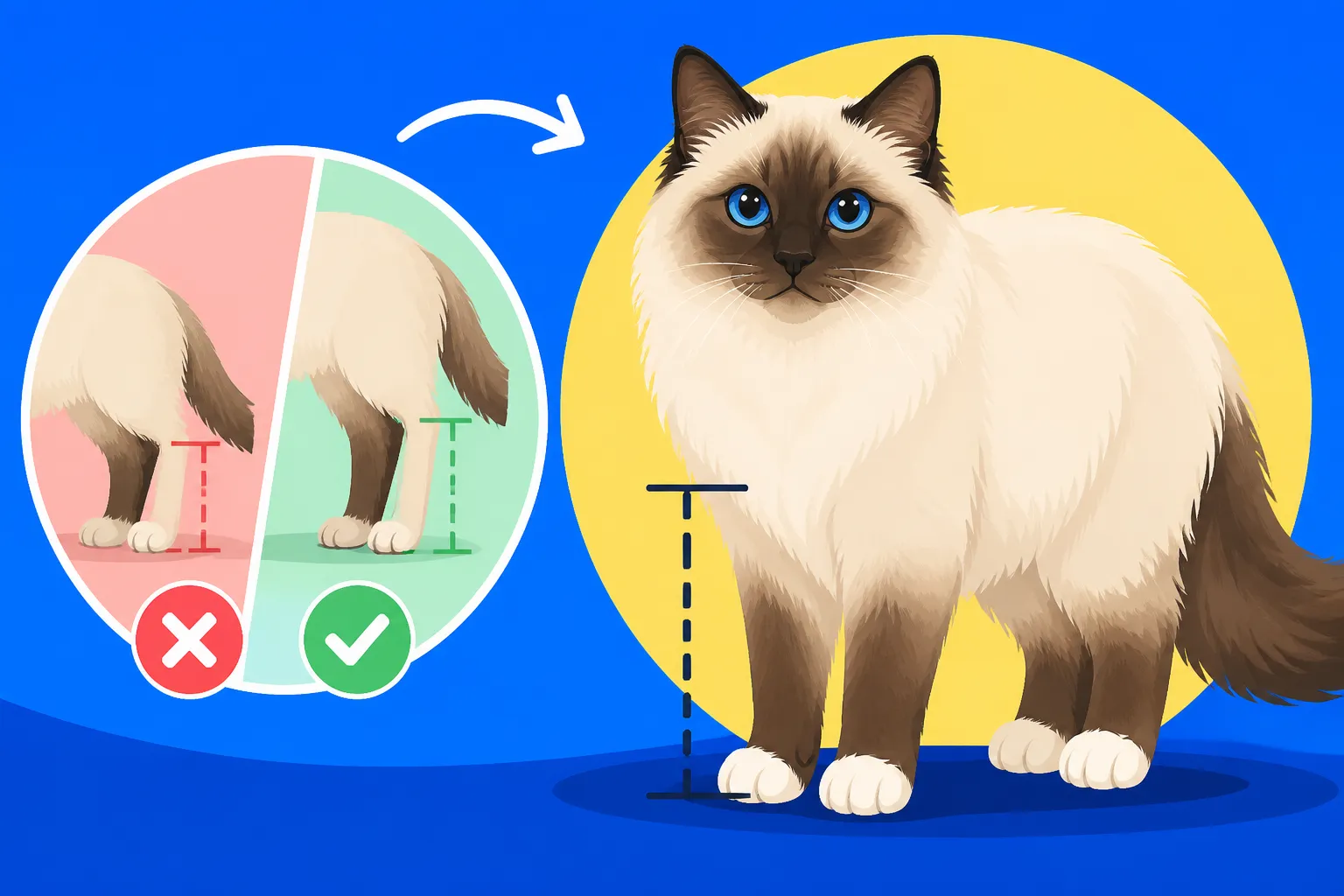
How Long a Birman’s Legs Should Be
A Birman’s long, silky coat can make its legs look shorter than they are, while a kitten’s changing proportions can make them seem too long one month and just right the next. The breed is meant to have medium-length, well-balanced legs—not an extreme, exaggerated shape. This guide explains what that looks like, how to judge proportion, and when a leg or gait concern deserves a vet’s attention.
The Birman’s ideal leg length
Medium length, balanced with the body
A Birman’s legs should be medium in length and in proportion to its body. They should support a substantial, muscular cat without making it look either low-slung and cobby or unusually tall and fine-boned. The overall impression is of a sturdy, balanced animal—not a cat whose legs dominate its outline.
That balance matters more than a single measurement. Breed descriptions do not give owners a simple leg-length figure to check at home, and measuring from the floor to a particular point on a fluffy cat can be misleading. Coat, posture, and camera angle all affect what the legs appear to look like. In a show ring, judges assess the cat’s whole structure rather than treating leg length as an isolated number.
The Birman is often described as sitting between more compact and more slender body types. Its legs contribute to that middle-ground outline: neither extremely short nor notably long. If you’re comparing a Birman with another longhair, the broader shape can be more useful than trying to judge the legs by themselves. Why the Birman Is Called Neither Cobby Nor Foreign
Strong enough to suit a substantial cat
A Birman’s legs should look sturdy and capable of carrying its body. That doesn’t mean they should look thick or heavy for the cat’s frame. Rather, the legs, body, and paws should fit together naturally. A balanced Birman can look graceful while still having a solid, muscular build beneath its coat.
The body can continue filling out as a young Birman matures. That can change how its legs seem in relation to its torso: a lankier-looking youngster may appear more balanced as the body develops, while a kitten’s fluffy coat can make its outline seem rounder than its actual frame. For that reason, avoid judging a growing cat’s proportions by one photograph or a brief glance. Why a Birman Is Still Filling Out at Three
A cat that looks a little different from a show ideal is not automatically unhealthy or poorly cared for. Breed standards describe the desired appearance for judging, not a medical test. If your Birman walks, runs, and moves comfortably, a visual difference in leg proportions alone may simply be a variation in build. A change in movement, however, is a separate issue and should be considered on its own.
How to judge proportions without being misled
Look at the whole outline, not just the legs
A practical way to assess leg proportion is to watch your Birman standing naturally on a flat surface. Look at the relationship between the legs, body, and overall height. Does the cat appear balanced, with a body that is neither unusually close to the ground nor perched conspicuously high? Do the legs look in keeping with the cat’s sturdy frame? These broad impressions are more useful than trying to estimate a precise ratio.
It can help to observe your cat from the side while it is relaxed and standing squarely. A crouch, stretch, seated pose, or mid-step can make the legs seem shorter or longer than they are. Photos can be especially deceptive: a low camera angle may exaggerate leg length, while a view from above can make the body look wider and the legs less noticeable.
The Birman’s overall body length also affects the impression of its legs. A cat with a longer body may look lower to the ground even when its legs are an appropriate length. For a broader picture of the breed’s proportions, see How Long a Birman Is Nose to Tail.
Remember what the coat and white feet can hide
A Birman’s coat is silky and can be longer around areas such as the ruff and britches. The fur along the legs may soften their outline, especially when the cat is sitting or moving. A thick fringe of coat can make a limb look shorter, while closely cropped fur—or a coat that lies flat—can make the same limb look longer and more defined.
The white markings on the feet can also affect how the lower legs appear. Birman gloves are a feature of the paws, not evidence that the legs should have a particular length. On the back feet, the white markings may extend up the rear of the leg in what are often called laces or gauntlets. These markings are judged for their placement and shape; they do not change the underlying bone or the desired overall leg proportion. What Judges Look For on a Birman's Paws First
Coat condition and grooming can change the silhouette further. Mats, uneven trimming, or a long coat bunching around the feet can obscure the natural line of the legs. The breed’s coat should have a silky texture rather than a woolly, dense appearance, which is part of why the outline may look different from one cat to another. What a Birman's Coat Texture Should Be
| What you notice | What it may mean | A sensible next step |
|---|---|---|
| Legs look short when the cat is sitting | Posture and coat can compress the visible outline | Observe your cat standing naturally |
| Legs look long in a photograph | Camera angle or a stretched pose may exaggerate them | Compare several relaxed side views |
| White fur extends above a hind paw | This may be a marking pattern, not extra leg length | Assess the underlying leg shape separately |
| Your young cat looks lanky | A growing cat’s proportions may change as it matures | Track development over time rather than judging one snapshot |
| Your cat suddenly limps or avoids a leg | A change in movement may indicate pain or injury | Contact a veterinarian for advice |
Birman kittens and adult proportions
Why a kitten can look out of proportion
Kittens change quickly, and their bodies do not always develop in a perfectly even-looking sequence. At one stage, a Birman kitten may seem leggy; later, its body may lengthen or fill out and make those same legs appear shorter. A fluffy coat can add to the effect, particularly when the kitten’s body shape is changing.
Try not to compare a young kitten too literally with photographs of fully grown adults. Differences in posture, age, coat development, and the angle of the photograph can make comparisons unreliable. If you are choosing a kitten, ask the breeder how the kitten is growing and whether its movement and general development appear typical. A responsible breeder should be comfortable discussing the kitten’s health and build without promising that it will meet every show preference as an adult.
Nor should a kitten’s leg length be treated as a stand-alone predictor of its eventual adult appearance. A single snapshot cannot tell you exactly how the cat will mature. If you’re trying to understand how body size differs between male and female Birmans as adults, those broader comparisons can provide context: How Heavy a Full Grown Birman Tom Gets and How Much Smaller a Birman Queen Finishes.
Compare breeds carefully
When people compare Birmans with other longhaired cats, they may notice different body outlines and assume that one breed’s legs must be longer. But overall appearance depends on more than limb length: body shape, bone, coat, posture, and head proportions all contribute. Even two cats with similar leg lengths can look quite different because their bodies are built differently.
A comparison is most helpful when you look at the whole cat standing naturally. Avoid relying on a single feature—such as a ruff, a white paw, or a photograph taken from above—to decide whether the legs are unusually short or long. If you’re comparing Birmans with Ragdolls, focus on the broader differences in build and outline as well as the legs. How a Birman Differs From a Ragdoll on Sight
When leg appearance is a health concern
Breed shape is different from a change in movement
A Birman’s legs can look shorter or longer because of coat, stance, or individual build. A sudden change in how the cat uses a leg is different. Limping, repeatedly holding up a paw, reluctance to jump, stiffness, or a new difficulty walking should not be dismissed as a breed trait or an awkward phase of growth.
Pay attention to changes from your cat’s usual routine. If a Birman that normally walks freely begins hesitating at stairs, landing unusually, or avoiding play, note when you first saw the change and whether it is getting worse. A short video of the movement may help you explain what you have noticed to your veterinarian, but it does not replace an examination.
Contact a veterinarian for guidance if your cat seems painful, cannot bear weight, has visible swelling, or develops a sudden and marked change in movement. A veterinarian can assess the cat’s limbs and joints and decide whether further examination is needed. The right response depends on the individual cat and what the vet finds; leg length by itself cannot explain a limp.
What owners can monitor at home
For a healthy Birman, you don’t need to measure the legs regularly. Instead, get familiar with your cat’s normal posture and movement. Notice how it stands, walks, climbs, and gets up after resting. Familiarity with that baseline makes it easier to spot a meaningful change rather than worrying over a coat that looks different after grooming or a posture that looks odd in one photo.
You can also take occasional side-on photos while your cat is standing on a level surface. Keep the camera at roughly the same height and distance each time. These pictures won’t provide a formal breed assessment, but they may help you see whether your cat’s outline is changing as it matures. If you have questions about show-standard proportions, a reputable Birman breeder or experienced breed judge can explain what they look for in the complete silhouette.
The simplest rule is to separate appearance from function. Medium, balanced legs suit the Birman’s sturdy, graceful outline, but normal movement matters more to your cat’s everyday wellbeing than whether its proportions match an idealized photograph. If the concern is a sudden limp or a change in comfort, ask a vet rather than trying to diagnose it from leg length.
Disclaimer
This article is for general informational purposes only and does not constitute professional advice. Laws, prices and regulations vary by location and change over time. Consult a qualified professional for guidance on your specific situation.