What a Birman’s Coat Texture Should Be
A Birman’s coat should feel soft, silky, and smooth rather than dense, woolly, or cottony. Yet a long coat can look like a grooming challenge, and changes in texture can leave owners wondering whether they are feeling normal seasonal variation or a problem. This guide explains the breed’s typical coat, what affects its feel, and how to care for it without damaging its delicate texture.
What a Birman’s coat should feel like
Silky, soft, and easy to separate
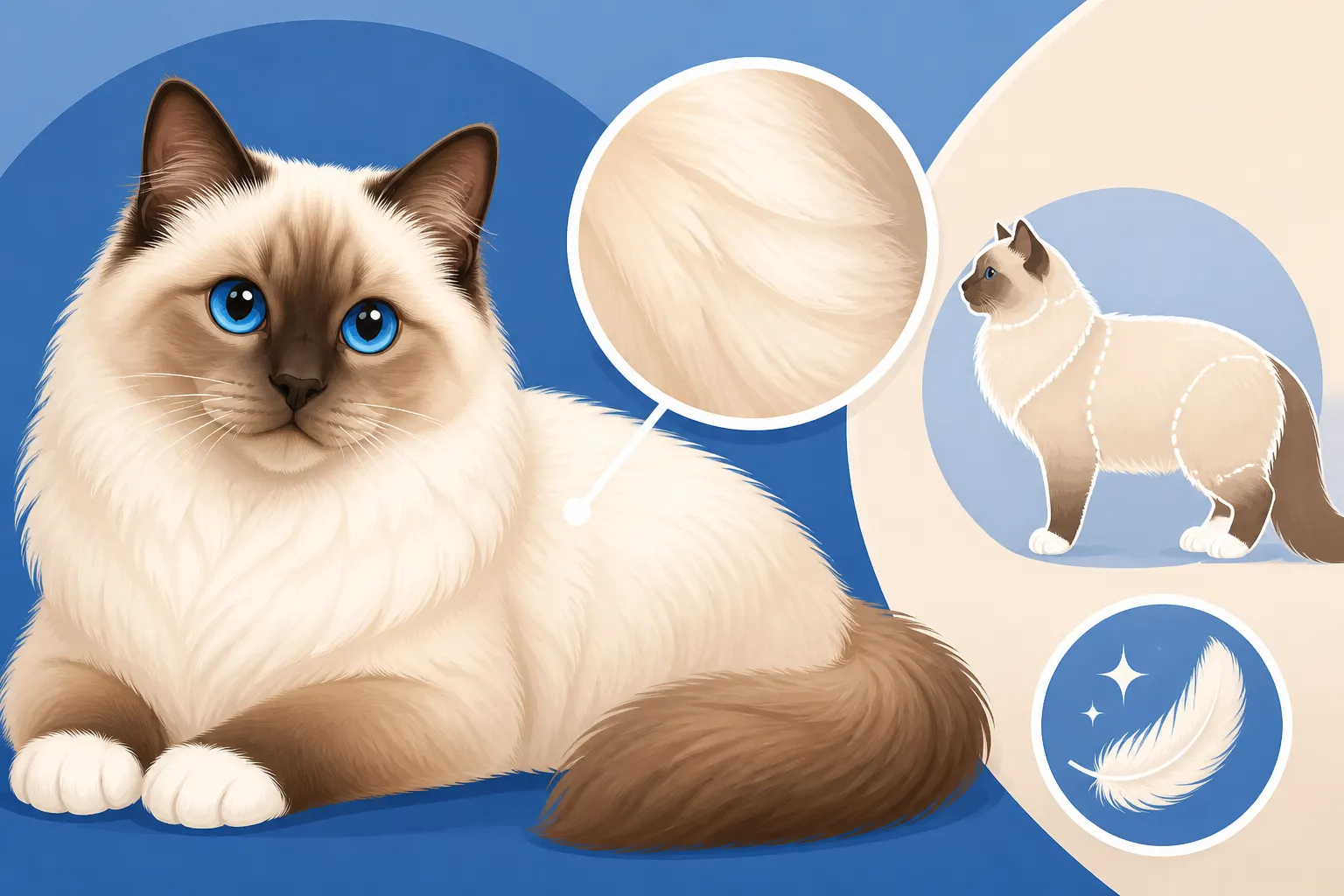
A healthy Birman coat is generally fine and silky to the touch. When you run your fingers through it, the hairs should feel smooth and fall back into place rather than forming a thick, compact layer. The coat may feel fuller in some areas than others, but it usually should not have the dense, woolly sensation associated with breeds that have a heavy undercoat.
That softness can be easy to mistake for fragility. A Birman’s coat is long enough to catch around the britches, belly, and behind the ears, but it is not usually as prone to dense tangling as a thick double coat. It still needs regular attention: a few small knots can tighten quickly if they are ignored, especially where the coat rubs against itself or the cat’s body.
Breed coat descriptions often use the word “silky” because it captures both the texture and the way the coat moves. It should drape rather than stand out in a thick, woolly mass. For a closer look at the distinction, see What Makes a Birman's Coat Silky Rather Than Woolly and Why a Birman's Single Coat Never Developed a Woolly Layer.
Long fur does not automatically mean a heavy coat
A Birman’s coat is semi-long, with longer fur around the ruff, tail, and hindquarters. The ruff can look especially full, which may make the whole coat seem thicker than it feels when you part it. The fur on the body is often more moderate in length, while the tail forms a soft plume. How Long a Birman's Coat Actually Is describes these differences by body area, and Why a Birman's Ruff Is Its Longest Fur focuses on the noticeable collar around the neck.
Texture can vary a little between individual cats. One Birman may have a more abundant ruff, while another has a sleeker outline. Coat fullness can also change with season, age, health, and the cat’s overall condition. Those differences do not necessarily mean that one cat has the “correct” texture and another does not.
It helps to assess the coat by touch as well as appearance. Part the fur gently with your fingers and look at the roots. A coat that looks plush on the surface may still have a light, silky feel underneath. Conversely, a coat that seems unusually packed or rough at the roots deserves a closer look, particularly if that change is new.
The expected feel at a glance
| Coat feature | Typical Birman quality | What may need attention |
|---|---|---|
| Texture | Soft, smooth, and silky | New roughness, greasiness, or a brittle feel |
| Density | Full-looking but generally not heavily woolly | Dense tangles or mats close to the skin |
| Length | Semi-long, with a fuller ruff and tail | Persistent knots in high-friction areas |
| Movement | Fur falls and parts without much resistance | Coat that feels clumped or difficult to separate |
| Seasonal appearance | May look fuller or lighter at different times | Sudden changes with itching, bald patches, or skin irritation |
The table is a practical guide, not a diagnostic test. If your cat’s coat changes quickly or the skin underneath looks sore, flaky, or inflamed, ask a veterinarian rather than relying on texture alone.
Why a Birman’s coat texture can change
Seasonal and temperature-related changes
A Birman’s coat may look or feel different as the seasons change. The ruff and body coat can seem fuller at some times of year and lighter at others, and shedding can make the texture feel less even while loose hair is being released. A coat that feels slightly different after a seasonal shed is not automatically a sign that anything is wrong.
Temperature can also affect the appearance of a Birman’s color points. The darker areas on the face, ears, legs, and tail may deepen with age and can be influenced by cooler conditions. That color shift is separate from a change in coat texture: a darker point does not, by itself, mean the hair has become damaged or unhealthy.
Pay attention to patterns rather than one day’s impression. If the fur seems a little less full during a shed but remains smooth and the skin looks comfortable, routine combing may be all that is needed. If the texture changes along with persistent scratching, bald spots, or a sudden loss of shine, record when you noticed it and discuss it with your vet.
Age and overall condition
A kitten’s coat may not feel exactly like an adult’s. As a Birman grows, its coat and body continue to develop, so a young cat may have a different balance of length and fullness from a mature adult. It is more useful to compare your cat with its own usual coat than to expect every Birman to feel identical.
In older cats, coat changes can reflect more than age. Some cats groom less effectively when they have stiffness or discomfort, and fur that was once smooth may become untidy or knotted because the cat cannot reach certain areas as easily. A coat that suddenly looks neglected can be an early clue that your cat is having trouble with grooming or movement.
Nutrition and general health also matter. A poor or dull coat is not enough to identify a specific illness, but it can be one part of a broader change in condition. If you notice reduced appetite, weight change, low energy, increased scratching, or changes in toileting at the same time, mention the full picture at a veterinary appointment instead of treating the coat as an isolated grooming issue.
When a texture change needs a closer look
A Birman’s coat should not feel persistently greasy, brittle, or unusually rough without an obvious explanation. A sudden change may come from a grooming problem, skin irritation, parasites, or another health issue. It is not possible to tell the cause by touch alone, so avoid trying several shampoos or supplements in quick succession before you know what is going on.
Look at the skin as you part the fur. Redness, scabs, scaling, an unpleasant odor, or areas of thinning are reasons to seek veterinary advice. So is repeated licking or scratching, even if the coat still looks mostly normal. Cats can hide discomfort, and a calm temperament does not necessarily mean that an itchy or sore patch is minor.
If the coat simply feels a little less smooth after a missed grooming session, start gently. Check for loose tangles with your fingers and a suitable comb. Do not pull hard at a knot or use scissors close to the skin; a cat’s skin can be drawn into a tight mat, making an accidental cut easier than it looks.
How to groom without damaging the silky texture
Choose a comb that glides through the coat
For routine care, a metal comb with suitable spacing can help you check the coat and work through loose hair without scraping or pulling. Start with the wider teeth, then use a finer section only where the coat needs it. Move slowly and keep the comb close enough to see what you are doing, especially around the belly, legs, and tail.
A slicker brush or aggressive deshedding tool may be tempting when you find loose hair, but repeated scraping can rough up delicate guard hairs and make a silky coat look less smooth. The goal is not to strip out every loose hair in one session. It is to keep the coat free of small tangles while making grooming comfortable for your cat. For tool guidance, see Which Comb Gets Through a Birman's Ruff Without Pulling and Why a Slicker Tears a Birman's Silky Guard Hairs.
If you are shopping for a comb or other basic grooming supplies, you may see options at retailers such as Chewy. Focus on the tool’s shape, tooth spacing, and how it feels against your cat’s coat rather than choosing a product simply because it is marketed for long-haired cats. A comb that works well on a dense-coated breed may be too harsh for a Birman.
Work in small sections and watch your cat’s signals
A full coat check does not need to become a long wrestling match. Let your Birman settle on a stable surface, then work through one area at a time. Comb the ruff in sections, check behind the ears, and gently inspect the britches and belly. Short, calm sessions are often easier than trying to finish the whole cat after it has already become restless.
Pay attention to signs that your cat has had enough: turning away, flattening the ears, twitching the tail, or repeatedly trying to leave. Pause rather than holding the cat down and forcing the session. You can finish another area later. If you are using Chewy or another shop to compare combs, remember that no tool can compensate for a rushed or uncomfortable routine; careful handling matters just as much as the grooming equipment.
A comb should pass through the coat without repeated tugging. If you meet resistance, stop and use your fingers to locate the tangle. Hold the fur between the knot and the skin to reduce pulling, then tease the knot apart a little at a time. If it is tight, large, or close to the skin, ask a groomer or veterinarian for help rather than cutting blindly.
Keep a simple, regular routine
Many Birman owners find that regular combing is easier than waiting until the coat looks tangled. The right frequency depends on the individual cat, shedding, and how much time it spends grooming itself. A quick check several times a week can catch small knots before they become painful mats. Why Three Combings a Week Is Enough for a Birman explains why steady, gentle maintenance can work well for this coat type.
Common trouble spots include behind the ears, under the front legs, the belly, and the britches. These are places where fur rubs, folds, or is less accessible to the cat’s tongue. If your cat dislikes being handled in a particular area, start with a brief touch and reward calm cooperation before attempting a longer comb-through.
You do not need to bathe a Birman simply because its coat is long. Bathing may be appropriate when the cat is soiled or a veterinarian recommends it, but frequent washing can dry or disturb the coat and skin. If you are considering shampoo, ask your vet what is suitable for your cat’s specific circumstances. Chewy and similar retailers carry many grooming products, but a product being labeled for cats does not mean it is necessary for every Birman.
How to tell normal variation from a coat problem
Compare with your cat’s usual coat
The most useful baseline is your own cat. Notice how the coat feels after a normal grooming session, where it tends to form small knots, and whether its fullness changes seasonally. A brief note or photo can help you describe a gradual change more accurately at a checkup, especially if the shift is subtle.
A healthy coat does not need to feel identical from the ruff to the tail. Longer areas may feel fuller, and a recently shed area may seem lighter. What matters is whether the coat remains reasonably smooth and comfortable, whether the skin looks healthy, and whether your cat is behaving as usual.
If you are uncertain, avoid overgrooming to “fix” a texture that may be normal. Excessive brushing can irritate the skin or break hairs. A gentle comb-through and a check for tangles are usually more useful than repeated brushing with several tools.
Watch for accompanying signs
A rough coat becomes more concerning when it appears alongside other changes. Look for persistent itching, overgrooming, dandruff, sores, bald patches, unusual odor, or clumped fur. Also notice whether your Birman has stopped grooming its back or hindquarters, seems reluctant to jump, or reacts when you touch a particular area.
Those details help a veterinarian distinguish a coat-care issue from a skin or general health concern. For example, a cat that cannot comfortably twist to groom may develop tangles in places it once kept smooth. A cat that is licking one spot repeatedly may leave the coat looking broken or thin. The appearance alone does not identify the cause, but the pattern is useful information.
If you find a change, describe when it began, where it is located, and whether it is getting worse. Mention any changes in food, grooming products, household routine, or other symptoms. That is more helpful than trying to diagnose the problem based on a single patch of fur.
Keep expectations realistic
A silky Birman coat is not maintenance-free, and it will not remain perfectly smooth without occasional care. Loose hair, a few small tangles, and seasonal differences are ordinary parts of living with a longhaired cat. The aim is a comfortable coat and healthy skin, not a flawless show-ring finish every day.
At the same time, a long coat should not conceal a persistent problem. If the fur becomes suddenly rough, greasy, matted, or thin—or if your cat seems uncomfortable—check in with a veterinarian. Gentle combing, a suitable tool, and attention to your cat’s normal pattern are the best starting points for caring for the coat while preserving its soft, silky feel.
Disclaimer
This article is for general informational purposes only and does not constitute professional advice. Laws, prices and regulations vary by location and change over time. Consult a qualified professional for guidance on your specific situation.