Whether the Birman Is in the Ragdoll’s Background
A Birman’s white gloves and a Ragdoll’s pointed coat can make the two breeds look like close relatives, so it’s natural to wonder whether one helped create the other. The short answer is that Birman ancestry is often suggested, but a direct, documented link is difficult to establish. Here’s how the history, appearance, and available pedigree evidence fit together.
Why people connect Birmans and Ragdolls
Their markings can look remarkably similar
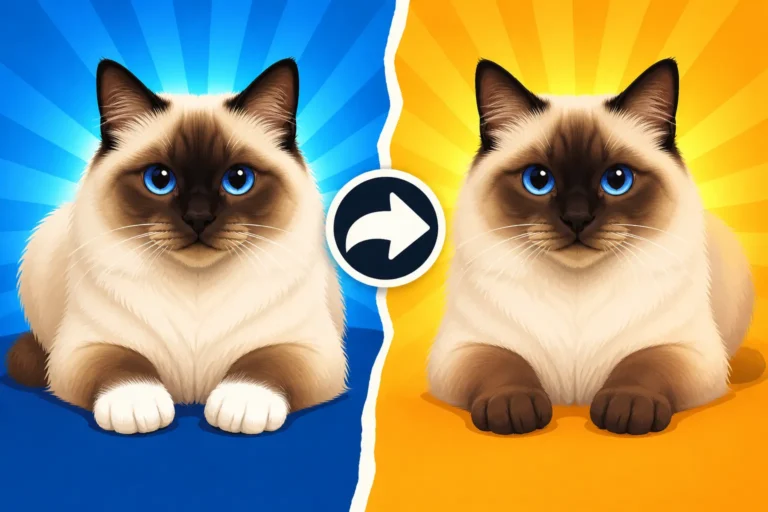
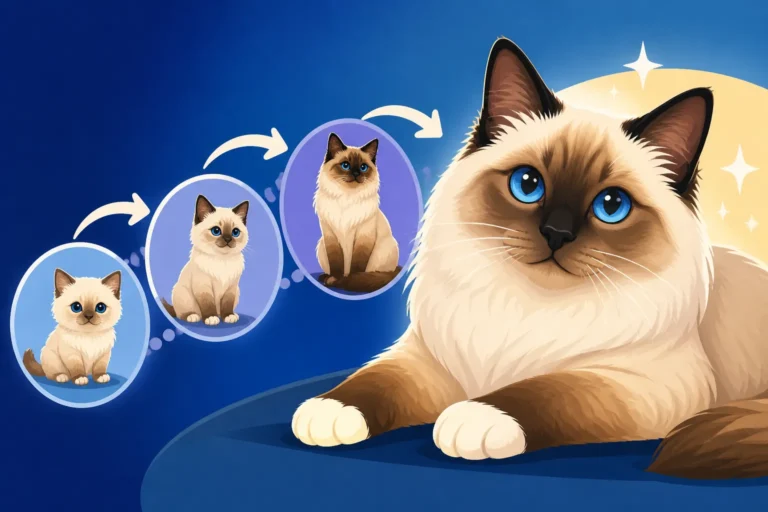
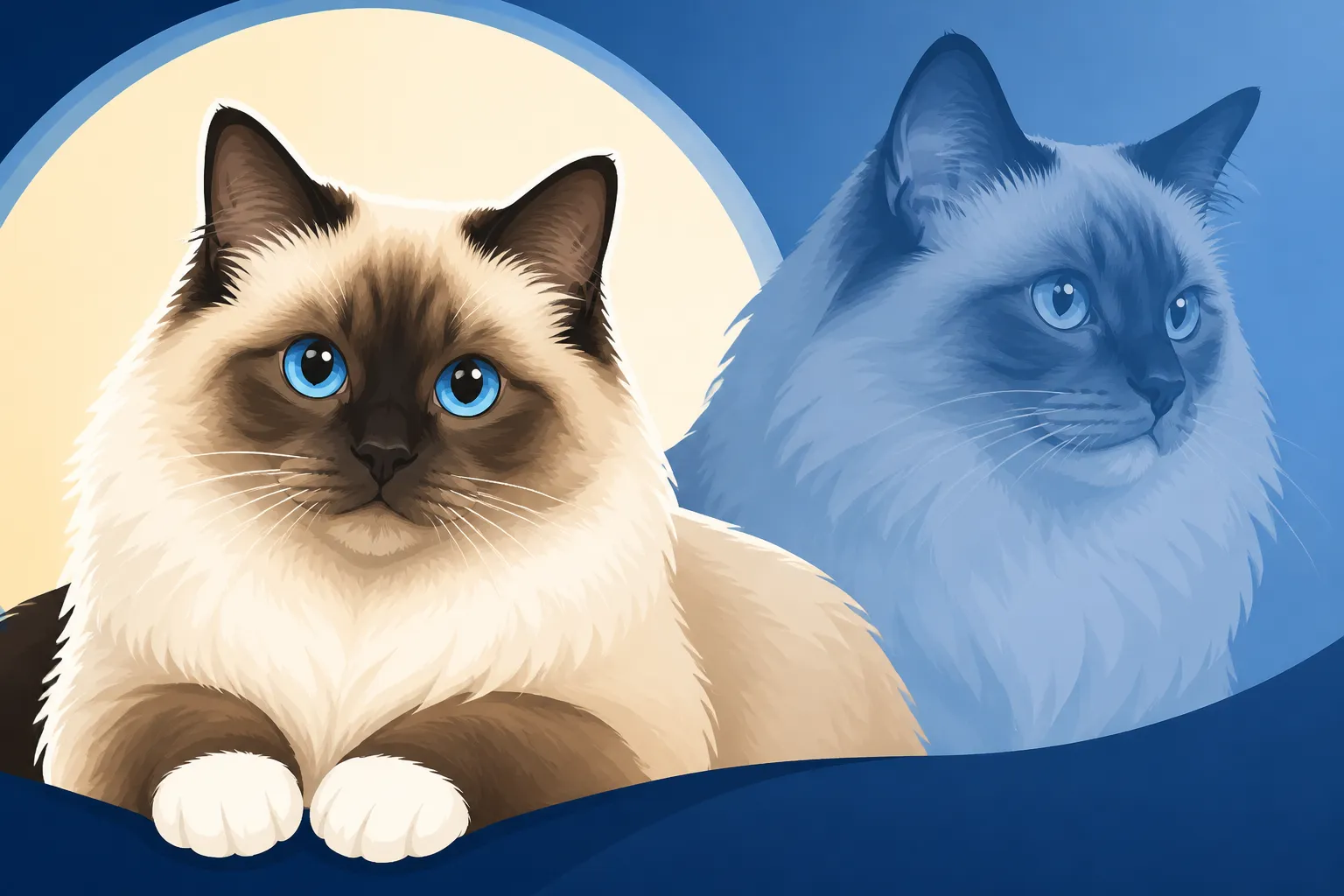
Both breeds can have blue eyes, darker color on the face, ears, legs, and tail, and pale bodies. Some Ragdolls also have white paws, which can bring a mitted Ragdoll to mind when you see a Birman’s distinctive gloves. In photographs, the resemblance can be especially convincing: a seal-point cat with white feet may look like it belongs to either breed.
But a shared look does not, by itself, establish shared ancestry. Similar patterns can occur in separate breeds, and a single photograph rarely shows enough detail to identify a cat confidently. The Birman’s white gloves are a defining breed feature, while Ragdolls come in several patterns, including colorpoint, mitted, and bicolor. A mitted Ragdoll’s white markings may resemble Birman gloves without being proof that the cat descends from Birmans.
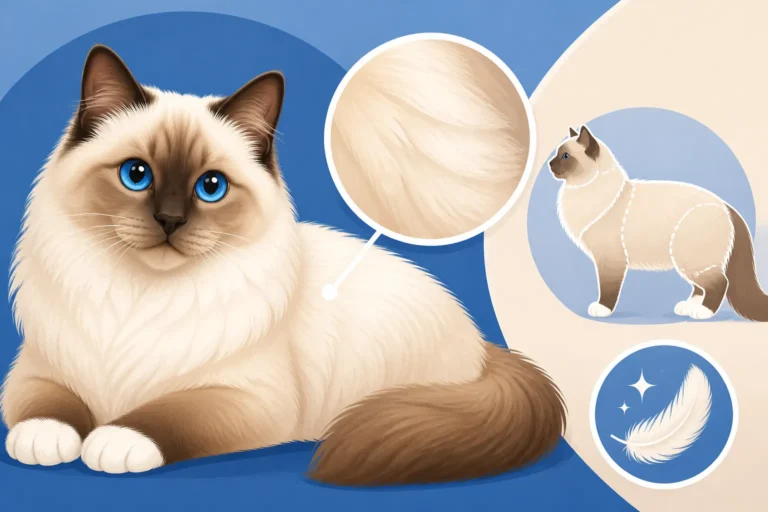
The difference becomes clearer when you consider the whole cat rather than focusing on its paws. Body proportions, coat texture, head shape, pattern details, and documented pedigree all matter. For a closer visual comparison, see How a Birman Differs From a Ragdoll on Sight.
Both breeds are longhaired colorpoint cats
Birmans and Ragdolls are both longhaired cats with colorpoint coloring. Colorpoint cats are typically born very pale, with darker coloring developing on the cooler parts of the body as they grow. That shared combination—long fur, blue eyes, and darker points—makes it easy to assume the breeds must have a straightforward family connection.
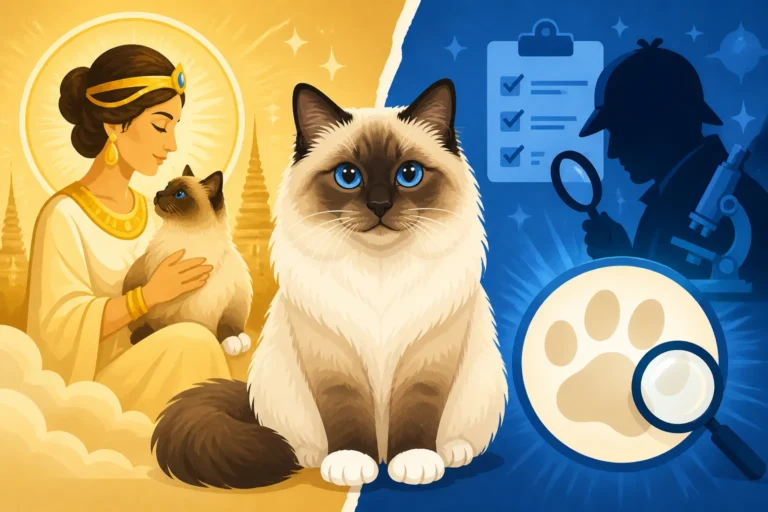
Their historical development, however, is not equally well documented. The Birman has a long, complicated origin story, with both legend and later breeding history shaping what people believe about its beginnings. The Ragdoll was developed much more recently in the United States, but stories about its foundation cats and early breeding have also varied. Those incomplete histories leave room for speculation, especially when the breeds look alike.
Appearance can suggest a question worth investigating, but it cannot settle that question. To understand whether Birmans contributed to the Ragdoll, it helps to separate what is known about each breed from claims that are plausible but unconfirmed.
What is known about the Ragdoll’s beginnings
The Ragdoll was developed in California
The Ragdoll breed was developed in Riverside, California, in the 1960s by breeder Ann Baker. Its early foundation is generally associated with a longhaired white cat named Josephine and other cats used in Baker’s breeding program. Accounts of exactly which cats were involved and how they were related have not always been consistent, which makes a neat, fully verifiable family tree difficult to reconstruct.
That uncertainty is important. When a breed is being established, early matings may not be recorded with the same detail as modern pedigree breeding. Some foundation cats may have had unknown or mixed ancestry, and accounts of their backgrounds can differ. It is therefore possible that cats resembling Birmans, or cats with some Birman ancestry, could have been part of the broader population used in early development. Possibility, though, is not the same as a documented contribution.
The Ragdoll’s early history is also separate from the Birman’s documented European breed development. If you’re curious about how the Birman’s own background is pieced together, What Genetics Say About the Birman's Origin and Which Cats the First French Birmans Were Crossed With explore why its history is not as simple as a single origin claim.
The exact foundation pedigree is not conclusive
A reliable claim that one breed contributed to another needs more than a resemblance or a story repeated from one account to the next. Ideally, it would be supported by pedigrees, breeding records, or other evidence connecting specific cats to recognized members of the earlier breed. For the Ragdoll’s early development, the available historical accounts do not provide a universally accepted, complete pedigree that proves Birman cats were used as foundation animals.
This is why you’ll encounter different versions of the Ragdoll’s ancestry. Some descriptions suggest that Birmans or Birman-like cats may have been involved; others focus on the known foundation cats without establishing a direct Birman line. When the early records are incomplete or disputed, confident statements can outrun the evidence.
A careful answer is therefore: Birman ancestry is sometimes proposed, but a direct contribution from registered Birmans is not firmly established by clear, complete foundation records. That wording may feel less satisfying than a definite yes or no, but it is more honest about what the historical record can support.
How the Birman’s history differs
The Birman’s development also includes uncertainty
The Birman’s origin story is famously wrapped in legend, but the breed’s modern history is more complicated than the legend suggests. Its early development in Europe and the rebuilding of the breed after the Second World War involved a very limited population and later outcrossing. That history can make it tempting to connect the Birman to other longhaired breeds whenever a similar coat or pattern appears.
The existence of outcrossing in the Birman’s own history does not automatically mean Birmans were later used to create Ragdolls. The direction and timing of a possible cross matter. A breed can have a complicated background without being a proven ancestor of every later breed that shares its looks. For more on the Birman’s postwar recovery, see Which Longhairs Rebuilt the Birman After 1945.
Likewise, a familiar claim about one breed’s ancestry should be checked against what is known about that breed specifically. The Birman’s own early development has prompted questions about possible Siamese and Persian influence, but those questions do not establish Ragdoll ancestry. Whether the Birman Is a Siamese and Persian Cross looks at that separate issue.
Breed appearance is not the same as breed identity
A cat can resemble a Birman or Ragdoll without being a registered example of either breed. A white-pawed colorpoint cat from a shelter, for instance, might have a mixed background. Its coat can help describe its appearance, but only reliable pedigree records can establish breed ancestry in the conventional sense.
Genetic testing may provide information about a cat’s genetic background, depending on the test and the available reference populations. It should not be treated as a magic certificate that proves an undocumented historical cross. A test result and a pedigree answer related but different questions: one reports genetic similarities within the limits of the test, while the other traces recorded parentage.
This distinction matters when you’re choosing a pet or researching a cat you already have. Breed profiles from retailers such as Chewy can be handy for getting a broad sense of temperament or care needs, but a breed description is not proof of a particular cat’s ancestry. If lineage matters, ask the breeder for registration and pedigree documents rather than relying on a color pattern or online description.
How to assess the claim without getting misled
Separate documented facts from repeated claims
When you read that the Birman is “in the Ragdoll’s background,” look for the specific claim being made. Does it name a particular Birman, show a pedigree connection, or describe a documented mating? Or does it simply point to shared blue eyes, pointed coloring, and white feet? The first kind of detail could support a historical argument; the second explains why people make the comparison but does not prove ancestry.
It also helps to notice whether a writer distinguishes registered Birmans from cats that merely looked Birman-like. In early breed development, informal labels and retrospective descriptions can blur together. A foundation cat described as a “Birman type” is not automatically a pedigreed Birman.
If a seller or online listing makes a strong ancestry claim, ask for the records behind it. A retailer such as Chewy may offer useful general information about cat breeds and supplies, but it cannot authenticate the pedigree of an individual cat from a listing description. The same standard applies to social media posts and informal breed articles: look for verifiable records, not just confident wording.
Use the comparison for the questions it can answer
Even if the exact ancestry cannot be settled, comparing the breeds can still help you decide what you want in a cat. Birmans and Ragdolls can differ in build, coat presentation, accepted patterns, and individual temperament. There is plenty of variation from one cat to another, so breed tendencies should be a starting point rather than a promise about a particular kitten.
A prospective owner might be drawn to both breeds because they want a sociable, longhaired companion. In that case, the practical questions are often more useful than the ancestry debate: how much grooming will the cat need, how does it handle household activity, what health screening has the breeder done, and what support is available after adoption? To compare everyday behavior, see Whether a Birman and a Ragdoll Behave Alike. If you’re deciding between them, Whether to Choose a Birman or a Ragdoll focuses on the choice itself.
| Question | What it can tell you | What it cannot prove |
|---|---|---|
| Does the cat have blue eyes, points, or white feet? | The cat’s visible appearance and pattern | That it has Birman ancestry |
| Does a breeder provide a pedigree? | Recorded parentage within the stated lineage | That every early foundation claim is historically complete |
| Does a breed article mention Birman influence? | That the connection has been proposed | That a specific Birman was used to establish the Ragdoll |
| Does a genetic test show similarities? | Genetic information within the test’s scope | A complete, documented historical pedigree |
If you want to understand whether Birmans contributed to breeds beyond the Ragdoll, Whether the Birman Contributed to Any Other Breed offers useful context. The key is to keep the claims separate: shared appearance is observable, historical influence is possible, and a proven pedigree connection requires evidence.
Disclaimer
This article is for general informational purposes only and does not constitute professional advice. Laws, prices and regulations vary by location and change over time. Consult a qualified professional for guidance on your specific situation.