Whether the Birman Contributed to Any Other Breed
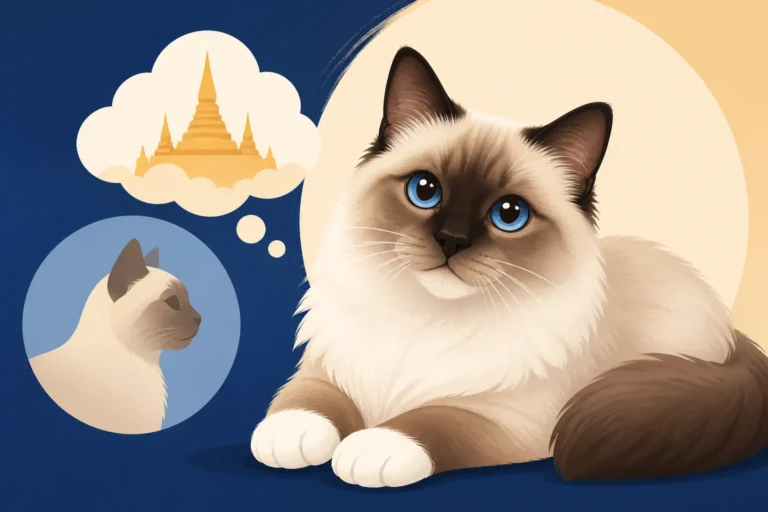
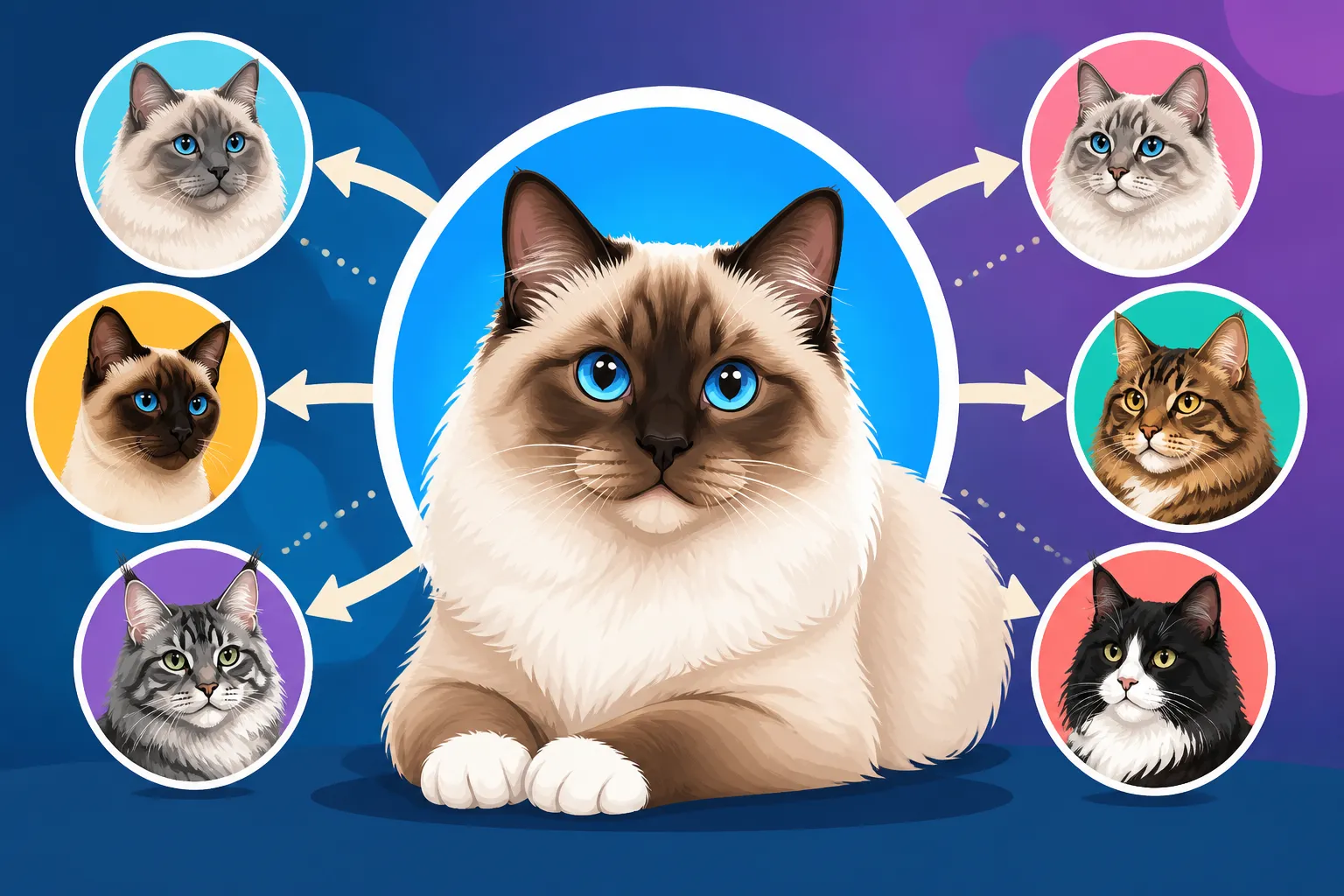
The Birman’s striking white gloves, blue eyes, and colorpoint coat make it easy to see why people connect it to other longhaired breeds. But resemblance is not the same as documented ancestry. This guide separates the Birman’s confirmed role in breed history from popular claims about its influence, especially the often-repeated idea that it helped create the Ragdoll.
What it means for one cat breed to contribute to another
Appearance is a clue, not proof
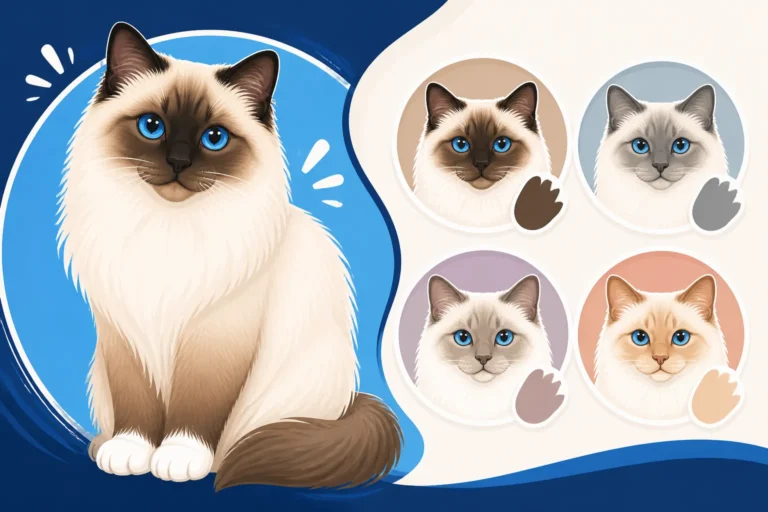
Two breeds can share obvious features without one descending from the other. A silky coat, blue eyes, colorpoint markings, or a relaxed temperament may invite comparisons, but those traits can arise in more than one breed. Colorpoint patterns, in particular, are not unique to Birmans.
To establish that a breed contributed to another, historians and breeders look for more than a familiar-looking cat. Useful evidence includes recorded matings, named foundation cats, pedigrees, breeding records, and accounts from the people who developed the later breed. The more independent records agree, the stronger the case.
This distinction matters because breed histories are often retold as neat origin stories. A description such as “a Birman-type cat” may mean a cat that looked like a Birman, not a registered Birman with a traceable pedigree. Likewise, saying two breeds share features does not establish that one was used to develop the other.
When comparing breed histories, it helps to ask three separate questions: Was a Birman deliberately used in the breeding program? Is there a documented Birman ancestor in the foundation line? Or does the later breed simply resemble the Birman? Those questions can have different answers.
What the evidence can and cannot tell us
Cat breeds have not always been developed with the kind of detailed, standardized recordkeeping people expect today. Some older histories rely on breeder recollections, incomplete pedigrees, or accounts written after the fact. That does not make every story false, but it does mean a confident-sounding origin claim should be treated carefully.
A useful way to read a breed-history claim is to distinguish documented ancestry from possible influence and visual resemblance. A named cat recorded in a pedigree is stronger evidence than a later statement that a breed “may have” been involved. A cat with similar markings is weaker evidence still.
| Claim about Birman influence | What would support it | How to interpret it |
|---|---|---|
| A Birman was a foundation cat | A named cat and a traceable pedigree or breeding record | Strong evidence of direct contribution |
| A breeder used a Birman in an early cross | Records identifying the cat and the pairing | Evidence of a specific, limited contribution |
| A breed resembles a Birman | Shared coat, color, eye, or temperament traits | A comparison, not proof of ancestry |
| A breed is described as “Birman-like” | A descriptive account without pedigree details | Suggestive language, not confirmation |
If you are sorting through competing stories, look for whether the account identifies actual cats and dates, or whether it relies mostly on words such as “similar,” “related,” or “possibly.” For broader background, What Genetics Say About the Birman's Origin is a useful companion topic, as is Which Cats the First French Birmans Were Crossed With.
The Birman’s best-documented historical contribution
The breed’s own rebuilding after the Second World War
The Birman’s clearest historical role is in the rebuilding of its own breed after the Second World War. The war left the European Birman population severely reduced. Breeders had to work from a very small number of surviving cats and use carefully selected outcrosses to restore a viable breeding population.
That history is sometimes confused with the idea that Birmans were broadly used to create other breeds. The documented story is primarily about preserving and re-establishing the Birman itself. Early rebuilding involved longhaired cats, and the resulting lines were bred back toward the Birman type over generations. The details are covered in Which Longhairs Rebuilt the Birman After 1945.
A small founder group can have a lasting effect on a breed’s genetic diversity and on the way its history is told. It also makes accurate pedigrees especially valuable: when a breed has had to recover from a bottleneck, the ancestry of its lines matters for understanding both appearance and inherited health. That is different from claiming the breed then served as a foundation for another.
The difference between an outcross and a new breed
An outcross is a mating between cats from different breeds or populations. It may be used to broaden a gene pool, introduce a trait, or rebuild a reduced population. A new breed, by contrast, usually involves a sustained breeding program that selects for a recognizable type over multiple generations.
A single Birman used in an outcross would not automatically mean the Birman “created” the resulting breed. The size and purpose of the contribution matter. A cat might contribute to one line without becoming a major or defining ancestor of the breed as a whole. Conversely, a breed’s later appearance might reflect several influences, with no one ancestor accounting for its look.
This is why historical wording matters. “A Birman was used in a particular cross” is a narrower claim than “the breed descends from Birmans.” The first could be true for a specific pairing, while the second would require much more extensive pedigree evidence. When examining a claim, ask whether it refers to an isolated mating, a whole foundation population, or just a resemblance.
Did the Birman contribute to the Ragdoll?
Why the two breeds are often linked
The Ragdoll is the breed most often brought into conversations about possible Birman influence. The resemblance is understandable: both breeds are longhaired, blue-eyed, colorpoint cats, and both may have white markings. Their calm, people-oriented reputations can also sound similar in casual breed descriptions.
The Ragdoll was developed in California in the 1960s. Accounts of its beginnings commonly center on a foundation cat named Josephine and cats from her offspring, including cats associated with the early breeding program. The details of the foundation story have been retold in different ways, which has helped fuel speculation about what breeds may have been involved.
Some descriptions refer to cats that looked Birman-like, and that phrase can easily turn into a stronger claim as the story is repeated. But a cat with white feet or a pointed coat is not necessarily a Birman. Without a record identifying a Birman ancestor, visual similarity alone cannot establish that the Birman was part of the Ragdoll’s documented foundation.
For a closer look at the overlap and the limits of the available history, see Whether the Birman Is in the Ragdoll's Background. It is also helpful to compare the breeds as they are recognized today in How a Birman Differs From a Ragdoll on Sight.
A careful answer to the Ragdoll question
The most cautious answer is that the Birman is not generally established as a documented foundation breed of the Ragdoll. Popular accounts sometimes suggest a connection, but a claim of direct ancestry needs identifiable cats and traceable records—not just a cat that looks like a Birman or a resemblance between the finished breeds.
That does not mean every possible historical connection can be ruled out. Early breeding records can be incomplete, and informal crosses may not have been recorded in the way modern pedigree programs expect. Still, “a connection is possible” and “the Birman contributed to the breed” are not interchangeable statements. The second needs stronger evidence.
It is also worth separating ancestry from influence on public perception. The Birman may have shaped how people describe or compare the Ragdoll, because the breeds share visible traits. That is a cultural or descriptive association, not proof that Birman cats were used in the Ragdoll’s development.
For owners choosing between the breeds, ancestry claims may matter less than practical differences in size, coat care, activity, and temperament. Breed profiles and retailer care material, including guides from Chewy, can help frame everyday questions, but those resources should not be treated as pedigree evidence. If a breeder makes a specific ancestry claim, ask for the cats’ names and supporting records.
How to evaluate claims about Birman influence
Check the wording and the records
Start with the exact wording of the claim. “The breed resembles the Birman” describes appearance. “The breed may have Birman ancestry” signals uncertainty. “The Birman was used as a foundation breed” is a definite historical statement and should be supported by identifiable evidence.
Next, look for detail. Does the account name the cat, breeder, date, and mating? Does it point to a pedigree or a contemporaneous record? Or does it repeat a broad story without saying where the information came from? More specificity does not guarantee accuracy, but vague claims are difficult to verify.
It can also help to compare several accounts rather than relying on a single simplified summary. Breed histories may differ in how they describe early cats, especially when records are incomplete. Look for areas of agreement and note where writers are speculating. The histories of the Birman’s development in France and its later spread through Europe provide useful context; How the Birman Reached Germany and Britain From France follows that wider path.
Keep ancestry separate from care and breed choice
A historical connection does not tell you whether a cat will be a good fit for your household. Two breeds with similar coats can have different grooming needs, and cats within the same breed can vary in confidence, sociability, and play style. If you are choosing a companion, meet the individual cat and ask about its health, daily routine, and temperament rather than relying on a supposed shared ancestor.
For an owner who has already brought home a Birman, its documented relationship to another breed does not change the basics of care. Regular veterinary attention, a suitable diet, gentle coat care, and a comfortable indoor environment are more useful than trying to infer needs from a rumored ancestral connection. Chewy may be one place to browse everyday care products, but product descriptions cannot confirm a cat’s lineage or replace advice from a veterinarian.
If the breed-history question comes up while comparing Birmans with Ragdolls, focus first on the differences you can observe and verify. The guide Whether a Birman and a Ragdoll Behave Alike can help separate broad temperament reputations from the needs of an individual cat. For questions about the Birman’s earlier history, Whether the Birman Is a Siamese and Persian Cross addresses another common ancestry claim that is often repeated more confidently than the evidence warrants.
Chewy’s general pet-care material can be useful for practical planning, such as gathering questions about grooming or household supplies, but it should be kept separate from pedigree research. For ancestry, prioritize breed-history records, registries, and documentation from breeders. The short version of the evidence-based answer is that the Birman’s strongest documented contribution is to its own recovery and development; its direct contribution to another established breed, particularly the Ragdoll, is not clearly demonstrated by the commonly cited similarities.
Disclaimer
This article is for general informational purposes only and does not constitute professional advice. Laws, prices and regulations vary by location and change over time. Consult a qualified professional for guidance on your specific situation.