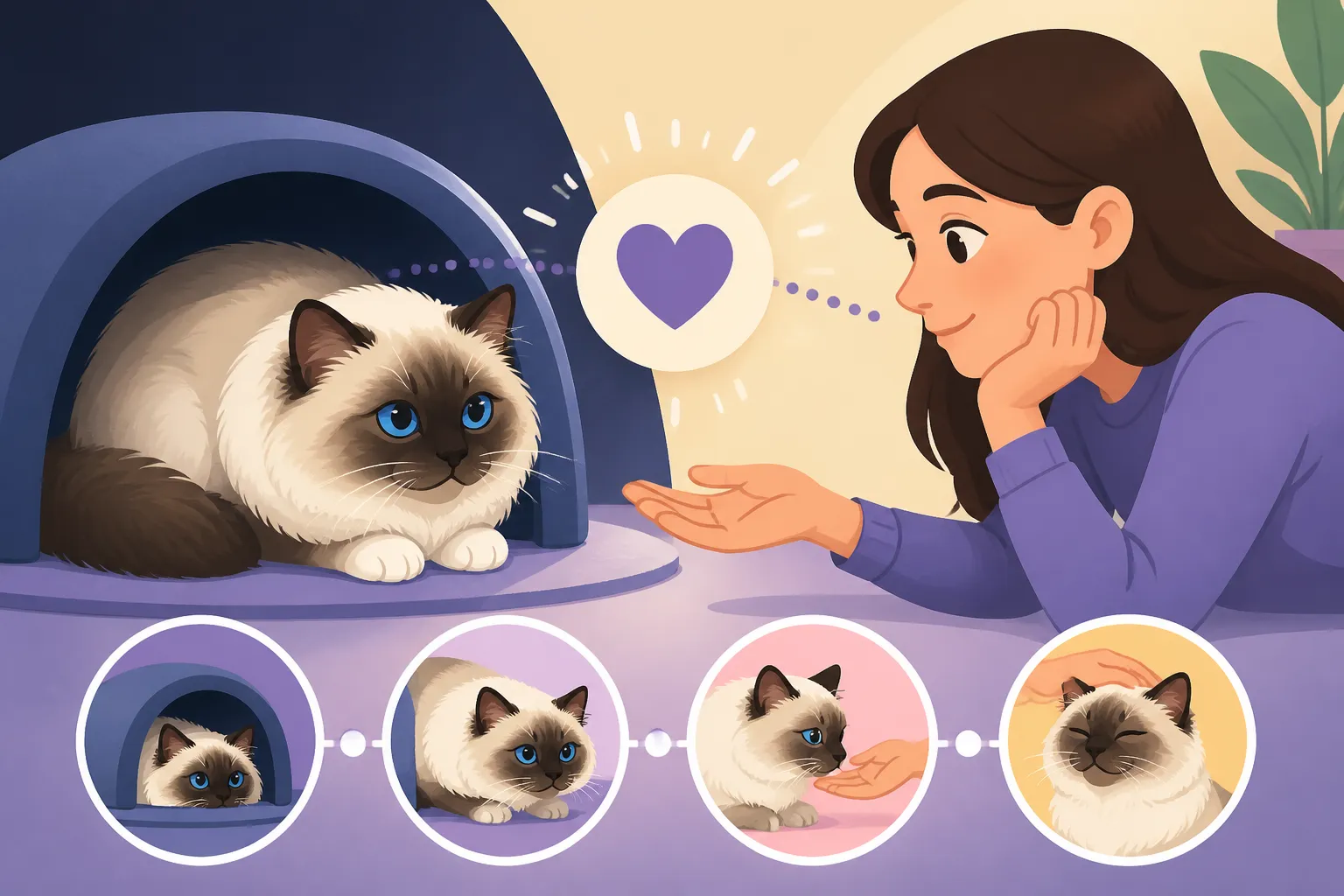
How Long a Birman Takes to Trust Someone New
It can feel incredibly frustrating when you bring someone new into your home, whether it’s a new partner, a friend staying over, or even just a new pet sitter, and your beloved Birman transforms into a shadow, hiding away or seeming aloof. You might worry they'll never warm up, or that this new person will forever be an outsider. The truth is, while Birmans are known for their gentle and social nature, earning their trust, especially with someone entirely new, is a gradual process that truly hinges on patience and understanding their unique personality. This guide will walk you through what influences a Birman's trust-building timeline and offer practical steps to help your Birman embrace new faces with confidence.
The Birman's Innate Temperament and Its Impact on Trust
Understanding the core personality of your Birman is the first step in appreciating how they approach new people. These cats aren't like some of the more boisterous or immediately gregarious breeds; their trust is something precious, earned steadily, not given freely at first glance. Their inherent disposition plays a massive role in how quickly, or slowly, they decide someone new is worthy of their attention and affection.
The Birman's Gentle and Placid Nature
Birmans are famously gentle souls. They possess a placid, calm demeanor that often sees them described as "middle of the road" cats – not overly demanding like some Siamese, but not as reclusive as some Persians. This gentle nature means that when faced with a new person, they are far less likely to react with aggression or extreme fear. You won't typically see a Birman hiss and swipe at a stranger who enters their space. Instead, their initial reaction is usually one of cautious observation. They might retreat to a favorite high perch, like a cat tree or the back of a sofa, or simply observe from a distance, perhaps from under a bed. This isn't rudeness; it's their way of assessing the situation, taking in new scents, sounds, and energy before deciding if this newcomer is safe. This quiet assessment period is crucial for them to feel secure enough to even consider an approach.
The Birman's Preference for Familiarity
Birmans thrive on routine and familiarity. They are creatures of habit and find comfort in knowing what to expect from their environment and the people within it. A change in their usual schedule, a rearrangement of furniture, or the introduction of a new person can be a significant disruption to their carefully constructed world of predictability. When a new person enters the home, it's not just a new face; it's a new scent, a new voice, and potentially a shift in the household's energy. This can make them initially wary. They love their familiar people and spaces, often finding comfort in their usual spots, or perhaps a warm, cozy bed. Why a Birman Prefers a Sofa Back to a Wall Shelf They will usually continue to seek out their primary caregivers, even while a stranger is present, using their trusted humans as a reference point for safety. Extending their circle of trust beyond their immediate family takes time because they need to integrate this new individual into their established understanding of their world.
Inherited Traits from Ancestry
The Birman's unique temperament is a beautiful blend of its supposed ancestry, lying somewhere between the vocal, active Siamese and the serene, sometimes reserved Persian. The Birman Sits Between the Siamese and the Persian This genetic cocktail contributes significantly to how they interact with new people. From the Siamese side, they inherit a degree of sociability and an enjoyment of companionship, but often without the intense, demanding communication style. From the Persian, they derive that calm, gentle patience and a preference for a tranquil environment. This means a Birman wants to be part of the household activities and will eventually seek out interaction, but they usually won't force it. They will wait to be approached in a respectful manner, or they will make a quiet, understated overture when they feel ready. It's a subtle approach, far from the instant exuberance you might see in a dog or even some other cat breeds. They appreciate companionship but on their own terms, which includes how quickly they accept new acquaintances.
Factors Influencing a Birman's Trust-Building Timeline
It's natural to want your Birman to instantly fall in love with everyone who walks through the door, but it just doesn't work that way. Several key factors can either speed up or slow down the process of a Birman warming up to a new person. Understanding these can help you manage expectations and tailor your approach to be most effective.
Early Socialization and Kittenhood Experiences
The experiences a Birman kitten has during its formative weeks are absolutely critical in shaping its future disposition towards people, both familiar and new. Kittens exposed to a variety of gentle, positive human interactions – being handled, played with, and exposed to different sights and sounds – tend to grow into more confident, well-adjusted adults. If a Birman kitten spent its early life in a quiet cattery with limited exposure to diverse people, or worse, had negative experiences, it might take a significantly longer time to trust someone new. A well-socialized kitten, by contrast, already has a foundation of positive associations with humans. They learn that new faces aren't automatically threats but rather potential sources of comfort, play, or treats. How to Handle a Birman Kitten From Day One This early conditioning makes a world of difference when a new person enters their life later on; it's like they've already got a head start on the trust journey.
The New Person's Approach and Demeanor
Perhaps the most influential factor in how quickly a Birman trusts someone new is the new person's own behavior. Birmans, with their keen senses and observant nature, pick up on subtle cues. A person who is loud, makes sudden movements, stares directly at the cat, or tries to force interaction by reaching out too quickly will almost certainly prolong the trust-building process. Imagine how you would feel if someone unfamiliar immediately moved into your personal space without invitation – it’s similar for a cat.
The best approach for a new person is patience and gentleness. Advise them to:
- Be calm and quiet: Avoid loud noises or boisterous behavior.
- Allow the Birman to initiate: Let the cat approach them first.
- Avoid direct eye contact: A direct stare can be perceived as a challenge or threat. Instead, a slow blink can signal friendliness and non-aggression.
- Offer a hand slowly: Extend a closed fist, allowing the Birman to sniff and investigate on its terms.
- Sit on the floor: Being at the cat's level can make a person seem less imposing.
- Speak softly: A gentle, even tone is less alarming than a loud voice.
These seemingly small actions send clear signals of safety and respect, which are paramount to a Birman's willingness to engage.
The Home Environment and Routine Stability
A Birman's sense of security is deeply tied to its environment and the stability of its daily routine. A home that is generally calm, predictable, and free from sudden, intense stressors provides the ideal backdrop for trust to blossom. If the environment itself is already chaotic, noisy, or undergoing significant changes (like a recent move, construction work, or the addition of other pets), a Birman will be naturally more on edge. In such circumstances, their focus is on re-establishing their own sense of safety within the environment, making them less receptive to bonding with a new person. How Long a Birman Takes to Settle After a Move
A stable routine, where meal times, play sessions, and quiet periods are consistent, allows a Birman to feel secure. When a new person is introduced, if the household can maintain as much of this routine as possible, it signals to the Birman that despite the new presence, their world is still largely safe and predictable. Providing safe, elevated spaces where the Birman can observe without feeling vulnerable is also incredibly important. These sanctuary spots allow them to gauge the new person from a distance, slowly building confidence on their own terms without feeling pressured.
Practical Strategies for Fostering Trust with a New Acquaintance
So, you have a new person in your life and you're eager for your Birman to accept them. It’s not about rushing the process, but rather implementing thoughtful strategies that respect your cat's nature and encourage positive associations. Think of it as laying down a series of gentle invitations, rather than demanding their presence.
Gradual Introduction and Passive Presence
The "less is more" approach is truly golden when it comes to Birmans and new people. Instead of trying to force an immediate friendship, encourage the new person to simply exist peacefully in the same space as the cat, without making demands. This means having them sit quietly in a room where the Birman might naturally wander, perhaps reading a book or gently scrolling on their phone, allowing the cat to come and go as it pleases.
Start with brief, supervised interactions. If the new person is staying over, ensure they understand that the Birman needs space. Don't let them chase or corner the cat. Initially, they might just sit in the living room while the Birman observes from a doorway or under a coffee table. Over time, as the Birman becomes accustomed to their presence and scent, they'll likely start to venture closer. You can even have the new person leave a piece of their clothing, like a soft sweater, in a common area for the Birman to sniff and get used to their scent passively. This passive presence helps the Birman understand that this new individual is not a threat and is merely part of the household landscape.
Positive Reinforcement and Gentle Interaction
Once the Birman seems a little more at ease with the new person's presence, it's time to introduce positive reinforcement. The key here is to associate the new person with good things. This could involve:
- Treats: Have the new person offer high-value treats (like freeze-dried chicken or salmon bits you might find on Amazon) by gently placing them on the floor nearby, rather than trying to hand-feed immediately. As trust grows, they can gradually offer treats from their open palm.
- Play: Birmans enjoy interactive play, especially with wand toys. A new person can slowly introduce play by dangling a feather wand (many great options on Amazon) a distance from the Birman, letting the cat engage on its terms. This turns the interaction into a fun, low-pressure experience.
- Soft Talk and Praise: Gentle, reassuring words can go a long way. When the Birman ventures closer or makes eye contact, the new person can offer soft praise. Praise Motivates a Birman More Than Food Avoid loud exclamations, even if they're positive, as these can be startling.
- Grooming: If the Birman is truly comfortable, a soft brush might be introduced. However, this is usually a later stage, only once more basic trust has been established.
Remember, the goal is for the Birman to associate the new person with pleasant, non-threatening experiences. Never force physical contact. If the cat backs away, respect that boundary.
Understanding Birman Communication Cues
Birmans are masters of subtle communication, and learning to read their body language is essential for fostering trust. When a new person is trying to bond with your Birman, teach them what to look for:
- Positive Cues: A relaxed posture, ears forward but not stiff, a soft gaze, a slow blink, a tail held high with a slight curl or gentle sway, rubbing against legs (a huge compliment!), or even a quiet trill. How a Birman Shows Affection Without Making Demands If your Birman chooses to sit near the new person or even jump onto the sofa next to them, that's a significant step.
- Cautionary Cues: Ears slightly flattened or turned sideways, pupils dilated (even in good light), a low crouch, a twitching tail, stiff whiskers, or backing away. These are signs the cat is feeling anxious or uncomfortable and needs more space.
- No-Go Cues: Hissing, spitting, growling, a puffed-up tail, flattened ears, or an aggressive stance. While rare for Birmans, these are clear signs that the cat feels threatened and the interaction should cease immediately.
By recognizing and respecting these signals, the new person can adjust their behavior, giving the Birman the space it needs and only increasing interaction when the cat explicitly invites it. This respect builds confidence and accelerates the trust-building process far more effectively than any forced interaction.
The Typical Trust Timeline and Long-Term Relationships
It's tempting to put a precise number on how long it takes for a Birman to trust someone new, but just like with humans, every cat is an individual. What we can do is talk about general patterns and how that trust deepens over time into a lasting relationship.
Initial Reactions vs. Deep-Seated Trust
When a new person first arrives, a Birman might go through several stages. Initially, there's the "ghost phase" where they might disappear entirely or only be seen observing from a distance. This could last a few hours, a day, or even a few days, especially if the cat is naturally more timid or had less socialization as a kitten. Over the next few days to a week, with consistent, gentle exposure, they might progress to the "curious observer" phase, where they're in the same room, but still maintaining distance. They might sniff the air, watch the new person's movements, and perhaps even briefly allow themselves to be seen.
True acceptance, where the Birman doesn't feel the need to retreat when the person is around, can often take a week or two. This means they'll carry on with their normal activities – eating, grooming, playing – even with the new person present. Deep-seated trust, however, is a different beast entirely. This isn't just about not hiding; it's about actively seeking out the new person for comfort, attention, or play. This level of bonding can take anywhere from a few weeks to several months, depending on all the factors we've discussed. It's about building a history of positive, consistent interactions, allowing the Birman to form a strong, secure attachment.
The "Follow Without Demanding" Phase
One of the most heartwarming signs that a Birman truly trusts and accepts a new person is when they enter the "follow without demanding" phase. This is classic Birman behavior. Unlike some breeds that might jump into a new person's lap or loudly vocalize for attention, a Birman’s trust often manifests as a quiet, comforting presence. They might follow the new person from room to room, settling on a nearby chair, the floor, or the end of the bed. How a Birman Follows You Room to Room
This isn't them asking for anything; it’s them simply choosing to be in the new person’s orbit, demonstrating their comfort and companionship. They are saying, "I feel safe with you, and I enjoy your presence." This behavior indicates that the new person has been fully integrated into the Birman's trusted circle. They've learned to anticipate the new person's movements and sounds, and they associate them with peace and security. It's a subtle but incredibly powerful testament to the bond that has been forged.
Maintaining Trust Over Time
Once a Birman has decided to trust someone new, it's not a set-it-and-forget-it situation, especially if that new person becomes a regular part of their life. Consistency and continued positive interaction are key to maintaining and deepening that trust. If the new person is a frequent visitor, or even moves in, regular gentle play, quiet companionship, and respectful interaction will solidify the bond.
Occasional treats (perhaps some enticing salmon bits from Amazon that they now associate with this person) and shared quiet moments on the sofa are excellent ways to reinforce the connection. If the new person will be involved in daily care, like feeding, grooming, or scooping the litter box, these tasks should be introduced gradually, making sure the Birman always associates them with positive outcomes. Remember, a Birman’s trust is a gift; it's something to be cherished and nurtured with ongoing kindness and understanding. It’s a beautiful thing to watch your Birman finally relax into a new relationship, becoming just as comfortable and affectionate with a new face as they are with yours.
Here's a quick look at common Birman trust indicators:
| Birman Behavior Stage | Typical Timeframe (Approx.) | Key Indicators |
|---|---|---|
| Initial Observation | Hours to 1-2 Days | Hiding, observing from a distance, quick retreats, stiff body language. |
| Cautious Acceptance | 2-7 Days | Stays in the same room, may not hide, brief eye contact, remains at a distance, accepts treats on the floor. |
| Tentative Approach | 1-3 Weeks | Starts to explore closer, sniffs, allows brief, gentle touches, might rub nearby objects with scent glands. |
| Developing Trust | 3 Weeks to 2 Months | Initiates contact, accepts petting, plays with wand toys, sits in same room, follows quietly. |
| Deep-Seated Bond | 2+ Months | Seeks out for comfort/attention, sleeps near/on person, purrs readily, relaxed body language. |
Disclaimer
This article is for general informational purposes only and does not constitute professional advice. Laws, prices and regulations vary by location and change over time. Consult a qualified professional for guidance on your specific situation.