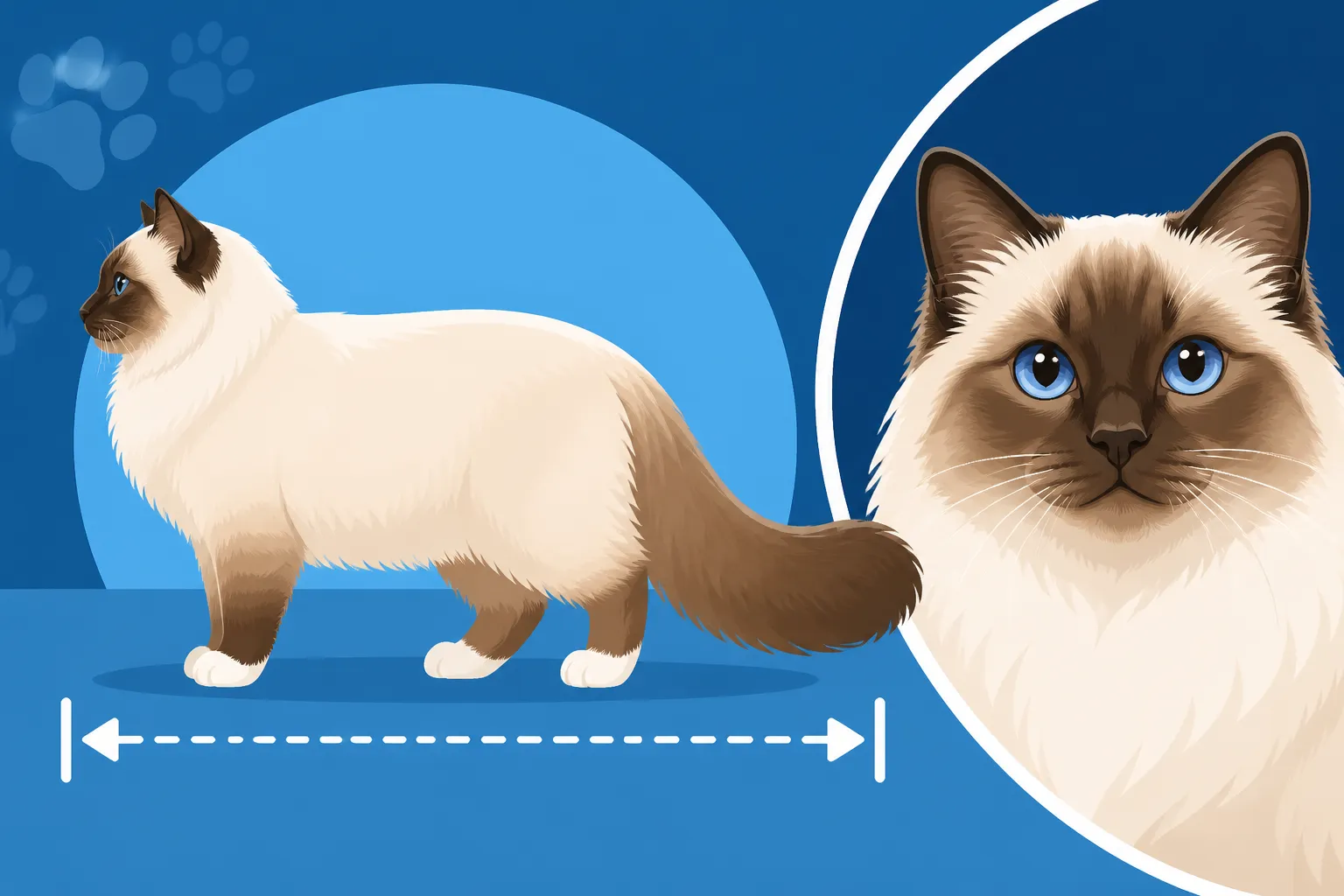
How Long a Birman Is Nose to Tail
Many prospective Birman parents spend hours poring over pictures of these majestic cats, marveling at their stunning blue eyes and silky coats, but one question often pops up in conversations: just how long do these beautiful felines get from nose to tail? It's a fair question, as photos can be deceiving, and understanding their full physical dimensions is key to preparing for life with a Birman. This guide will walk you through everything you need to know about a Birman's length, from kittenhood to their full adult stature, exploring the factors that influence their size and what to expect as they grow.
Understanding Birman Size and Growth Stages
Bringing home a Birman kitten is an exciting time, and you'll quickly notice how rapidly they change. However, unlike some breeds that hit their full size relatively quickly, Birmans are a breed that takes its sweet time, often surprising owners with their gradual, consistent growth. This extended development period means you'll watch them transform from a tiny, almost white fluffball into a substantial, elegant feline over several years.
The Birman Kitten's Initial Growth Spurt
When your Birman kitten first arrives, typically around 12-13 weeks old, they're still quite small, especially compared to their future adult selves. They'll have distinct "points" – the darker coloration on their face, ears, paws, and tail – beginning to show, but their body will largely be soft and light. In these early months, you'll see a noticeable growth spurt. They're like little sponges, absorbing nutrients and putting on both weight and length at a rapid pace.
During this initial phase, their bones are lengthening, and their musculature is beginning to define itself. Don't be surprised if your kitten seems to stretch out overnight. This is a critical time for proper nutrition and providing a safe, stimulating environment for their physical development. While they might appear leggy and a bit disproportionate at times, this is all part of the normal, healthy growth trajectory for a Birman.
Reaching Full Length: It's a Marathon, Not a Sprint
One of the fascinating aspects of the Birman breed is their relatively slow maturation. While many cat breeds are considered fully grown by their first birthday, Birmans can continue to grow and fill out for up to three years. This isn't just about weight; it's about their skeletal structure reaching its full length, their chest deepening, and their overall frame solidifying. So, if your one-year-old Birman still looks a bit slender or not quite as grand as the mature Birmans you see in pictures, rest assured, they likely still have some growing to do. How Long a Birman Keeps Adding Coat and Weight
This extended growth period contributes to their sturdy, well-balanced appearance as adults. They don't just add bulk; they achieve a graceful, rectangular body type that is characteristic of the breed. It's a slow process that requires patience, but the eventual result is a magnificently sized cat with an impressive presence, whose length from nose to the tip of their plumed tail can be quite striking. You'll literally watch them elongate year after year.
Variations Between Males and Females
Just like in many other animal species, there's a discernible difference in size between male and female Birmans. Typically, male Birmans (toms) will be longer and heavier than their female counterparts (queens). A full-grown male Birman can easily measure significantly longer than a female, particularly when you account for their tail. This is a natural biological difference that contributes to the overall diversity within the breed.
Female Birmans are still substantial cats, don't get me wrong, and certainly not delicate by any means. They possess the same elegant, long body type, but on a slightly smaller scale. This difference in size might influence things like the choice of carrier – you'll want to ensure it's generously sized, perhaps looking at options on Chewy for larger cats, especially for a male. Understanding these variations helps set realistic expectations for your Birman's adult size. How Much Smaller a Birman Queen Finishes
Factors Influencing a Birman's Overall Length
While the general expectation for a Birman's length is fairly consistent, there are several key factors that can influence just how long your individual cat will ultimately become. It's not just a matter of "they grow as they grow"; a complex interplay of genetics, nutrition, and even activity levels plays a significant role in reaching their full potential.
Genetics and Lineage: The Blueprint
At the core of your Birman's eventual length and overall size is its genetic heritage. Just like people inherit height from their parents, cats inherit their predispositions for size. A Birman whose parents and grandparents were known for being particularly long-bodied will likely pass on those genes to their offspring. This is why a reputable breeder will often be able to give you an idea of the likely adult size of a kitten, based on the lineage they come from.
Beyond simple parentage, the broader genetic pool of the Birman breed itself contributes to their characteristic length. The breed standard calls for a medium to large cat with a long, rectangular body. Therefore, breeders select for these traits, ensuring that the genetic blueprint for a substantial, elongated frame is consistently passed down through generations. This inherent genetic programming is the primary determinant of their potential maximum length.
Nutrition and Its Role in Skeletal Development
While genetics provide the potential, proper nutrition is what allows that potential to be fully realized. During the crucial growth phases, especially from kittenhood through their first two to three years, a Birman needs a high-quality diet rich in appropriate proteins, fats, vitamins, and minerals. These nutrients are vital for healthy skeletal development, strong muscles, and a magnificent coat. Inadequate nutrition during these formative years can potentially stunt growth or lead to less robust development.
Think of it like building a house: you can have the best blueprints (genetics), but if you use poor quality materials (nutrition), the final structure won't be as strong or as large as it could be. Providing a balanced diet, often specific to kittens or growing cats, ensures their bones elongate correctly and their muscles develop to support that length. Many owners find a good quality, protein-rich dry food supplemented with wet food is an excellent approach, readily available from online retailers like Chewy.
Activity Levels and Muscle Definition
Though perhaps less impactful on sheer bone length, a Birman's activity level does play a subtle but important role in their overall physique and how their length is perceived. Birmans are known for being playful and moderately active, enjoying short bursts of play and exploring their environment. Regular exercise, even if it's just chasing a wand toy around the living room, helps to build and maintain healthy muscle tone.
Well-developed muscles contribute to a more substantial and impressive physique, making a cat's length appear more pronounced and powerful. A Birman that is active and enjoys stretching, climbing (even if only to mid-height), and playing will develop a lean, athletic body that perfectly complements its long frame. Conversely, a sedentary Birman might not develop the same muscle definition, even if its bone length is the same, making it appear less imposing.
Comparing Birman Length to Other Popular Breeds
When you're trying to visualize how long a Birman actually is, it often helps to compare them to other well-known cat breeds. The Birman truly occupies a unique middle ground in terms of size, being neither as petite as some nor as colossal as others. This comparison can really help put their characteristic length into perspective.
Birman vs. Ragdoll: A Lengthy Comparison
The Birman and the Ragdoll are often grouped together due to their similar colorpoint patterns, gentle temperaments, and semi-long coats. However, there's a noticeable difference in their overall size and, particularly, their length. Ragdolls are generally larger and heavier than Birmans, often taking the crown as one of the largest domesticated cat breeds. A Ragdoll typically boasts a longer, heavier body with a more substantial frame.
While a Birman is a long cat, a Ragdoll will usually outstretch it both in body length and overall mass. Think of a Birman as a substantial, elegant medium-to-large cat, and a Ragdoll as a truly large, hefty feline. This difference is also reflected in their growth rates; while both are slow to mature, Ragdolls often continue to grow and fill out for even longer, sometimes up to four or five years. Why a Birman Is Smaller Than a Ragdoll
Birman vs. Siamese: Sleek vs. Sturdy
Comparing a Birman to a Siamese cat highlights the difference between a svelte, foreign body type and the Birman's sturdier, rectangular build. Siamese cats are famously sleek, long, and slender, with fine bones and an athletic, almost tubular body. Their length is undeniable, but it's a very different kind of length – one of elegance and agility, rather than robust substance.
The Birman, by contrast, has a longer, more muscular, and more heavily boned body. While a Birman's body is elongated, it carries more weight and has a broader chest. So, while both breeds are considered "long" in some sense, the Birman's length is accompanied by a greater presence and a less delicate frame. The Birman Sits Between the Siamese and the Persian This distinction is clear when you see them side-by-side; the Siamese appears built for speed and grace, the Birman for serene, sturdy companionship.
Birman vs. Persian: The Body Under the Fluff
The Persian cat is perhaps most renowned for its luxuriously long, dense coat and often a more cobby, compact body type. While their fur can make them appear quite large, underneath all that fluff, a Persian typically has a rounded, heavily boned body that is not particularly long. Their overall silhouette is often described as cobby or square.
The Birman, on the other hand, even with its beautiful semi-long coat, reveals a distinctly long, rectangular body when you run your hands along its frame. Their length is a defining characteristic, not just an illusion created by fur. While the Persian's coat often obscures its true body shape, the Birman's silky single coat drapes elegantly over its elongated form, allowing its true length to be more evident. So, don't let a Persian's fluff fool you; the Birman definitely has the edge in actual nose-to-tail length.
Measuring Your Birman Accurately
Knowing your Birman's exact length can be more than just a fun fact; it can be useful for selecting appropriately sized carriers, beds, and even for tracking their growth against breed standards. However, measuring a wriggly cat isn't always the easiest task! With a few tips and tricks, you can get a fairly accurate measurement without causing too much fuss for your feline friend.
Tips for a Stress-Free Measurement Session
The key to successfully measuring your Birman is patience and a calm approach. First, choose a time when your cat is relaxed, perhaps after a meal or a good play session when they're winding down. Avoid trying to measure them when they're full of energy or feeling agitated. A second pair of hands can be invaluable – one person to gently hold and distract, the other to measure.
Use a soft, flexible tailor's tape measure rather than a rigid ruler, as it will conform better to your cat's curves and be less intimidating. Lay your Birman down on a flat surface, like a bed or a rug, in as relaxed and stretched-out a position as possible. Offer treats (perhaps some delicious freeze-dried salmon from Chewy) and plenty of gentle praise throughout the process. If your Birman starts to get stressed, it's better to stop and try again another time. The goal is to make it a positive, or at least neutral, experience.
What to Measure: Nose, Body, and Tail
To get a true "nose to tail" measurement, you'll want to measure the full length of your Birman's body, excluding the tail, and then separately measure the tail.
- Body Length (Nose to Base of Tail): Start your tape measure at the very tip of your Birman's nose. Gently run the tape along their spine, over their head and back, all the way to the very base of their tail where it joins the body. Make sure they are stretched out and not curled. This gives you their primary body length.
- Tail Length: Then, measure from the base of the tail to the very tip, not including any fur plume. The tail on a Birman is long and plumed, a significant part of their overall "linear" dimension.
- Total Length (Nose to Tip of Tail): Add these two measurements together to get the full "nose to tail" length. This comprehensive measurement really showcases their elongated physique.
Remember, the goal isn't necessarily show-ring precision for most pet owners, but a good approximation. Don't worry if the numbers vary slightly each time; consistency in your method is more important.
Tracking Growth Over Time
Since Birmans mature slowly, tracking their length over time can be quite interesting, especially during their first few years. Regular measurements, perhaps once a month or every few months, can help you visualize their growth trajectory. Keep a little notebook or a digital file to record these numbers along with their age. This not only gives you a fun record of their development but can also be useful for health monitoring.
If you ever have concerns about your Birman's growth – perhaps they seem unusually small, or their growth has suddenly halted – having a record of their measurements can provide valuable data for your veterinarian. It allows them to assess whether your cat is developing within the expected range for the breed. Why a Birman Takes Three Years to Finish
Here's a general idea of how a Birman's length (nose to base of tail) and weight can progress, keeping in mind individual variations:
| Age | Average Body Length (Nose to Base of Tail) | Average Weight (Approx.) | Notes |
|---|---|---|---|
| 12 Weeks (Kitten) | 8-10 inches (20-25 cm) | 3-5 lbs (1.4-2.3 kg) | Rapid initial growth, still quite small |
| 6 Months | 12-14 inches (30-35 cm) | 6-9 lbs (2.7-4.1 kg) | Leggy, growing quickly, starting to fill out |
| 1 Year | 15-17 inches (38-43 cm) | 8-12 lbs (3.6-5.4 kg) | Approaching adult length, still gaining muscle/density |
| 2-3 Years (Adult) | 16-18+ inches (40-46+ cm) | 10-15 lbs (4.5-6.8 kg) | Full mature length, body has filled out and deepened |
Note: Tail length (typically 10-14 inches / 25-35 cm) should be added to these figures for total nose-to-tail length. How Long a Birman Tom Grows Along the Body
What a Healthy Length Means for a Birman's Well-being
Understanding your Birman's length isn't just about curiosity or bragging rights; it ties directly into their overall health and well-being. A healthy length implies a well-developed skeletal structure, which is fundamental to their physical comfort and long-term health. Knowing what's normal helps you spot potential issues and appreciate the beauty of their natural form.
Avoiding Misconceptions About "Giant" Cats
Sometimes, people confuse "long" with "giant." While Birmans are indeed substantial cats with impressive length, they are not typically considered a giant breed in the same category as, say, a Maine Coon. They are classified as medium to large. Their length contributes significantly to their presence, but they maintain an elegant and balanced physique rather than being overwhelmingly large. How Long a Birman Lives Against Other Longhairs
It's important not to try and force your Birman to become larger than their genetics dictate, nor to worry if they don't reach the absolute maximum lengths observed in some individuals. The focus should always be on healthy, proportionate growth rather than chasing an arbitrary "largest" title. A healthy Birman, regardless of hitting a specific maximum length, will be active, have a good appetite, and maintain a lustrous coat.
The Importance of a Well-Proportioned Frame
A Birman's breed standard emphasizes a long, rectangular body that is well-boned and muscular, but always in proportion. This means their length should be balanced by an appropriate height and depth of body. You don't want a cat that is excessively long and spindly, nor one that is too compact for its length. A well-proportioned Birman moves gracefully, with a steady gait, reflecting the harmonious development of its skeleton and muscles.
Maintaining this balance is crucial for their comfort and health. An overly long body with weak musculature or an incorrect bone structure could lead to issues like joint strain later in life. This is why good nutrition throughout their growth and adequate opportunities for gentle exercise are so important. A well-proportioned frame ensures they can jump, stretch, and play without undue stress on their body. Why a Birman Skips a Step Going Up the Stairs
When to Consult Your Vet About Growth Concerns
While Birmans have a wide range of normal growth patterns, there are times when it's wise to consult your veterinarian about your cat's size or growth rate. If your Birman kitten seems significantly smaller than expected for its age, or if its growth suddenly plateaus for an extended period, it's worth a check-up. Similarly, if they appear unusually thin despite eating well, or if their proportions seem off, a vet can offer guidance.
A vet can rule out underlying health conditions, such as parasites, dietary deficiencies, or other medical issues that might be impeding healthy growth. They can also provide tailored advice on nutrition or lifestyle to ensure your Birman is getting everything they need to reach their natural, healthy adult length and weight. The Age a Birman Starts Needing Yearly Heart Checks It's always better to be safe than sorry, especially during those critical developmental years.
Accommodating Your Long Birman
Once your Birman reaches its full adult length, you'll find that their impressive size influences some practical aspects of daily life. From where they sleep to how they travel, their elongated body means you need to think a little differently about certain provisions.
Choosing the Right Gear for a Long Cat
Considering a Birman's length is crucial when purchasing essential items. A cat bed that might seem spacious for a domestic shorthair might feel cramped for a fully stretched-out Birman. Look for beds with ample length, perhaps rectangular or even extra-large circular options where they can fully extend without dangling off. A truly luxurious option might be a memory foam bed available on Chewy, offering comfort for their long spine.
Similarly, litter boxes need to be generous. A Birman's long body means they need sufficient space to turn around comfortably without touching the sides, and to eliminate without making a mess. Opt for large or extra-large litter boxes, preferably uncovered, to give them plenty of room. Why a Birman Needs a Longer Box Than a Round Cat This thoughtful selection of gear contributes significantly to your Birman's comfort and happiness, ensuring their environment is perfectly suited to their majestic length.
Travel and Transportation Considerations
If you plan to travel with your Birman, their length becomes a major factor in choosing a carrier. Standard carriers often don't provide enough room for a fully grown Birman to stand, turn around, or lie down comfortably. You'll need to invest in a large, airline-approved carrier, even if you're just going to the vet. The carrier should be long enough for them to stretch out without their nose or tail touching the ends. Which Carrier Fits a Birman's Length
Practicing positive association with the carrier from a young age is also important. Place treats inside, leave the door open, and make it a cozy, familiar space. A Birman who is comfortable and has enough room in their carrier will have a much less stressful travel experience, whether it's a short trip across town or a longer journey. Their comfort is paramount for their placid temperament.
Ensuring Adequate Space in Your Home
While Birmans are not known for being extreme climbers, their length still means they appreciate space. They enjoy stretching out on sofas, sunbeams, or even the floor. Ensure they have clear paths and comfortable spots where they can fully extend their bodies. A cat tree that offers longer perches or hammocks can be a good investment, even if they prefer mid-height rather than scaling to the ceiling.
Their long body also means they can reach things that might be just out of reach for a smaller cat. Be mindful of counter spaces or shelves with tempting items. While they might not be as acrobatic as some breeds, their reach can be quite impressive when motivated! Ultimately, providing a home environment that respects their natural length and grace contributes to a contented, well-adjusted Birman.
Disclaimer
This article is for general informational purposes only and does not constitute professional advice. Laws, prices and regulations vary by location and change over time. Consult a qualified professional for guidance on your specific situation.