Where the KIT Gloving Variant Sits in the Genome
A Birman’s white gloves are a breed signature, but the DNA behind them is easy to misunderstand. The KIT gloving variant is a change in a specific gene on a cat chromosome, not a separate “glove chromosome” or a guarantee of perfectly even markings. This guide explains where the variant sits, what its location means, and why gloves still vary.
The KIT gloving variant’s place in the genome
From chromosome to gene to variant
A cat’s genome is organized into chromosomes, long DNA molecules that carry many genes. A gene is a particular stretch of DNA with a role in the body; a variant is a difference in the DNA sequence within or near that gene. Those terms describe different scales, much like a street, a building on it, and a specific change inside one room.
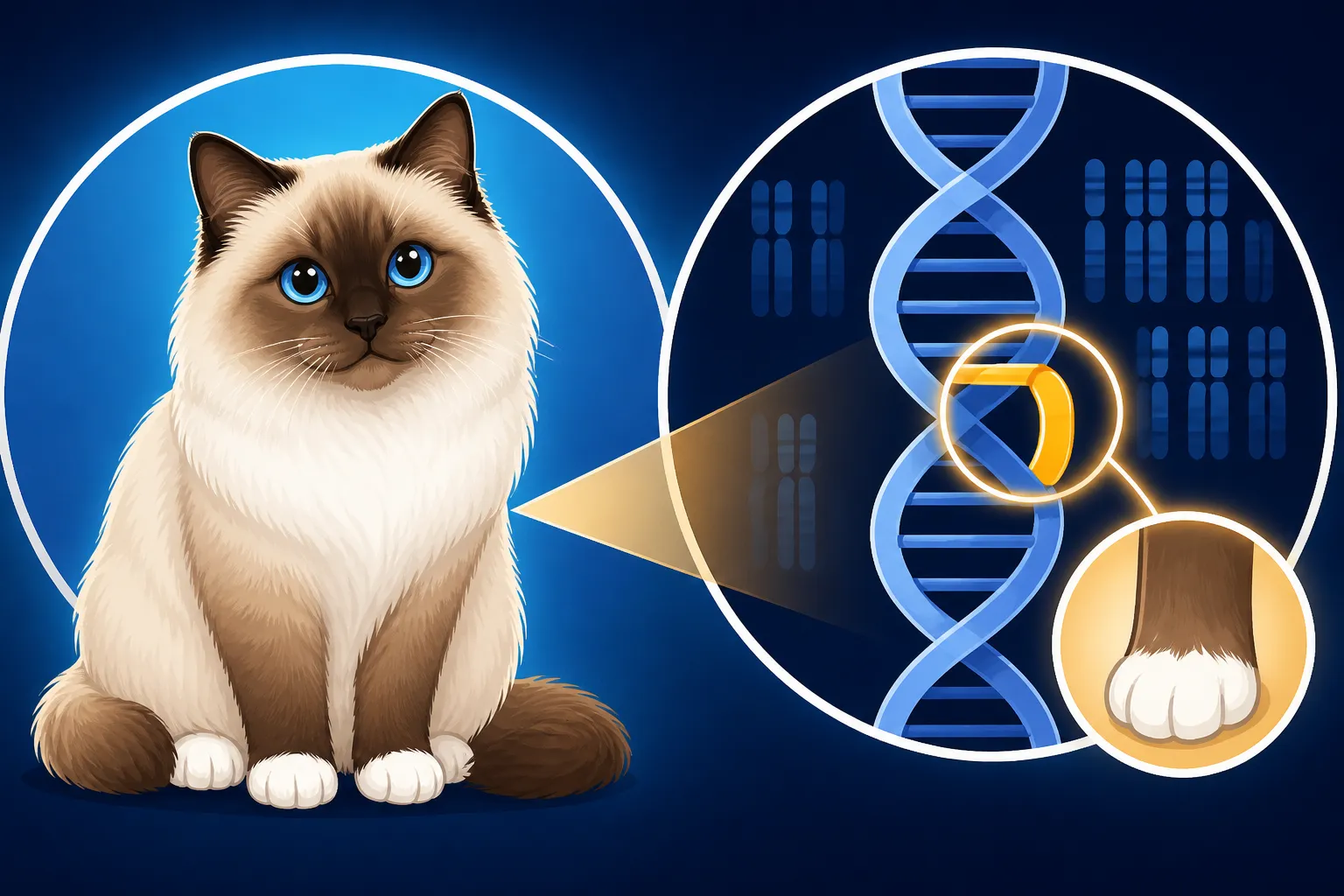
The Birman gloving variant is associated with the KIT gene, which is located on feline chromosome B1. The variant is a change within the KIT gene. So, when someone asks where the Birman gloving variant sits, the useful answer is that it is in KIT on chromosome B1—not that it occupies an entire chromosome or exists as a separate gene of its own.
That chromosome-level description is often the clearest way to orient yourself. Exact DNA coordinates are more technical and can depend on which version of the reference genome is being used. For understanding the trait, the essential point is the relationship: chromosome B1 contains the KIT gene, and a variant associated with Birman gloves lies within that gene.
What KIT does in relation to pigmentation
KIT is involved in the development and movement of pigment-producing cells. These cells help give skin and hair their color. Changes affecting KIT can therefore influence where pigment appears during development, which is why the gene is associated with white spotting patterns in cats and other animals.
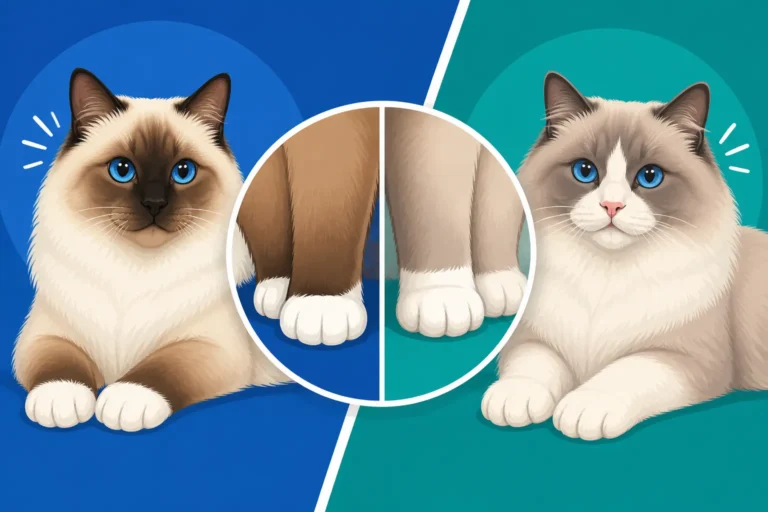
A Birman’s white feet are a distinctive pattern, not simply white fur caused by a cat’s overall coat color. The gloving variant is part of the genetic explanation for that pattern. It helps distinguish the Birman’s characteristic markings from the white feet or patches that may occur in other cats for different genetic reasons.
It is worth keeping the description precise: KIT participates in a wider biological process, but that does not mean the gene controls every detail of a Birman’s coat. The color of the points, the boundaries of the white markings, and the final shape of each glove involve more than a gene’s location alone. For more on the trait’s inheritance, see How the Gloving Gene Works in a Birman.
Why the variant’s location matters
It identifies the genetic address, not the whole explanation
Knowing the variant is in KIT gives researchers and breeders a specific place to investigate. It helps distinguish a genetic explanation tied to the Birman’s gloving trait from a general guess based only on the cat’s appearance. A DNA result can provide information about the variant a cat carries, while a visual assessment describes what its paws look like.
Those are related but not interchangeable kinds of information. A kitten may show gloves that look uneven, while its DNA still carries the breed-associated variant. Conversely, a photograph of four white feet cannot establish the exact genetic makeup of a cat. Appearance is useful for observing the pattern; genetic testing examines the relevant DNA.
A location also provides a framework for research. Scientists can study the sequence around KIT, compare cats with different coat patterns, and investigate how the variant is inherited. The finding does not, by itself, explain every biological step between a DNA change and a white marking. A gene’s address is a starting point for understanding, not a complete account of all the processes involved.
Chromosome location and DNA coordinates are not the same thing
A chromosome number tells you which large DNA molecule contains a gene. A coordinate gives a more precise position along a particular genome reference. If you see a coordinate in a test report or research paper, it should be interpreted with the reference assembly and naming system that report uses.
This matters because genomic references can be updated. A position described using one assembly may not be written identically in another, even though the biological variant being discussed is the same. That is why a simple statement such as “the Birman gloving variant is in KIT on chromosome B1” can be more useful for general readers than a string of numbers without context.
When reviewing a breeder’s paperwork, focus first on what the test says about the relevant variant and how the result is interpreted. If a report gives a precise coordinate, ask which reference it uses rather than assuming the number is meaningful on its own. For broader context about how the finding was established, see How the Birman Gloving Variant Was Identified.
| Term | What it describes | How it applies to Birman gloves |
|---|---|---|
| Chromosome | A large DNA molecule carrying many genes | The KIT gene is located on feline chromosome B1 |
| Gene | A defined stretch of DNA with a biological role | KIT is associated with pigment-cell development |
| Variant | A difference in DNA sequence | The Birman gloving variant is associated with the characteristic white feet |
| DNA coordinate | A more exact position in a specified genome reference | Useful in technical reports, but it needs the reference assembly for context |
| Visible marking | The pattern seen on the cat | Shows the appearance of the gloves, not the full DNA result |
Why Birman gloves can differ despite the same variant
A shared variant does not make every paw identical
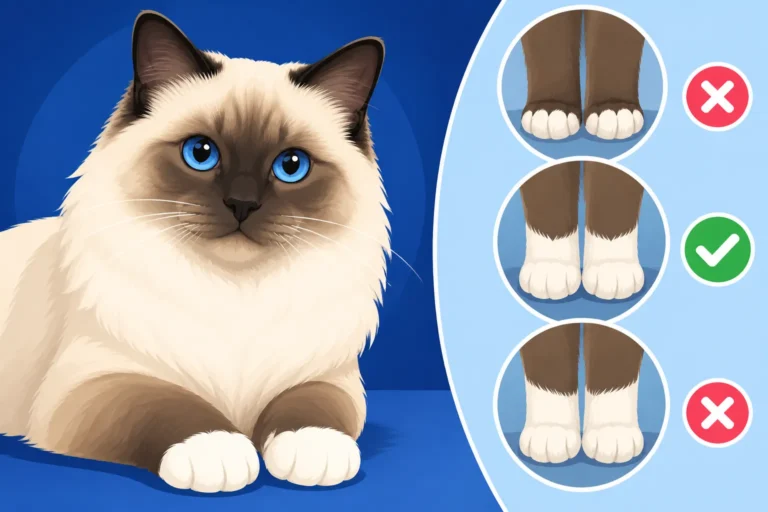
Breed traits can be strongly associated with a particular genetic variant without producing identical markings in every cat. Birman gloves differ in height, symmetry, and shape. One cat may have front gloves that appear neatly matched, while another has a small difference between the two paws or a back marking that extends differently.
The underlying reason is that a visible trait can reflect more than one genetic influence and the way development unfolds. The KIT variant is central to the gloving pattern, but other genetic factors may affect how the white markings appear. That is why a shared breed-associated variant should not be treated as a blueprint that dictates every edge of every glove.
There is a practical distinction here between having the genetic basis for the trait and having markings that meet a show standard. A DNA result can help identify the variant, but it cannot promise a particular glove shape or symmetry. For a closer look at this distinction, see Why Birman Gloves Vary Despite the Fixed Gene and Which Modifier Genes Affect a Birman's Gloves.
The breed pattern is not the same as a perfect show marking
People sometimes hear that the gloving variant is fixed in the Birman and conclude that every Birman must have four visually perfect gloves. “Fixed” in this context refers to the variant being established in the breed population; it does not mean that every cat’s markings will be identical or that every kitten will have show-quality symmetry.
A show judge evaluates the visible markings against a standard. That assessment concerns the shape and placement of the white on the paws, including how the front gloves and back laces look. It is a different question from whether the cat carries the gloving variant. A breeder may select for more consistent markings over generations, but breeding cannot guarantee a specific result in every kitten.
That can be disappointing for someone choosing a kitten from photographs and hoping for perfectly matched paws. It is also why a breeder should be cautious about promising exact markings before a kitten’s gloves are fully visible. For more on the distinction between the inherited trait and its appearance, see Why the Gloving Variant Is Fixed in the Birman and Whether a Birman Glove Can Be Bred to Order.
Using the information responsibly
What a genetic result can and cannot tell you
A test focused on the gloving variant can answer a question about that particular DNA change. It does not automatically assess every health condition, establish the overall quality of a pedigree, or predict a kitten’s exact future markings. Read the test report carefully and check which variant the laboratory examined, what the result categories mean, and whether the report identifies the tested cat.
If you are considering a kitten, ask the breeder what testing has been done and request copies of relevant records. It is reasonable to ask how the breeder interprets the result, especially if a report uses technical terms you have not seen before. A responsible discussion should make a clear distinction between genetic testing, health screening, and judging the cat’s visible markings.
The gloving variant should not be confused with health-related testing. Birman buyers may encounter separate conversations about heart screening or other inherited conditions, which involve different questions and methods. Genetic information about gloves is useful for understanding coat pattern, but it is not a substitute for broader veterinary care or appropriate health documentation.
What to ask a breeder or laboratory
Keep the questions simple and specific. Ask whether the result refers to the Birman gloving variant in KIT, what the laboratory’s wording means, and whether the report is linked to the cat you are considering. If a breeder makes a claim about perfect gloves based only on a genetic result, ask how that claim accounts for the visible variation that can occur between kittens.
You can also ask how the breeder assesses markings as kittens develop. Clear photographs of each paw may help you follow changes, but images can be misleading because of lighting, angle, or a kitten’s position. If markings matter to you, request views of all four paws and remember that photographs are not a genetic test or a guarantee of show assessment.
If you are bringing a kitten home, genetic paperwork is only one part of preparation. Make room for veterinary records, feeding instructions, and familiar supplies. Some owners use retailers such as Chewy to organize routine items like food, litter, and a carrier, but a retailer’s product listing is not evidence of a genetic result. Keep the breeder’s test documents with the kitten’s other records, regardless of where you buy supplies.
Chewy may be convenient for replacing everyday items once you know which food and litter the kitten already uses. Still, avoid changing several things at once during the settling-in period; a new home is enough of an adjustment without an abrupt diet change. If you use Chewy for supplies, treat it as a shopping option, not a source for interpreting KIT test results.
For a broader genetics overview, The Gloving Gene Every Birman Carries Two Copies Of explains how the breed’s characteristic trait is discussed at the inheritance level. And if you are sorting out the difference between DNA testing and what you see on the paws, How the Birman Gloving Variant Was Identified provides useful background.
Disclaimer
This article is for general informational purposes only and does not constitute professional advice. Laws, prices and regulations vary by location and change over time. Consult a qualified professional for guidance on your specific situation.