How the Birman Gloving Variant Was Identified
A Birman’s white gloves can look like simple markings, but they are tied to a specific genetic pattern—and a DNA result can’t tell you whether those markings will be perfectly shaped. This guide explains how researchers linked Birman gloving to a variant in the KIT gene, what that discovery means for inheritance and testing, and what it cannot predict about a kitten’s paws.
What the Birman gloving variant means
The markings are a distinct inherited trait
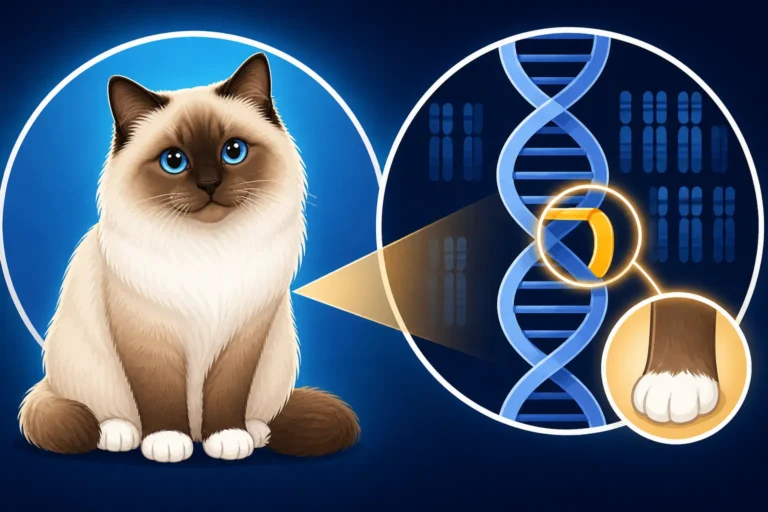
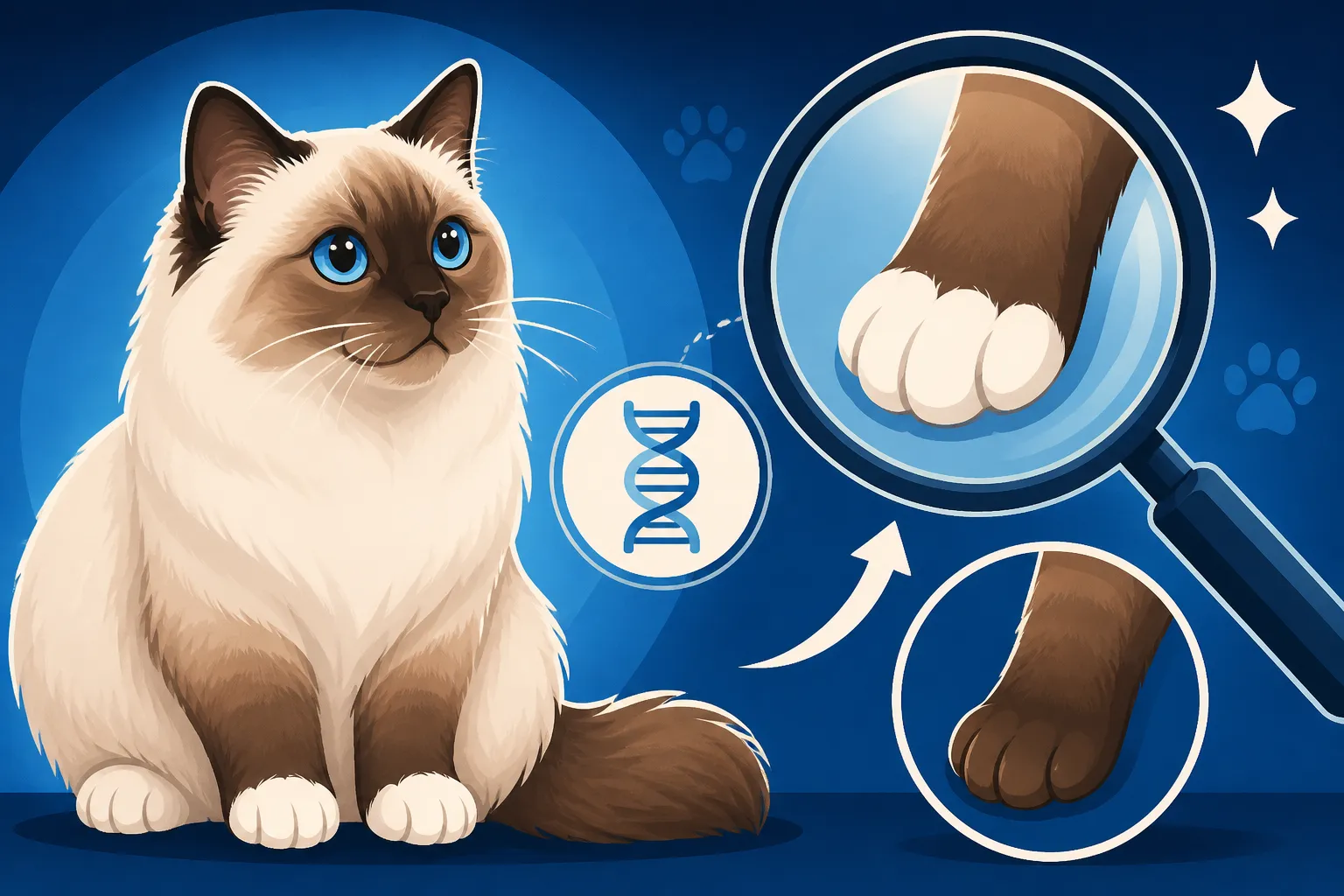
Birmans are pointed cats with pale bodies, darker points, blue eyes and white feet. The white markings on the paws are known as gloving. They are part of the breed’s characteristic appearance, but they are not the same thing as the color-point pattern that creates the darker face, ears, legs and tail.
The distinction matters because several genetic processes shape a Birman’s appearance. A cat can inherit genes affecting its point color and, separately, the genetic variant associated with white gloving. That helps explain why the white feet remain a recognizable breed feature even as point colors differ. For an overview of how the marking is treated in the breed, see The Gloving Gene Every Birman Carries Two Copies Of.
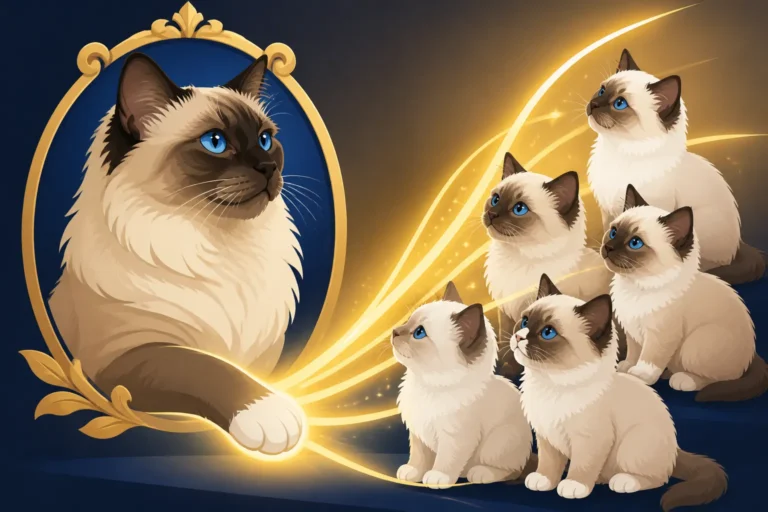
Gloving is generally described as a recessively inherited trait: a Birman typically needs two copies of the associated variant to show the characteristic white gloves. A cat with one copy may carry it without displaying the same pattern. In breeding discussions, it is therefore important to distinguish a visible trait from the genetic result behind it. The basics of inheritance are explored further in How the Gloving Gene Works in a Birman.
KIT became a promising gene to investigate
KIT is a gene with a known role in the development and distribution of pigment-producing cells. Those cells contribute to coat pigmentation, so changes affecting KIT can be relevant to white markings in animals. That made it a reasonable candidate for researchers investigating why Birmans have their distinctive white feet.
A candidate gene is not a conclusion by itself. Researchers first need a plausible biological reason to study a gene, then evidence that a particular genetic difference tracks with the trait in the cats being examined. In this case, the focus on KIT offered a way to investigate gloving at the level of DNA rather than relying only on what a cat’s paws looked like.
That distinction is useful for owners, too. The gene name tells you where researchers found a relevant clue; it does not mean every KIT change produces Birman gloves. Different genetic changes can have different effects, and the specific variant and the test used to detect it matter. For more on its location, see Where the KIT Gloving Variant Sits in the Genome.
How researchers linked the variant to Birman gloves
They connected a visible trait with genetic evidence
A genetic study of a breed trait starts with careful descriptions of the cats. Researchers need to know which cats visibly show the relevant markings, which do not, and how the animals are related. Pedigree information can help reveal whether a trait appears across families in a pattern consistent with an inheritance model.
Once a trait is clearly defined, researchers can compare DNA from cats with different observed patterns. If a particular genetic variant appears consistently in cats with gloving and follows the expected pattern across related cats, it becomes a strong candidate. The combination of a plausible gene, observed markings and inheritance evidence is much more informative than an isolated DNA difference in one cat.
This is why a photo alone cannot establish a genetic result. Lighting, pose and the age of the kitten can make white markings look different, and a photograph cannot reveal whether a cat carries one or two copies of a variant. Genetic evidence addresses a different question from visual assessment: what variant is present, rather than how the paws appear on a particular day.
Sequencing helped narrow down the genetic change
After identifying a promising gene, researchers can examine its DNA sequence for differences that might be associated with the trait. Sequencing allows them to compare the relevant genetic material in cats with different gloving patterns and look for a variant that fits the observed inheritance.
The strength of a genetic finding comes from how well the evidence fits together: the variant is in a biologically plausible gene, it is associated with the observed trait, and its distribution among the cats studied is consistent with the inheritance pattern. This process is more precise than guessing from appearance, but it still depends on the quality and scope of the study and on whether the test targets the same variant.
For a pet owner, the practical takeaway is to ask what a test actually measures. A general cat ancestry report is not automatically a validated test for the Birman gloving variant. If you begin your search through a pet-supply retailer such as Chewy, look for the named variant, the laboratory responsible for the result and a clear explanation of what the test can establish. A listing or a breed estimate alone does not answer those questions.
What a DNA test can and cannot tell you
A test can identify copies of the tested variant
A targeted genetic test can report whether a cat has zero, one or two copies of the variant it examines. That information can help breeders understand whether a cat may pass the variant to offspring, particularly when considered alongside the other parent’s result and the cat’s pedigree.
A result should be read according to the laboratory’s wording. “Clear,” “carrier” and “affected” are often used for recessive traits, but laboratories may present results differently. Ask the testing provider to explain whether its terminology refers to the specific variant, the expected visible trait, or a breeding interpretation. For a more detailed guide to using results, see Whether a Birman Glove Test Exists and How a Birman's Gloves Are Scored.
If you are comparing genetic testing options while browsing Chewy or another retailer, check the actual test panel rather than relying on broad phrases such as “breed health” or “DNA profile.” Confirm that the report includes the Birman gloving variant specifically, and ask whether the result is intended for individual identification, breeding decisions or both. A consumer report may be interesting, but breeding decisions deserve clear, variant-specific information.
A test does not grade the shape of the gloves
Knowing a cat’s genotype does not tell you whether its front gloves will end at an even height or whether its back markings will form the desired laces. These are questions of visible pattern and show assessment, not simply whether the cat carries the variant associated with gloving.
That difference can surprise prospective owners. A kitten may inherit the genetic basis for white gloves yet grow up with markings that are uneven, too high, too low or otherwise different from a show ideal. The DNA result describes a genetic feature; it does not promise a particular distribution of white hair on each paw. The reasons visible gloves vary are discussed in Why Birman Gloves Vary Despite the Fixed Gene and Which Modifier Genes Affect a Birman's Gloves.
The same principle applies when choosing a kitten. If glove appearance matters to you, ask the breeder how they assess the paws as the kitten grows and what uncertainty remains. A genetic result can be useful background, but it is not a substitute for seeing the cat’s markings or understanding the breed standard. Why a Birman's Front Gloves Must End Evenly explains why visual symmetry is a separate concern.
| Question | What the gloving test may answer | What it does not establish by itself |
|---|---|---|
| Does the cat carry the tested variant? | Whether the tested DNA sample shows zero, one or two copies, according to the lab’s report | The cat’s complete ancestry or overall health |
| Could the cat pass the variant on? | A result can help inform inheritance when paired with the other parent’s result | The exact appearance of every kitten |
| Will the kitten have ideal gloves? | No; genotype may relate to gloving, but it does not grade paw markings | Even front gloves, correct lace length or show quality |
| Is a general DNA profile enough? | Only if the report explicitly tests the relevant variant | That every Birman-related trait has been tested |
How to use the discovery responsibly
Ask precise questions before making breeding decisions
If you are speaking with a breeder, ask which laboratory performed the test, what variant was tested and how the result is recorded. Request the actual report or documentation rather than relying on a verbal description such as “tested” or “genetically clear.” If a report uses unfamiliar terms, ask the laboratory or a veterinarian to explain them before treating them as a breeding recommendation.
A single result also needs context. For a recessive trait, the status of both parents affects the possible genotypes of their kittens. A breeder should interpret the two results together and understand the relevant inheritance pattern. That does not mean a carrier cat is automatically unsuitable for breeding; it means planning should be based on reliable results and responsible pairing rather than assumptions.
If a seller mentions a DNA test while you are researching supplies or services through Chewy, treat the retailer as a starting point for finding information, not as the authority on what a specific laboratory result means. Verify the assay and its scope with the testing provider. The useful question is not simply “Was a DNA test done?” but “Which variant did it test, and what does the report say?”
Keep genetics separate from judging and general care
The discovery of a gloving-associated variant helps explain a distinctive Birman trait, but it does not replace ordinary assessment of a kitten’s health, temperament, environment or care needs. Nor does it make every genetic result a prediction of show success. A kitten’s paws still need to be evaluated as visible markings, while health questions call for the appropriate health history and veterinary care.
It can help to think of the evidence in three separate layers: the DNA result, the visible markings and the cat’s overall welfare. The DNA result concerns a tested variant. The visible markings are assessed against the breed’s appearance and standards. Welfare includes the animal’s health and day-to-day needs. Mixing these up can lead to misplaced confidence—for example, assuming that a gloving result certifies a kitten as healthy or guarantees ideal white feet.
For owners, the discovery is most useful as an explanation of how a defining feature can be studied and inherited. For breeders, it can add information to careful planning, provided the test is specific and the result is interpreted correctly. For anyone choosing a Birman, it is one part of a much bigger picture: ask for evidence, look at the cat in front of you, and avoid treating a single genetic result as a promise.
Disclaimer
This article is for general informational purposes only and does not constitute professional advice. Laws, prices and regulations vary by location and change over time. Consult a qualified professional for guidance on your specific situation.