How a Birman’s Point Color Is Registered
A Birman kitten can look almost entirely white when its registration paperwork is being prepared, while its seal, blue, chocolate, or other points are still developing. That makes color registration confusing for new owners. This guide explains how a Birman’s point color is identified, what the paperwork records, why names can vary between registries, and what to check before accepting a pedigree.
What Birman point color registration records
Point color is the darker color on the face, ears, legs, and tail
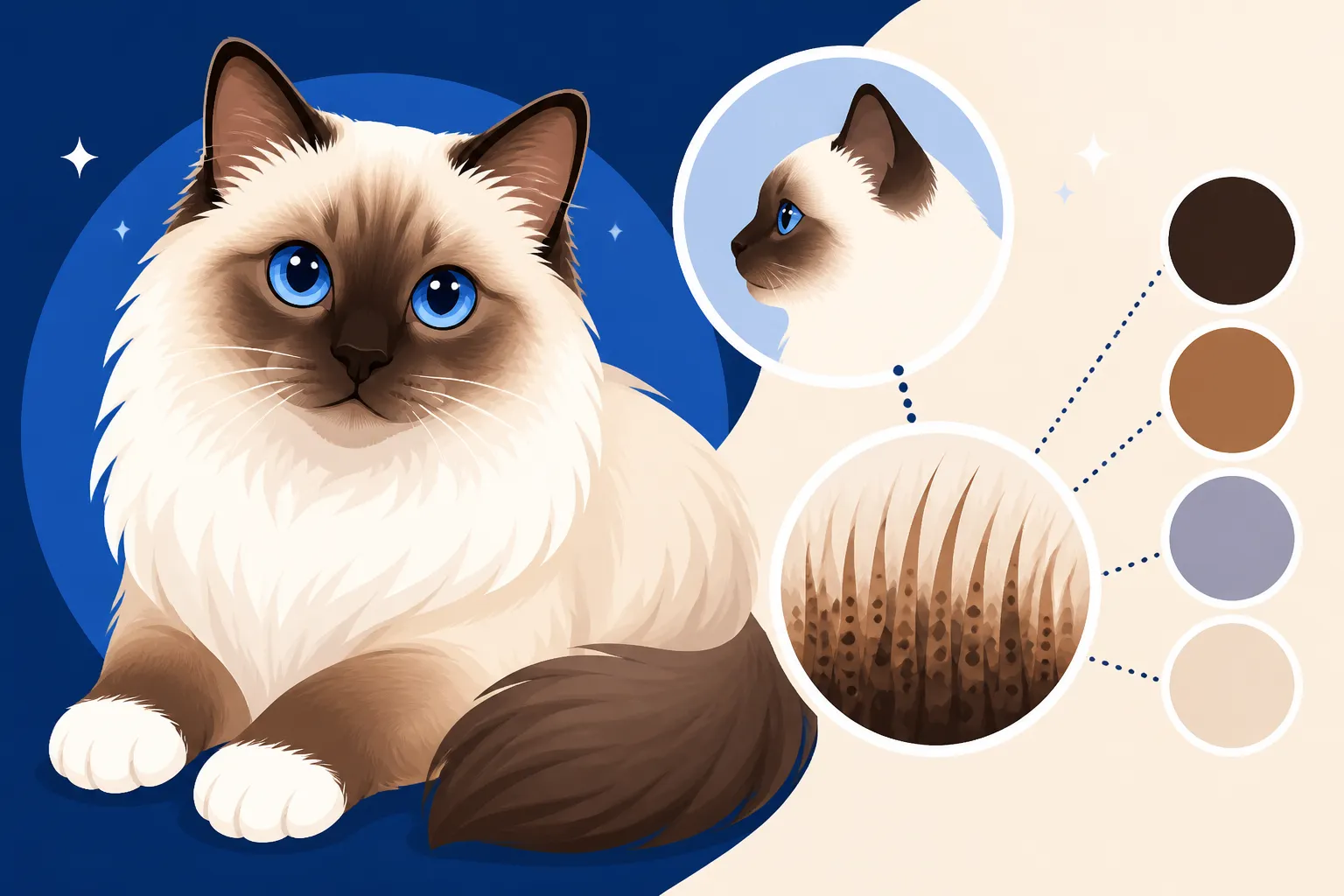
Birmans have a light-colored body and darker “points” on the face, ears, legs, and tail. Their characteristic white gloves and laces are separate markings: they are not the point color and do not determine whether a cat is registered as seal point, blue point, or another color.
A kitten may be registered under a color description such as seal point, blue point, chocolate point, lilac point, red point, cream point, or a tortie or tabby version of a recognized point color. The exact list depends on the registry and its rules. Some registries use terms such as “lynx point” where others may use “tabby point,” so a difference in wording does not automatically mean the cat has been recorded incorrectly.
The registered color is meant to identify the cat’s coat-color category in the registry’s system. It does not grade the depth or quality of the color, certify that the white markings are ideal, or guarantee that the cat meets every part of the show standard. To understand which categories a particular association accepts, see Which Point Colors the Birman Standard Allows and How Many Point Colors a Birman Is Registered In.
Registration names follow the registry’s own rules
A breeder registers a kitten through a recognized registry, and that organization’s standards and record-keeping system determine which color names are available. The same general coat pattern may be described using slightly different terminology across organizations or countries. A breeder may also discuss a kitten informally using a familiar color name while the official paperwork uses a registry-specific label or code.
This is why it helps to distinguish between a color name used in everyday conversation and the wording on the official record. If an owner later transfers the cat’s registration to another association, the new association may classify the color according to its own categories. The coat has not changed; the administrative label may have been translated into a different system.
For example, a breeder may say “blue point” when describing a kitten, while an official document includes a longer description or a code. The code is meaningful within that registry, but it may not be obvious to someone reading the document without the registry’s code guide. If a code or label is unclear, ask the breeder or registry to confirm what it represents rather than guessing from the letters or numbers.
A color registration is not the same as a show assessment
Registration establishes the cat’s identity and records information such as its breed, color designation, parentage, and registration details. A show judge, by contrast, assesses the cat against the relevant breed standard. That assessment may include coat color, pattern, eye color, body type, and the placement and shape of the white gloves.
A kitten can be correctly registered as a Birman in a recognized color and still have markings that are considered imperfect for showing. Conversely, a kitten’s striking appearance does not by itself prove that its breed or color has been registered correctly. Registration and show evaluation answer different questions.
It is also useful not to treat a color label as a complete description of quality or health. A cat registered as a recognized point color still needs ordinary veterinary care, and its color does not predict its temperament. If you are comparing kittens, focus on the full paperwork and the breeder’s care practices, not just the color name. For a closer look at the distinctions among recognized categories, Which Point Colors CFA Accepts in a Birman explains how one major registry frames its accepted colors.
Why a Birman kitten’s color can be hard to identify
Most kittens begin life looking very pale
Birman kittens are born very pale, and their points develop gradually. At first, the ears, face, paws, and tail may show little obvious contrast with the body. As the kitten grows, darker pigment becomes easier to see, so an early color guess may be less certain than a later assessment.
That timing can leave new owners wondering why the kitten’s paperwork uses a particular color name when the kitten still looks nearly white. It does not necessarily mean the breeder has made an error. The breeder may be identifying the developing pattern from early signs, the parents’ colors, and experience with the line, while recognizing that the coat will become clearer over time.
A young kitten’s color can be especially difficult to judge in photographs. Indoor lighting, camera settings, shadows, and the kitten’s age can make subtle differences between pale shades look stronger or weaker than they are. A clear picture can help document appearance, but it cannot always settle a close color distinction on its own. Why Every Birman Kitten Is Born Pure White and How a Birman Kitten's Points Come In offer more detail on this gradual change.
Seal, blue, chocolate, and lilac can look different as they develop
Some Birman point colors are easier to recognize than others once the coat develops, but early appearance can still be misleading. Seal points generally develop a deep brown tone, while blue points have a cooler, slate-like appearance. Chocolate and lilac points are often paler or softer in tone, and the difference between related shades may not be obvious in a very young kitten.
Red and cream points, along with tortie patterns, add other visual details that can take time to become clear. In a tortie point, the point areas show a mixture of colors. In a tabby or lynx point, the pattern includes markings within the colored areas. The names describe different coat-color patterns; they do not mean the cat is a different breed.
If you are checking a kitten’s likely color, look at more than one area and more than one photograph. Compare the ears, mask, legs, and tail in natural, even light, and ask whether the breeder is describing the color as an early identification or as the final entry on the registration. A seal point may look very different from a blue point as an adult; What a Seal Point Birman Looks Like and What a Blue Point Birman Looks Like provide useful comparisons.
Age and temperature can affect how dark the points look
Point color is influenced by temperature-sensitive pigmentation. The cooler areas of the body tend to develop more pigment than warmer areas, which is one reason the points are darker than the torso. A Birman’s coat may also look darker as the cat matures, and changes in environment or body temperature can influence the appearance of its points.
This can make an owner’s photos from different seasons look inconsistent. A cat might appear darker in a cooler room or during colder weather, while the body coat looks lighter or the contrast seems less pronounced in a warmer setting. These shifts do not mean that the cat has changed registration category. The official record generally remains the same even when the visible intensity of the coat changes.
For a fair comparison, avoid deciding that the registration is wrong based on a single image or a temporary change in coat appearance. Compare the adult coat in consistent lighting, and ask the breeder or registry about the formal color category if there is a genuine discrepancy. The topic Why a Birman's Point Color Affects Price is also worth reading if you are trying to separate color naming from the price or quality claims sometimes attached to it.
How breeders and registries identify and record color
Breeders make an initial identification from the kitten and its lineage
A breeder usually has more context than a buyer looking at a single kitten. They can compare the kitten with its parents and littermates, observe how the points develop, and refer to the color information recorded for the breeding cats. That background helps with identification, although it does not make every early color call instantly obvious.
When a breeder discusses a kitten’s color, ask whether the term is a preliminary description or the color entered on the registration application. That small question can prevent a lot of confusion later, especially if the kitten is very young or belongs to a color pattern that takes time to distinguish.
The breeder should be able to explain the color description in ordinary language. You do not need to be an expert in feline coat genetics to understand whether the cat is being recorded as, for example, seal point or blue point. If the explanation relies only on a marketing phrase such as “rare color” without identifying the registry category, ask for the formal description and the relevant paperwork.
The application and pedigree connect color to the cat’s identity
When a litter is registered, the breeder provides identifying details required by the registry. The exact forms and procedures vary, but the registration process commonly links each kitten to its registered parents and records a color designation. Once the cat is individually registered, that information appears on its certificate, pedigree, or other official documents, depending on the registry.
When you receive the paperwork, check that the name, breed, color, date of birth, and parentage match the kitten and the breeder’s records. Some documents may show a color name; others may use a code or include both. If the color entry seems inconsistent with what you were told, ask the breeder to clarify whether the difference is just a registry term or whether a correction is needed.
If the breeder says the paperwork will follow later, ask what document is pending and how it will be provided. A registration certificate, a pedigree, a health record, and a sales contract are not interchangeable documents, even though they may all be handed over around the same time. For help understanding the organization behind the record, see Which Registry Body Issues a Birman's Papers.
Registration can be updated or interpreted differently across organizations
A registry may have procedures for correcting a clerical mistake or updating information when an application was incomplete. If the registered color appears wrong, begin by contacting the breeder, since they generally submitted the original litter application. Ask for the exact wording or code they entered and whether they can check it against the registry’s rules.
If the cat’s registration is transferred to a different organization, do not assume every field will be copied word-for-word. A second registry may use another color list, a different code, or a different naming convention. Ask the receiving registry how it maps the original description into its own system, and keep copies of the original certificate and pedigree.
A mismatch in wording is not always a mistake, but a mismatch in the cat’s identity or parentage deserves careful attention. If the name, registration number, or recorded parents do not correspond with the documents you received, ask for clarification before relying on the paperwork for breeding, showing, or future registration. Keep written responses and copies of forms so you have a clear record of what was corrected or explained.
What to check on a Birman’s color paperwork
Compare the certificate with the kitten and the breeder’s description
Start with the basics: confirm that the certificate refers to your kitten and that the breed and registered color are present. Then compare the color wording with the breeder’s description and ask whether both use the same registry terminology. If the paperwork uses a code, request the registry’s explanation of that code rather than relying on a search result or an assumption.
It can help to save a few dated photos as the points develop. These images are not a substitute for official documentation, but they give you a useful record of how the kitten looked when the breeder identified its color. Take them in natural light and include the face, ears, legs, and tail so the point areas are visible.
If you are buying a kitten, ask to see the paperwork that is available before making assumptions about what will be included later. The practical questions are simple: Which registry issued the document? What color is recorded? Is the registration individual to this kitten, or is the breeder showing litter-level paperwork? A clear answer is more useful than a confident but vague assurance.
Separate color records from gloves and other markings
Birmans are known for their white gloves and, on the hind feet, white laces. These markings are an important part of the breed’s appearance, but the color registration and the assessment of glove quality are different matters. A cat’s color designation does not tell you whether its gloves are even, whether the laces reach the preferred points, or how a judge might evaluate the markings.
For example, a blue point Birman with uneven gloves may still be registered under the blue point category. The registration describes the color; the show standard assesses the whole cat. This distinction is especially helpful when someone describes a kitten as “perfectly marked” or “show quality” based only on its color or a carefully chosen photograph.
Ask for the exact color description and, separately, ask what is known about the kitten’s markings and show prospects. The answer may be that the kitten is correctly registered but being sold as a pet because of a marking fault. That is not a contradiction. It is a reminder that color, registration, and show evaluation are related but separate parts of the picture.
Treat “rare color” claims as a reason to ask precise questions
Color can influence how a kitten is described in advertisements, and unusual-sounding names can create the impression that a cat has a special registration status. The key is to confirm the formal color category with the registry paperwork. A sales description is not a registry record, and a color name used by a seller may not match the official label.
A useful question is: “What exact color is written on the registration document, and which registry issued it?” You can also ask whether the color is confirmed or still developing, especially if the kitten is young. These questions are straightforward and help you understand what you are being told without turning a color discussion into an argument.
If the answer is unclear, focus on verifiable details: the certificate, the pedigree, the kitten’s identity, and the breeder’s explanation of any differences in terminology. A Birman’s registered point color is one useful detail in its record, but it does not replace responsible breeding, sound care, or a good match between the cat and its future home.
Disclaimer
This article is for general informational purposes only and does not constitute professional advice. Laws, prices and regulations vary by location and change over time. Consult a qualified professional for guidance on your specific situation.