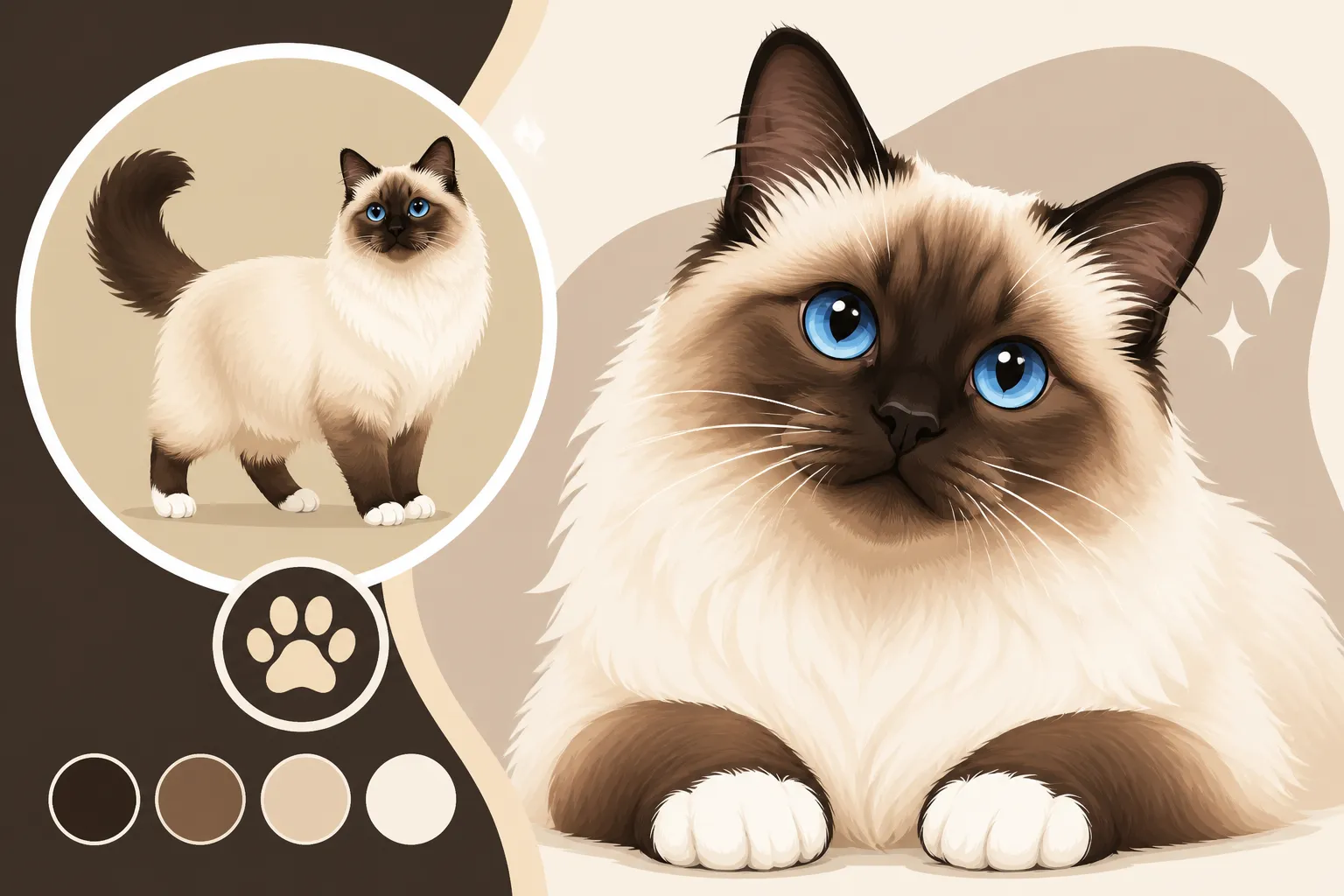
What a Chocolate Point Birman Looks Like
There’s a unique charm to Birmans, isn't there? Their stunning blue eyes, those elegant white gloves, and that incredibly silky coat—it's easy to fall head over heels. But when it comes to pinpointing their exact color, especially beyond the classic Seal or Blue, things can get a little tricky. You might see a beautiful Birman kitten, and the breeder calls it a "Chocolate Point," but what does that really mean? How is it different from a Seal or even a Lilac? This guide is here to walk you through exactly what a Chocolate Point Birman looks like, helping you appreciate the subtle, warm tones that make this particular coloration so special.
The Signature Look of a Chocolate Point Birman
When you hear "Chocolate Point," you're likely imagining something rich and inviting, and for the Birman, that's exactly what you get. It’s a point color that stands out with its warm, delectable hue, quite distinct from its darker relatives.
The Rich, Warm Chocolate Points
Imagine the color of a really good milk chocolate bar, or perhaps a warm, creamy cocoa on a chilly evening. That’s the essence of a Chocolate Point Birman’s coloration. Their "points"—the cooler extremities of their body where pigment develops—display this beautiful, softer brown. You’ll see it most vividly on their mask, which covers their face, extends to their ears, runs down their legs, and forms their tail. Unlike the much deeper, almost black-brown of a Seal Point, the chocolate is unmistakably warmer and lighter, often described as a medium, rich brown.
When a Chocolate Point Birman kitten is born, just like all Birmans, they arrive almost completely white. It’s truly fascinating to watch their points slowly emerge and deepen over the first few weeks and months. This development isn't just a gradual darkening; it’s a revelation of that specific chocolatey warmth. Why a Birman Kitten Is Born Almost White delves into this phenomenon, explaining why temperature plays such a crucial role. As they grow, their points will continue to mature, but the underlying warm, milk chocolate tone remains their defining characteristic. You might notice the color becoming a bit more pronounced in cooler environments, as the temperature affects how much pigment is produced.
The distinction truly lies in the warmth. If you line up a Seal Point and a Chocolate Point, the difference is immediate once you know what to look for. The chocolate offers a gentle, inviting quality, a shade that complements their white gloving and creamy body beautifully. This particular warmth isn’t just aesthetic; it's a key identifier of the genetic makeup that creates this stunning color.
The Creamy Ivory Body and Golden Hue
Beyond their striking points, a Chocolate Point Birman’s body coloration is equally important in defining their overall look. Their torsos are typically a soft, creamy ivory, or sometimes even a pale champagne hue. This light body provides a gorgeous contrast to their rich chocolate points, making those warmer brown extremities pop even more. It’s not a stark white like some cats, but a gentle, understated cream that adds to their luxurious appearance.
What often distinguishes a Chocolate Point’s body from, say, a Blue Point’s paler, cooler body, is a subtle golden sheen that can sometimes be observed, especially in good lighting. It’s not a yellow or orange overtone, but rather an underlying warmth that permeates their fur, giving it a soft, radiant quality. This golden hue complements the chocolate points perfectly, creating a harmonious and cohesive color palette across the entire cat. Caring for a Birman Once Its Points Have Gone Dark touches on how the body color can change slightly with age and environmental factors, but the creamy base remains constant.
This creamy body color is also influenced by the same temperature-sensitive gene that dictates the point color. Areas of the body that stay warmer, like the torso, produce less pigment, resulting in this light, ethereal shade. The contrast between the cool extremities and the warm body is a hallmark of the Birman breed, and for the Chocolate Point, it’s a particularly beautiful expression of this genetic trait. As your Birman ages, their body might darken slightly, but it will almost always retain that elegant creaminess that makes the chocolate points so striking.
The Distinctive Nose Leather and Paw Pads
One of the most telling features for identifying a Birman's point color, especially for a Chocolate Point, lies in the small details: their nose leather and paw pads. These areas, like the other points, reflect the specific pigment coloration and offer immediate clues.
For a Chocolate Point Birman, their nose leather will be a warm, milk chocolate brown, matching the tone of their points. It’s not dark black or charcoal grey, but that same inviting, gentle brown. This consistency across all point areas is a key indicator. If you were to compare it to a Seal Point, which would have a dark, almost black nose leather, the difference is very clear. It's a small detail, but breeders and enthusiasts often look to these features for a definitive identification of the point color.
Similarly, their paw pads will also exhibit this beautiful chocolate brown. Imagine those perfectly gloved white paws, and beneath the soft fur, you'll find pads that mirror the warm brown of their mask and tail. This is another area where the contrast with other point colors is stark. A Blue Point, for instance, would have slate grey paw pads. These fine details, the nose leather and paw pads, are like nature's swatch book, confirming the warm, dilute brown genetics at play. It’s a joy to observe these subtle yet significant markers that complete the picture of a true Chocolate Point Birman.
Distinguishing Chocolate from Other Birman Point Colors
Understanding what a Chocolate Point looks like is one thing, but truly appreciating its uniqueness often comes down to comparing it with the other stunning variations within the Birman family. It’s all about those subtle nuances!
Unpacking the Differences from Seal Points
The most common point color often seen in Birmans is the Seal Point, and this is where many people might initially confuse it with a Chocolate Point. However, once you know what to look for, the difference is quite clear, and it largely comes down to the warmth versus coolness of the brown tones. What a Seal Point Birman Looks Like offers a deep dive into this classic coloration.
A Seal Point Birman displays points that are a very dark, rich, almost black-brown. Think of dark, bitter chocolate or a deep espresso. Their nose leather and paw pads are typically a very dark brown or even black. The body of a Seal Point tends to be an ivory or cream, but often without the distinctly golden hue you might find in a Chocolate Point. The overall impression of a Seal Point is one of striking contrast and a cooler, deeper tone.
In contrast, the Chocolate Point, as we’ve discussed, has a much warmer, lighter, and milkier brown. Its points never reach that deep, dark intensity of a Seal. When you see them side-by-side, the Chocolate Point almost glows with its lighter, softer brown, while the Seal Point presents a more intense, almost shadowy elegance. It’s like comparing dark roast coffee to a milky latte – both brown, but with vastly different depths and undertones. Paying attention to the nose leather and paw pads is often the easiest way to confirm the difference if you're ever in doubt.
Clearly Different from Blue Points
While Seal and Chocolate points can sometimes cause confusion due to both being "brown" shades, distinguishing a Chocolate Point from a Blue Point Birman is generally much easier. The difference in underlying pigment is quite profound, moving from brown tones to cool grey.
A Blue Point Birman features points that are a cool, slate grey. Imagine a smoky, muted blue-grey, not brown at all. Their nose leather and paw pads will also be a matching slate grey. Their body fur often has a cooler, almost off-white or pale cream tone, which can sometimes appear to have a subtle blue tint, especially in certain lighting. What a Blue Point Birman Looks Like provides a detailed description of this elegant color.
The Chocolate Point, with its warm brown points, nose leather, and paw pads, stands in stark contrast to the Blue Point's cool grey. There’s no mistaking the two once you understand the fundamental color difference. It’s like comparing a warm wooden cabinet to a cool, polished stone countertop – both beautiful, but distinctly different in their color family. This contrast highlights the specific genetic dilution at play for each color, one diluting black to blue, and the other diluting black to chocolate brown.
Quick Comparison to Lilac and Red Points
To round out our understanding of where the Chocolate Point sits in the Birman color spectrum, let's briefly touch on Lilac and Red Points. These are less common than Seal or Blue, but equally beautiful and distinct.
A Lilac Point Birman is an even further dilution of the chocolate pigment. Instead of a milk chocolate, think of a warm, delicate pinkish-grey or frosty lilac. Their points are very pale, often described as a "frosty lilac" or "dove grey" with a warm undertone. Their body is usually an almost pure white. What a Lilac Point Birman Looks Like explains this beautiful, ethereal shade in more detail. When compared to a Chocolate Point, the Lilac is significantly lighter and has a distinctly grey-pink cast rather than a true brown.
Red Point Birmans, also known as Flame Points, are quite different again. Their points range from a soft orange-cream to a vibrant reddish-orange, and their bodies are often creamy white. These colors arise from a completely different gene responsible for red pigment, rather than the black-based pigments of the Seal, Blue, Chocolate, and Lilac points. So, while a Chocolate Point has warm brown points, a Red Point has warm orange/red points, making them very easy to differentiate. Each of these point colors adds another layer to the incredible diversity and beauty of the Birman breed.
| Point Color | Point Description | Body Color | Nose Leather | Paw Pads |
|---|---|---|---|---|
| Seal | Very dark brown, almost black | Cream to warm ivory | Dark brown/black | Dark brown/black |
| Blue | Cool slate grey | Off-white to pale cream | Slate grey | Slate grey |
| Chocolate | Warm milk chocolate brown | Creamy ivory/champagne | Warm chocolate brown | Warm chocolate brown |
| Lilac | Frosty pinkish-grey/lavender | Glacier white | Lavender-pink | Lavender-pink |
| Red | Orange to reddish-orange | Creamy white | Pinkish | Pinkish |
The Genetic Basis of Chocolate Point Coloration
It's truly fascinating to think that such a beautiful and specific color, like the Chocolate Point, isn't just a random occurrence but the result of intricate genetic instructions. Understanding the genetics can deepen your appreciation for this lovely variant.
The "b" Allele and Temperature-Sensitive Pigmentation
At the heart of all Birman point coloration lies a specific gene responsible for the "colorpoint" pattern, which is actually a form of partial albinism. This gene, often referred to as the "Himalayan gene," produces a temperature-sensitive enzyme called tyrosinase. This enzyme is crucial for melanin production (pigment), but it only functions effectively in cooler temperatures. That's why Birmans are born white and develop color on their cooler extremities (points) – face, ears, legs, and tail. How a Birman Kitten's Points Come In explains this process in detail.
For the Chocolate Point specifically, we're looking at a different allele (a variant of a gene) at what's called the "B/b" locus. The "B" allele produces black pigment, which, when combined with the colorpoint gene, results in a Seal Point. However, the "b" allele is a recessive mutation that causes the black pigment to be converted into a rich, warm brown pigment instead. So, a Birman must inherit two copies of this "b" allele (bb) to express the chocolate color. This is why you won't see a Chocolate Point Birman if they only carry one "b" and one "B" (Bb) – they would still be a Seal Point, but would carry the chocolate gene. This genetic dance is what dictates the beautiful, warm brown we see.
The combination of the temperature-sensitive colorpoint gene and the "bb" genotype is what creates the Chocolate Point Birman. The same tyrosinase enzyme that only works in cool areas is now producing chocolate-colored pigment instead of black. This genetic blueprint ensures that the unique warm brown develops consistently on their points, differentiating them genetically and visually from their Seal Point relatives.
What it Means for Breeders and Owners
For Birman breeders, understanding these genetics is absolutely fundamental. They meticulously track the genetic lines of their cats to predict kitten colors and ensure healthy pairings. To produce Chocolate Point kittens, both parents must either be Chocolate Points themselves (bb), or they must be Seal Points who carry the chocolate gene (Bb). When two carriers are mated, there's a statistical chance of producing Chocolate Point kittens alongside Seal Points. This careful genetic planning ensures the continuation of these beautiful and specific color lines. Whether Show Marking Can Be Predicted From Birman Parents highlights the complexities of breeding for specific traits.
For owners, while you don't need to be a geneticist, knowing that your Chocolate Point Birman's color is genetically determined can add to your appreciation. You might notice that if your Birman spends more time in a cooler environment, their points may deepen slightly over time, or if they live in a particularly warm climate, their points might remain a bit lighter. Why a Birman Living Somewhere Cold Gets Darker explains this environmental influence on pigment. It's a natural and charming aspect of owning a colorpoint cat. Rest assured, your beautiful Chocolate Point Birman will retain its distinctive warm hue, a testament to its unique genetic heritage, regardless of these minor environmental influences.
Living with a Chocolate Point Birman
Beyond their stunning appearance, owning a Chocolate Point Birman, or any Birman, means embracing their wonderful temperament and ensuring they receive the best care. Their coat, while beautiful, does have specific needs, and general health is always paramount.
Maintaining Their Distinctive Coat
The Birman is famous for its long, silky coat that, thankfully, has very little undercoat. This means it's less prone to matting than some other long-haired breeds, making grooming a more manageable task. However, to keep that creamy ivory body pristine and those chocolate points looking their best, regular grooming is still key. No Undercoat Is What Makes a Birman Easy to Groom describes this wonderful characteristic of the breed.
You'll want to comb your Chocolate Point Birman a few times a week, focusing on areas like their ruff, britches, and tail plume, where tangles might occasionally form. A good quality comb with widely spaced teeth will glide through their coat without pulling. This regular attention not only keeps their coat free of knots but also helps distribute natural oils, contributing to that lovely sheen. For diet, look for high-quality cat foods rich in omega fatty acids, which are fantastic for skin and coat health. Many excellent options are available from reputable online retailers like Chewy, offering convenient delivery right to your door. Some owners also explore fresh or lightly cooked food options, which can provide carefully balanced meals that contribute to a lustrous coat.
Keeping their beautiful white gloves and creamy body clean might require a bit of extra attention, especially if they enjoy exploring dusty corners or playing near something that could stain their fur. While Birmans aren't usually in need of frequent bathing, spot cleaning their feet or around their mouth might be necessary from time to time to keep them looking their best. Keeping a Birman's White Gloves White offers practical advice for this specific challenge. A healthy diet, coupled with consistent, gentle grooming, will ensure your Chocolate Point Birman’s coat remains a magnificent reflection of their unique coloration.
General Health and Wellness
Owning any pedigree cat, including a Birman, means being mindful of their breed-specific health considerations. While Chocolate Points aren't inherently more prone to specific issues than other Birman colors, understanding the breed's general health profile is crucial for ensuring a long, happy life with your feline companion.
Birmans are generally a healthy breed, often living into their mid-teens, but like many purebreds, there are certain conditions that breeders carefully screen for. Hypertrophic Cardiomyopathy (HCM), a form of heart disease, is one such concern. Regular vet check-ups, including listening to their heart, and possibly periodic echocardiograms, especially for breeding cats, are vital. How Often HCM Turns Up in Echo Scanned Birman Lines provides further context on this. Polycystic Kidney Disease (PKD) is another inherited condition that has been seen in the breed's ancestry, though responsible breeders screen for it, and DNA tests like PKD1 can clear lines. Keeping track of your Birman's water intake and ensuring they have access to fresh water is always a good practice, especially given the breed's history with PKD. Why a Birman's PKD History Makes Water Intake Matter delves into this.
Beyond these specific conditions, routine veterinary care is essential. This includes regular vaccinations, parasite control, and dental check-ups. Birmans can be prone to dental issues due to their jaw structure, so a proactive approach to oral hygiene with brushing and professional cleanings can prevent problems down the line. Investing in pet insurance, such as a comprehensive plan from Healthy Paws, can provide immense peace of mind, helping to cover unexpected veterinary costs, from routine care to more serious health challenges. Remember, a quiet Birman is often a well-behaved Birman, but it’s also important to recognize subtle changes in behavior that might indicate discomfort or illness, as Birmans tend to hide pain. Regular vet visits and attentive observation are your best tools for keeping your Chocolate Point Birman healthy and happy for many years to come.
Disclaimer
This article is for general informational purposes only and does not constitute professional advice. Laws, prices and regulations vary by location and change over time. Consult a qualified professional for guidance on your specific situation.