The Birman Is the Sacred Cat of Burma, and the Story Is a Legend
Many people are drawn to the Birman cat by its stunning looks and gentle reputation, but often, the true origins of this magnificent breed are shrouded in romanticized tales and whispers. It can be hard to sift through the folklore to truly understand where these cats came from and how they became the beloved companions we know today. This comprehensive guide aims to illuminate the Birman's captivating history, from the mystical legends surrounding its birth to the dedicated efforts that shaped its survival and distinct characteristics.
The Whispers of the Sacred Cat of Burma: A Legendary Origin
The Birman cat is often introduced with the evocative title, "The Sacred Cat of Burma," and indeed, its origin story is steeped in a captivating legend that tells of transformation and divine intervention. This isn't just a charming anecdote; it's a foundational myth that has colored how many perceive the breed's unique appearance and serene disposition. While the scientific evidence points to a more terrestrial development for the breed, the legend offers a beautiful explanation for their striking features.
The Temple of Lao-Tsun and the Goddess Tsim-Kyan-Kse
The most widely circulated legend places the Birman's origins in the ancient Temple of Lao-Tsun, nestled high in the mountains of Burma (modern-day Myanmar). This wasn't just any temple; it was a sanctuary dedicated to the golden goddess Tsim-Kyan-Kse, a deity with sapphire-blue eyes who watched over the souls of the departed. The legend paints a picture of saffron-robed Kittah priests, devoted to their goddess and surrounded by a hundred pure white cats with golden eyes. These cats were seen as sacred extensions of the priests, living in harmony within the temple's hallowed walls.
The legend describes a tranquil existence, where the cats moved silently among the priests, their pure white coats a symbol of their untouched purity. The golden hue of their eyes mirrored the revered statue of Tsim-Kyan-Kse. This setting provides a rich, spiritual backdrop, suggesting that the Birman's noble qualities are more than just genetic; they are imbued with a divine essence. It's a tale that perfectly complements the Birman's naturally placid and almost ethereal demeanor.
Sinh, the Priest's Cat, and the Miracle of Golden Eyes
The pivotal moment in the legend revolves around a venerable high priest named Mun-Ha, known for his wisdom and profound devotion to Tsim-Kyan-Kse. Mun-Ha had a particularly devoted companion, a pure white cat named Sinh, whose golden eyes were said to never leave his master's face. One fateful night, the temple was attacked by intruders, seeking to steal the goddess's golden statue. Mun-Ha was gravely wounded, and as he lay dying before the statue, Sinh leapt onto his chest, facing the goddess.
In that profound moment of his master's passing, a miracle occurred. Sinh's pure white fur transformed, taking on a golden hue, reflecting the goddess's golden body. His golden eyes deepened into a brilliant sapphire blue, mirroring Tsim-Kyan-Kse's own. And most strikingly, his paws, which rested on his master, remained untouched by the golden transformation, staying pure white as a symbol of Mun-Ha's purity and Sinh's loyalty, immortalizing them as the breed's iconic "gloves." As Sinh turned to face the temple doors, the remaining ninety-nine cats in the temple underwent the same miraculous transformation. This legend, as captivating as it is, perfectly explains the Birman's distinctive markings: the colorpoint body, deep blue eyes, and especially the pristine white "gloves" on all four paws. Why the Birman Legend Explains the White Gloves delves deeper into how this narrative aligns with the breed's appearance.
Separating Fact from the Poetic Narrative
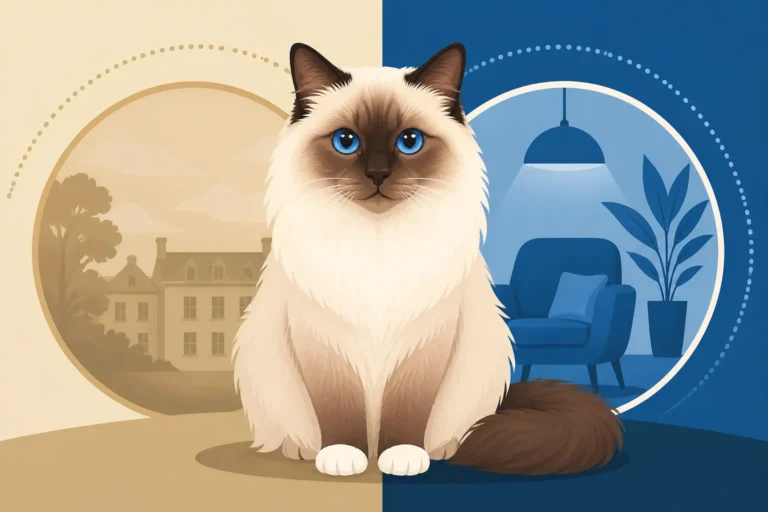
While the legend of the Temple of Lao-Tsun is undeniably beautiful and forms an integral part of the Birman's mystique, it’s important for any prospective owner to understand that it is, indeed, a legend. Cat historians and geneticists agree that the Birman likely originated in Europe, with its distinctive features resulting from deliberate breeding programs, rather than a spontaneous divine intervention in Burma. The narrative was most likely created in France to provide a romantic and exotic backstory for the breed as it was being developed and introduced to the Western world.
This doesn't diminish the Birman's special qualities in the slightest! Instead, it highlights how deeply humans connect with animals and seek to imbue them with meaningful stories. The true origins, though less mystical, are still a testament to dedicated breeders who painstakingly selected for the specific traits that make the Birman so beloved today. It speaks to a human desire for a beautiful, noble companion, and the legend simply serves to enhance that perception. The Birman’s serene disposition and striking appearance certainly lend themselves well to such a magical tale.
From Legend to European Shores: The Birman's Journey West
Even if the legend of the sacred temples is more myth than history, the Birman’s arrival in Europe marks the true beginning of its recorded story. It was in the early 20th century that these stunning felines truly began their journey into the hearts and homes of cat lovers, starting in the sophisticated salons of France. The path from potential Burmese temple cat to recognized European pedigree was not without its challenges, shaping the breed’s very survival.
The First Recorded Birmans Arrive in France
The prevailing historical account suggests that the first Birmans were brought to France around 1919, though the exact details remain a bit fuzzy and steeped in stories that are hard to verify completely. One popular theory tells of a pair of Birmans being smuggled out of Burma by a wealthy industrialist, possibly a Major Gordon Russell or an American millionaire named Vanderbilt, who was involved in the rubber trade in Southeast Asia. The tale goes that the cats were a gift from Burmese priests in gratitude for his assistance. Sadly, the male cat, named Madalpour, reportedly died during the arduous sea voyage, but the female, named Sita, arrived pregnant in Nice, France.
Sita then gave birth to a litter, and from this litter, one female kitten named Poupée de Madalpour is widely regarded as a foundational cat for the breed in Europe. This marks the earliest credible point where the Birman began its documented existence outside of its supposed homeland. These cats immediately captivated the attention of French fanciers with their striking colorpoint patterns, silky coats, and those distinctive white paws. Their unique appearance quickly set them apart from other breeds then known in Europe.
Early Breeding Efforts and the Formal Recognition
With the arrival of Poupée de Madalpour and her descendants, dedicated French breeders began the meticulous work of establishing the Birman as a distinct breed. This was a slow and careful process, involving selective breeding to solidify the desired characteristics: the deep blue eyes, the colorpoint body, the long, silky hair, and, crucially, the perfectly symmetrical white "gloves" on all four feet. The breeders were striving to create a cat that consistently displayed these beautiful traits across generations.
Their efforts paid off relatively quickly. By 1925, just a few years after their supposed arrival, the Birman was officially recognized in France by the Fédération Féline Française, under the name "Sacre de Birmanie." This recognition was a significant milestone, giving the breed a formal identity and a standard to breed towards. It meant that the Birman was no longer just an exotic curiosity but a legitimate pedigree cat, laying the groundwork for its eventual popularity across the globe.
The Devastation of War and the Near Loss of the Breed
Just as the Birman was beginning to establish its foothold in the cat fancy, disaster struck in the form of World War II. The war years were incredibly harsh on all pedigree breeds in Europe, and the Birman was no exception. With resources scarce, travel restricted, and a general focus on survival, maintaining cat breeding programs became an impossible luxury for most. Many catteries were disbanded, and breeding stock was lost or died due to lack of care or food.
The Birman population plummeted dramatically. It’s a sobering thought, but by the end of the war, the breed was on the brink of extinction. It's believed that only a tiny handful of Birmans, perhaps just two known individuals, survived the conflict in France. This catastrophic loss meant that the meticulous work of the pre-war breeders was almost completely undone. The future of the Birman hung by a thread, and it would take immense dedication and strategic breeding to pull it back from the brink. The Birman Was Rebuilt From Two Cats and It Shows delves into the incredible story of this narrow escape from oblivion.
Rebuilding a Legacy: The Post-War Revival of the Birman
The aftermath of World War II presented a dire situation for many cat breeds, but for the Birman, it was truly a crisis. With only a precious few cats remaining, the task of rebuilding the breed from what amounted to a genetic bottleneck was monumental. It required courage, foresight, and a willingness to make difficult decisions that would ultimately define the modern Birman we cherish today.
The Critical Role of Orloff and Xenia de Kaabaa
In the immediate post-war period, the Birman breed was salvaged by an incredibly narrow margin. Historians point to two specific cats, a pair named Orloff and Xenia de Kaabaa, as the absolute linchpins of the breed's survival. These two individuals became the foundation of virtually every Birman alive today. Imagine, the entire genetic future of a beloved breed resting on just two sets of paws! This fact underscores the fragility of pedigree breeding, especially during times of global upheaval.
The breeders who owned these cats faced an immense challenge. They had to ensure the survival of the bloodline while simultaneously trying to expand the gene pool enough to avoid the serious health issues that come with extreme inbreeding. It was a delicate balance, and their tireless efforts, against all odds, are what allowed the Birman to escape extinction. Without their dedication, the gentle Birman would simply not exist today. It's a testament to the passion of cat fanciers to preserve these unique companions.
The Necessity of Outcrossing: Introducing New Bloodlines
With such a severely limited gene pool, simply breeding Orloff and Xenia de Kaabaa and their direct descendants together repeatedly would have led to a host of genetic problems and a lack of vitality in the breed. To introduce much-needed genetic diversity and to ensure the Birman's health and vigor, breeders made the courageous and necessary decision to "outcross." This meant carefully introducing other breeds into the Birman lines.
The primary breeds used for outcrossing were the Persian and the Siamese. The Persian, with its long, luxurious coat and sturdy build, contributed to the Birman's beautiful fur and gentle temperament. The Siamese, on the other hand, brought the distinct colorpoint pattern and a sleek elegance, though breeders meticulously worked to temper the Siamese's more vocal traits. These outcrossings were carefully managed and often involved breeding back to a "pure" Birman after a generation or two to re-establish the core Birman characteristics. Why Post War Outcrossing Was Unavoidable for the Birman explains the critical reasons behind this decision. This strategic infusion of new blood ensured the breed's long-term health and helped solidify its unique appearance.
Establishing the Modern Birman Gene Pool
The process of outcrossing and then carefully breeding back was not quick. It took several generations and many years of dedicated work to stabilize the Birman breed again and establish a robust, modern gene pool that consistently produced cats true to the emerging breed standard. This painstaking effort ensured that the Birman retained its defining traits—the striking blue eyes, the colorpoint pattern, the semi-long silky coat, and those distinctive white gloves—while gaining genetic strength.
By the 1950s and 60s, the Birman had successfully navigated its post-war recovery and began to spread from France to other parts of Europe, including Great Britain and Germany. Later, it made its way across the Atlantic to North America, where it quickly gained recognition from major cat registries like the CFA (Cat Fanciers' Association) and TICA (The International Cat Association). The fact that nearly every Birman alive today can trace its lineage back to those few post-war survivors, coupled with the careful outcrossing, makes its survival and flourishing a truly remarkable story in the history of pedigree cats. Which Two Cats Every Birman Descends From provides even more detail on this incredible genetic bottleneck.
The Hallmarks of a Birman: Understanding the Breed Standard
Once a breed is established, its defining characteristics are enshrined in a "breed standard" – a detailed description that outlines the ideal physical traits and temperament. For the Birman, this standard captures everything from the tips of its ears to the unique white "gloves" on its paws, ensuring consistency and preserving the beauty of the breed. Understanding these hallmarks helps enthusiasts and prospective owners appreciate the Birman's distinct charm.
The Distinctive Gloving and Lacing: A Genetic Marvel
Without a doubt, the most striking and defining feature of the Birman is its pristine white "gloves" on all four paws, famously left untouched by the colorpoint gene. This isn't just any white marking; it's a specific pattern that is incredibly difficult to achieve perfectly through breeding, yet it is absolutely essential to the Birman standard. On the front paws, these gloves should ideally be symmetrical and end cleanly at the metacarpal-phalangeal joint (where the toes meet the foot), resembling perfectly dipped white socks.
On the hind feet, the white extends further up the back of the leg, forming what are known as "laces" or "gauntlets." These laces should ideally terminate in a precise inverted "V" shape, stopping just below the hock joint, and should also be symmetrical. Any mismarkings, such as splashes of color within the white, unevenness, or gloves that extend too high or too low, are considered faults in the show ring. It's these demanding standards for the gloving that make breeding a show-quality Birman a true art form. What Judges Look For on a Birman's Paws First offers a deeper dive into these intricate details. The presence of these gloves, combined with the point coloration, is truly a genetic marvel and a hallmark unique to the Birman. The Gloving Gene Every Birman Carries Two Copies Of further explores the genetics behind this fascinating trait.
The Mesmerizing Blue Eyes and Roman Nose
Beyond the gloves, a Birman's face holds its own captivating features. Their eyes are invariably a brilliant, deep sapphire blue, an intense hue that contrasts beautifully with their colorpoint facial mask. The shape is typically round, or slightly oval, expressive and wide-set, conveying a gentle and intelligent look. Any other eye color, even traces of green or yellow, is considered a fault in the breed standard. This specific blue eye color is directly linked to the gene responsible for the colorpoint pattern, making it an intrinsic part of the Birman's allure.
Another distinctive facial feature is the Birman's "Roman nose." In profile, the nose should have a slight, gentle dip, creating a distinctive convex curve, rather than being completely straight or having a pronounced break (as seen in some Persian lines). This gives the Birman a noble and classical appearance. The chin should be firm and well-developed, aligning with the nose and forehead to create a balanced facial profile. These facial characteristics, combined with the deep blue eyes, contribute significantly to the Birman's unique expression of serene wisdom.
Coat Texture, Body Type, and Point Colors
The Birman boasts a medium-long, silky coat that is surprisingly easy to maintain due to its single coat nature – it lacks a dense undercoat, which means it rarely mats. The fur is soft to the touch, flowing and luxurious, forming a beautiful ruff around the neck, a bushy tail, and "britches" on the hind legs. This lack of an undercoat distinguishes it from many other long-haired breeds, making grooming a much less demanding task. A good brush from Chewy once or twice a week is usually all it takes to keep it looking pristine.
In terms of body type, the Birman is a sturdy, moderately cobby cat, neither extreme in length nor stockiness. They possess a long, rectangular body, substantial bone structure, and strong, well-muscled legs. Males are generally larger and more robust than females, often taking up to three years to fully mature and fill out. Their overall impression is one of elegance combined with power and substance.
Finally, the Birman comes in a delightful array of point colors. The "points" refer to the cooler extremities of the body – face mask, ears, legs, and tail – where the color is expressed. Common colors include the classic Seal Point (dark brown), Blue Point (slate grey), Chocolate Point (warm brown), and Lilac Point (pale grey/pinkish). Rarer variations include Red Point, Cream Point, and various Tortie and Tabby Points. All Birmans are born pure white, with their point colors gradually developing as they mature and respond to cooler temperatures. This progression from white kitten to fully pointed adult is a fascinating aspect of their development.
Birman vs. Lookalikes: Key Distinctions and Comparisons
With their striking colorpoint patterns and long, flowing coats, Birmans are sometimes confused with other breeds. However, once you know what to look for, their unique characteristics make them stand out. Understanding these distinctions is crucial for anyone considering a Birman, ensuring they bring home the cat that truly matches their expectations.
How to Tell a Birman From a Ragdoll by Its Feet
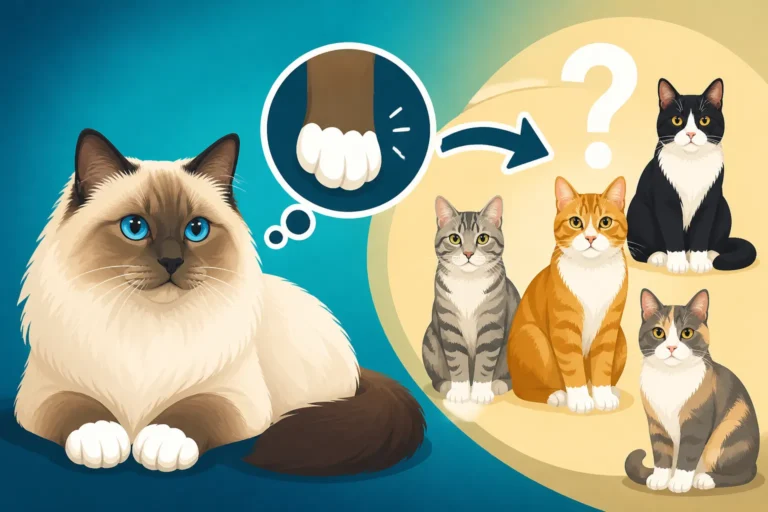
Perhaps the most common confusion arises between the Birman and the Ragdoll, both beloved long-haired, blue-eyed, colorpoint breeds known for their gentle dispositions. While they share many superficial similarities, the most definitive distinguishing feature lies in their paws – specifically, the white markings. This is often the first thing experienced fanciers look for.
A Birman always has distinct white "gloves" on all four paws, with "laces" extending up the back of the hind legs. These gloves are a core genetic trait and a non-negotiable part of the breed standard. They are always a pure, pristine white, clearly demarcated from the point color above. A Ragdoll, on the other hand, typically does not have these distinct gloves. While some Ragdoll patterns, particularly the mitted variety, will have white paws, these markings are generally less precise, often extending higher up the leg or being less uniformly defined than a Birman's gloves. Furthermore, Ragdolls come in several patterns (colorpoint, mitted, bicolor) where white is often more expansive on the face or belly, which is not characteristic of the Birman. The Birman's white is exclusively confined to the paws in that very specific "gloved" pattern. How to Tell a Birman From a Ragdoll by Its Feet offers detailed visual guidance to help you spot the difference with confidence.
Distinguishing a Birman from a Himalayan or Snowshoe
Other breeds also sport colorpoint patterns, leading to occasional mix-ups. The Himalayan, for instance, is essentially a Persian cat with the Siamese colorpoint gene. While it shares the blue eyes and point coloration with the Birman, the Himalayan's overall body structure is distinctly Persian: a much more cobby body, shorter legs, a massively dense double coat, and most notably, a very flat, "peke-faced" profile. The Birman, in contrast, has a longer, more rectangular body, a semi-long single coat (without the dense undercoat of a Persian), and that distinct Roman nose profile. The Himalayan also lacks the Birman's characteristic white gloves entirely.
The Snowshoe is another colorpoint breed, often with white markings, but again, its distinguishing features are clear. Snowshoes are typically shorthaired, or have a very short, dense coat, which immediately sets them apart from the long-haired Birman. While they do have white feet, these markings are usually more irregular and extensive, often covering more of the leg than a Birman's precise gloves and laces. Snowshoes also often have white facial markings, which are not found in the Birman breed standard. Their body type tends to be more svelte and athletic compared to the Birman's moderate, sturdy build. These key differences make it clear that while they might share a colorpoint gene, the overall presentation of a Birman is truly unique.
The Differences Between a Birman and a Burmese
Less common, but still possible, is confusion with a Burmese cat. This might seem surprising given their vastly different appearances, but the shared "Burma" in their names can sometimes lead to misunderstandings, especially if someone is only vaguely familiar with cat breeds. However, the two breeds are distinct in almost every way.
The Burmese is a sleek, shorthaired cat with a compact, muscular body. Their coat is fine and glossy, lying close to the body, and they are typically solid-colored, though sometimes they display a "pointed" gene in very subtle ways (leading to colors like sable, champagne, blue, and platinum). Crucially, their eye color is usually gold or green, never the deep blue found in Birmans. They are also known for being very active, playful, and vocal, often quite demanding of attention. The Birman, by contrast, has a semi-long, silky coat, the defining white gloves, piercing blue eyes, and a far more placid, quiet demeanor. They are physically larger and longer-bodied than a Burmese. Genetically, historically, and temperamentally, the Birman and Burmese are entirely separate breeds, sharing only a historical geographical association in name.
Living with a Birman: Who This Gentle Giant Truly Suits
The Birman's beauty is undeniable, but their true appeal often lies in their temperament. This isn't a breed for just anyone; it's a cat that thrives in specific environments and with owners who appreciate its unique personality. Understanding their nature is key to providing a happy home and ensuring a fulfilling relationship.
The Birman's Temperament: Affectionate, Calm, and Undemanding
If you're looking for a cat that will greet you at the door, follow you from room to room, and settle quietly by your side without being overtly demanding, then a Birman might just be your perfect match. They are renowned for their incredibly affectionate and gentle nature. Unlike some more boisterous or vocal breeds, the Birman is generally quite placid and possesses a soft, trilling voice rather than a loud meow. They communicate their needs subtly, often with a soft nudge or by simply sitting nearby, waiting for an invitation for attention.
This isn't to say they aren't playful; Birmans enjoy a good play session, especially with wand toys or crinkle balls, but their play tends to be less frenetic and more graceful. They are intelligent and curious but rarely destructive, preferring to observe the world around them from a comfortable perch rather than climbing to the highest shelves. They seek companionship and presence more than constant interaction, making them wonderful companions for those who appreciate a calm, steady presence in their home. Why a Birman Follows You Without Demanding Anything perfectly captures this unique aspect of their personality.
Compatibility with Children, Other Pets, and Apartment Living
One of the Birman's standout traits is its remarkable adaptability and tolerance, making it an excellent choice for a variety of households. They are famously good with children, displaying patience and a gentle disposition even with enthusiastic toddlers. Instead of reacting with a swipe or a hiss when over-handled, a Birman is far more likely to simply walk away, making them a safer bet for families with young ones learning how to interact with pets. This calm demeanor extends to other animals as well. Birmans often get along famously with cat-friendly dogs and other cats, frequently seeking out companionship from their furry housemates. They prefer company to solitude, so having another pet around can actually be a huge benefit for a Birman, especially if you have a busy household.
Their moderate energy levels and relatively low climbing drive make them ideal apartment dwellers. While they appreciate vertical space, they don't have the same intense need to scale everything to the ceiling that some other breeds do. A comfortable cat tree or a window perch provides ample satisfaction. Their indoor-only lifestyle is also safer for their pristine white gloves, which can easily become stained or dirty outdoors. The fact that they are so well-suited to diverse living situations is one of the many reasons Why a Birman Is the Cat Families Are Told to Get.
Why a Birman Needs Company More Than Stimulation
It's a common misconception that all cats need constant high-energy play or elaborate environmental enrichment to be happy. While Birmans do appreciate toys and some mental stimulation, their primary need is for companionship. They are deeply bonded to their human families and thrive on being part of the household activities. A Birman would much rather curl up on the sofa while you read, or follow you into the kitchen as you cook, than be left alone in a room full of untouched toys.
If you work long hours or travel frequently, a Birman might experience loneliness. They are not a breed that does well being left entirely alone for extended periods. This is where the concept of "two Birmans are better than one" often comes into play, or ensuring they have a compatible animal companion. Their preference for company over intense physical or mental stimulation means that while puzzle feeders are fine, they won't replace human interaction or the presence of another living being. Why a Birman Needs Company More Than Stimulation highlights this crucial aspect of their well-being. Ensuring your Birman has a consistent, loving presence is the most important ingredient for their happiness.
Genetic Foundations: What Every Birman Owner Should Know
Understanding the genetic underpinnings of the Birman breed is fascinating and incredibly important for responsible ownership and breeding. While the breed's post-war history created a strong foundation, specific genes continue to define their appearance and also carry implications for their health. Knowing these details helps owners appreciate their cat's unique traits and make informed decisions about their care.
The Fixed Gloving Gene: A Defining Trait
The Birman's famous white "gloves" are not just a random marking; they are the result of a specific genetic mutation. This unique trait is caused by a recessive gene, sometimes referred to as the "Birman gloving gene" or the KIT gene variant. What's truly remarkable about the Birman is that this gene is "fixed" within the breed. This means that every single Birman carries two copies of this specific gene variant (they are homozygous for it). It's why you won't find a purebred Birman without gloves, and it's also why breeding two Birmans together will always result in kittens with gloves, even if the individual expression of those gloves varies in perfection.
This genetic consistency is a testament to the rigorous breeding efforts after World War II to re-establish the breed's defining characteristics. While the presence of the gloves is genetically guaranteed, the quality and symmetry of the gloves (how clean, even, and well-defined they are) are influenced by a complex interplay of other "modifier" genes. This is why even within a litter from well-gloved parents, you might see variations in the perfection of the white markings, ranging from show-quality to pet-quality markings. The consistency of the primary gloving gene, however, is what makes the Birman immediately recognizable.
Understanding Point Color Genetics
Beyond the gloves, the Birman is a "colorpoint" cat, meaning its body color is restricted to the cooler extremities: the face mask, ears, legs, and tail. This distinctive pattern is due to a form of temperature-sensitive albinism, controlled by the Siamese (cs/cs) allele on the TYR gene. The gene produces an enzyme that is active only at cooler body temperatures, allowing pigment to develop in those cooler areas, while the warmer parts of the body (the torso) remain a lighter cream or ivory. This is why all Birman kittens are born pure white – they were uniformly warm in their mother's womb – and their points gradually darken as they are exposed to the cooler ambient air.
The specific color of the points (seal, blue, chocolate, lilac, red, cream, tortie, tabby) is determined by other genes that control basic coat color and pattern. For example, a Birman with a black base coat gene, modified by the colorpoint gene, will develop Seal Points. If that same base coat gene is diluted, you get Blue Points. This genetic dance creates the stunning array of colors we see in Birmans today. It also explains why an older Birman or one living in a cooler climate might have darker, more expansive points than a younger cat or one in a warmer environment – the enzyme has simply had more time or more opportunity to produce pigment. How a Birman Kitten's Points Come In illustrates this fascinating process from birth to maturity.
Health Considerations Inherited from the Breed's History
While Birmans are generally a healthy and robust breed, their unique genetic history and the small founder population after WWII do mean there are some health considerations that prospective owners and breeders should be aware of. The limited gene pool meant that any genetic predispositions present in the founding cats or introduced through the early outcrosses could become more prevalent in the breed.
One such concern is hypertrophic cardiomyopathy (HCM), a common heart condition in many purebred cats, where the heart muscle thickens. While Birmans are not considered as high-risk as some other breeds, responsible breeders will regularly screen their breeding cats with echocardiograms (heart ultrasounds) to ensure they are clear of HCM before breeding. Another condition of note is Polycystic Kidney Disease (PKD), which likely entered the Birman gene pool through the Persian outcrosses. Thankfully, a DNA test is available for PKD1, and most reputable Birman breeders now test their breeding stock to ensure they are clear of this condition. Why a Birman Breeder Still Tests for PKD explains the importance of this screening.
Blood type compatibility is also a consideration for Birman breeders. Like some other breeds, Birmans can carry different blood types (A, B, or AB). If a Type B queen is mated to a Type A tom, it can lead to neonatal isoerythrolysis, a potentially fatal condition for kittens. Responsible breeders test their cats' blood types to prevent such dangerous matings. While these sound like serious concerns, the good news is that reputable Birman breeders are proactive about health testing, ensuring that they are breeding healthy, genetically sound cats. By choosing a breeder who transparently shares health clearances and takes these genetic considerations seriously, you significantly increase the chances of bringing home a healthy and long-lived Birman companion.
Disclaimer
This article is for general informational purposes only and does not constitute professional advice. Laws, prices and regulations vary by location and change over time. Consult a qualified professional for guidance on your specific situation.