Who Auguste Pavie Was Said to Be
The Birman cat's origins are often shrouded in captivating tales of ancient temples and exotic lands, leading many to wonder about the figures involved in bringing this beautiful breed to the Western world. Among these figures, one name frequently appears: Auguste Pavie. But who exactly was Auguste Pavie, and what is his true connection to the Birman cat? This guide will explore the legendary narratives and historical facts surrounding his supposed involvement and the breed's journey to Europe.
Unraveling the Myth of Auguste Pavie and the Birman
The story of the Birman cat's introduction to the Western world is steeped in legend, often placing its origins in the golden temples of Burma, guarded by priests. Within these captivating tales, a specific individual, Auguste Pavie, frequently emerges as a key player in the cat's journey to Europe. For many years, breeders and enthusiasts would recount how Pavie, a French diplomat and explorer, was responsible for bringing the very first Birmans out of Burma, essentially gifting them to the Western world. This version of events paints a vivid picture of adventure and exotic discovery, appealing to the mystique that surrounds such a beautiful and unique breed.
The Sacred Cat of Burma Legend's Entourage
The most famous legend associated with the Birman is that of the Temple of Lao-Tsun. It tells of a blue-eyed goddess, Tsun-Kyan-Kse, and a revered priest, Mun-Ha, who was protected by a magnificent white cat named Sinh with golden eyes. When the temple was attacked, Sinh transformed, inheriting the priest's sapphire eyes, a golden coat, and four white paws, signifying purity. This transformation is said to be the origin of the Birman's distinctive appearance. While captivating, these stories are largely regarded as romanticized fictions, likely created in France to enhance the breed's allure and exotic appeal when it was first being established. The "Sacred Cat of Burma" designation itself lends an air of ancient, mystical heritage that breeders often love to share.
However, the legend isn't just about the temple and the goddess; it often includes a human element, a Westerner who somehow facilitated the breed's transition from sacred guardians to household companions. This is where Auguste Pavie steps in, or rather, is said to have stepped in. He becomes part of the heroic narrative, a discoverer who braved the exotic lands to bring these treasures back. It's a classic trope in the history of many animal breeds, where a captivating origin story, even if partially fictional, adds to the breed's mystique and marketability. Understanding that this is largely a romantic overlay helps us approach the historical records with a clearer perspective.
Pavie's Role in the Birman's Narrative
In the popular Birman lore, Auguste Pavie is often depicted as a central figure, sometimes receiving a pair of Birman cats as a gift from monks grateful for his intervention during a temple raid. The story goes that he then arranged for their transport to France, thus beginning the breed's European journey. This narrative positions him as the direct conduit, the adventurous diplomat who bridged two worlds, bringing an ancient treasure to modern civilization. This kind of story, passed down through generations of cat fanciers, imbues the breed with a sense of importance and a dramatic history.
However, historical records regarding Auguste Pavie himself tell a slightly different, though equally impressive, story. Auguste Pavie was indeed a renowned French diplomat, explorer, and colonial administrator, largely active in Indochina during the late 19th and early 20th centuries. He played a significant role in establishing French influence in Laos and Cambodia, and his expeditions were instrumental in mapping vast regions. He was known for his extensive travels, his diplomatic skills, and his fascination with the cultures of Southeast Asia. His life was certainly one of adventure and discovery, making him a plausible, if unverified, candidate for such a romanticized cat origin story.
The critical distinction is that while Pavie was active in the region often cited in the Birman legends (Southeast Asia, specifically Indochina which borders Burma), there is no concrete historical documentation directly linking him to the acquisition or transport of cats specifically identifiable as Birmans to France. Many researchers and breed historians point out that the tales connecting Pavie directly to the cats appeared much later, often in breed literature, rather than in his own extensive journals or contemporary reports. This suggests that his name was likely borrowed from a well-known figure of the era to lend credibility and a compelling narrative to the Birman's origins. It’s a bit like giving a new car a cool, legendary backstory to boost its appeal; it doesn't have to be entirely true to be effective in capturing the imagination.
The Historical Journey of the Birman to the West
While the Auguste Pavie narrative is largely considered a romantic embellishment, the Birman cat did indeed make its way to Europe, though the exact circumstances remain somewhat shrouded in the mists of time and early 20th-century cat fancy records. The true story, while perhaps less dramatic than temple raids and diplomatic gifts, is no less fascinating and reveals the challenging path many exotic breeds faced in establishing themselves in a new continent. It's a testament to the perseverance of early breeders and the undeniable charm of these beautiful cats that they survived and thrived.
The Murky Origins and Early European Accounts
The earliest verifiable records of what we now recognize as Birmans arriving in Europe are from France in the early 1920s. While some sources vaguely refer to a pair arriving in Nice around 1919, with one male supposedly dying on the voyage, concrete details are scarce. What is clear is that a breeding pair, often identified as a female named Sita and a male, did arrive and form the initial foundation of the breed in Europe. Which Two Cats Every Birman Descends From delves into the specific foundation cats. These early arrivals were critical, but their immediate origins—who exactly sent them, from where, and why—are not as neatly documented as one might hope.
It's important to remember that during this period, formal breed registries and detailed import records for domestic animals were not as stringent or centralized as they are today. Many cats arrived from foreign lands without extensive documentation of their precise lineage or the exact circumstances of their journey. This lack of rigorous record-keeping created fertile ground for legends to sprout and fill in the gaps. The appeal of a mysterious, exotic origin was undoubtedly strong, particularly for a breed with such a distinctive and almost "designed" appearance with its white "gloves" and "laces." Early European accounts often relied on anecdotal evidence and word-of-mouth, which naturally leads to a blurring of fact and fiction over time.
The First Documented Pair: A Glimmer of Truth
Despite the initial ambiguity, a pivotal moment in the Birman's history occurred when a cat named Poupee de Madalpour emerged as a foundational queen. Who Poupee de Madalpour Was is a name that appears consistently in early Birman pedigrees and is often linked to the first successful breeding efforts in France. While the initial male cat that was said to arrive with Sita tragically died, another male, named Ghandi de Madalpour, is frequently cited as being part of the early breeding program, likely sired by the original imported male before his demise. These early individuals, regardless of their precise journey to Europe, are the undeniable ancestors of virtually every Birman cat alive today.
The breeding programs that began in France aimed to stabilize the breed's unique features, particularly the stunning blue eyes, color points, and, most notably, the white "gloves" and "laces" on their paws. This was no small feat, as establishing a consistent phenotype from a limited gene pool requires careful selection and often, as was the case for the Birman, a degree of outcrossing. The Birman Was Rebuilt From Two Cats and It Shows highlights the challenges faced by these pioneering breeders. The existence of these documented foundation cats, even if their import story is somewhat vague, provides a more tangible starting point for the breed's history than the purely legendary accounts.
Breeders quickly realized the challenges in maintaining these unique traits and began working to standardize them. The distinct pattern of the Birman, with its contrasting points and crisp white paws, was unlike anything else seen in Europe at the time, making it an immediate sensation among cat fanciers. The novelty and beauty of the breed ensured its survival and growing popularity, despite the scarcity of initial breeding stock and the setbacks that would come with global conflicts. These early efforts laid the groundwork for the Birman we know and love today, far more concretely than any legendary tale. You can find quality Birman-specific food and toys at retailers like Chewy.
Understanding the Birman's Early European Development
Once the Birman cats, or what would become the Birman breed, were on European soil, primarily in France, the real work of establishing and standardizing the breed began. This phase of their history is less about ancient legends and more about the dedicated efforts of early cat fanciers who painstakingly developed the characteristics we associate with the Birman today. It was a period of careful breeding, meticulous record-keeping (where possible), and the gradual shaping of a unique feline identity.
Establishing the Breed in France
France holds the distinction of being the birthplace of the modern Birman breed, as we recognize it. It was here, in the early 1920s, that dedicated enthusiasts began to consistently breed these cats, focusing on standardizing their appearance and temperament. The breed was officially recognized in France in 1925 under the name "Sacré de Birmanie," or Sacred Birman. This official recognition was a crucial step, moving the cat from an exotic curiosity to a recognized and celebrated pedigree breed. It meant that a standard was established, and breeders could work towards a common goal.
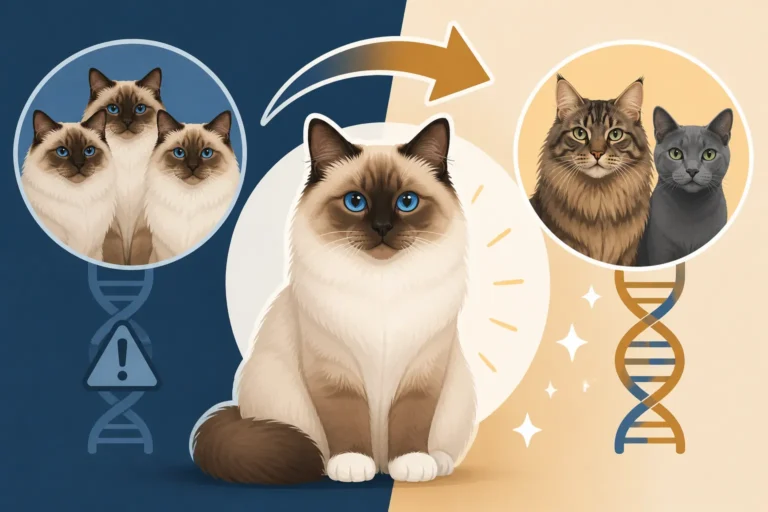
The initial gene pool was extremely limited, making the task of establishing the breed quite challenging. Breeders likely faced issues with genetic diversity and consistency in traits. To overcome these hurdles, and especially to recover after the devastating impact of World War II, outcrossing to other breeds was necessary. Which Breeds Were Crossed In to Save the Birman reveals how breeds like the Persian and Siamese were instrumental in rebuilding the Birman population and diversifying its genetic makeup. These carefully managed crosses helped reinforce desired traits while slowly widening the gene pool. It's a fascinating example of how passionate breeders can literally bring a breed back from the brink.
The early French breeders developed a detailed standard, outlining the specific requirements for the Birman's physical appearance, including head shape, body type, coat texture, eye color, and of course, the signature white gloves and laces. This standard served as a blueprint for all subsequent breeding efforts, guiding selections and ensuring that the Birman retained its distinct characteristics. This meticulous approach by early breeders highlights the significant effort involved in establishing any pedigree breed, especially one with such specific and unique marking requirements. This standard has evolved over the decades but remains the core definition of the breed.
The Impact of Early Records and Registries
The formal recognition by French registries in 1925 was a landmark achievement. It meant that specific Birmans could be registered, their pedigrees tracked, and their lineage documented, even if retrospectively for some of the earlier imports. This formal framework allowed for organized breeding programs and the eventual spread of the Birman throughout Europe and beyond. Without these early efforts to record and categorize, the Birman's history would be even more fragmented and anecdotal. When France Registered the Sacre de Birmanie marks this important moment in time.
The rigorous standards and the process of official registration also brought a degree of accountability and transparency to breeding. Prospective owners could inquire about a kitten's lineage and ensure it met the breed's criteria. This contrasts sharply with the pre-registry era, where much of the information was passed informally. Modern breeders continue this tradition, often providing comprehensive records and health clearances for their kittens, which is something a resource like Chewy helps new owners stock up on essential supplies for, knowing their kitten is healthy. Which Certificates a Birman Breeder Hands Over With the Kitten outlines the crucial paperwork.
As the breed gained traction, more Birmans were bred, and their popularity grew beyond France. They spread to other European countries like Britain and Germany, and eventually across the Atlantic to North America. Each new country meant the establishment of local breed clubs and adherence to international or national registry standards, further solidifying the Birman's place in the global cat fancy. The journey from a legendary temple cat to a universally admired household companion is a testament to the dedication of those early pioneers, even if the role of figures like Auguste Pavie remains largely in the realm of enchanting myth rather than concrete history. Whether you're researching history or buying cat food, sites like Chewy have made the process easier than it once was.
Here's a small table summarizing the legendary vs. documented origins:
| Aspect | Legendary Narrative (Auguste Pavie) | Documented Historical Account |
|---|---|---|
| Origin Point | Sacred temples in Burma, received as a gift from grateful monks | Murky, likely Southeast Asia, specific locale less clear |
| Key Figure | Auguste Pavie, French diplomat/explorer | Early French breeders and fanciers |
| Arrival in Europe | Directly brought by Pavie to France | A pair arrived in France around 1919-1920, exact courier unknown |
| Purpose of Arrival | Gifted due to noble deeds | Commercial venture, exotic pet introduction, or similar |
| Verifiable Proof | No direct contemporary records from Pavie or official documents | Pedigree records starting with Poupee de Madalpour in France |
In essence, while Auguste Pavie's name adds a wonderful layer of romanticism to the Birman's origin story, his direct involvement is largely legendary. The actual history involves a more complex and less clear-cut journey from Asia to Europe, followed by the diligent work of dedicated French breeders who shaped the Birman into the beloved cat we know today. What is certain, however, is the enduring appeal of the Birman cat, regardless of the precise details of its fascinating journey from myth to reality. Keeping these facts in mind helps us appreciate the breed's genuine history alongside its enchanting folklore. New Birman owners, after confirming the legitimacy of their kitten's pedigree, often turn to reputable pet supply stores like Chewy for all their new pet's needs, from food to toys that satisfy their gentle playfulness.
Disclaimer
This article is for general informational purposes only and does not constitute professional advice. Laws, prices and regulations vary by location and change over time. Consult a qualified professional for guidance on your specific situation.