Whether Siamese Blood Is in Every Modern Birman
A Birman’s blue eyes, colorpoint coat, and white gloves can make the breed look unmistakably Siamese-related, but appearance alone cannot prove ancestry. The history is complicated by an early period with few surviving cats and later outcrossing. This guide explains what is known, what remains uncertain, and how to judge claims about Siamese blood in modern Birmans.
Why Siamese ancestry is often linked to the Birman
Similar looks do not prove a shared recent ancestor
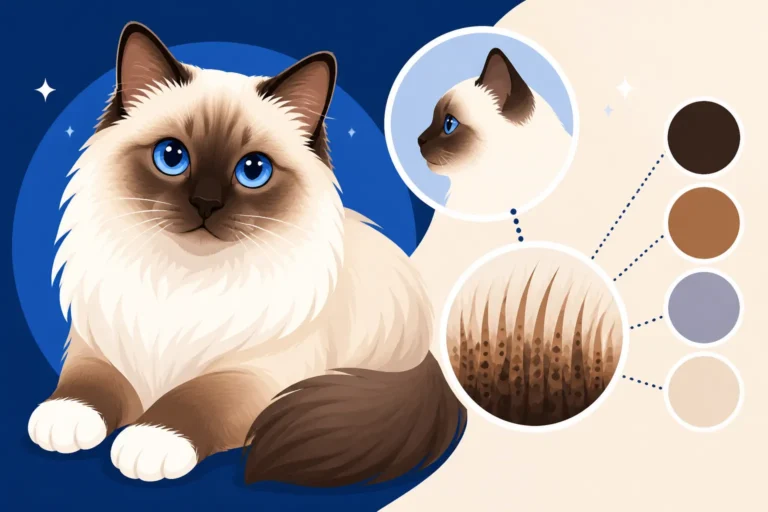
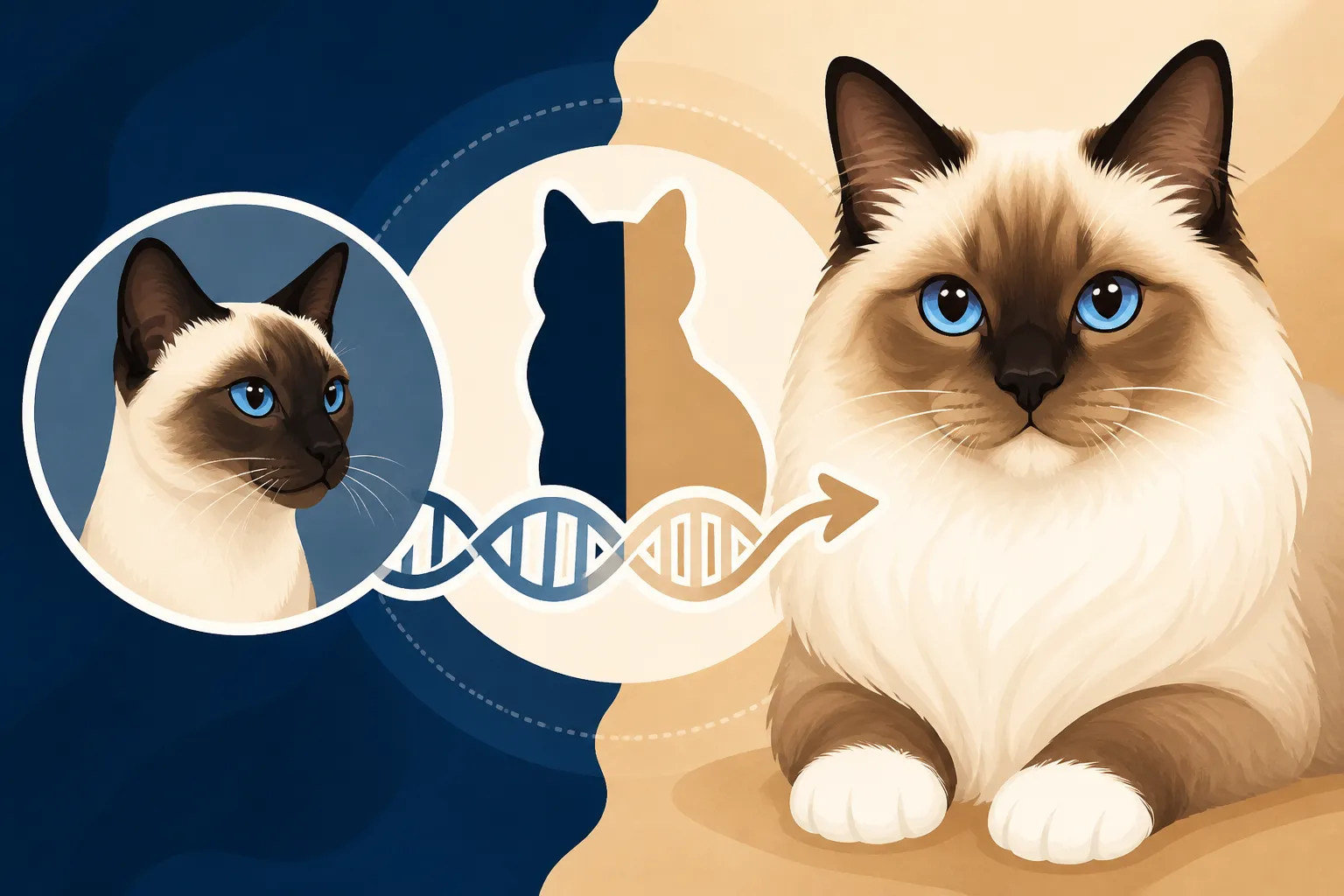
Birmans and Siamese cats share several visible traits: both have blue eyes and colorpoint coats, with darker coloring on the face, ears, legs, and tail. Those similarities make it understandable that people assume one breed came directly from the other. But a shared appearance does not establish a recent Siamese ancestor. The colorpoint pattern is a genetic trait, and it can appear in breeds with different histories.
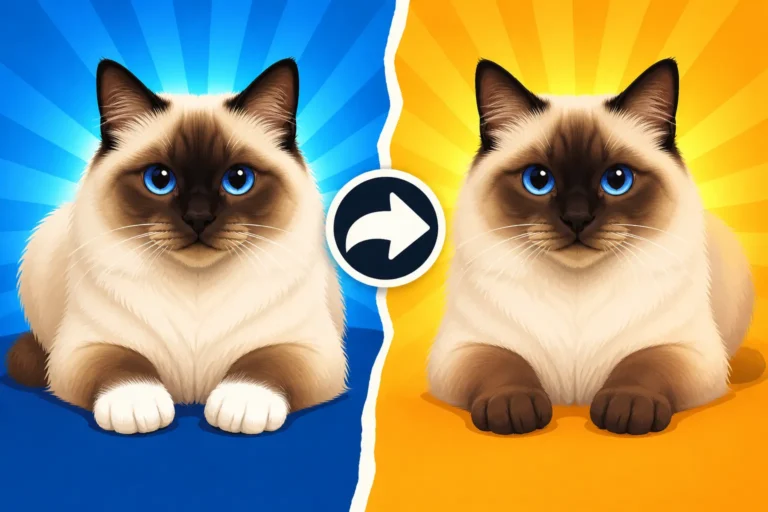
Birmans also have features that set them apart, especially their white gloves and a medium-long, silky coat. Their bodies and faces differ from the familiar modern Siamese silhouette, too. Breed appearance is shaped by multiple genes, selective breeding, and breed standards—not by a single ancestral contribution that can be read off a cat’s coat.
This distinction matters when a listing or conversation treats “Siamese-looking” as proof of Siamese ancestry. A Chewy product page, a breeder’s description, or a social media post may offer a handy breed summary, but a visual description is not a pedigree record. For a particular cat, documented ancestry is a stronger basis for an answer than resemblance.
The Birman’s origin story is not the same as documented ancestry
The Birman is often called the Sacred Cat of Burma, and its traditional origin story connects the breed with temple cats. That story is part of the breed’s cultural identity, but it should not be mistaken for a complete, verifiable family tree. The surviving historical record does not provide a continuous pedigree reaching back to a clearly established Siamese foundation.
The breed became established in Europe, especially France, in the early twentieth century. Early accounts and later retellings differ in detail, and some popular explanations describe the Birman as a Siamese-Persian cross. That phrase may seem plausible because of the shared colorpoint pattern and the Birman’s longer coat, but it oversimplifies what is known. Appearance and breed lore cannot confirm the exact parentage of early cats.
For more context, see Whether the Birman Is a Siamese and Persian Cross and What Genetics Say About the Birman's Origin. The central point is that a neat origin story is not the same thing as a documented lineage. Historical uncertainty should be acknowledged rather than filled in with confident guesses.
What happened to Birman ancestry after the Second World War
A very small surviving population led to reconstruction
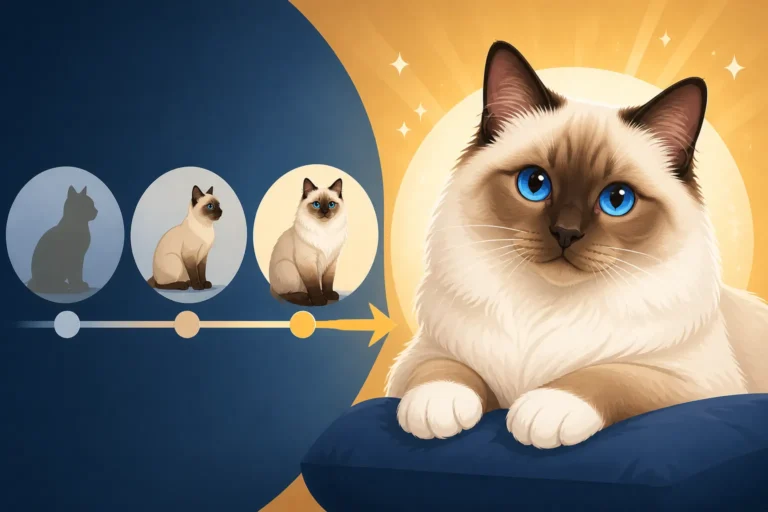
The Birman’s population was severely reduced during the Second World War. Breed histories commonly describe only a very small number of surviving cats, often naming Orloff and Xenia de Kaabaa among them. When a breed is rebuilt from so few animals, breeders have limited options: they must work with the surviving lines, and they may need to use outcrosses to restore a viable population.
That period helps explain why modern Birman ancestry is not a simple, uninterrupted line from the breed’s earliest cats. Breeders used other cats in reconstruction, and later generations were selected to regain and stabilize the Birman’s distinctive traits. The process took time. A cat might contribute to a breed’s history without every later Birman carrying that cat as a clearly traceable ancestor in a particular pedigree.
The historical account is often summarized as “two cats rebuilt the breed,” but that shorthand leaves out the wider breeding work and the role of outcrossing. The Birman Came Out of the War With Two Cats Left and Which Longhairs Rebuilt the Birman After 1945 explore that background. They help explain why claims about a single, precise ancestral recipe should be treated cautiously.
Outcrossing does not automatically mean Siamese blood is in every modern Birman
Persians are frequently mentioned in accounts of the Birman’s postwar reconstruction. Some histories also suggest Siamese or other longhaired cats may have been used, but the records and retellings are not always consistent enough to establish one universal ancestry claim. Even if Siamese cats contributed at some point in the breed’s early development or rebuilding, that does not demonstrate that every modern Birman descends from a particular Siamese ancestor.
There is an important difference between saying “Siamese cats may have contributed to the breed’s history” and saying “every modern Birman has Siamese blood.” The first is a broad historical possibility. The second is a claim about every individual pedigree, and it requires evidence across those pedigrees. A breed’s history may include outcrosses that do not appear in every present-day line, or whose contribution cannot be established from the available records.
The same care applies to Persian ancestry. A historical outcross can influence a breed without making every modern cat a straightforward cross between two named breeds. For a fuller look at this distinction, see Why Birman Breeders Had to Outcross and Whether Persian Blood Is in Every Modern Birman.
How to evaluate claims about a modern Birman
Start with the individual pedigree, not a general breed claim
If you want to know whether a specific Birman has a Siamese ancestor, ask for the cat’s pedigree and trace the documented generations as far back as the records allow. A registered pedigree can show named ancestors and breeding relationships. It cannot necessarily answer every question about distant, undocumented cats, but it is more useful than relying on a breed label or a seller’s casual description.
Ask the breeder or registry what the paperwork actually confirms. A pedigree records ancestry according to its documented entries; it does not prove that every ancestor’s full genetic background is known. If someone makes a strong claim—such as identifying a particular Siamese founder—ask what record supports it. A responsible answer may acknowledge gaps rather than pretend every historical detail is settled.
Online descriptions need the same scrutiny. A Chewy listing or another retailer’s breed information can be a starting point for general reading, but it is not a substitute for a cat’s registration papers. Nor should a product listing for a DNA test be treated as proof that the test can reconstruct a complete pedigree. Check what a test measures, what its report can and cannot establish, and whether it is designed to identify ancestry or to screen for specific inherited conditions.
| Claim | What it may mean | What it does not prove |
|---|---|---|
| Birmans and Siamese share blue eyes and colorpoint coats | They share visible traits associated with colorpoint genetics | That a particular Birman has a recent Siamese ancestor |
| Siamese cats may have been used in early breeding or reconstruction | Siamese contribution is possible in some historical accounts | That every modern Birman descends from Siamese cats |
| A pedigree lists named Birman ancestors | Those relationships are recorded in the pedigree | That every distant ancestor or outcross is fully known |
| A DNA report shows a broad genetic similarity | The test found similarities within the limits of its method | A complete, definitive breed-by-breed family tree |
Understand what DNA and breed labels can tell you
A cat’s visible traits are not a reliable ancestry test. Blue eyes and a pointed coat can reflect inherited color patterns, while white gloves are another distinctive feature of the Birman. These characteristics help identify the breed’s appearance, but they do not name the cat’s ancestors. That is why a cat that looks “part Siamese” cannot be confidently identified as having Siamese blood by sight.
DNA tests also have limits. A test may examine selected genetic markers and compare them with reference populations, but a result depends on the test’s design and the data it uses. It may offer clues about genetic similarity without tracing every ancestor or confirming a historical cross. Before relying on a result, read the explanation of the test’s scope and limitations. A retailer such as Chewy may be where someone encounters a test listing, but the test provider’s description—not the sales page—is the place to understand what the result means.
Breed standards and registry rules are useful for understanding how Birmans are classified today, but they do not settle every question about older ancestry. The modern breed is recognized through its defining traits and recorded breeding lines. Historical contributors may be difficult to identify or verify in every line. For related background, see What Genetics Say About the Birman's Origin and Whether the Birman's Gene Pool Has Widened Since.
The most accurate answer about Siamese blood
A breed-wide yes or no goes beyond the evidence
The most careful answer is that Siamese cats may have contributed to the Birman’s early development or later reconstruction, but that does not establish Siamese ancestry in every modern Birman. The available breed history includes uncertainty, and the surviving population bottleneck makes the reconstruction story more complex than a simple crossbreed label suggests.
For an individual cat, the answer depends on its documented pedigree and how far that record can be followed. Some lines may include ancestors described in historical accounts as Siamese or Siamese-related; others may not show such a connection in the available records. Even where a pedigree reaches back through registered generations, it may not resolve every question about early outcrosses.
When a description says that all Birmans are part Siamese, it is reasonable to ask what evidence supports that universal statement. If the answer is simply that Birmans have blue eyes or pointed coats, that is not enough. Shared traits are clues to inherited features, not a substitute for documented ancestry.
A practical checklist for breeders and prospective owners
If you are considering a Birman kitten or researching your own cat, keep the question specific. Are you asking about the breed’s historical development, or whether a named Siamese appears in this cat’s family tree? Those are different questions and may have different answers. Clarifying the distinction helps avoid treating a broad history as proof about an individual animal.
Use this checklist when someone makes an ancestry claim:
- Ask whether the claim is about the breed generally or a particular cat.
- Request the individual cat’s pedigree and the names of the ancestors being discussed.
- Ask whether the claim is based on registry records, historical writing, appearance, or a DNA result.
- Check what the cited evidence can actually establish.
- Treat uncertain or incomplete records as uncertainty, not as proof either way.
A breeder who cannot document a distant ancestor may still be able to describe the known history of the line accurately. Likewise, a broad breed-history summary from a retailer such as Chewy can help introduce the topic, but it should not be used to settle a pedigree question. Keeping those categories separate—history, appearance, genetic testing, and individual records—leads to the clearest answer.
Ultimately, Siamese ancestry is a plausible part of some accounts of the Birman’s past, not a fact that can be confidently assigned to every modern Birman. The breed’s history involves a small surviving population, postwar rebuilding, and incomplete early records. For an individual cat, its pedigree is the best starting point; for the breed as a whole, the honest account leaves room for what remains uncertain.
Disclaimer
This article is for general informational purposes only and does not constitute professional advice. Laws, prices and regulations vary by location and change over time. Consult a qualified professional for guidance on your specific situation.