Which Modifier Genes Affect a Birman’s Gloves
A Birman’s white gloves can look beautifully matched in one kitten and uneven in its littermate, even when both inherit the breed’s characteristic gloving pattern. The difference is not explained by one simple “perfect glove” gene. This guide separates what researchers know about the Birman’s KIT gloving variant from what remains uncertain about the modifier genes that may influence the edges and shape of its markings.
The Birman glove pattern starts with KIT
What the gloving variant does
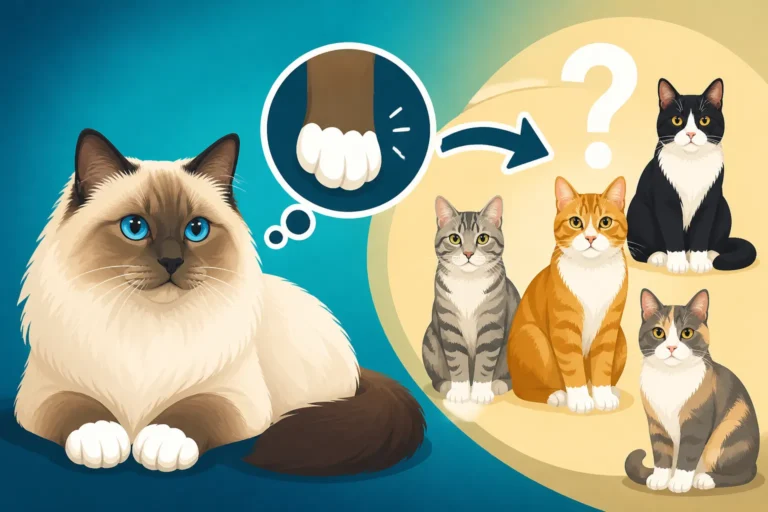
The Birman’s white feet are associated with a variant in the KIT gene. KIT is involved in the development and movement of pigment-producing cells. In Birmans, the breed-associated variant is linked to the distinctive white markings on the paws. It is not the same as simply having white feet by chance: the Birman pattern is part of the breed’s defining appearance.
A useful starting point is The Gloving Gene Every Birman Carries Two Copies Of. It explains the inherited foundation of the pattern, while Where the KIT Gloving Variant Sits in the Genome looks at the location of the known variant. The key point for this article is that a gene associated with the basic pattern does not necessarily dictate every detail of how that pattern looks.
In other words, KIT helps explain why the white gloves occur, but it does not provide a reliable blueprint for the exact height, symmetry, or outline of every marking. Two kittens can inherit the same breed-associated gloving pattern and still develop paws that differ in visible ways.
A gene for the pattern is not a gene for perfect symmetry
People often imagine that a specific “glove gene” should produce identical white markings whenever a kitten inherits it. Coat patterns rarely work that neatly. A gene can contribute to whether a feature appears without controlling every fine detail of its size or placement.
A Birman’s front gloves are judged partly on how evenly they end across the paws, while the rear markings are expected to form laces that extend up the back of the feet. Small differences in where pigment cells settle or how the white marking develops can affect the finished outline. The breed’s underlying gloving variant can be present even when the markings do not meet an ideal show standard.
That distinction helps make sense of the difference between “has Birman gloves” and “has gloves with the preferred shape.” For a practical description of the visible markings, see How a Birman's Gloves Are Scored and Where a Birman's Back Lace Should End. Neither the pattern’s presence nor its breed association guarantees show-level symmetry.
What modifier genes may change
The genetic background can influence how markings appear
A modifier gene is a gene that changes how another gene’s effect is expressed. In principle, genetic differences elsewhere in the genome could influence how the Birman gloving pattern develops. They might affect the extent, boundary, or consistency of white markings without replacing the role of KIT.
For Birman gloves, it is safest to describe modifier genes as a plausible explanation for variation rather than a list of proven, individually identified causes. The visible differences among cats suggest that more than the basic gloving variant may be involved, but a precise, widely established map of the modifier genes responsible for glove height or symmetry is not available as a simple test result.
This is why statements such as “this particular gene makes the front gloves even” should be treated cautiously unless they are backed by specific, well-supported genetic evidence. A breeder may observe that certain lines tend to produce more consistent markings, but a pattern in a family is not the same thing as identifying the responsible modifier gene.
Several influences may combine rather than act alone
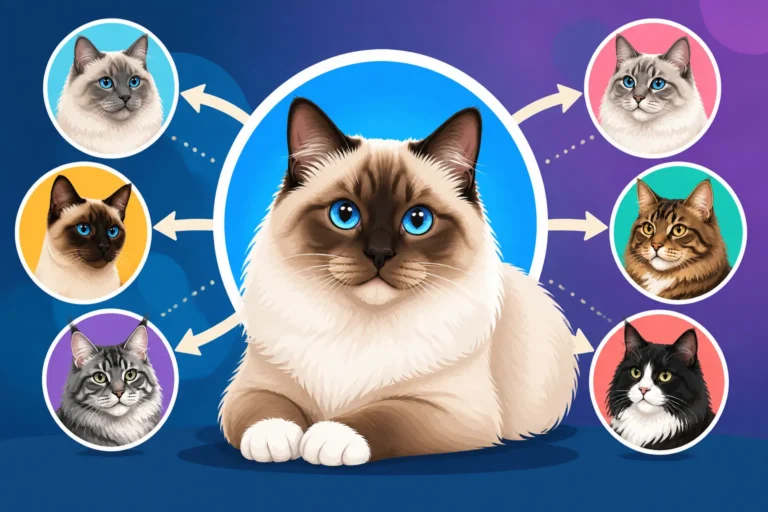
If genetic modifiers do contribute, they may work together rather than as one switch. A combination of inherited differences could influence the amount or distribution of pigment, with each factor having a small effect. That kind of complex inheritance can produce a range of outcomes within a litter.
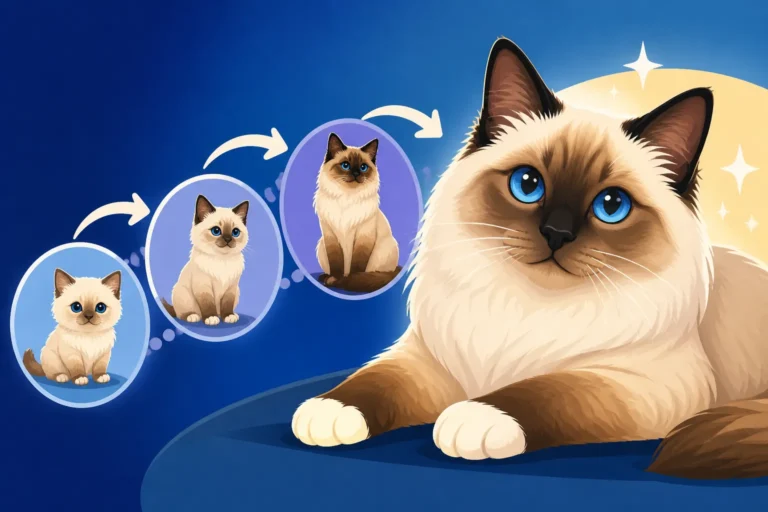
This helps explain why a kitten’s markings cannot always be predicted from a quick look at its parents’ paws. Even when both parents have attractive gloves, their kittens may not all inherit the same combination of influences. And a kitten with uneven markings does not necessarily indicate that its parents lack the Birman gloving variant.
The subject is also easy to muddle with other coat traits. Point color, such as seal, blue, or chocolate, describes color on the face, ears, legs, and tail; it does not by itself explain why a glove ends a little higher on one paw than another. For more on why visible markings vary despite the breed’s characteristic pattern, read Why Birman Gloves Vary Despite the Fixed Gene.
| Feature | What is reasonably understood | What it does not tell you |
|---|---|---|
| Birman-associated KIT variant | It is linked to the breed’s characteristic gloving pattern | It does not predict exact glove symmetry |
| Possible modifier genes | They may help explain variation in marking shape or extent | A specific, confirmed “perfect glove” modifier should not be assumed |
| Point color | It affects the colored points on the coat | It does not independently determine glove boundaries |
| A parent’s markings | They can provide clues about a family’s appearance | They cannot guarantee a kitten’s final glove grading |
| A kitten’s early markings | They offer an early impression of the pattern | They may not settle every question about its mature appearance |
What breeders can and cannot predict
Family patterns offer clues, not guarantees
Experienced breeders may notice that particular lines tend to produce certain kinds of gloves. That can be useful when making informed breeding decisions, especially when records include multiple generations and photographs of adult cats. Still, family resemblance is not proof that one known modifier gene is responsible.
A litter is a mix of inherited traits. Even full siblings can receive different combinations of genes from the same parents, which is one reason their gloves may not match. A breeder who has seen repeated outcomes across related cats may have a reasonable expectation about a line, but that expectation should not be presented as certainty.
This is also why a kitten’s parents cannot guarantee show markings. A breeder can discuss the family’s history and explain what they have observed, but even well-matched parents may produce kittens with different glove heights or laces. The topic is explored further in Whether a Birman Glove Can Be Bred to Order.
A glove test is not the same as a glove forecast
A genetic test can answer a defined question about a specific variant. It cannot automatically predict every feature that depends on several genes or on complex development. A result relating to the Birman gloving variant should therefore not be confused with a test that scores symmetry, measures the height of each glove, or forecasts a kitten’s final show potential.
When asking a breeder about testing, it is reasonable to ask what the test examines and what its result can actually establish. If someone claims a test guarantees perfectly matched gloves, ask for a clear explanation of what is being tested and how the result supports that promise. A genetic result may clarify inheritance of a known variant without resolving the broader question of modifiers.
For background on how researchers identified the known Birman variant, see How the Birman Gloving Variant Was Identified. That history is useful, but identifying the variant associated with the basic pattern is not the same as identifying every genetic influence on glove shape.
How to interpret a Birman’s gloves in everyday life
Separate breed identity from show grading
A Birman can have the characteristic white paws without having markings that meet every show preference. Those are related but different questions. Breed identity concerns the overall combination of traits and pedigree, while show grading evaluates visible details according to a standard.
That distinction matters to prospective owners. A pet Birman with a slightly uneven front glove or a shorter-than-ideal rear lace can still be a wonderful example of the breed’s gentle, distinctive look. An unusual marking is not, by itself, evidence of a health problem or of poor care.
If you are learning the visual standard, compare the markings calmly rather than trying to diagnose genetics from a single photograph. Lighting, a cat’s posture, long fur, and the angle of a paw can make a marking appear more or less even. The guide What a Birman's Front Gloves Should Look Like focuses on the visible front markings, while How a Birman's Gloves Are Scored places them in the context of judging.
Ask useful questions instead of expecting certainty
When speaking with a breeder, ask how they describe the parents’ markings, whether they keep photographs of adult cats from earlier litters, and how they distinguish a genetic test result from a visual assessment. These questions invite a concrete conversation without demanding a promise that biology cannot reliably provide.
It can also help to ask when the breeder believes a kitten’s markings are clear enough to assess and what aspects may remain difficult to predict. A responsible answer should acknowledge variation. If a breeder describes glove symmetry as guaranteed, ask what evidence supports that claim and whether the guarantee concerns appearance, genetic status, or something else entirely.
Ultimately, the best-supported explanation is straightforward: KIT is associated with the Birman’s characteristic gloving pattern, while the fine variation in glove shape may involve additional genetic influences that are not captured by a simple, settled list of modifier genes. Treat proposed modifiers with care, view breeding patterns as clues rather than proof, and enjoy the individuality of each cat’s white paws.
Disclaimer
This article is for general informational purposes only and does not constitute professional advice. Laws, prices and regulations vary by location and change over time. Consult a qualified professional for guidance on your specific situation.