Why a Birman’s Front Gloves Must End Evenly
A Birman’s front gloves are judged not only for being white, but for where the white marking stops. When one glove ends higher or at a slant compared with the other, the paws can look unbalanced, even on a healthy, beautifully cared-for cat. This guide explains the ideal front-glove shape, why symmetry matters in the breed standard, and what owners should know about kittens and coat care.
What an even front glove looks like
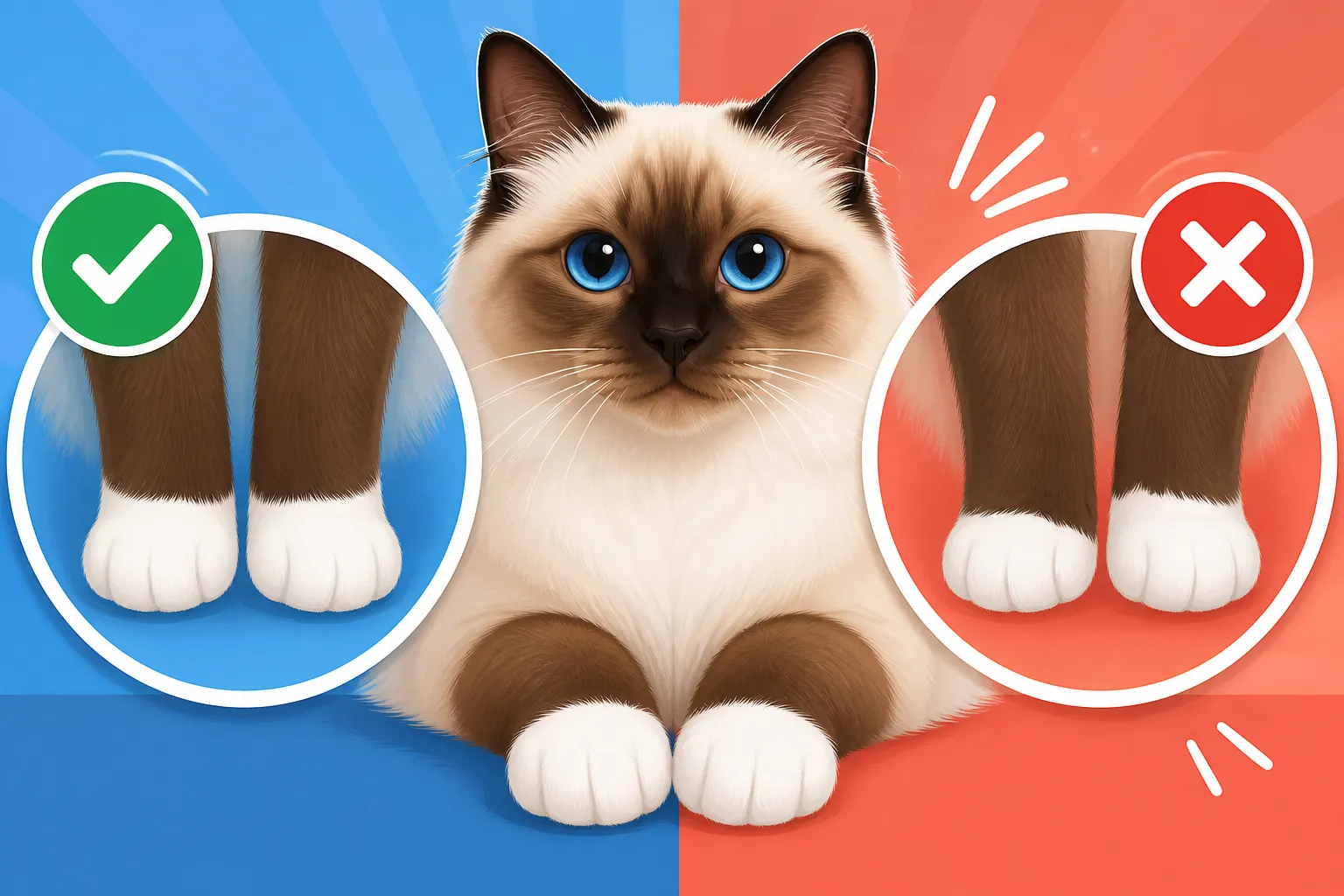
The white marking should stop at a clear, level line
A Birman’s front gloves are the white markings on its front paws. In the ideal show marking, each glove ends at the transition between the paw and the leg, creating a neat edge rather than climbing unevenly up the limb. When the two front paws are viewed together, their white markings should appear similar in height and shape.
“Even” does not mean that the left and right paws have to be mirror images down to every hair. Cats are living animals, not painted figurines, and small natural differences can occur. The important point is that neither glove should look conspicuously higher, lower, or more irregular than its partner.
The front gloves are also distinct from the white laces on the back paws. Laces extend upward along the rear of the hind legs and ideally finish in a clean point. Front gloves are shorter markings: judges look for their placement and the evenness of the line where the white ends. The standards used by different registries can vary in wording, so a breeder preparing a cat for a particular show should check the relevant registry’s standard.
Why the line affects the overall impression
A Birman’s coat has a striking contrast: colored points on the face, ears, legs, and tail, set against a pale body, with white feet. The gloves help complete that pattern. If one front marking ends noticeably higher than the other, the eye tends to notice the imbalance before it takes in the cat’s overall shape or expression.
This is why front-glove symmetry is a specific show consideration rather than a general preference for tidy paws. A cat can have a lovely temperament, excellent coat, and sound body while still having a marking that is less desirable in the show ring. Conversely, an uneven glove does not mean the cat is unwell or less affectionate. It describes a coat-pattern feature, not the cat’s health or value as a companion.
The details of the markings are part of how judges assess a Birman. For a broader look at the marking criteria, see How a Birman's Gloves Are Scored. It can also help to understand What Judges Look For on a Birman's Paws First, because the gloves are considered alongside the rest of the cat rather than in isolation.
Symmetry is judged by comparison, not by one paw alone
A single paw can look quite neat when examined by itself. The difference becomes clearer when both front legs are placed side by side, or when the cat stands naturally on a level surface. One glove may finish in a fairly straight line while the other angles upward toward the inside or outside of the leg. That difference is what creates the impression of unevenness.
Judges assess the visible marking, not an owner’s intention or the way a cat holds its feet in one particular moment. A Birman may shift its weight, tuck a paw, or sit with one leg turned slightly inward. For a fair impression, look at the markings in more than one relaxed position rather than judging from a single snapshot.
| What you notice | What it may mean for the marking |
|---|---|
| Both gloves finish at similar heights | The front markings appear balanced |
| One glove rises clearly higher | The pair may look uneven |
| One edge slopes while the other is level | The markings may lack matching shape |
| A small difference visible only on close inspection | It may be a minor variation rather than an obvious imbalance |
| White extends well up one front leg | The marking may be considered too high under the relevant standard |
Why breeders and judges care about even gloves
The standard describes a desired pattern, not a health requirement
A breed standard gives judges a shared description of the appearance sought in the show ring. It helps them compare cats consistently, including details such as coat, body, eye color, and white markings. The requirement for evenly ending front gloves is about the visual pattern: it is not a sign that an uneven-gloved Birman is unhealthy, poorly cared for, or somehow less of a Birman.
That distinction matters for pet owners. It is easy to hear that a kitten is “mismarked” and assume something is wrong. Usually, this term refers to a marking that does not meet a particular show ideal. A marking difference does not change the cat’s everyday needs, personality, or ability to enjoy family life.
Show standards also should not be confused with a guarantee that every kitten from carefully selected parents will have perfect gloves. Even experienced breeders cannot reliably choose the exact shape and height of every kitten’s markings. Why Glove Genetics Are Unpredictable in a Birman explains why the outcome can vary within a litter.
The white gloves are not simply painted on
Birman glove markings are associated with a genetic pattern, but the presence of the marking does not dictate its exact outline. The height, edge, and balance of the white areas can vary. That is why two kittens with the same parents may have noticeably different front gloves, even when both have the characteristic white feet.
Breeders can make informed choices by studying pedigrees and the markings of relatives, but they cannot promise that two cats with attractive gloves will produce kittens whose gloves match perfectly. The breed’s distinctive pattern is influenced by more than an owner’s visual impression of the parents. How the Gloving Gene Works in a Birman offers more background on the genetics, while Which Modifier Genes Affect a Birman's Gloves looks at why the visible result can differ.
For a kitten buyer, this is a good reason to ask clear questions rather than focus only on photographs or a claim that a kitten will be show quality. A responsible breeder should be able to explain what they can and cannot predict, and what they mean when describing a kitten’s markings. You can also read What Counts as a Mismarked Birman for a useful distinction between show preferences and the traits people often mistake for a problem.
A show fault does not make a poor companion
A front glove that ends unevenly may affect how a cat is assessed in a show, but it does not change the affection, playfulness, or companionship that cat can offer. Many families choose a Birman because they want a gentle, people-oriented cat rather than a show prospect. For them, comfort, health, temperament, and a good fit with the household should carry far more weight than a small difference in white markings.
If a breeder describes a kitten as pet quality because of its gloves, ask what that means in the breeder’s own context. It may simply mean the kitten is not being offered as a show or breeding prospect. Ask about health records, socialization, registration, and the terms of the sale separately; those are different questions from whether the front markings end evenly.
A thoughtful breeder will not treat a kitten’s glove symmetry as a substitute for discussing health and care. If the conversation stays focused only on perfect markings, it is reasonable to bring it back to the practical questions that matter for a lifetime with the cat.
How to assess a kitten’s front gloves
Look at both paws in calm, natural positions
Kittens rarely hold a perfect pose on demand. They may sit with one paw tucked under, stretch one leg forward, or twist their bodies while investigating something interesting. Those positions can make the gloves look more uneven than they do when the kitten stands naturally. Give the kitten time to move around, then compare both front paws when it is relaxed.
Check the edge of each white marking without pulling the legs into a forced position. Look for the approximate height where the white stops and whether the edges have a similar shape. It is more useful to notice a clear, repeated difference than to scrutinize every stray hair or tiny irregularity.
Photographs can help you remember what you saw, but they can also mislead. A paw closer to the camera can appear larger, lighting can wash out the edge of a white marking, and a kitten’s posture can hide one glove. That is why Why Birman Gloves Have to Be Seen, Not Photographed is good advice when you are evaluating markings in person.
Give growing kittens room to change
A kitten’s appearance develops as it grows, and its coat and points become more apparent over time. The shape of a white marking can be visible early, but judging a young kitten’s eventual show potential with complete confidence is difficult. An owner should avoid treating an early photograph as a promise that the final pattern will be exact.
Ask the breeder how they assess the kitten’s markings at its current age and whether they expect any changes in how clearly the edges show as the coat develops. The breeder may be able to explain what they see, but careful language is a good sign: a prediction is not the same thing as a guarantee. For more on timing, see When a Birman Kitten's Gloves Are Final and How a Breeder Judges a Birman Kitten's Gloves.
If you are buying a pet, you do not need to make a show-ring decision on the kitten’s behalf. A slightly uneven glove is not a reason to expect extra care needs, and it does not predict the cat’s personality. Choose a kitten based on the whole picture, including its health, early handling, and whether its temperament suits your home.
Ask specific questions instead of relying on labels
Words like “perfect,” “show marked,” or “mismarked” can mean different things in casual conversation. Ask the breeder to point out what they mean on the kitten’s actual paws. If they say the front gloves are even, ask how they reached that assessment and whether they are describing a current impression or a firm show evaluation.
You can also ask whether the kitten is being placed as a pet or as a potential show cat, and what the contract says about registration or breeding. Those details should be explained separately from coat markings. A breeder’s written information and willingness to answer questions are more useful than a dramatic sales description.
When looking at a litter, compare kittens under similar conditions. A clean, well-lit room and a relaxed stance make it easier to see the markings than a quick view through a carrier door. If you are choosing from a distance, request clear views of both front paws and ask for the breeder’s candid assessment, while remembering that pictures cannot fully replace seeing the kitten in person.
Caring for white paws without changing the markings
Keep grooming gentle and routine
White paws can show dirt more readily than darker fur, but ordinary care is usually enough. If a paw needs cleaning, use a soft, damp cloth and be gentle around the toes. Avoid scrubbing, bleaching products, or whitening treatments unless a veterinarian has advised a specific product for a specific reason. Cosmetic products can irritate skin, and they cannot change the underlying glove pattern.
Routine handling makes paw checks less stressful. Briefly touch each foot during calm moments, reward the kitten or cat for staying relaxed, and stop before it becomes uncomfortable. Owners who need basic grooming supplies sometimes browse retailers such as Chewy for a gentle comb or soft cloth, but the tool matters less than using it carefully and keeping the experience low-pressure.
The gloves themselves do not need special treatment to remain “even.” If one looks different from the other, that is a marking feature rather than a grooming problem. Trying to trim or shape the white fur to make the edge look level can create an unnatural appearance and may bother the cat.
Do not mistake a coat stain for a glove fault
A stain, litter dust, or residue on white fur can make a paw look darker or messier, but it does not alter where the natural marking ends. First check whether the discoloration is on the surface of the coat and whether it comes away with gentle cleaning. If the skin looks irritated, swollen, or sore, treat that as a health question rather than a show-marking question and ask a veterinarian.
For routine cleaning, use products made for cats and follow their labels. Some owners look at Chewy when comparing everyday pet-care items, but do not assume that a product marketed for whitening is appropriate for a cat’s paws. Avoid anything intended for human hair or household stain removal, and do not let the pursuit of a bright white coat take priority over skin comfort.
The same caution applies before a show. A clean coat is sensible; harsh whitening methods or attempts to alter the outline are not a substitute for the cat’s natural markings. If you are preparing a cat for judging, ask an experienced Birman breeder or show mentor what routine grooming is appropriate for the event and registry.
Keep the cat’s comfort ahead of cosmetic expectations
Most pet Birmans do not need frequent bathing or elaborate paw treatment. A cat that dislikes having its feet handled should not be restrained for a cosmetic check. Start gradually, use a calm voice, and make each session short. A few seconds of comfortable handling is more useful than a long session that leaves the cat anxious.
A comb and a reward can help establish a simple grooming routine. Owners may find grooming tools and small training treats through retailers such as Chewy, but choose items suitable for cats and introduce them one at a time. The aim is to make care predictable, not to persuade a cat to tolerate unnecessary grooming.
Ultimately, front-glove symmetry is a specific detail in the Birman’s show appearance. Evenly ending gloves contribute to a balanced pattern, while differences in height or angle may be considered a fault under a relevant standard. For a companion cat, those differences are simply part of that individual’s appearance—not a measure of health, temperament, or the bond it can build with its family.
Disclaimer
This article is for general informational purposes only and does not constitute professional advice. Laws, prices and regulations vary by location and change over time. Consult a qualified professional for guidance on your specific situation.