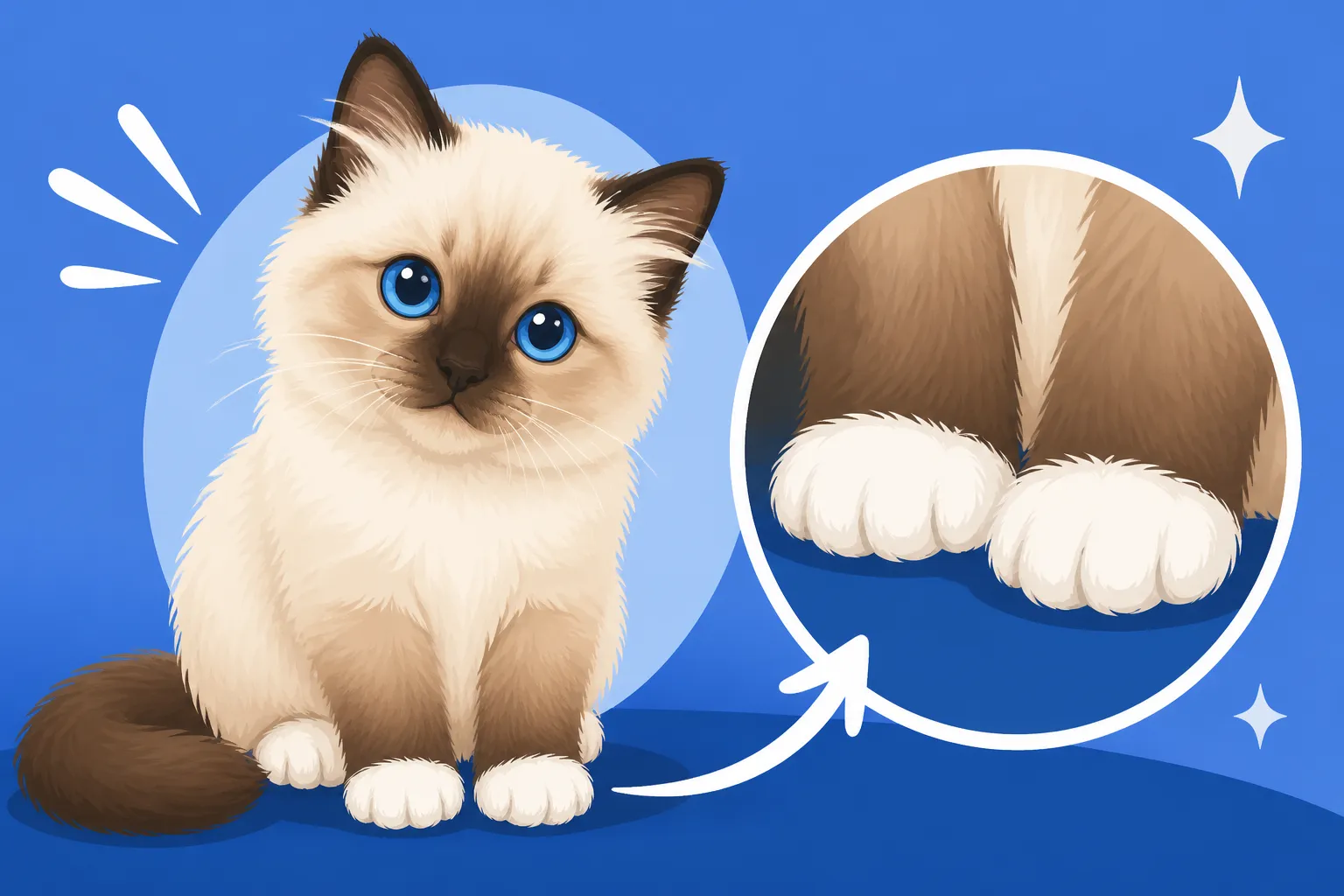
Why a Birman Kitten’s Gloves Are Clearest at Eight Weeks
A Birman kitten’s white paws can look deceptively uneven in early photos: one glove may seem higher, a back lace may be hard to see, and the coat’s points may still be developing. Around eight weeks, the contrast often makes markings easier to assess—but that is not the same as saying they are finished. Here’s what you can judge, what may still change, and how to ask a breeder useful questions.
Why eight weeks can make a Birman kitten’s gloves easier to see
The coat is changing from newborn white
Birman kittens are born almost entirely white. Their characteristic darker points develop gradually, so a newborn’s paws may offer little contrast for judging how the white markings meet the colored coat. As the kitten grows, the points on the face, ears, tail, and legs begin to become more apparent. The white feet remain a defining feature, but their edges can be easier to distinguish as the surrounding color comes in (see Why Every Birman Kitten Is Born Pure White).
The timing is not a switch that flips on one particular day. At eight weeks, one kitten may show clear contrast around the feet while a littermate’s points remain pale. Lighting, coat color, and the individual kitten’s development all affect what you can see. A seal point kitten, for example, may appear to have stronger contrast sooner than a kitten whose points are a lighter shade.
This is why an eight-week photo can be helpful without being conclusive. It gives a breeder or prospective owner a better view than a newborn picture, but it is still a snapshot of a growing kitten. The developing points can make the white areas easier to outline; they do not make the markings permanently settled. How a Birman Kitten's Points Come In
Contrast helps reveal the outline of the white markings
A Birman’s gloves are white markings on the front paws. On the back paws, the white markings are expected to extend up the rear of the leg in a pattern often called laces. When the colored points are still very pale, it can be difficult to tell exactly where white ends and point color begins. As that contrast develops, the boundary may become clearer.
A breeder assessing a litter will look at each paw, rather than relying on a quick glance at the kitten’s overall appearance. The front gloves are judged for their shape and how evenly they end, while the rear markings are assessed for their placement and extension. That requires a close view of all four feet, ideally with the kitten relaxed and the paws visible.
For a family choosing a pet, the practical question is often whether the kitten’s markings look pleasing and whether the breeder has explained any variation. For a show prospect, the markings matter against the breed standard and deserve a more exact assessment. In either case, the developing contrast around eight weeks can make it easier to discuss what is visible now—and what remains uncertain. How a Birman's Gloves Are Scored
Eight weeks is a useful viewing point, not a final verdict
It is easy to treat an eight-week photograph as if it were a finished portrait. In reality, a kitten is still growing, and small paws can be difficult to position consistently. A foot turned inward or a kitten stretching its toes may make a glove look shorter, higher, or less even than it appears when the paw is placed naturally.
Photographs also flatten depth and can distort color. Warm indoor lighting may make white fur appear cream, while a bright flash can wash out the edge between a glove and a pale point. A single image of the kitten sitting upright may hide the back of a rear paw altogether. Clear, evenly lit pictures from several angles are more informative than one carefully posed shot.
The sensible reading is: at eight weeks, gloves are often easier to inspect because the kitten’s coat has developed more contrast and the paws are larger and more visible. They are not necessarily final, and a photo cannot replace a breeder’s careful, repeated observation. How a Birman Kitten's Gloves Change as It Grows
What breeders look at when assessing a Birman’s paws
Front gloves and rear laces are judged differently
The front gloves are expected to be white and to finish at a reasonably even level across the two paws. The rear markings have a different shape: the white should extend up the back of each hind leg in a lace. These are separate features, so a kitten can have attractive front gloves while its rear markings are less symmetrical, or vice versa.
A breeder may gently turn a kitten’s paw to see the markings from the side and underneath, then compare the left and right feet. This is more useful than judging from a head-on picture, where the paws may overlap. It also helps distinguish a true marking boundary from an effect caused by the kitten’s posture or long fur.
If you are looking at a kitten, ask to see all four paws rather than only the prettiest angle. That request is reasonable, especially if the breeder is discussing show potential or making a claim about particularly even markings. Why to Ask a Birman Breeder for Photos of All Four Paws
Symmetry matters, but kittens are not always easy to pose
People naturally compare the left and right sides. A small difference can stand out when the kitten’s feet are placed together, but posture can exaggerate it. One paw may be tucked under the body; another may be stretched forward. The kitten may also be moving, grooming, or resisting the pose, which makes a fair comparison difficult.
A careful breeder will consider more than a single photograph. They may check the kitten’s markings over time and compare several views of each foot. If you are choosing a companion rather than a show cat, a modest variation in glove height may be less important to your daily life than health, temperament, and the breeder’s care practices.
This is also where clear expectations matter. Ask what the breeder can confidently say about the markings today, whether the kitten is being offered as a pet or show prospect, and how the breeder describes any visible faults. Good explanations should be specific and calm, not a promise that a young kitten’s markings will become perfect later.
Genes establish the pattern, but exact markings can vary
Birman gloving is a distinctive inherited feature, but having the breed’s characteristic white paws does not make every kitten’s markings identical. The placement and extent of the white can vary, which is one reason breeders pay close attention to the paws when evaluating a litter. Why Glove Genetics Are Unpredictable in a Birman
The word “genetic” can sound as if a breeder can predict every detail. It does not mean that two well-marked parents will produce kittens with matching gloves, or that a particular paw pattern can be guaranteed. The visible result is shaped by inherited variation, and the practical assessment still depends on looking at the kitten.
For a prospective owner, that means a breeder’s description should be grounded in what can actually be seen. If you are told that a kitten is an especially strong show prospect, ask what features support that assessment and whether the breeder has evaluated the kitten in person. A responsible answer can acknowledge both promise and uncertainty.
| What you are checking | What to look for | Why a photo can mislead |
|---|---|---|
| Front gloves | White areas and how evenly they appear to end | The kitten may have its paws at different angles |
| Rear laces | White markings extending along the back of each hind leg | The rear of the paw may not be visible |
| Left-right balance | How the two front paws and two rear paws compare | A curled toe or tucked paw can change the apparent outline |
| Point contrast | The boundary between white markings and developing colored points | Young kittens may still have pale points |
| Overall assessment | The breeder’s repeated observations and explanation | One image cannot show how markings look from every angle |
How to assess a kitten’s gloves without overreading photos
Ask for clear views of all four paws
A useful set of pictures shows the kitten’s front paws and rear paws separately, with enough light to distinguish white fur from point color. Ask for a relaxed view rather than a forceful pose. The kitten should not be held in a way that looks uncomfortable just to make a marking easier to photograph.
A short video can add context. It may show whether an apparent difference was caused by a paw being tucked or turned, and it can let you see the kitten moving naturally. Still, video is not a substitute for a direct assessment: shadows, camera settings, and the angle can all alter how the markings appear.
If the breeder is nearby, seeing the kitten in person can make the conversation easier. You can look at the feet while the kitten is standing or resting, and ask the breeder to point out the front gloves and rear laces. If you are preparing to bring the kitten home, you might also ask what grooming and litter routine the breeder uses. Owners comparing basic supplies may browse Chewy for suitable combs or litter options, but the breeder’s advice and the kitten’s needs should guide the choice.
Separate visible facts from predictions
A breeder can describe the kitten’s current markings: for example, that the front gloves appear fairly even, or that one rear lace is less clearly defined. A prediction that the markings will become perfect is a different kind of statement and should be treated cautiously. Ask the breeder to distinguish what they see now from what they expect as the kitten develops.
You can make the conversation more useful by asking a few direct questions:
- Can I see clear views of all four paws?
- How do you assess the front gloves and rear laces separately?
- Are you describing this kitten as a pet or a show prospect?
- What parts of the markings are already clear, and what remains uncertain?
- Have you assessed the kitten in person more than once?
A breeder who evaluates kittens regularly should be able to explain their reasoning in plain language. It is also fair for them to say that a young kitten’s exact adult appearance cannot be promised. How a Breeder Judges a Birman Kitten's Gloves
Don’t let markings distract from the broader decision
Beautiful gloves can be captivating, particularly when you have been waiting for a particular color or litter. But a kitten is a companion first. Ask about health records, early veterinary care, socialization, the parents, and the breeder’s support after the kitten goes home. A careful breeder should welcome thoughtful questions rather than steering the entire conversation toward appearance.
Consider how the kitten behaves, too. Is it comfortable being handled? Does it recover after a new sound or a brief interruption? Does the breeder describe its habits in a way that matches what you observe? These everyday details may shape your life together far more than a small difference in glove height.
If you are arranging your home before pickup, focus on safe, practical basics rather than trying to correct or preserve the kitten’s markings. A suitable carrier, food transition plan, litter setup, and gentle grooming tools are more useful than cosmetic products. Chewy is one retailer owners may use to compare ordinary cat-care items, but check that any product is appropriate for a young kitten and follow the breeder’s transition guidance.
When Birman kitten gloves are actually settled
Markings can remain easier to evaluate as the kitten matures
Eight weeks is a useful stage for observation, but it is not a universal deadline for judging a Birman’s markings. As a kitten grows, the coat and points continue developing, and a breeder may revisit the assessment. What appears clear at one age can look different when the kitten is standing, moving, or viewed in stronger natural light.
That is why “clearest at eight weeks” should be understood as a practical viewing window, not a guarantee that the gloves are final. A kitten’s paws are easier to examine than they were at birth, and increasing contrast helps show the boundaries. But the quality of the assessment still depends on repeated observation and careful comparison.
If you are buying a pet kitten, you do not need to wait for an exact show evaluation before deciding whether you love the kitten. If a breeder is selling a kitten as a show prospect, ask how and when the markings will be reassessed and what their terms mean. When a Birman Kitten's Gloves Are Final
A kitten’s best photo is not necessarily its best assessment
Photos are useful records, especially when you are choosing from a distance, but they should not carry more authority than they can support. A high-angle shot may make one glove appear shorter. A close-up with a shallow focus may blur the edge of the white marking. A kitten photographed on a dark blanket may look more sharply contrasted than the same kitten does in daylight.
It can help to compare photos taken under similar conditions and from similar angles. If the breeder sends pictures over several weeks, look for the overall pattern rather than trying to measure a tiny difference in each frame. Ask whether the breeder has noticed the same feature when handling the kitten, and whether the kitten’s markings are being described as a current observation or a future possibility.
For your own records, keep the original images rather than relying on screenshots that may alter color or crop out useful detail. If you want to compare them later, take your own photos in even light and avoid filters. Chewy may be convenient for general kitten supplies, but no grooming product, food, or litter can change the inherited shape of a glove.
Choose a breeder who explains uncertainty honestly
A trustworthy assessment does not need to sound dramatic. The breeder should be able to show the paws, explain the difference between gloves and laces, and tell you what they can and cannot predict. If the markings are uneven, that should be discussed openly rather than hidden behind a flattering angle or vague reassurance.
Be cautious if a seller refuses to show the paws, makes absolute claims about a very young kitten’s eventual show quality, or pressures you to decide before you can ask basic questions. Markings are only one part of responsible breeding, and a beautiful photograph is not evidence of health testing, good kitten care, or a supportive placement.
The most balanced approach is to enjoy what is visible at eight weeks while leaving room for growth. Those little white feet are often much easier to assess by then, but no single age or image tells the whole story. A breeder’s careful observations, your own view of all four paws, and clear expectations will give you a far better basis for understanding the kitten’s gloves.
Disclaimer
This article is for general informational purposes only and does not constitute professional advice. Laws, prices and regulations vary by location and change over time. Consult a qualified professional for guidance on your specific situation.