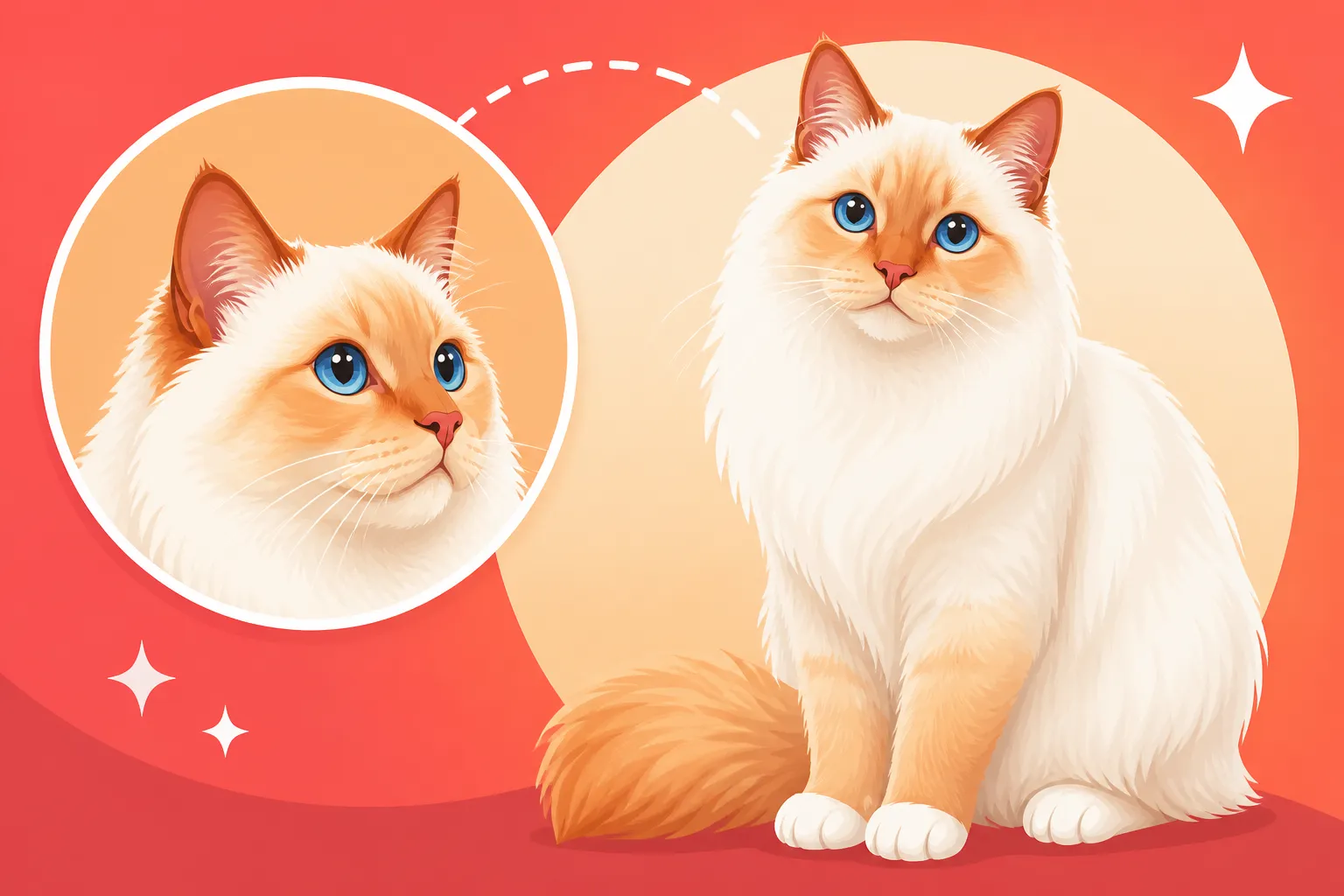
What a Red Point Birman Looks Like
It can be incredibly confusing trying to wrap your head around all the different point colors in the Birman world. You see terms like "seal point," "blue point," and then suddenly "red point" pops up, and you might wonder if it’s truly red or just a fancy name for orange. This guide is here to clear up that mystery, giving you a crystal-clear picture of what a Red Point Birman truly looks like, how their unique color develops, and what makes them such a visually stunning and sought-after variety of this beloved breed.
The Fiery Palette of the Red Point Birman
When you hear "red point," don't picture a fire engine red cat. In feline genetics, "red" actually refers to a spectrum that ranges from a deep, marmalade orange to a vibrant apricot. For a Red Point Birman, this means their distinguishing features – the "points" – display these gorgeous, warm, coppery tones. It's a color that truly stands out, often shimmering with a golden undertone on the body, especially when compared to the cooler hues of a blue or lilac point.
Understanding the "Red" in Red Point
The "red" in a Red Point Birman comes from a specific gene that produces phaeomelanin, the pigment responsible for red and cream colors in cats. This isn't the eumelanin that gives us black, blue, or chocolate. Instead, it’s a gene that essentially masks other point colors, allowing the warm, fiery pigment to shine through. What you get is a rich, warm apricot or deep orange color on the extremities, rather than a stark, primary red. It's truly a beautiful, sun-kissed shade that gives these Birmans an incredibly distinct and inviting look. The depth of this red can vary, from a softer strawberry blonde to a more intense, almost burnt orange, all within the accepted range for a Red Point.
The Creamy Body and Warm Gold Undercoat
One of the most enchanting aspects of a Red Point Birman is not just their colorful points, but how beautifully their body color complements them. Unlike a Seal Point, which often has a creamy fawn or light golden body, the Red Point Birman typically sports a soft, off-white or very pale cream body that carries a distinct warm, golden hue. It’s not a stark, bleached white, but rather a soft, inviting ivory that seems to glow in certain lights. This warmth in the body fur acts as a perfect canvas for the vibrant red points, creating a harmonious and aesthetically pleasing overall appearance. You might notice this golden sheen particularly on their back and flanks, especially as they mature. This warm base distinguishes them sharply from the almost pure white body of a Blue Point, which contrasts with cool, slate grey points.
Where the Red Points Show Up: A Map of Color
The points on a Birman are the cooler parts of their body where pigment can express itself, and on a Red Point, these areas are where the magic happens. Imagine a cat dipped in a sunset, and you’re getting close to the visual impact. The contrast between the warm points and the creamy body is absolutely captivating. Knowing exactly where to look for these fiery splashes of color helps you appreciate the breed's unique presentation.
Mask, Ears, and Legs: The Primary Point Areas
The most obvious places to see the striking red pigment are on the mask of their face, their ears, and their legs. The mask usually covers the nose, muzzle, and extends around the eyes, presenting as a uniform, warm red or apricot. Their ears will be fully saturated with this color, often appearing a bit darker and more intense than the facial mask due to the thinner fur and colder temperature. On the legs, the red color will extend from the paws upwards, usually fading gently as it approaches the body, creating a lovely gradient. The front legs will typically show a deeper red all the way down, while the rear legs will also carry the color, stopping abruptly at the famous white "laces" of the Birman. It’s this vibrant red on these key areas that immediately tells you you’re looking at a Red Point Birman.
The Tail: A Fiery Plume
The tail of a Red Point Birman is often the most spectacular and deeply colored of all their points. Because the tail is consistently one of the coolest parts of a cat's body, the red pigment has the best opportunity to develop into its most intense and vivid shade there. You'll typically see a rich, almost fiery orange or deep apricot covering the entire tail, from base to tip, forming a luxurious, colorful plume. The color on the tail usually appears denser and more concentrated than on the mask or legs, sometimes even showing hints of a darker, almost reddish-brown tone depending on the individual cat and its genetic modifiers. It’s a true showstopper and a hallmark of the Red Point variety. The fullness and beauty of the Birman's tail plume are something to truly admire. How long a Birman's tail plume is is a common question, and on a Red Point, it's a magnificent display of color.
The Iconic White Gloves and Laces Against the Red
Perhaps the most defining feature of any Birman, regardless of point color, is their pristine white gloves and laces. For the Red Point Birman, these white markings create an even more dramatic and beautiful contrast against the warm, fiery points. The "gloves" are the pure white areas on the front paws, extending symmetrically to the articulation of the paw. The "laces" are the white markings on the back paws, which extend higher up the leg, ending in a distinct, inverted "V" shape on the hocks. These white areas should be absolutely clean and free of any red "bleeding" or staining from the points. The stark white against the deep apricot of the points makes the gloves pop even more, highlighting the breed's unique charm and the intricate genetics involved in its appearance. It's this striking combination of vibrant color and pure white that makes the Red Point Birman truly unforgettable. You can learn more about this by reading How a Breeder Judges a Birman Kitten's Gloves. Keeping those gloves pristine often means choosing a low-dust litter, which is something platforms like Chewy make easy to find with their wide selection of specialty litters.
The Maturation of a Red Point Birman's Color
One of the most fascinating journeys to observe in a Birman is the development of their point color. Kittens are not born with their vibrant points already present; it's a process that unfolds over time, influenced by genetics and environment. Understanding this maturation helps you appreciate the gradual transformation of these beautiful felines.
Born White: The Kitten Phase
It’s always a delightful surprise for first-time Birman owners to learn that all Birman kittens are born almost pure white! This is a characteristic shared by all pointed breeds. The gene responsible for their point coloration is temperature-sensitive, meaning the pigment only expresses itself in the cooler parts of the body. Inside the warmth of the mother’s womb, the kitten's body temperature is uniform, preventing any color from developing. So, when a litter of Red Point Birman kittens arrives, they look like little fluffy white clouds. It's incredible to witness, and for a few precious days, you might even wonder if you’ve got a rare, all-white Birman on your hands! You can see What a Birman Kitten Looks Like at Birth for more on this.
Gradual Appearance of Red Points
After birth, as the kittens are exposed to the cooler ambient air, their extremities (the ears, nose, paws, and tail) begin to cool down, allowing the temperature-sensitive gene to activate and start producing pigment. For a Red Point Birman kitten, this means the first hints of a soft, pale apricot or cream will start to appear on their nose and ears, usually within the first week or two. Over the following weeks and months, these colors will gradually deepen and spread to the mask, legs, and tail. By the time they are When a Birman Kitten's Points Start to Show, typically around 3-4 weeks, the red points will be clearly visible, though still much lighter than their adult intensity. It's a slow reveal, building anticipation as you watch their unique pattern emerge. This careful development is why breeders often hold kittens longer, so you can see their true colors and markings, as explored in Why Birman Kittens Are Sold Late.
Darkening with Age and Environment
The color journey doesn't stop once the points are visible; a Red Point Birman's color will continue to deepen and intensify throughout its life, often not reaching its full, mature shade until they are two or even three years old. This is part of How Long a Birman Keeps Adding Coat and Weight. Factors such as ambient temperature play a significant role. A Birman living in a cooler climate or a cooler household might develop darker, richer points than one living in a consistently warm environment, as the colder temperatures encourage more pigment production. How a Birman's Points Darken With Cold delves deeper into this fascinating phenomenon. Their activity levels and even diet can subtly influence the richness of their coat and point color. Providing a high-quality diet can support overall coat health and vibrancy. Don't be surprised if your adult Red Point Birman seems to grow darker with each passing year; it’s a natural and beautiful part of their aging process.
Common Misconceptions and Variations in Red Point Birmans
With so many beautiful point colors and potential variations, it's easy for some confusion to creep in when discussing Red Point Birmans. Understanding the nuances can help you appreciate the subtle differences and correctly identify these stunning felines. It's not just about the "red" – it's about what type of red and what other patterns might be present.
Red Point vs. Cream Point: What's the Difference?
This is perhaps the most common point of confusion. While both "red" and "cream" refer to variations of phaeomelanin pigment, they are genetically distinct and visually different. A Red Point Birman, as we've discussed, has vibrant apricot to deep orange points. A Cream Point Birman, on the other hand, carries a dilute gene that lightens the red pigment, resulting in much softer, pastel, and often paler, almost buff-colored points. Think of it like this: if Red Point is a sunset orange, Cream Point is a delicate peach or strawberry blonde. The difference is quite noticeable when you see them side-by-side. The body color of a Cream Point will also be a softer ivory, mirroring the gentle hue of their points. Both are stunning, but distinct. The breed standard, as outlined in Which Point Colors the Birman Standard Allows, has specific definitions for each.
Red Tabby Point: When Stripes Enter the Picture
Sometimes, you might encounter a Red Point Birman with faint stripes within its points, particularly on the face and legs. This isn't a fault; it's a Red Tabby Point Birman! The tabby gene, when present alongside the red point gene, expresses itself as subtle "ghost" stripes within the solid red areas. On the face, this often manifests as the classic "M" marking on the forehead, and delicate barring on the legs and tail. These tabby markings can be quite subtle, especially when the red color is very dense, but they add another layer of intricate beauty to the cat's appearance. It's a genetic variation that creates a truly unique and appealing look, blending the warmth of the red points with the charm of tabby patterns. If you're looking for Whether a Tabby Point Birman Is Priced Apart, breeders might have different opinions based on demand and the clarity of the markings.
The Importance of Health Testing in Red Point Lines
No matter how beautiful a Red Point Birman's coat or how perfect its gloves, health should always be the top priority. Reputable breeders will perform comprehensive health screenings for genetic conditions prevalent in the Birman breed. This includes testing for What the FOXN1 Test Costs and screening for What the PKD1 Test Costs for a Birman. Additionally, regular cardiac evaluations, such as echo scans, are crucial, as highlighted in Why a Birman's Echo Screening Costs. When you are looking for a Birman, always ask to see the health certificates for both parents. Many owners opt for pet insurance like Healthy Paws to help manage potential veterinary costs associated with these conditions, giving them peace of mind that their beautiful Red Point Birman is covered. It's part of responsible ownership and ensures that your beloved feline companion lives a long, happy, and healthy life.
Red Point Birman vs. Other Pointed Breeds
It's easy to confuse different pointed breeds, especially when their colors can overlap. While a Red Point Birman shares the pointed pattern with breeds like the Ragdoll or Himalayan, its specific body type, coat texture, and, of course, the signature white gloves set it apart. For instance, a Ragdoll might have similar point colors, but it lacks the gloves and typically has a much denser, rabbit-like coat. The Birman's coat, while long, is single-coated and silky, making it less prone to matting than some other long-haired breeds. You can read more about this in How a Birman's Coat Differs From a Ragdoll's. The combination of the striking red points, creamy body, and the unique white paws creates a distinct Birman look that is truly unparalleled.
| Feature | Red Point Birman | Cream Point Birman | Seal Point Birman | Blue Point Birman |
|---|---|---|---|---|
| Point Color | Vibrant apricot to deep orange/red-gold | Soft, pale peach or strawberry blonde | Dark brown, almost black | Slate grey |
| Body Color | Warm ivory, soft cream, often with golden sheen | Pale cream, light buff, very soft white undertone | Fawn, pale golden tan, warm cream | Off-white, cool-toned white, almost silvery |
| Nose Leather | Pink, often rose-colored | Pink | Dark brown | Slate grey, often with a bluish tint |
| Paw Pads | Pink, often rose-colored | Pink | Dark brown | Slate grey |
| Color Intensity | Strong, bold | Muted, pastel | Deep, rich | Cool, smoky |
| Contrast | High contrast with warm body | Soft, gentle contrast with light body | High contrast with warm body | High contrast with cool body |
Disclaimer
This article is for general informational purposes only and does not constitute professional advice. Laws, prices and regulations vary by location and change over time. Consult a qualified professional for guidance on your specific situation.