Whether a Tortie Point Birman Is Recognized
A tortie point Birman can be recognized, but the answer depends on the cat registry and country whose rules matter to you. Tortie describes a point-color pattern, not a separate breed, and it does not cancel the Birman’s defining white gloves. This guide explains what the pattern looks like, how recognition works, and what to check before registering or buying a kitten.
What a tortie point Birman looks like
The tortie pattern appears in the colored points
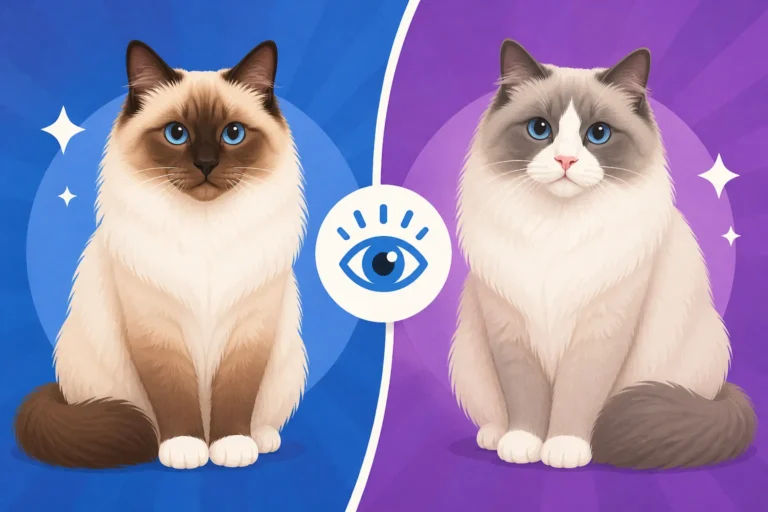
A tortie point Birman has a light-colored body and darker color on the face, ears, legs, and tail, as other pointed Birmans do. What makes the cat tortie is a mixture of color in those points: the usual base point color is interspersed with patches of red or cream. Depending on the cat, the pattern can look like distinct mottling or a softer blend.
The pattern is easiest to assess on the points, not on the pale body. A seal tortie point, for example, combines dark brown points with red patches; a blue-cream tortie point combines blue-gray with cream. The exact name varies with the base color and the terminology used by a particular registry.
Tortie point is a color pattern, not a guarantee of show eligibility. A cat can have a recognizable tortie pattern and still have markings, coat color, or other features that do not meet a show standard. Likewise, a registry’s acceptance of a color does not mean every cat of that color is eligible for competition.
White gloves remain part of the Birman picture
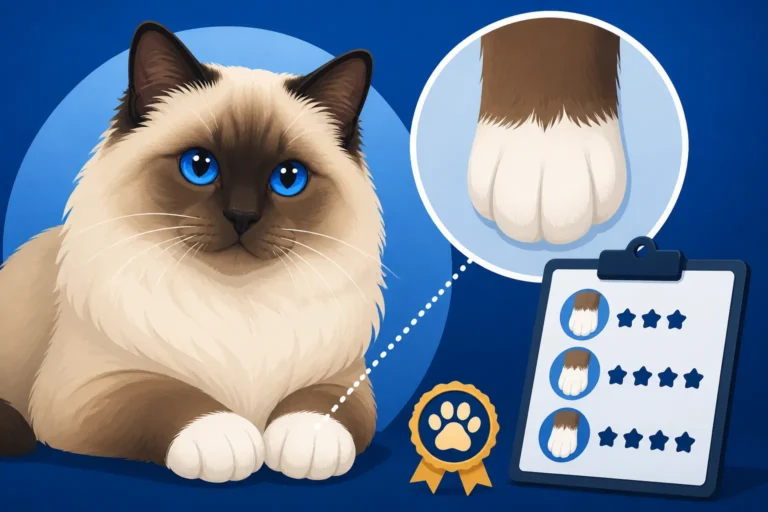
The Birman’s white feet are not optional decoration. They are a defining breed feature, and the front gloves and back laces are judged for their appearance. A tortie pattern on the points does not replace or explain the gloves: the two features are distinct. The tortie pattern concerns colored areas; the gloves are white markings on the paws.
This is one reason photographs can be misleading. Lighting, shadows, and a kitten’s developing coat can make the points look more or less mottled, while an angle can hide the ends of the gloves. If you are assessing a kitten for a show or registration, ask for clear photographs of the face, tail, and all four paws, and confirm the details with the breeder or registry. The standard’s emphasis on markings is discussed in How Judges Look For on a Birman's Paws First and How a Birman's Gloves Are Scored.
Some registries use a different set of accepted color names or evaluate markings differently. For a broader overview of the recognized palette, see Which Point Colors the Birman Standard Allows. The specific standard matters more than a seller’s shorthand description.
Are tortie point Birmans officially recognized
Recognition depends on the registry
There is no single worldwide authority that sets one registration rule for every Birman. Breed clubs and registries publish their own standards, and accepted colors can differ between organizations and countries. Tortie point varieties are recognized within some Birman standards, but you should check the rules of the registry that will issue or assess the cat’s papers rather than assume every organization treats the color the same way.
This matters most when a cat is being registered, entered in a show, or considered for breeding. A breeder may use “tortie point” accurately as a description while the registry uses a longer color name, a different spelling, or a specific category. Ask for the exact registered color, not just a casual label in an advertisement.
If you are asking about a particular organization, look for its current Birman breed standard or contact the registry directly. The color list for one association may not match another’s; Which Point Colors CFA Accepts in a Birman is a useful example of why it helps to check the named registry rather than rely on a general answer.
A color name is not the same as registration proof
A kitten can look tortie point without being registered as a Birman. Registration depends on its pedigree and the registry’s rules, not coat appearance alone. If a seller says a kitten is a registered Birman, ask which registry issued the papers and request documentation that identifies the kitten and its registered color.
For a show prospect, ask whether the color is accepted for the class you plan to enter and whether the kitten’s markings meet the relevant standard. A color can be recognized while an individual cat still has a fault or does not fit the show requirements. That distinction can prevent a disappointing surprise after you have chosen a kitten based on photographs or an informal description.
When comparing point colors, it can also help to understand how other patterns are categorized. Whether a Tabby Point Birman Is Recognized covers another pattern whose naming and acceptance can depend on the registry. For a general explanation of the pointed pattern, see Why a Birman Is Always Pointed and Never Solid.
| Question | What to check |
|---|---|
| Is tortie point recognized? | The Birman standard of the specific registry |
| What color name will appear on papers? | The registry’s official color terminology |
| Is the kitten registered as a Birman? | Pedigree and registration documents |
| Is the cat show eligible? | Color acceptance plus the individual cat’s markings and conformation |
| Are the gloves correct? | The standard’s requirements for all four paws |
Why tortie point patterns vary
The pattern can look different from cat to cat
Tortie markings are not arranged in neat, identical patches. One Birman may show obvious red or cream areas on the face and legs, while another has a subtler mix that is harder to see in a quick glance. The amount and placement of the contrasting color can vary, so two cats with the same broad color label may look quite different.
Age and coat development can affect how clearly the pattern appears, too. A young kitten’s points may still be developing, and photographs taken in different light can make the same coat seem warmer, cooler, lighter, or darker. Ask a breeder to describe what is visible in person and to provide recent images in natural light if you cannot visit.
The gloves add another layer of variation. A tortie pattern does not predict whether the white markings will be even or whether the back laces will end in the preferred place. The color pattern and the glove quality should be assessed separately. For more on why markings can differ even when the breed carries the same gloving trait, see Why Birman Gloves Vary Despite the Fixed Gene.
Most tortie point cats are female, but the pattern is not an absolute sex test
Tortoiseshell coloring is associated with the genes that influence orange and non-orange coat color, which are linked to the X chromosome. As a result, tortie cats are most commonly female. Male torties are uncommon, but “uncommon” is not the same as impossible; unusual chromosome patterns can produce a male with tortie coloring.
That is why coat color should not be used to confirm a kitten’s sex. If sex matters for your plans, ask the breeder or veterinarian to verify it. If a male tortie point Birman is being offered, ask for clear registration and veterinary documentation rather than treating the color itself as proof of anything.
The same practical caution applies to claims about rarity. A seller may describe a color as rare, but that word does not establish pedigree, health, or show quality. Focus on the paperwork, the health information available for the line, and the registry’s exact rules. Which Year a Pair of Birmans Was Shipped From Burma and What Genetics Say About the Birman's Origin offer context on the breed’s history, but modern registration still comes down to the relevant registry’s requirements.
What to ask a breeder or registry
Get the official color and paperwork details
Before placing a deposit or planning a show entry, ask the breeder to state the kitten’s registered color and the registry involved. Request to see the parents’ registration details and ask how the kitten’s pedigree and registration will be transferred or provided. If the kitten is not yet registered, ask what the breeder expects the recorded color to be and who will make that determination.
For a kitten you hope to show, ask whether the breeder considers the color acceptable under the show organization’s rules and whether they see any concerns with the kitten’s gloves or other markings. A responsible breeder should be able to explain the distinction between a recognized color and a kitten that is a strong show prospect. They should not promise a show result based on color alone.
If the answer is vague, check the registry’s published standard yourself or contact its office. Retailer listings are not evidence of registration eligibility. Chewy may be useful for ordinary cat supplies once a kitten comes home, but it cannot verify a pedigree or decide how a registry classifies a color.
Separate color questions from everyday care
A tortie point Birman does not need a special diet or grooming routine simply because its points are tortie. The practical basics are the same as for other Birmans: routine coat care, a suitable diet, regular veterinary attention, and a comfortable home. If you are preparing for a kitten, make a separate shopping list for essentials; a retailer such as Chewy can be one place to browse basic items, while your breeder or veterinarian can advise on what is appropriate for your cat.
The white paws may need a little extra attention if they pick up litter or dirt, but that is a grooming issue rather than a tortie-color issue. Ask the breeder how the kitten has been handled and groomed, then introduce combing gently and consistently. If you are comparing grooming tools, Chewy’s product listings can help you see the available options, but the tool should suit the cat’s coat and be used comfortably.
Most importantly, don’t let a striking coat pattern distract from the questions that matter for any kitten: health history, temperament, socialization, pedigree, and clear paperwork. For background on the full range of accepted patterns, revisit Which Point Colors the Birman Standard Allows, and use the relevant registry’s own standard whenever registration or showing is part of your decision. Chewy can help with everyday supplies, but questions about breed status and official color recognition belong with the breeder and registry.
Disclaimer
This article is for general informational purposes only and does not constitute professional advice. Laws, prices and regulations vary by location and change over time. Consult a qualified professional for guidance on your specific situation.