Whether the Birman’s Gene Pool Is Safe Now
A Birman’s small postwar founder population is a real part of the breed’s history, but it does not mean every Birman today has the same genetic risks—or that the gene pool is automatically safe. This guide explains what breeders can measure, which health concerns testing can and cannot address, and what questions help you judge a particular Birman line.
What the Birman’s gene pool history means today
A narrow beginning is not the whole story
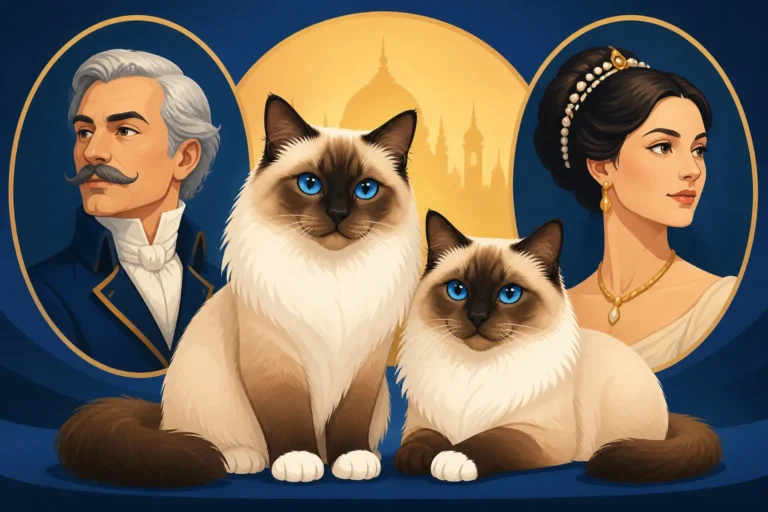
The modern Birman was rebuilt after the Second World War from a very small number of surviving cats. Breeders used outcrosses, including longhaired breeds such as Persians, before Birman lines were re-established. That history matters: when a breed begins from few founders, related cats can appear repeatedly in pedigrees, and inherited variants may become more common simply because there were fewer unrelated ancestors to draw from.
But a narrow founding population does not, by itself, tell us how much diversity remains in today’s Birman population. A breed’s genetic health depends on what happened after its founding, how widely different lines were used, and how breeding decisions are made now. Two cats with different names in their pedigrees may still share ancestors; conversely, a well-managed line can preserve useful variation even within a breed that had a difficult start.
That is why a single dramatic fact about the breed’s origins should not be treated as a verdict on every kitten. For background on the rebuilding period, see The Birman Came Out of the War With Two Cats Left and How Two Cats in 1945 Shaped the Birman's Health. They help explain why pedigree depth and breeder choices matter, but they cannot replace information about a specific cat’s family.
“Safe” depends on what you mean
There is no simple yes-or-no test that certifies an entire breed’s gene pool as safe. “Safe” might mean a low risk of close inbreeding, a broad range of unrelated breeding lines, fewer harmful inherited variants, or a breeder’s willingness to test and share results. Those are related questions, but they are not interchangeable.
For example, a line could have a documented history of careful mating choices and still carry a recessive variant. A genetic test may help identify that variant, but it does not measure the full diversity of the breed. Likewise, a pedigree that looks varied on paper does not necessarily tell you whether the cats share distant ancestors or whether a popular sire has contributed heavily across many generations.
It is more useful to ask whether a particular breeding program is managing risk responsibly than to look for a blanket guarantee about all Birmans. A transparent breeder should be able to discuss the family behind a litter, explain which health checks are relevant, and describe how results influence mating decisions. If you want to understand the wider question of founding diversity, How Narrow the Birman's Founder Base Really Was explores that history in more detail.
What breeders can and cannot learn from testing
Genetic tests answer specific questions
A DNA test is valuable when it targets a known variant and the result can guide breeding decisions. For example, Birman breeders may consider testing for the FOXN1 variant associated with Birman hypotrichosis and for PKD1, a variant associated with polycystic kidney disease. The purpose is not to label a cat as “good” or “bad.” It is to understand what it may pass to offspring and avoid matings that could produce affected kittens.
A result also needs to be interpreted correctly. A cat that carries one copy of a recessive disease variant may be healthy. If it is bred, the other parent’s result matters: the goal is to avoid a pairing that could give kittens two copies of the variant. A breeder who can explain this clearly is showing more than a test certificate; they are showing how the information is used. For details about one of these conditions, see FOXN1 Is the Birman's Own Genetic Disease.
Tests have limits. A clear result for one variant does not prove that a cat is free from every inherited condition, and a health panel is not a measure of total genetic diversity. Ask which test was performed, what condition it addresses, whose sample was tested, and whether the certificate identifies the cat. For a closer look at how a result should be read, How to Read a Birman's Carrier Result is a useful companion.
Some important risks need clinical screening, not a DNA result
Hypertrophic cardiomyopathy, or HCM, is a key example of why “genetically tested” should never be read as “fully screened.” There is no established DNA test that can rule out HCM in a Birman. Echocardiography, performed by a veterinary cardiologist, is the relevant way to examine heart structure. Even an echo describes the cat at the time of the scan; it is not a lifetime guarantee that heart disease will never develop.
This distinction affects how you assess a breeding program. Ask whether the parents have had appropriate heart screening, when it was performed, and whether the breeder can provide the actual results or the cardiologist’s report. A general veterinary check or a normal-sounding heartbeat is not the same as an echocardiogram. The guide HCM in a Birman Has No DNA Test, Only an Echo explains why those checks are different.
PKD screening and heart screening also answer different questions. A DNA result can identify a specific PKD1 variant, while kidney imaging and veterinary monitoring may provide other information about a cat’s health. A breeder should be able to explain which checks were done and what each one can reasonably tell you, rather than presenting a stack of paperwork as proof that every possible risk has disappeared.
| Question | What can help answer it | What the result does not prove |
|---|---|---|
| Does this cat carry a tested FOXN1 variant? | A correctly identified DNA test | That the cat has no other inherited risks |
| Does this cat carry a tested PKD1 variant? | A correctly identified DNA test | That every kidney concern is ruled out |
| Does this cat show signs of HCM on imaging now? | Echocardiography by a veterinary cardiologist | That HCM cannot develop later |
| Is this line genetically diverse? | Pedigree analysis and population-level information | A complete answer from one health test |
| Is a planned mating responsible? | Parent results, family history, and breeder reasoning | A guarantee that every kitten will remain healthy |
How to judge whether a breeding line is being managed well
Look beyond a single certificate
A certificate is a useful starting point, not the whole story. Confirm that it belongs to the named cat and that it describes the test or examination you were told about. If a breeder says both parents are clear, ask what “clear” means in that specific context: clear of which variant, based on what test, and under which identification details?
Then ask about the broader family. Have close relatives had relevant health problems? How does the breeder decide which cats to keep for breeding? Are the same popular cats appearing repeatedly in the pedigree? A responsible breeder may not have every answer immediately, but should be willing to explain what is known and what remains uncertain. A refusal to discuss family history is more concerning than an honest admission that a risk cannot be eliminated.
A breeder’s paperwork should also fit the actual condition. For HCM, ask about echo reports rather than expecting a DNA certificate. For inherited variants, ask for the relevant laboratory result. Which Results a Birman Breeder Must Put in Writing offers a practical way to think about documentation, while Why a Birman Breeder Still Tests for PKD explains why one test can remain relevant even when a breeder is also checking other risks.
Ask questions that invite a real explanation
It can feel awkward to ask a breeder detailed health questions, especially when you are excited about a kitten or worried that someone else will be offered the litter. These questions are ordinary due diligence. A breeder who prioritizes the cats’ long-term welfare should understand why you are asking.
Try questions such as:
- Which genetic tests have been done on both parents, and may I see the results?
- Have the parents had echocardiograms, and can I review the reports?
- What health conditions have appeared in close relatives?
- How do you avoid pairing two cats that could produce kittens affected by a recessive condition?
- Are there several breeding lines in your program, or does it rely heavily on a small number of cats?
- What would you do if a kitten’s test result or veterinary examination raised a concern?
Listen for explanations rather than reassuring slogans. “Our cats are healthy” is not as informative as a clear account of specific testing, family history, and mating decisions. You can also ask whether the breeder will explain results with you and your veterinarian after the kitten comes home. Ordinary supplies from Chewy or another retailer may help you prepare for a new cat, but they cannot tell you whether a breeding line has been responsibly managed.
What owners can do after bringing a Birman home
Keep health records and share family information
Once your cat is home, keep copies of the pedigree, test certificates, vaccination history, and veterinary reports in one place. At routine appointments, tell your veterinarian what is known about the cat’s line and ask what monitoring makes sense for its age and history. This is especially helpful if a breeder has mentioned a condition in relatives or if your cat develops a change in appetite, activity, or breathing.
A clear record can also prevent confusion later. If a document says “clear,” keep the page that identifies the test and the tested cat, not just a note in a message. If your veterinarian recommends further evaluation, ask what question the next test is intended to answer. This keeps screening purposeful rather than turning it into a search for a guarantee no test can provide.
If you buy food, litter, or grooming basics through Chewy, keep those routine purchases separate from medical records. A receipt or product order history can be useful for everyday care, but it is not evidence of genetic health. For wider health planning, How Often a Birman With Clear Papers Still Needs a Vet discusses why veterinary care still matters even when a breeder has supplied documentation.
Make the decision about the individual cat, not a breed-wide promise
The Birman’s founder history deserves attention, but it should not be used to assume that every Birman is unhealthy or that every modern line is genetically secure. Look for a breeder who can discuss the breed’s history without using it to excuse missing information, and who can describe present-day testing without promising certainty.
Chewy may be one of several places an owner uses for routine cat-care items, but choosing a retailer does not change the inherited risks a kitten may have. Those risks are better assessed through the breeder’s records, relevant veterinary screening, and ongoing care. If you are still comparing breeders, take time to review the answers and documents before placing a deposit.
A well-managed gene pool is not a permanent status that one certificate can establish. It is the result of repeated choices: avoiding risky pairings, using relevant health checks, keeping useful family information, and making thoughtful decisions about which cats are bred. For a prospective owner, the practical goal is not to find a Birman guaranteed to have no health risks. It is to choose a transparent, responsible source and build a veterinary relationship that supports the cat throughout its life.
Disclaimer
This article is for general informational purposes only and does not constitute professional advice. Laws, prices and regulations vary by location and change over time. Consult a qualified professional for guidance on your specific situation.